
Castlepook’s Solitary Incision31510 BCE
31,510 BCE is a modern label for an imprecisely dated Late Pleistocene interval, rather than a recoverable Irish event. During Marine Isotope Stage 3, Ireland experienced severe, fluctuating cold before the later maximum of the Irish Ice Sheet; glaciers and postglacial seas destroyed or concealed much evidence. Derryvree, County Fermanagh, preserves a cold, treeless wetland ecosystem dating broadly to this period. Castlepook Cave, County Cork, yielded fauna including reindeer and a femur with a possible stone-tool incision. This may indicate Upper Palaeolithic human activity, but cannot prove settlement, hunting, or population continuity. No political, cultural or religious history is recoverable.
Dateline
31,510 BCE is a modern chronological label, not a year that anyone in Ireland could have named, recorded or commemorated. There were no written chronicles, calendars, states or rulers from which an event for this particular year might be recovered. The responsible way to approach it is through the Late Pleistocene archaeological and environmental record: deposits with wide dating ranges, animal bones, pollen, plant remains, cave sediments and the changing traces of ice. In calendar arithmetic, this notional date lies about 33,460 years before the conventional radiocarbon reference year of AD 1950, but that does not make it a precisely datable archaeological moment.
It falls within Marine Isotope Stage 3, a long and climatically unstable part of the last glacial cycle. Radiocarbon ages from so far back must be calibrated, and calibration commonly produces ranges rather than a single calendar year. The evidence therefore illuminates Ireland around the early thirty-fourth millennium before present, not a particular summer, journey or hunt in 31,510 BCE. Its central historical question is not who ruled Ireland, but whether people reached it at all, and what kind of country they encountered.
A Landscape Before Maximum Ice
Ireland was not yet simply the ice-covered island often imagined by later Ice Age maps. The best-established maximum advance of the last Irish Ice Sheet came considerably later, broadly between about 27,000 and 23,000 calibrated years before present, though the timing and extent of its growth varied by region. Evidence beneath later glacial deposits indicates that parts of Ireland retained ice-free or less heavily glaciated landscapes earlier in the last glacial cycle. At about 31,510 BCE, the island stood amid a transition marked by severe cold, fluctuating moisture and the growing power of ice masses, rather than at one uniform climatic state.
That distinction matters because later glaciers both reshaped the terrain and damaged the evidence of what came before. Ice eroded bedrock, redeposited sediment and buried earlier land surfaces beneath till. Rising seas after the glacial period then submerged extensive coastal plains and altered every shoreline. The absence of campsites, hearths or tools from this deep period is therefore meaningful, but it is not straightforward proof that no person ever entered Ireland. Archaeologists must weigh the scarcity of discoveries against the extraordinary destruction and concealment of Pleistocene landscapes.
Sea level was lower than today because immense volumes of water were stored in northern ice sheets. Ireland’s coastline was consequently very different, with broad shelves exposed in some directions and the geography of the Irish Sea basin transformed. Yet no secure archaeological route can be drawn from that fact alone. It cannot be assumed that there was a simple, dry land bridge available at every cold phase, or that people necessarily crossed if a route existed. The topography of travel, sea ice, rivers, coastlines and ice margins changed repeatedly; evidence for an actual human crossing remains exceptionally slight.
Derryvree’s Cold Wetland
The strongest environmental window broadly relevant to this date lies far from north Cork, at Derryvree near Maguiresbridge in County Fermanagh. Road works there exposed an organic freshwater deposit sealed between tills in a drumlin. The deposit produced a conventional radiocarbon age of 30,500 ± 1,170/1,030 radiocarbon years BP; published calibration has placed it broadly around 36,900–31,700 calibrated years BP. That is a substantial span, but it overlaps the broad age represented by 31,510 BCE and is much more informative than attempting to force a one-year reconstruction.
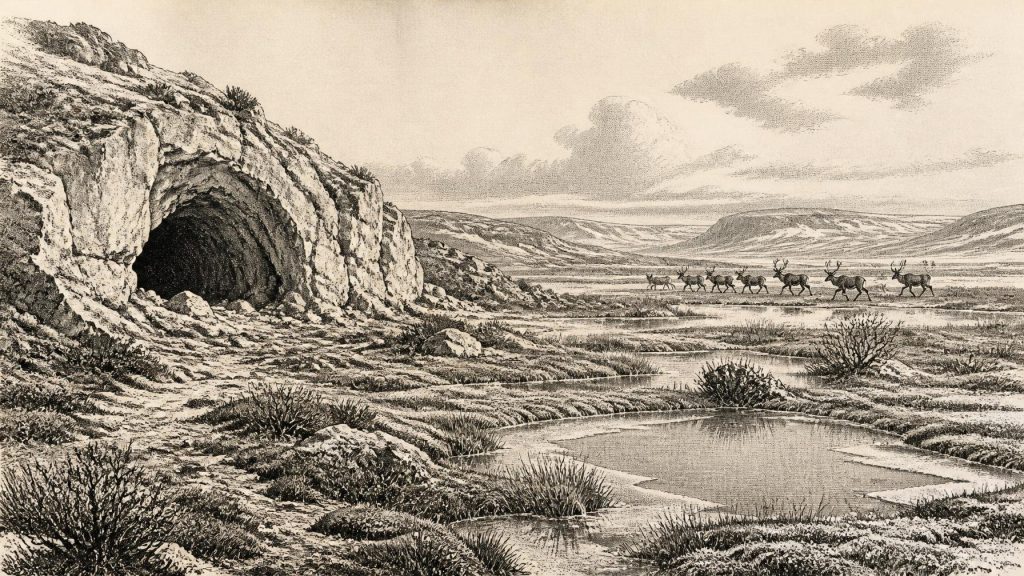
Pollen, plant macrofossils, mosses and insect remains from Derryvree show a largely treeless, periglacial environment. The setting has been described as tundra or muskeg: wet ground with shallow pools, sedge-rich margins and sparse vegetation adapted to cold conditions. Such evidence does not depict an empty wasteland. It records a living mosaic of wetland and open ground, shaped by frost, seasonal thaw and low-growing plant communities. The few pollen grains from trees need not demonstrate nearby woodland; long-distance transport can place tree pollen in otherwise open environments. The more secure conclusion is that dense forest did not cover this part of Ireland.
Derryvree is a local archive, not an island-wide weather report. County Fermanagh’s lowland wetland cannot stand in for every coastal plain, limestone cave or mountain slope. Nevertheless, it proves that terrestrial and freshwater ecosystems survived during a cold interval before the later ice-sheet maximum. It also explains why deposits beneath drumlins are so valuable: they preserve fragments of an older Ireland that the moving ice did not wholly erase.
Castlepook and the Human Question
The object most directly associated with this approximate era is a fragment of reindeer femur from Castlepook Cave, near Doneraile in north County Cork. Castlepook, once commonly called Mammoth Cave, yielded a large collection of Pleistocene animal remains during cave investigations in the early twentieth century. County Cork heritage material presents the marked femur as dating to about 31,000 BCE and identifies a deep incision as consistent with the use of a sharp stone tool on fresh bone. If that interpretation is correct, it would be dramatic evidence that one or more Upper Palaeolithic people handled a reindeer in Ireland tens of millennia before the well-attested Mesolithic settlement record.
The evidence is important precisely because it is limited. The bone is physical evidence; the inference that hunters butchered it is a specialist interpretation of the surface modification. A radiocarbon result dates the animal’s bone collagen, not the incision independently, and it cannot establish where the animal was killed or where the carcass was first processed. Nor does one modified bone demonstrate a resident population, a settlement, a seasonal camp or descent from any later Irish community.
Castlepook’s older collections also require unusual caution. Many cave assemblages were excavated before modern standards of three-dimensional recording, sediment sampling and stratigraphic control. Caves are not neutral storehouses. Carnivores can drag carcass parts inside, gnaw bone and accumulate material from different places; water, collapse, burrowing and earlier excavation can disturb deposits. Recent work on Irish cave fauna has also shown that improved pretreatment can substantially revise old radiocarbon results. The Castlepook femur is therefore best understood as a provocative indication of possible human activity, not as a complete Palaeolithic site.
Reindeer Country
Even without assuming human occupation, Castlepook’s fauna demonstrates that Pleistocene Ireland could support animal communities now unimaginable on the island. The wider cave evidence includes reindeer, woolly mammoth, giant deer, brown bear, wolf, Arctic fox, mountain hare, lemmings and spotted hyaena. These species were not necessarily contemporaries; the collection accumulated across many millennia and climatic shifts. Still, together they reveal recurring phases of open country capable of sustaining large grazers and the predators or scavengers that followed them.
Reindeer are particularly relevant because they point to cold, open habitats and to mobile herds whose movements could have offered a predictable resource to human hunters elsewhere in north-west Europe. Mammoth and giant deer indicate extensive vegetation and broad foraging ranges, while hyaenas and wolves remind us that caves could be carnivore places as much as human shelters. The animals themselves are evidence. A detailed scene of a single mixed herd, a fixed migration route or a coordinated hunt would be interpretation, and cannot securely be extracted from the bones.
Society Without a Settlement Record
No political affairs can be identified for Ireland at this date. There is no evidence for chiefs, territories, diplomacy, warfare, laws or organised communities on the island. Likewise, there is no Irish evidence for houses, clothing, boats, art, formal burial, ritual places, language or learning at about 31,510 BCE. It would be misleading to fill that silence with familiar images of “Ice Age tribes”. If people did reach Ireland, the Castlepook evidence suggests only the possibility of brief hunter-gatherer activity using stone-edged technology, comparable in the broadest sense to Upper Palaeolithic practices elsewhere in Europe.
Economy and trade must be described with the same restraint. There is no evidence here for farming, livestock keeping, metalworking, markets or an Irish exchange network. The available resources were wild animals, plants, freshwater and perhaps coastal foods, but no excavated occupation site of this age reveals how people used them. A reindeer bone bearing a possible tool mark may speak of carcass processing; it does not identify whether the animal was hunted, scavenged, divided among a party or carried to the cave by a predator afterwards.
Religion and culture are equally beyond recovery in this Irish context. Upper Palaeolithic Europe elsewhere preserves striking evidence of symbolic life, including ornaments, pigments, portable art and cave imagery. None has been securely connected to Ireland around this date. Such continental and British evidence establishes what was possible among contemporary human populations, but it cannot be transferred automatically across the sea or used to invent an Irish artistic tradition.
What This Date Can Bear
The historical importance of 31,510 BCE lies in a tension between possibility and proof. Ireland was a cold, environmentally varied Late Pleistocene land, with open wetland-tundra landscapes in at least some regions and with substantial mammal populations during suitable intervals. Derryvree supplies a carefully studied environmental record; Castlepook supplies an extraordinary faunal archive and one potentially humanly modified reindeer bone. Together, they make Ireland part of the wider north-west European Ice Age story rather than a blank beyond its edge.
But they do not yield an Irish nation in embryo, a named people or an annual event. Later glaciation, changing coasts and imperfectly recorded early excavations have left a fragmented archive. The appropriate conclusion is both cautious and compelling: around this notional year, Ireland contained habitats capable of supporting reindeer and other cold-stage animals, and it may have been visited by human hunters. Whether that solitary incision records a fleeting visit or the first trace of a more substantial, still undiscovered human presence remains one of the most consequential open questions in Irish prehistory.
Primary Sources
- Prehistoric Details: Mell Flint Flake
- Heritage Artefacts of County Cork
- 2022:564 — Castlepook Cave, Castlepook South, Cork
- A Reconsideration of the Radiocarbon Dating of the Marine Isotope Stage 3 Fauna from Southern Ireland
- The Irish Quaternary Fauna Project
- A Middle Midlandian Freshwater Series at Derryvree, Maguiresbridge, County Fermanagh, Northern Ireland
- Palaeoecology
- The Last Irish Ice Sheet: Extent and Chronology
- Response of the Irish Ice Sheet to Abrupt Climate Change During the Last Deglaciation
- Trimlines, Blockfields and the Vertical Extent of the Last Ice Sheet in Southern Ireland
- Dimensions and Chronology of the Last Ice Sheet in Western Ireland
- The Deglaciation of the Western Sector of the Irish Ice Sheet from the Inner Continental Shelf to its Terrestrial Margin
- Oscillating Retreat of the Last British-Irish Ice Sheet on the Continental Shelf Offshore Galway Bay, Western Ireland
- The Archaeology of Caves in Ireland
- First Evidence of a Late Upper Palaeolithic Human Presence in Ireland
- New Insights on the Fauna of Ireland's Younger Dryas and Early Holocene from Alice & Gwendoline Cave
- The Mesolithic in Ireland: When Was It?
- The IntCal20 Northern Hemisphere Radiocarbon Age Calibration Curve (0–55 cal kBP)
- Advances in Irish Quaternary Studies
- Exploring Controls of the Early and Stepped Deglaciation on the Western Margin of the British-Irish Ice Sheet