
Derryvree’s Moss and Mammoths31438 BCE
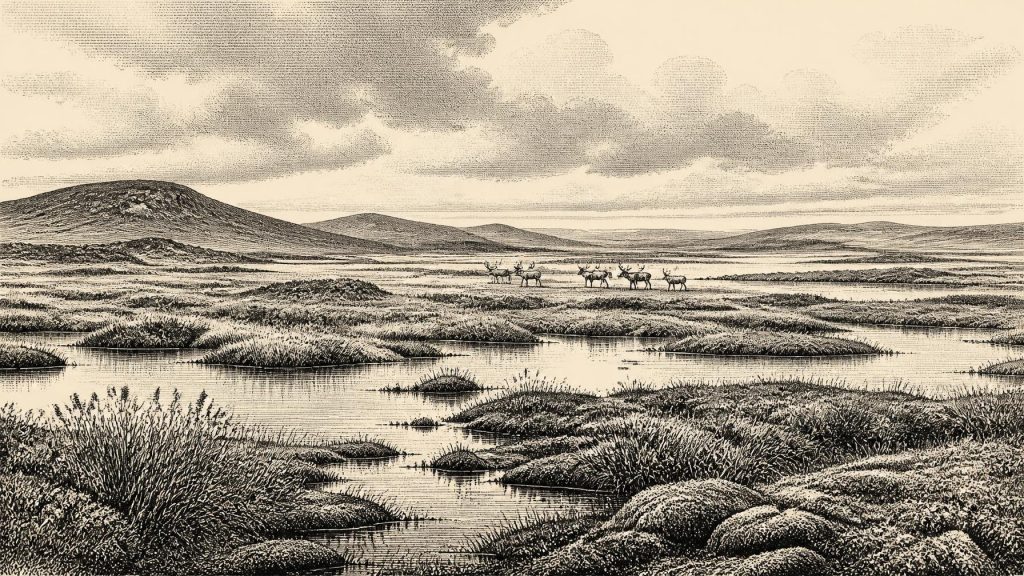
Around 31,438 BCE, Ireland had no historical calendar, communities or written record; evidence instead describes a changing Late Pleistocene environment. At Derryvree, County Fermanagh, organic sediments between glacial tills indicate a locally ice-free, open tundra wetland during a broad, uncertain interval, later buried by ice. Plant and insect remains reveal cold, damp, sparsely vegetated ground. Castlepook Cave, County Cork, preserves mixed remains of mammoths, reindeer, giant deer, predators and other cold-adapted animals, demonstrating intermittent access to suitable habitats. A marked reindeer bone may indicate human butchery, but cannot establish settlement. Subsequent glaciation destroyed or obscured evidence of Ireland’s earliest visitors.
Dateline
The label 31,438 BCE gives a useful position on a modern timeline, but it cannot identify an event in an Irish calendar year. No writing, calendar, named community or historical chronicle existed on the island at this depth of time. In radiocarbon convention the date falls about 33,388 years before AD 1950, in the later part of the Late Pleistocene and Marine Isotope Stage 3. Yet radiocarbon measurements must be calibrated, carry sizeable uncertainties at this age, and date samples rather than moments of national history. The responsible approach is therefore to describe a broad interval, not to invent an occurrence for a particular year.
For Ireland, the closest illuminating evidence is a small number of deposits and cave-bone collections, most of them preserved by chance and later disturbed by ice, water, excavation or old collecting practices. They show a cold, open and changeable land before the fullest expansion of the last Irish Ice Sheet. They do not reveal a state, tribe, settlement network, religion or economy in the ordinary historical sense. Around this point, Ireland’s story is principally one of ice, wetlands, animals and the unresolved question of very early human visitors.
A Date Within a Wide Range
The key environmental sequence lies at Derryvree near Maguiresbridge in County Fermanagh. Road works in 1969 cut through a drumlin and exposed fine sands and organic freshwater silts trapped between two thick layers of till, sediment deposited directly by glacier ice. The organic layer produced a conventional radiocarbon determination of 30,500 ± 1,100 radiocarbon years BP. Published calibration has placed that result broadly at about 36,900–31,700 calendar years BP: roughly 34,950–29,750 BCE. The modern date 31,438 BCE falls inside that large interval, but is not a date for the Derryvree wetland itself, much less for an island-wide event.
This distinction matters. A radiocarbon date on waterlogged plant material gives an age estimate for carbon that entered the deposit; stratigraphy establishes only that the freshwater bed lay between episodes of glaciation. Neither method can identify a single season, a named generation or a precise year. Modern calibration curves improve the conversion of radiocarbon ages into calendar ranges, but they do not make such remote evidence annual in resolution. At Derryvree, the strongest conclusion is that north-central Ireland had locally ice-free ground during part of the broad interval represented by the sediments, before later ice buried the site beneath the drumlin.
The Wetland Beneath the Drumlin
Derryvree is unusually valuable because it preserves biological detail from a landscape otherwise largely erased by subsequent glaciation. Pollen, seeds and other plant macrofossils, mosses and insect remains point towards open, treeless tundra or muskeg-like wetland. Grasses, sedges, herbs and low shrubs were more important than woodland. Mossy ground held standing or slow-moving freshwater in pools and hollows, while frost, poor drainage and short growing seasons constrained taller vegetation. This was not a uniformly barren sheet of snow: it was a patchwork of damp ground, shallow water, sparse plant cover and exposed mineral surfaces.
That reconstruction is evidence-based, but its limits should be kept in view. The deposit represents one locality, not a map of every Irish valley. Plant remains show what grew near the accumulating water and what was blown or washed into it; they do not provide a complete census of the island. Likewise, insect assemblages support an interpretation of cold, open, plant-rich wetland, but cannot supply daily temperatures. Still, the agreement of independent indicators makes the general picture persuasive: a severe periglacial environment, not a forested Ireland and not yet an island wholly overwhelmed by the later ice-sheet maximum.
At a regional scale, this was a period of climatic instability. The British–Irish Ice Sheet did not appear as one instantaneous blanket. Its margins, domes and flow routes altered over millennia, responding to changing snowfall, temperatures, sea level and the shape of the land beneath. Evidence from Ireland indicates that the main build-up of the last ice sheet followed earlier ice-free conditions and eventually reached a much greater extent considerably later, during the Last Glacial Maximum. Thus 31,438 BCE should not be pictured as the height of the last glaciation. It belongs to the long, uneven prelude to that maximum, when habitable-looking patches of cold ground could exist even as conditions became increasingly hostile.
Mammoths, Reindeer and Hyenas
The other major archive is Castlepook Cave, also known as Mammoth Cave, near Doneraile in north County Cork. Its old bone collections and surviving deposits have produced Ireland’s best-known assemblage of pre-Last Glacial Maximum mammals. Finds attributed broadly to the Middle Midlandian include woolly mammoth, reindeer, giant deer, brown bear, wolf, fox, Arctic fox, mountain hare, collared and Norwegian lemmings, and spotted hyena. These are not all necessarily contemporary. Cave deposits often accumulate over long periods, and bones can be carried in by carnivores, water or people, then mixed by later disturbance. The collection records a succession of animal presences rather than one perfectly preserved ecosystem.
Even so, the fauna gives Derryvree’s cold landscape a larger scale. Reindeer and lemmings are consistent with open northern environments; mammoth and giant deer demonstrate that large herbivores could reach or inhabit parts of Ireland in suitable phases. Spotted hyena is especially revealing. Its presence shows that Ireland’s Pleistocene fauna was not simply a scattered assortment of harmless grazers: large carnivores could use cave systems, transport bones and compete for carcasses. A mammoth bone from Castlepook bears damage consistent with hyena activity, a reminder that caves may have been dens and feeding places rather than neutral shelters.
These animals also imply connection, although not necessarily a permanently open land bridge at the precise moment in question. Sea level was far lower than today during the wider glacial period, exposing parts of the continental shelves and altering routes between Ireland, Britain and mainland Europe. The exact accessibility of those routes changed as ice, sea and topography changed. The faunal evidence establishes that animals had entered Ireland during cold-stage intervals; it does not permit a simple claim that every species crossed together, by a single route or in one migration.
The Human Question
There is no securely excavated settlement, hearth, stone-tool assemblage, burial or continuous human population in Ireland that can responsibly be assigned to 31,438 BCE. Consequently there is no basis for describing political authority, diplomacy, warfare, language, law, religious institutions, trade systems or social rank on the island. Terms such as Gaelic, Celtic and Irish belong to immensely later cultural and historical contexts and should not be projected backwards into the Pleistocene.
There is, however, a striking but limited clue from Castlepook. A reindeer femur from an early twentieth-century collection has been reported as bearing a deep mark interpreted by zooarchaeologist Ruth Carden as a cut or chopping mark made with a sharp stone tool while the bone was fresh. The animal bone has been publicised as dating to around 33,000 years ago, bringing it broadly close to the period considered here. If the modification is confirmed as human butchery, it would be evidence that Upper Palaeolithic people processed a reindeer in Ireland long before the well-attested post-glacial settlement of the island.
The appropriate conclusion remains cautious. The femur was not recovered in a modern, intact occupation layer; the age of a bone is not automatically the exact age of every mark upon it; and one modified object cannot prove a resident population. It may record a short visit by highly mobile hunters rather than settlement. Subsequent Castlepook research has identified promising Pleistocene deposits and sought charcoal, stone artefacts and further modified bones, but the case for a substantial Palaeolithic occupation still requires securely stratified corroboration. The find is important precisely because it is potentially transformative, not because it settles the question.
Life Without a Historical Record
If people did enter Ireland during this broad interval, their most plausible activities would have been practical and mobile: following game, exploiting carcasses, making brief use of shelter, and carrying lightweight tools and clothing suited to cold conditions. Such statements are analogies from Upper Palaeolithic Europe, not direct observations from an Irish camp. No Irish evidence currently demonstrates houses, ritual deposits, art, exchange goods or organised hunting parties at this date. Equally, the absence of such finds is not proof that no visitors came: later ice sheets and changing coastlines had exceptional power to remove, bury or submerge fragile traces.
For animals, everyday life was more securely rooted in the available evidence. Herbivores negotiated an open landscape in which wetland plants, grasses and sedges could provide seasonal forage. Predators and scavengers followed them. Freshwater pools mattered to plants, insects and mammals alike, while caves offered den sites and traps for accumulating bones. Winter conditions were harsh, but the Derryvree flora and fauna show that this was a living environment, not merely a frozen void.
What This Year Can Mean
Modern Ireland was not yet taking historical shape. There were no towns, farms, monuments, ships, kingdoms or written memories. The pertinent evidence is local and fragmentary: a Fermanagh wetland sealed beneath glacial sediment, a Cork cave holding a complex bone archive, and laboratory dates that must be read as ranges. Together they show an island in a cold-stage transformation. Locally ice-free tundra wetland persisted at Derryvree; cold-adapted mammals moved through landscapes that could support both prey and powerful carnivores; and a controversial reindeer bone raises the possibility of a fleeting human encounter.
That is already a substantial history, though not a conventional one. Around 31,438 BCE, Ireland is best understood not as a nation awaiting its first chapter but as a changing northern environment whose later glaciers nearly destroyed its earliest archives. The surviving mosses, insects, silts and bones do not yield a dated human story for this individual year. They do, responsibly, illuminate the deep environmental conditions from which all later Irish history eventually emerged.
Primary Sources
- A Middle Midlandian Freshwater Series at Derryvree, Maguiresbridge, County Fermanagh, Northern Ireland
- Irish Pleistocene Biostratigraphy
- Palaeoecology
- Figure 6.— The Subdivision of the Quaternary Period in Ireland
- Trimlines, Blockfields and the Vertical Extent of the Last Ice Sheet in Southern Ireland
- Exploring the Controls on the Dynamics of the Former Donegal Bay Ice Stream of the British–Irish Ice Sheet
- Growth and Retreat of the Last British–Irish Ice Sheet, 31,000 to 15,000 Years Ago: the BRITICE-CHRONO Reconstruction
- Deglaciation Chronology of the Donegal Ice Centre, North-West Ireland
- New Data for the Last Glacial Maximum in Great Britain and Ireland
- A Reconsideration of the Radiocarbon Dating of the Marine Isotope Stage 3 Fauna from Southern Ireland
- The Irish Quaternary Fauna Project
- Pleistocene Vertebrates in the British Isles
- Spotted Hyena Skull
- Archaeology Research Excavation Grant 2022
- 32564: Castlepook Cave, Castlepook, Doneraile, Cork
- Reindeer Bone Found in Cork Cave Shows Human Activity in Ireland 33,000 Years Ago
- Ireland’s Palaeolithic Archaeology – Fleeting Footprints in a Frozen Land
- Ireland: Submerged Prehistoric Sites and Lands
- The Mesolithic in Ireland: When Was It?
- The IntCal20 Northern Hemisphere Radiocarbon Age Calibration Curve (0–55 cal kBP)
- IntCal Publications
- IntCal History
- Proceedings of the Royal Irish Academy