
Derryvree’s Tundra Insects31437 BCE
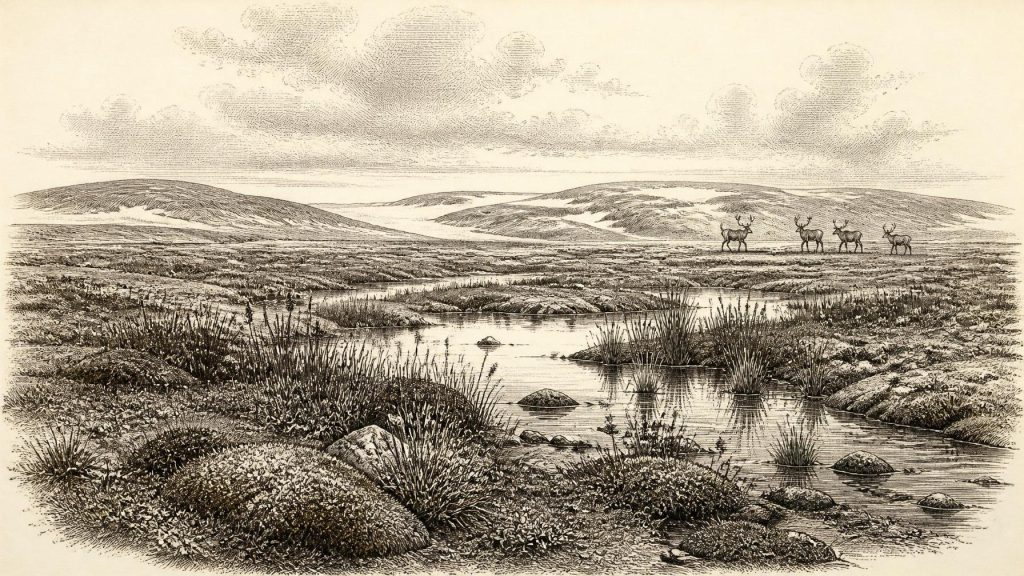
31,437 BCE is a modern label within a broad calibrated Late Pleistocene MIS 3 range, not a datable Irish year. At Derryvree, County Fermanagh, freshwater silts between glacial tills preserve mosses, sedges, aquatic plants and cold-adapted insects, indicating locally ice-free, open tundra-like wetland during fluctuating glaciation. Castlepook Cave, County Cork, contains MIS 3 fauna including reindeer, mammoth, giant deer, predators and other cold-stage species, demonstrating diverse open habitats. A marked reindeer femur may suggest human butchery, but lacks secure archaeological context and cannot prove occupation. No evidence supports contemporary Irish politics, settlements, beliefs or culture. The evidence records ice-age environments.
Dateline
“31,437 BCE” is a modern chronological label, not a year that anyone in Ireland could have named, recorded or commemorated. No writing, calendar, ruler-list or settlement sequence allows events to be fixed to a particular year so far back. Calendar arithmetic places the label roughly 33,386 years before AD 1950, but that must not be confused with a radiocarbon measurement. At this depth of time, archaeology works responsibly with broad phases, stratified deposits and calibrated probability ranges. The appropriate setting is the Late Pleistocene, within Marine Isotope Stage 3 (MIS 3), during the last glacial period but before the fullest expansion of the last Irish Ice Sheet.
The strongest Irish evidence close to this notional date comes not from a human camp, but from a buried wetland at Derryvree, near Maguiresbridge in County Fermanagh. Here, roadworks in 1969 cut through a drumlin and exposed freshwater silts and fine sands sealed between two layers of glacial till. The organic deposit produced the radiocarbon determination Birm-166: 30,500 radiocarbon years BP, with a substantial uncertainty. Later calibration places that result broadly at about 36,900–31,700 calibrated years BP, or approximately 34,950–29,750 BCE. Thus 31,437 BCE lies within the wide interval illuminated by Derryvree, but cannot be isolated as a moment within it.
A Wetland Between Ice Advances
Derryvree is important because its sedimentary sequence records change rather than a timeless image of an Ice Age Ireland. A lower till was laid down by ice; afterwards, liquid water collected and laid down silts rich in organic remains; then a later ice advance covered the deposit with another till. The deposit therefore demonstrates that this part of Fermanagh was ice-free, at least locally, during a cold interval between episodes of glaciation. It does not show that all Ireland was free of ice at once, nor does it identify the exact outline of coasts, glaciers or sea routes in 31,437 BCE.
The plants and insects preserved in the silts are the principal witnesses. Pollen was poorly preserved, but what survived was predominantly herbaceous. Moss macrofossils, sedges and freshwater plants indicate wet ground, shallow pools and waterlogged hollows. The insect assemblage has a distinctly northern, cold-adapted character. Researchers have interpreted the combined evidence as open, treeless tundra or muskeg-like country: a mosaic of saturated mossy ground, sedge beds, pools and sparse herb-rich patches, rather than the dense green woodland often imagined as Ireland’s natural condition.
That reconstruction is evidence-based, but its limits matter. It describes the vicinity of a freshwater basin, not every ridge, valley or coast on the island. Nor does “tundra” mean an unchanging sheet of snow. The ground would have varied with drainage, exposure, season and climatic fluctuation. Short summers could bring bursts of plant growth, insects and grazing; long winters would have been severe. Periglacial conditions—cold climates involving seasonal freezing, frost action and potentially permafrost—help explain why water, mud and vegetation formed such a distinctive local archive.
An Unstable North Atlantic Climate
Irish conditions were shaped by the restless North Atlantic climate of MIS 3. Greenland ice-core records show that the last glacial period was punctuated by abrupt shifts between colder stadials and relatively milder interstadials. Ireland did not reproduce Greenland’s climate exactly, and the Derryvree layers cannot resolve each shift to a single year. Yet their position between tills, their cold-adapted biology and their radiocarbon age fit a world in which ice margins and ecosystems could change markedly over millennia, sometimes more rapidly than later historical experience might suggest.
At the scale of the island, the picture remains debated. Reconstructions of the British–Irish Ice Sheet have been transformed by marine geophysics, cosmogenic dating and renewed examination of old stratigraphic sequences. There is wide agreement that the ice sheet expanded to a very large extent during the Last Glacial Maximum, broadly after this period, but its earlier growth was neither simple nor uniform. Derryvree’s freshwater horizon is valuable precisely because later ice preserved it beneath the drumlin. It shows that glacial Ireland was a sequence of advancing ice, exposed land, wetlands and ecological readjustments—not one continuous frozen blank.
The Castlepook Animal World
More than 300 kilometres to the south-west, Castlepook Cave near Doneraile in north County Cork offers a different sort of evidence. Often called Mammoth Cave, it has yielded one of Ireland’s most significant Pleistocene faunal collections. Modern re-dating has shown that at least part of its animal assemblage belongs to MIS 3, rather than to the much later end of the Ice Age. The wider cave record includes reindeer, woolly mammoth, giant deer, brown bear, wolf, Arctic fox, mountain hare, lemmings and spotted hyaena.
This is not a census of one landscape in one season. Caves accumulate remains through many processes: animals may die inside them; predators and scavengers can drag in carcasses or limbs; water can move bones; sediments can be disturbed; and early excavations often lacked the methods now expected. Castlepook’s deposits were explored from the early twentieth century onward, and their original layers were not always retained intact. The fauna nevertheless establishes that Ireland could support, or receive, a much richer cold-stage mammal community than the modern island.
Reindeer point particularly strongly towards open, cold-adapted grazing terrain. Mammoth and giant deer indicate extensive plant resources in suitable phases, while wolves and spotted hyaenas occupied the predator and scavenger side of the food web. Their presence should not be converted into a picturesque certainty about herd sizes or animal behaviour at Derryvree. It does, however, support the broader interpretation that portions of Ireland contained open habitats capable of sustaining large herbivores and their predators during MIS 3.
The Reindeer Femur Question
Castlepook is also central to the unresolved question of whether people reached Ireland at this early date. A reindeer femur from the cave has been publicised as approximately 33,000 years old and as carrying a deep mark interpreted by zooarchaeologist Ruth Carden as consistent with a stone-tool cut or chop made while the bone was fresh. County Cork heritage material has consequently presented it as possible evidence of Palaeolithic hunters processing reindeer around 31,000 BCE.
If that interpretation is upheld, it would be potentially transformative: it would push evidence for human activity in Ireland far earlier than the securely dated late Upper Palaeolithic bear bone from Alice and Gwendoline Cave, County Clare, dated to about 12,800–12,600 calibrated years BP. But the Castlepook femur cannot responsibly be treated as proof of a settled population in 31,437 BCE. It comes from an old cave collection, not a newly excavated, undisturbed occupation floor. No securely associated hearth, lithic assemblage, dwelling, burial, human remains or food-processing area of comparable date has been recovered there.
Moreover, a radiocarbon result dates the organic material in the animal bone, within a statistical range; it does not by itself date a surface mark, identify its maker or reveal whether the animal was killed at the cave. Distinguishing stone-tool damage from breakage, carnivore activity, trampling, sediment movement, weathering or excavation damage requires specialist taphonomic assessment. The careful conclusion is therefore that Castlepook contains a promising possible trace of human butchery, not demonstrated evidence of permanent occupation or continuous settlement.
People, Politics and Belief
There is no evidence from Ireland at this date for political institutions, named communities, warfare, diplomacy, territories, religious monuments or formal learning. Such subjects cannot be reconstructed by importing the societies of later Celtic Ireland, the Mesolithic, or even well-excavated Upper Palaeolithic regions of continental Europe. If people did visit Ireland during the broad period represented by the Castlepook femur, they may have been a very small mobile party, perhaps exploiting an animal carcass during a brief incursion. That is an interpretation of possibility, not a demonstrated history of a particular group.
The same restraint applies to economy and culture. Reindeer could potentially provide meat, fat, hide, sinew, antler and bone; Upper Palaeolithic people elsewhere in Europe used stone tools and had complex social and symbolic lives. Yet no Irish artefact or securely dated camp of this age permits those practices to be assigned to Ireland. There is likewise no sound basis for imagining trade networks, rituals in Castlepook Cave, or a specific route from Britain or the Continent. Lower sea levels changed the geography of the surrounding shelves, but the evidence does not settle whether visitors crossed open water, used temporarily exposed terrain, or reached the island at all.
A Landscape Known by Fragments
What can be said with confidence is both modest and remarkable. Around the broad calibrated span containing 31,437 BCE, parts of Ireland experienced a harsh, open and changeable Ice Age environment. At Derryvree, freshwater pools, mosses, sedges, herbs and cold-adapted insects persisted between phases of glaciation. In southern Ireland, cave deposits preserve the remains of animals that belonged to a wider north-west European cold-stage ecology. One marked reindeer bone may eventually alter the story of Ireland’s earliest human presence, but it remains a question rather than a foundation for invented biography.
Derryvree’s buried insects make the deeper point. They record neither kings nor battles, but they preserve the conditions under which every later Irish history became possible: water on a cold plain, plants rooted in saturated ground, and a landscape repeatedly reshaped by ice. For 31,437 BCE, that is not a thin substitute for history. It is the most truthful history the evidence allows.
Primary Sources
- A Middle Midlandian Freshwater Series at Derryvree, Maguiresbridge, County Fermanagh, Northern Ireland
- Early Midlandian–Middle Midlandian, Pleistocene, Northern Ireland
- Palaeoecology: IQUA Field Guide 16
- A reconsideration of the radiocarbon dating of the Marine Isotope Stage 3 fauna from southern Ireland
- The Irish Quaternary Fauna Project
- Trimlines, blockfields and the vertical extent of the last ice sheet in southern Ireland
- Growth and retreat of the last British–Irish Ice Sheet, 31,000 to 15,000 years ago: The BRITICE-CHRONO reconstruction
- Timing and pace of ice-sheet withdrawal across the marine–terrestrial transition west of Ireland during the last glaciation
- Last Glacial Maximum cirque glaciation in Ireland and implications for reconstructions of the Irish Ice Sheet
- The IntCal20 Northern Hemisphere Radiocarbon Age Calibration Curve (0–55 cal kBP)
- A stratigraphic framework for abrupt climatic changes during the Last Glacial period based on three synchronized Greenland ice-core records: refining and extending the INTIMATE event stratigraphy
- High-resolution record of Northern Hemisphere climate extending into the last interglacial period
- Ireland through Geological Time
- Quaternary
- 2022:564 – Castlepook Cave, Castlepook South, Cork
- Mammoth Cave, County Cork
- Heritage Artefacts of County Cork
- Guide to the National Museum of Ireland – Natural History
- First Evidence of a Late Upper Palaeolithic Human Presence in Ireland
- New Insights on the Fauna of Ireland's Younger Dryas and Early Holocene from Alice & Gwendoline Cave