Derryvree’s Moss and Milfoil30808 BCE
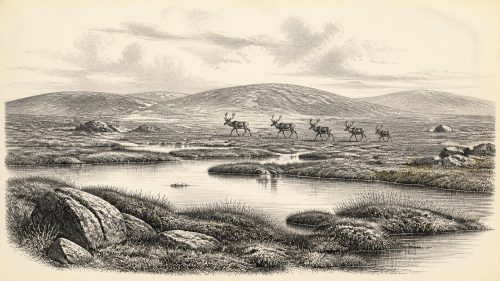
30,808 BCE is a modern label within a broad Late Glacial interval, not a recoverable Irish calendar year. At Derryvree, County Fermanagh, freshwater sediments sealed beneath tills date broadly to this period, showing locally ice-free or limited-ice periglacial conditions before major ice-sheet expansion. Pollen, plants, mosses and insects reveal wet, open tundra-like habitats with pools, sedges, grasses, herbs and scarce trees. Castlepook Cave in Cork records cold-adapted fauna, including mammoth, reindeer and predators, but its mixed deposits are not precisely contemporary. A possibly butchered reindeer bone suggests uncertain early human activity; no secure evidence demonstrates settlement, society, politics or trade.
Dateline
The label 30,808 BCE is a modern chronological convenience, not a year that can be recovered from Ireland’s prehistoric record. No one in Ireland counted years in this manner, and neither radiocarbon dating nor glacial stratigraphy can distinguish an event within one calendar year so far back. In simple calendar arithmetic, the label lies about 32,757 years before AD 1950, the conventional “present” of radiocarbon science. Its responsible historical setting is the later part of Marine Isotope Stage 3, during the Last Glacial Period but before the fullest expansion of the last Irish Ice Sheet.
The closest useful Irish evidence is not a written account, settlement or burial. It is a body of sediments, fossils and landforms whose dates span millennia. At Derryvree, near Maguiresbridge in County Fermanagh, freshwater silts and fine sands were found sealed between two layers of till, debris laid down by glacier ice. Organic material from the intervening deposit produced a radiocarbon age of about 30,500 ± 1,100 radiocarbon years before present. Published calibration places that broad result at roughly 36,900–31,700 calibrated years before present, or approximately 34,950–29,750 BCE. Thus 30,808 BCE falls within the wide range represented by the deposit, but cannot be pinpointed within it.
A Date Within a Long Cold Phase
That distinction matters. A radiocarbon measurement records the age of particular organic material, with uncertainty; it does not date every plant, animal or activity in a landscape to an exact calendar year. Calibration is necessary because atmospheric radiocarbon levels have changed through time, and at this depth in the past the calibrated ranges are especially broad. The date therefore belongs in an environmental interval, not in an annal-like sequence of events. It is best understood as a window onto a cold, changing Ireland over many generations.
Derryvree is particularly valuable because its organic sediments were protected beneath later glacial deposits. They show that, during the interval in which they formed, this part of Fermanagh was not buried beneath a continuous ice sheet. Other evidence supports a larger picture of limited or locally absent ice cover in parts of Ireland before the major build-up of the last ice sheet. Deposits beneath tills at Greenagho, also in Fermanagh, and marine evidence from Donegal Bay indicate that the island’s glacial history was not a simple progression from open ground to universal ice. Ice advanced, withdrew or failed to occupy some regions at different times.
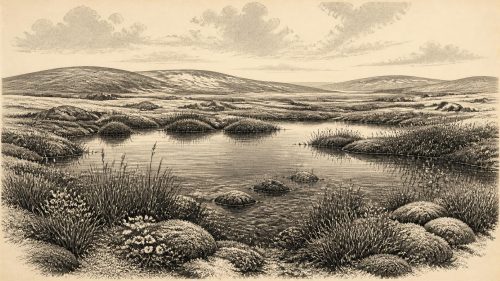
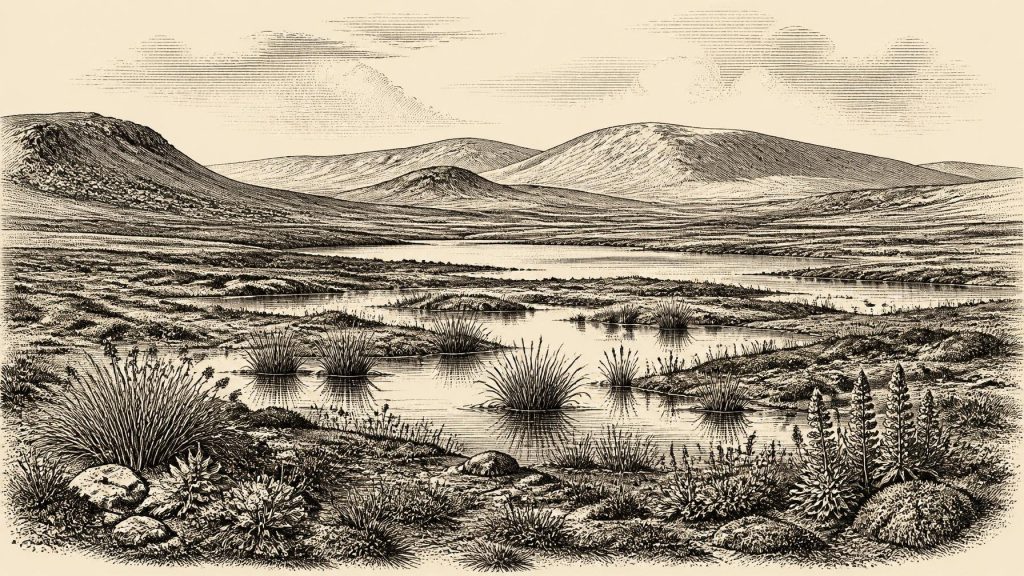
This does not mean that Ireland was mild. The Derryvree deposits record a periglacial world: one shaped by intense cold, seasonal freezing and thawing, sparse plant cover and wet ground. The word “tundra” is a helpful shorthand, but it should not conjure a single, uniform modern-Arctic scene. The evidence points instead to a mosaic of shallow freshwater, mossy margins, sedge-rich wetland and exposed mineral ground. Frost, wind and short growing seasons were as important as the plants themselves in structuring the landscape.
A Freshwater Refuge Beneath Later Ice
The surviving pollen, plant macrofossils, mosses and insect remains at Derryvree are unusually informative for Ireland at this age. Herbaceous pollen dominates, while the available evidence indicates grasses, sedges, cold-tolerant herbs, juniper and mosses rather than closed woodland. Freshwater plants show that at least some open water was present. Insects reinforce the picture of plant-rich wet ground and pools, often described as a tundra muskeg: a saturated, mossy environment with standing water rather than a featureless frozen plain.
Such evidence has limits. Pollen can travel on the wind, so rare tree pollen does not demonstrate local forest. A seed or moss fragment proves that a species was present in, or close enough to reach, the accumulating sediment; it cannot map every hillside in Ireland. Nor can one drumlin section stand for the whole island. Yet Derryvree responsibly overturns the image of a wholly sterile Ireland. It documents an ice-age habitat with water, vegetation and invertebrate life, later entombed beneath advancing ice.
The landscape beyond the wetland probably offered little shelter. Trees were absent or exceedingly scarce locally, and the terrain would have been exposed to severe winters. In summer, however, the long daylight of Ireland’s latitude could have supported a brief but productive growing season in sheltered hollows and beside water. Mosses and sedges stabilised wet ground; herbs and grasses supplied forage; pools provided small but persistent ecological refuges. The result was not a settled countryside but a shifting patchwork of usable habitats.
Animals in an Open Country
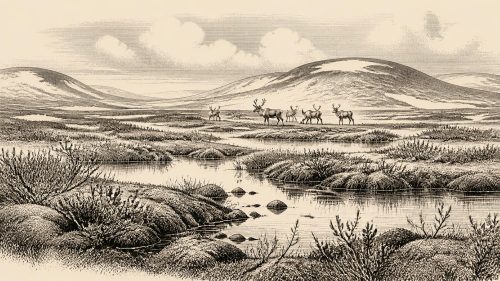
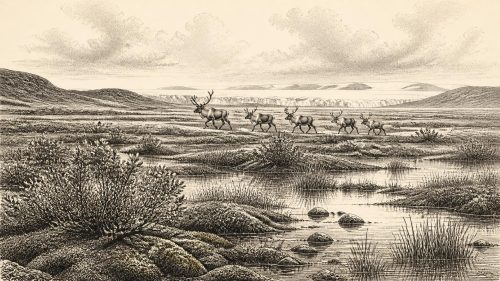
Faunal remains from Castlepook Cave near Doneraile in County Cork provide a separate, though not precisely contemporary, view of Middle Midlandian Ireland. The cave has yielded bones of woolly mammoth, reindeer, brown bear, spotted hyaena, wolf, foxes, hare, lemmings and giant deer. Direct radiocarbon results from parts of its large assemblage include dates around 35,000–34,000 radiocarbon years before present for some mammoth, hyaena, bear and reindeer remains. These animals demonstrate that Ireland supported a richer Pleistocene fauna than the modern island and that open, cold-adapted environments could sustain large herbivores and their predators.
But Castlepook must not be treated as a photograph of 30,808 BCE. Cave deposits accumulated over long periods. Bones entered by more than one route: animals may have fallen through openings, carnivores may have used sections of the system, and water later moved and mixed material. Researchers have specifically warned that different species and bones from different parts of the cave need not be contemporaneous. The cave supports a regional reconstruction of possible fauna and habitats across the period, not a claim that every listed animal stood together in Cork in this particular notional year.
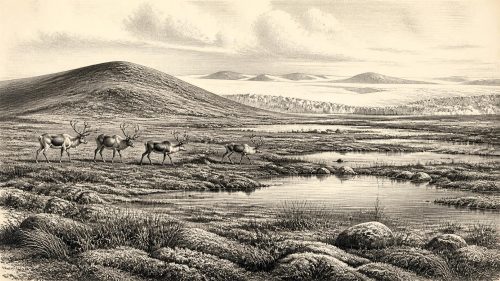
Reindeer are especially important to the period because a reindeer femur from Castlepook has been reported as bearing a deep mark interpreted as possible stone-tool butchery, with public reporting placing the bone at about 33,000 years ago. If that interpretation and dating are sustained by further analysis, it may represent very early human activity in Ireland. It remains a single, disputed and contextually difficult item rather than evidence for a permanent population, a camp, or a named hunting community. The National Museum of Ireland accordingly continues to describe clear Palaeolithic human presence in Ireland as unproven.
People: Possibility, Not a Society
For 30,808 BCE, no securely excavated Irish hearth, dwelling, tool assemblage, grave or human bone allows historians to describe a resident society. There is no basis for identifying a language, kin group, territory, leader or population size. Nor is there evidence for farming, metalworking, pottery, monuments, formal religion or artistic tradition on the island at this point. These absences are significant: they prevent the projection of later prehistoric Ireland backwards into the deep Pleistocene.
If people did reach Ireland intermittently during this cold phase, they would most plausibly have been mobile hunter-gatherers exploiting seasonal resources, as Upper Palaeolithic groups did elsewhere in north-west Europe. That is an interpretation based on wider European comparison, not a demonstrated Irish social history. It should not be inflated into claims of towns, tribes, migration routes or long-term settlement. Even lowered sea levels and exposed continental-shelf landscapes do not by themselves prove an easy land crossing or regular traffic to Ireland. Coastlines, ice margins, channels and access routes changed repeatedly, while direct archaeological evidence remains extremely scarce.
No Polities, No Diplomacy, No Recorded Conflict
Political affairs and diplomacy cannot be reconstructed because no political institutions are evidenced. Equally, there is no reliable proof of organised conflict, territorial boundaries or alliances. Predators competed with herbivores and scavenged carcasses; cold, hunger and unstable ground shaped survival. Those ecological pressures were real, but they are not substitutes for human history. A hyaena-marked bone or a possible cut mark can illuminate interactions with animals, not a war or a diplomatic relationship.
The best-supported “economy” is therefore ecological. Wetland plants, grazing animals and carnivores formed food webs rather than markets. If humans were present, animal meat, marrow, hide, sinew and bone would have been valuable resources, but no Irish assemblage from this date securely records how such materials were divided, transported or exchanged. There is likewise no evidence for trade. The central regional change was environmental: an ice-free or thinly glaciated northern landscape capable of supporting tundra wetland was approaching the prolonged expansion of the Irish Ice Sheet, which later buried or transformed many such records.
Seen responsibly, 30,808 BCE is not a year of Irish kings, battles or monuments. It is a point within a broad cold-age interval in which Derryvree preserves freshwater life beneath a later glacier, while Castlepook preserves fragmentary traces of an open-country fauna and a tantalising but unsettled question of human presence. The history is sparse, but not empty: mosses, silts, insects and bones establish an Ireland of severe climate, local ecological resilience and profound uncertainty.
Primary Sources
- A Middle Midlandian Freshwater Series at Derryvree, Maguiresbridge, County Fermanagh, Northern Ireland
- Palaeoecology
- The Subdivision of the Quaternary Period in Ireland
- Trimlines, blockfields and the vertical extent of the last ice sheet in southern Ireland
- The Irish Quaternary Fauna Project
- Late Pleistocene chronostratigraphy and ice sheet limits, southern Ireland
- Radiocarbon constraints on the age of the maximum advance of the British–Irish Ice Sheet in the Celtic Sea
- Radiocarbon constraints on the history of the western Irish ice sheet prior to the Last Glacial Maximum
- Last Glacial Maximum cirque glaciation in Ireland and implications for reconstructions of the Irish Ice Sheet
- Deglaciation chronology of the Donegal Ice Centre, north-west Ireland
- Bayesian Modelling the Retreat of the Irish Sea Ice Stream
- Exploring controls of the early and stepped deglaciation on the western margin of the British Irish Ice Sheet
- The IntCal20 Northern Hemisphere Radiocarbon Age Calibration Curve (0–55 cal kBP)
- Prehistoric Details
- Ireland's Palaeolithic Archaeology – Fleeting Footprints in a Frozen Land
- Heritage Artefacts of County Cork
- The Mesolithic in Ireland: when was it?
- New insights on the fauna of Ireland's Younger Dryas and Early Holocene from Alice & Gwendoline Cave
- Pleistocene Vertebrates in the British Isles
- The Antiquity of Man in Ireland
- New Data for the Last Glacial Maximum in Great Britain and Ireland
- Response of the Irish Ice Sheet to Abrupt Climate Change During the Last Deglaciation