
Derryvree’s Entombed Herbarium31439 BCE
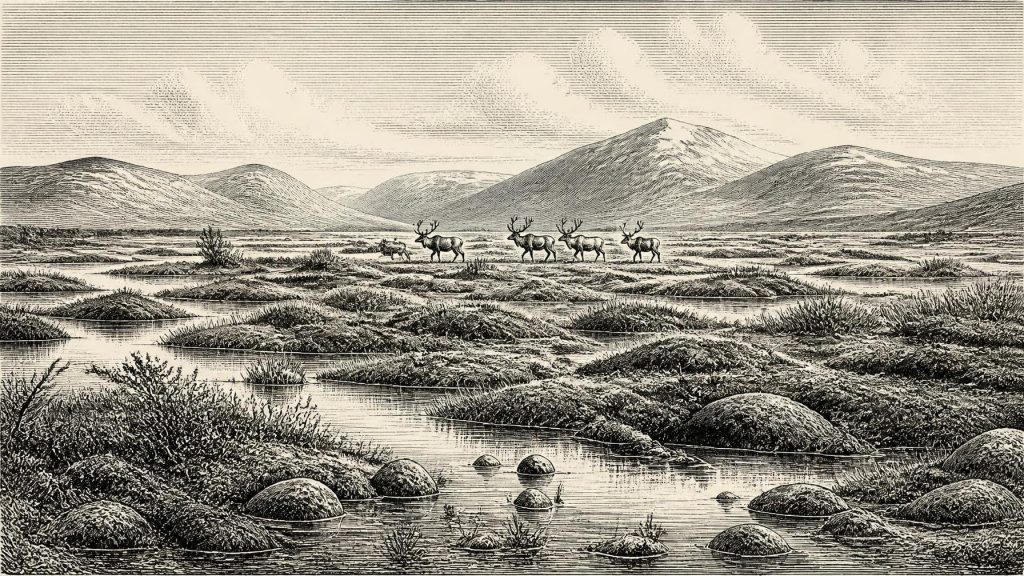
Around 31,439 BCE, a modern label within Marine Isotope Stage 3, Ireland was a changing cold-climate landscape rather than a historically documented society. Derryvree, County Fermanagh, preserves freshwater organic sediments beneath later glacial till, dated broadly to 36,900–31,700 calendar years BP. Pollen, plants and insects indicate open, wet tundra with sedges, mosses, herbs and pools. Cave faunas show reindeer, mammoth, hyaena and other cold-adapted animals reached Ireland, though deposits are mixed and imperfectly dated. A marked reindeer bone at Castlepook may suggest human butchery, but secure evidence of people is far later. Expanding ice eventually buried Derryvree’s wetland biological record.
Dateline
The label 31,439 BCE is a modern chronological convenience, not a year that any person in prehistoric Ireland could have known or recorded. It corresponds approximately to 33,400 calendar years before present, where “present” conventionally means AD 1950. At this depth of time, even excellent scientific dating normally yields ranges rather than single calendar years. The responsible subject is therefore Ireland during a broad part of Marine Isotope Stage 3 (MIS 3), an unstable interval of the last Ice Age, not an invented event in one named year.
A Date Within a Range
The strongest Irish evidence that brackets this notional date comes from Derryvree near Maguiresbridge, County Fermanagh. There, organic freshwater sediments were discovered between two layers of glacial till: deposits made before later ice advanced over and sealed the site. A conventional radiocarbon determination of about 30,500 radiocarbon years BP has been calibrated to a broad range of roughly 36,900–31,700 calendar years BP. That span includes the horizon represented by 31,439 BCE, but it emphatically does not permit historians to say what happened in that particular year.
This distinction matters. Radiocarbon years are not calendar years, because atmospheric carbon-14 has varied through time; calibration converts a measurement into a probability range, not a pinpoint date. The older the sample, the more cautiously its range must be handled. Derryvree is consequently an environmental archive for a long episode, perhaps interrupted by changes within it, rather than a diary of an Irish season. Its value lies in showing that a freshwater wetland existed in Fermanagh before it was overridden and buried by later ice.
Wet Ground Beneath Future Ice
The sediments preserve pollen, plant macrofossils and insects. Taken together, they indicate open, treeless country, commonly described as tundra or muskeg: wet, moss-rich ground with sedges, grasses, herbs and low shrubs, crossed by shallow pools and sluggish water. The assemblage is not a photographic reconstruction. Pollen can travel long distances, be reworked from older sediments, or survive unevenly. Yet the agreement between several kinds of evidence makes one conclusion secure: this was not the familiar, wooded Ireland of later prehistory.
Short summers could nevertheless be productive. Wetlands supported plant growth, insect life and decaying vegetation, while open ground offered grazing and movement routes for large mammals. The landscape was harsh, especially in winter, but it was not necessarily an unbroken white desert. Liquid water had accumulated at Derryvree, and calcite deposits in Crag Cave, County Kerry, show episodes of speleothem growth elsewhere in south-west Ireland during MIS 3. Because cave calcite needs water moving through rock, these deposits independently demonstrate that conditions fluctuated within the long cold stage.
Regional conditions were changing quickly on geological timescales. Research on the build-up of the British–Irish Ice Sheet places major expansion after roughly 35,000–32,000 years ago, before its maximum extent later in the Last Glacial Maximum. Around the broad horizon represented here, parts of Ireland could retain ice-free or seasonally habitable landscapes while ice masses expanded, altered drainage and increasingly constrained routes. The precise limits of ice in any single decade cannot be mapped with confidence. What is clear is that Derryvree’s wetland belonged to a world soon transformed: later glacier ice laid down the upper till and entombed its biological record.
Animals on an Open Island Margin
Irish caves add a second body of evidence. The Irish Quaternary Fauna Project showed that a varied Pleistocene fauna reached Ireland at different times between at least about 45,000 and 20,000 years ago. Cave collections, especially from Castlepook Cave near Doneraile in north County Cork, include remains attributed to reindeer, brown bear, spotted hyaena, wolf, fox, hare, lemming, horse and woolly mammoth. They reveal that Ireland could support, or be reached by, animals associated with open and cold north-west European environments.
These cave assemblages must not be treated as a single herd photographed in one moment. Bones accumulated through carnivore activity, water movement, deaths in or near caves, and nineteenth- and twentieth-century collecting. Old excavations disturbed much of the original stratigraphy. Improved sample preparation and redating have also shown that some early radiocarbon results from Irish cave bones were unreliable. A mammoth bone, a hyaena jaw and a reindeer bone found in the same cave need not be contemporary, and none by itself describes conditions throughout the island.
Still, Castlepook is important for the scale of the question it raises. A reindeer femur from its old collections has been dated to approximately 33,000 radiocarbon years ago and bears a deep mark interpreted by zoologist Ruth Carden as damage made with a sharp stone tool while the bone was fresh. County Cork heritage interpretation has connected the specimen with possible butchery by Upper Palaeolithic hunters. If that interpretation is confirmed by further analysis, it would place a human encounter with reindeer in Ireland far earlier than the previously secure terminal-Pleistocene evidence.
The Human Question
It remains a possibility, not a settled fact of annual history. The radiocarbon measurement dates the animal’s death, not automatically the making of the mark, the identity of its maker or the place where the carcass was processed. Carnivores may have carried remains into Castlepook after people, if people were involved at all, had dealt with an animal elsewhere. No securely associated stone-tool assemblage, hearth, shelter floor, human bone or repeated occupation layer of comparable age has yet been recovered from Ireland. Modern excavations at Castlepook have located surviving Pleistocene deposits and may eventually test the question with better stratigraphic control.
The closest secure evidence for human activity in Ireland is much later: a cut-marked brown-bear kneecap from Alice and Gwendoline Cave, County Clare, with calibrated dates around 12,800–12,600 years BP. That later find cannot disprove an earlier visit, but it establishes the difference between a directly dated, demonstrably modified specimen and an intriguing older trace from a disturbed cave collection. At 31,439 BCE, Ireland cannot responsibly be described as permanently settled, nor can continuity be drawn between any possible visitors and later Irish populations.
If people did reach Ireland during this broad period, they were probably small, mobile foraging groups operating within the wider Upper Palaeolithic world of north-west Europe. That is an inference from neighbouring regions, not a demonstrated social description of an Irish camp. Reindeer and other large animals would have supplied meat, fat, hides, sinew, bone and antler; routes through open country may have been seasonal. But Ireland has yielded no local evidence from this horizon for dwellings, clothing, watercraft, food stores or the organisation of a hunting party. The archaeology allows the possibility of brief visits, not a fully recoverable way of life.
What Cannot Be Written
There were no Irish kingdoms, chiefs, borders, treaties or diplomatic missions that can be identified at this date. There is no evidence for warfare, formal political institutions, named communities, trade networks or exchange goods. Lower sea levels changed coastlines and the geography of the Irish Sea basin, but evidence is insufficient to reconstruct a specific crossing route into Ireland around this horizon. Nor can archaeology identify religious practices, stories, languages, artistic traditions or systems of learning here. Their absence from the record is not proof that people lacked beliefs or culture; it means that no securely dated Irish material allows them to be described.
For this reason, the most meaningful history of Ireland around 31,439 BCE is not a tale of rulers or monuments. It is the history of a changing cold-climate landscape: sedges and mosses growing in a Fermanagh wetland; pools sustaining insects and small plants; cold-adapted mammals moving through open country; caves preserving scattered bones; and advancing ice eventually covering, eroding and sealing much of the evidence. Derryvree’s buried organic layer is an unusually eloquent survivor. It shows that beneath landscapes later reshaped by glaciers lay a living, watery tundra whose traces can still set limits on what Ireland’s deepest past can honestly tell us.
Primary Sources
- A Middle Midlandian Freshwater Series at Derryvree, Maguiresbridge, County Fermanagh, Northern Ireland
- A Reconsideration of the Radiocarbon Dating of the Marine Isotope Stage 3 Fauna from Southern Ireland
- The Irish Quaternary Fauna Project
- Trimlines, Blockfields and the Vertical Extent of the Last Ice Sheet in Southern Ireland
- Extent and Timing of the Last Glacial Maximum (LGM) in Britain and Ireland: A Review
- Timing, Pace and Controls on Ice Sheet Retreat: An Introduction to the BRITICE-CHRONO Transect Reconstructions of the British-Irish Ice Sheet
- Pattern and Timing of Retreat of the Last British-Irish Ice Sheet
- Growth and Retreat of the Last British-Irish Ice Sheet, 31 000 to 15 000 Years Ago
- Episodic Speleothem Deposition Tracks the Terrestrial Impact of Millennial-Scale Last Glacial Climate Variability in SW Ireland
- Spatio-Temporal Dynamics of Speleothem Growth and Glaciation in the British Isles
- New Insights on the Fauna of Ireland's Younger Dryas and Early Holocene from Alice & Gwendoline Cave
- HERITAGE ARTEFACTS of County Cork
- 18) CASTLEPOOK CAVES
- 32564 – CASTLEPOOK CAVE, Castlepook South
- Ireland's Palaeolithic Archaeology – Fleeting Footprints in a Frozen Land
- Figure 6.— The Subdivision of the Quaternary Period in Ireland
- Field Guides
- Outreach and Education Resources
- Geology of Ireland
- The IntCal20 Northern Hemisphere Radiocarbon Age Calibration Curve (0–55 cal kBP)
- IntCal Publications
- Help Needed from Citizen Scientists to Record One of Ireland’s Oldest Mammals