Avens Interval31513 BCE
Around 31,513 BCE, Ireland has no recoverable annual history, only sparse Late Pleistocene evidence from climatically unstable Marine Isotope Stage 3. At Derryvree, County Fermanagh, organic sediments trapped between glacial tills show an ice-free, cold freshwater wetland supporting tundra vegetation, insects and seasonal pools before renewed glaciation. Castlepook Cave, County Cork, preserves mixed remains of mammoth, giant deer, reindeer, bears and hyenas, demonstrating connections with wider European fauna. A cut-marked reindeer femur may indicate early human butchery, but proves neither settlement nor population. Later glaciation destroyed much evidence, leaving a complex, changing landscape and major uncertainties about people and environments.
Dateline
The label 31,513 BCE offers a useful point in a long chronological series, but it cannot identify a recoverable Irish event in a particular year. No calendar, writing system, named community or historical tradition existed on the island at this depth of time. In archaeological terms, the date stands roughly 33,462 years before AD 1950, the conventional reference point for “before present” dating. That arithmetic is not a scientific date for an Irish deposit. Radiocarbon ages must be calibrated, and at more than 30,000 years ago their calendar ranges can extend across many centuries or millennia. Ireland around this horizon can therefore be described only through broad Late Pleistocene evidence, not as a year-by-year narrative.
The relevant setting was Marine Isotope Stage 3, a climatically volatile part of the last Ice Age. It preceded the fullest growth of the last British–Irish Ice Sheet, conventionally called the Last Glacial Maximum, which came substantially later. Ireland was neither the familiar green, wooded island of recent millennia nor necessarily an unbroken white expanse of permanent ice. Its climate, sea level, ice margins and vegetation changed markedly over long intervals. The physical evidence is sparse because later glaciers eroded, redeposited or buried much of what had existed before them. A few exceptional sediments and cave collections consequently carry disproportionate importance.
A Wetland Beneath the Ice
The strongest environmental evidence near this notional date comes from Derryvree, near Maguiresbridge in County Fermanagh. Road works exposed a remarkable sequence within a drumlin: freshwater silts and fine sands containing organic remains lay between two deposits of till, the unsorted debris left by moving glacier ice. The sequence records a powerful regional rhythm. Ice had deposited the lower till; the site subsequently became an ice-free freshwater environment in which sediment, plants and insects accumulated; then a later ice advance sealed the wetland beneath another till.
Organic material from the Derryvree series produced a conventional radiocarbon age of about 30,500 years BP, with a large published uncertainty. When expressed through modern calibration, the relevant interval is commonly placed broadly at c. 36,900–31,700 calibrated years BP. The modern label 31,513 BCE falls within that wide span, but it cannot be assigned to a particular layer, season or generation. Nor should one local basin be mistaken for a weather report covering all Ireland. What Derryvree securely demonstrates is that part of northern Ireland supported an ice-free, cold freshwater landscape during later MIS 3, before renewed glaciation covered it.
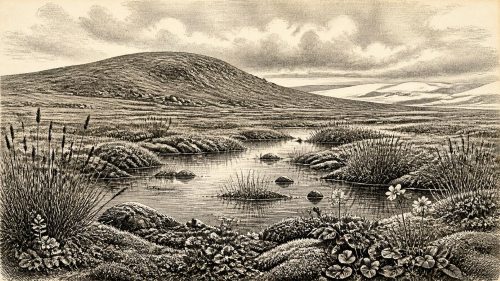
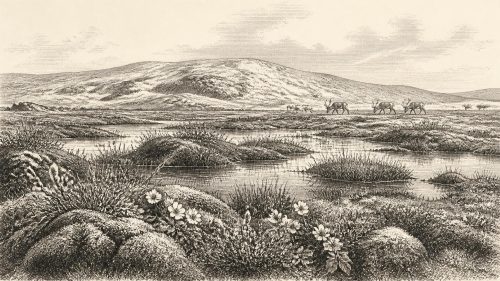
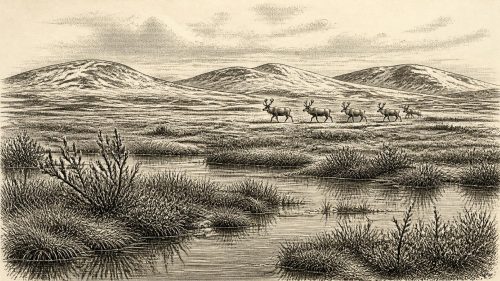
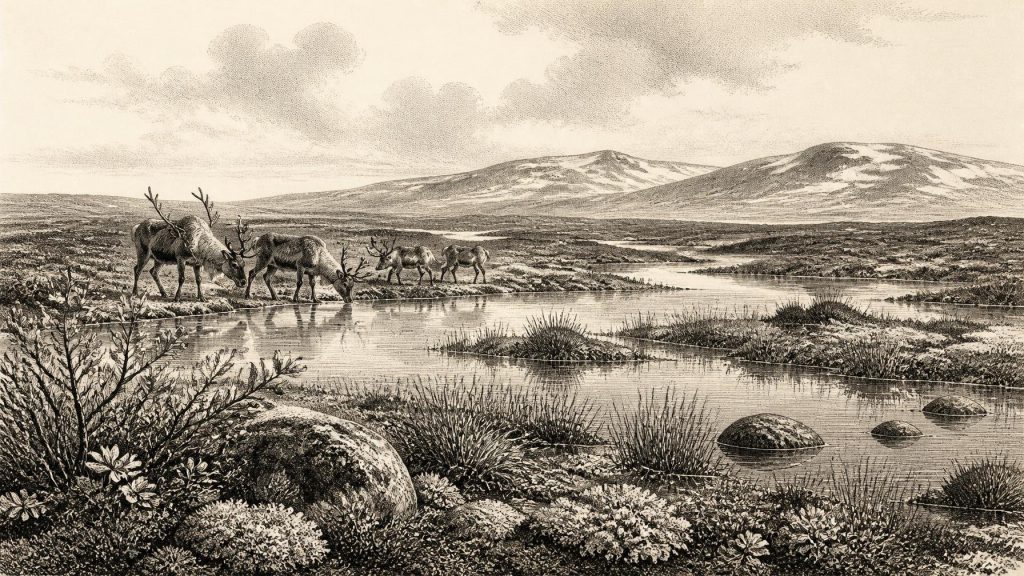
The biological remains make that conclusion vivid. Pollen, plant macrofossils and insect evidence indicate open, treeless tundra or muskeg rather than closed forest. Grasses, sedges, herbs, mosses and low shrubs grew around shallow pools and wet ground. Fossil records include bogbean, dwarf willow, mountain avens and water-milfoil. Their combination points to a mosaic of wet channels, plant-rich pools and drier exposed patches, subject to hard frosts, seasonal freezing and a short growing season. “Tundra” should not suggest a lifeless desert. In summer, water and vegetation could support insects and provide food for grazing animals; in winter, the same terrain would have been difficult, exposed and intensely cold.
Animals in the Cork Caves
County Cork offers a different but complementary archive. Castlepook Cave, near Doneraile in the Awbeg valley, has yielded Ireland’s richest known assemblage of vertebrate remains from the period before the Last Glacial Maximum. More than 2,000 bones recovered from its galleries represent animals that reached Ireland during a long interval broadly dated from about 45,700 to 19,950 radiocarbon years BP. The collection includes woolly mammoth, giant deer, reindeer, brown bear and spotted hyena. These are not all evidence for one moment, one climate phase or one local herd. They nevertheless establish that Ireland could at times form part of a wider north-west European world of large herbivores and predators.
The cave is especially revealing about the limitations of the evidence. Cave deposits may accumulate through carnivores dragging prey or scavenged portions underground, animals dying naturally, water movement, collapse and disturbance by nineteenth- and early twentieth-century excavators. A bone in a cave does not prove that the cave was a hunting camp, still less a settlement. Individual specimens have also been re-dated as scientific methods improved, underlining why older results require caution. Castlepook provides a faunal archive, but its mixture of ages and deposition histories makes simple stories unsafe.
One object has made Castlepook central to discussion of Ireland’s deepest human past: a reindeer femur bearing a deep mark interpreted by zooarchaeologist Ruth Carden as having been made by a sharp stone tool while the carcass was processed. County Cork heritage material places the bone broadly around 31,000 BCE. If the interpretation is confirmed and the modification is contemporary with the animal’s death, it would be Ireland’s earliest known indication of human activity, vastly earlier than the island’s well-established late-glacial archaeological record.
That conditional language matters. The bone is powerful evidence for a possible act of butchery, not secure evidence for a resident population. No associated stone-tool assemblage, hearth, occupation surface, structure, burial or securely grouped food refuse has yet been recovered for Ireland at this age. The radiocarbon result dates the animal bone, while identifying a surface scar as a human-made cut is a separate taphonomic judgement. The most responsible conclusion is modest but important: people may have reached or used Ireland during a favourable Late Pleistocene interval, but the scale, frequency, route and duration of any presence remain unknown.
People Without a Polity
There can be no meaningful account of Irish political affairs, diplomacy or institutions for 31,513 BCE. There are no named leaders, territories, alliances or boundaries, and no evidence for a kingdom, tribe or nation that can responsibly be connected with later Irish identities. Even if the marked reindeer femur records human butchery, it does not identify the people involved. It cannot decide whether they were a small travelling party, occasional visitors following game, or members of a more sustained but archaeologically invisible population.
Conflict is equally beyond the evidence. Predation certainly shaped the landscape: spotted hyenas, wolves and other carnivores competed for animal carcasses and sometimes used caves as dens or refuges. But competition among animals is not evidence of human warfare. Nor is there evidence for organised hunting drives, weapons, ritual violence or territorial defence in Ireland itself. European Upper Palaeolithic communities elsewhere demonstrate the technological and social capacities of Homo sapiens in this broad era, yet comparisons cannot be substituted for Irish finds.
If people were present, everyday life would have depended on mobility, close knowledge of weather, animal movements, fuel and sheltered ground. Reindeer, giant deer and other herbivores could have provided meat, hides, sinew, bone and antler, while wetland plants and small animals may have supplemented a seasonal diet. This is an inference from the environmental setting and wider hunter-gatherer practice, not direct evidence of an Irish camp. Ireland has yielded neither houses nor hearths of this age. It is safer to picture a demanding landscape offering temporary opportunities than to imagine a settled Ice Age village.
Culture, Belief and Connection
Nothing from Ireland around this horizon permits a direct reconstruction of religion, language, art or formal learning. No figurative art, personal ornament, grave, ceremonial site or inscribed object can be tied securely to this period. The cut-marked reindeer bone, if humanly modified, would attest practical skill with a sharp stone edge; it does not disclose a belief system. Likewise, the presence of game animals does not demonstrate the hunting rituals known or proposed elsewhere in Ice Age Europe.
Trade is also untraceable. There is no imported material, exchange network or quarry-to-site trail securely attributable to this date in Ireland. Any human arrival would, however, have required connection with landscapes beyond the island. Lower sea levels altered coastlines, but water crossings, changing ice barriers and the geography of the Irish Sea cannot be reduced to a simple permanent land bridge. A crossing may have been possible only at particular times and by particular routes; no direct evidence presently identifies how people or animals entered Ireland during MIS 3.
A Changing Island
The enduring story of this period is environmental change. Derryvree records a cold wetland flourishing between advances of ice. Castlepook records a succession of animals whose remains survived through accident, carnivore behaviour and cave preservation. Together they show that pre-Last Glacial Maximum Ireland had varied habitats and a more complex ecological history than an image of uninterrupted glaciation allows. They also explain the gaps in the record: later ice was capable of removing camps, soils and exposed bone deposits across wide areas.
For that reason, 31,513 BCE should be treated not as a date with a named Irish event, but as a window onto a fragile archive. Beneath a Fermanagh drumlin, plants from an open wetland survived. In north Cork caves, bones preserve evidence of animals—and perhaps a single human action—within a changing Ice Age landscape. Future excavation, improved radiocarbon pretreatment, microscopic analysis of bone surfaces and new sediment studies may refine this picture. For now, the evidence supports an Ireland of tundra wetlands, roaming megafauna, predators and profound uncertainty, poised long before the ice sheet’s later maximum reshaped the island.
Source References
Hover over a number to see the source. Select it to open the source.

- [1] Castlepook Cave, County Geological Site Report
- [2] Heritage Artefacts of County Cork
- [3] A Reconsideration of the Radiocarbon Dating of the Marine Isotope Stage 3 Fauna from Southern Ireland
- [4] The Irish Quaternary Fauna Project
- [5] Irish Pleistocene Biostratigraphy
- [6] New Insights on the Fauna of Ireland's Younger Dryas and Early Holocene from Alice & Gwendoline Cave
- [7] Spotted Hyena Skull
- [8] Menyanthes trifoliata
- [9] Salix herbacea
- [10] Dryas octopetala
- [11] Myriophyllum alterniflorum
- [12] The IntCal20 Northern Hemisphere Radiocarbon Age Calibration Curve (0–55 cal kBP)
- [13] Growth and Retreat of the Last British–Irish Ice Sheet, 31,000 to 15,000 Years Ago: the BRITICE-CHRONO Reconstruction
- [14] Pattern and Timing of Retreat of the Last British-Irish Ice Sheet
- [15] Maximum Extent and Dynamic Behaviour of the Last British–Irish Ice Sheet West of Ireland
- [16] Dimensions and Chronology of the Last Ice Sheet in Western Ireland
- [17] Oscillating Retreat of the Last British-Irish Ice Sheet on the Continental Shelf Offshore Galway Bay, Western Ireland
- [18] The Problem of a Late Quaternary Landbridge Between Britain and Ireland
- [19] The Island of Ireland: Drowning the Myth of an Irish Land-Bridge?
- [20] The Antiquity of Man in Ireland
- [21] Trimlines, Blockfields and the Vertical Extent of the Last Ice Sheet in Southern Ireland
Primary Sources
- Castlepook Cave, County Geological Site Report
- Heritage Artefacts of County Cork
- A Reconsideration of the Radiocarbon Dating of the Marine Isotope Stage 3 Fauna from Southern Ireland
- The Irish Quaternary Fauna Project
- Irish Pleistocene Biostratigraphy
- New Insights on the Fauna of Ireland's Younger Dryas and Early Holocene from Alice & Gwendoline Cave
- Spotted Hyena Skull
- Menyanthes trifoliata
- Salix herbacea
- Dryas octopetala
- Myriophyllum alterniflorum
- The IntCal20 Northern Hemisphere Radiocarbon Age Calibration Curve (0–55 cal kBP)
- Growth and Retreat of the Last British–Irish Ice Sheet, 31,000 to 15,000 Years Ago: the BRITICE-CHRONO Reconstruction
- Pattern and Timing of Retreat of the Last British-Irish Ice Sheet
- Maximum Extent and Dynamic Behaviour of the Last British–Irish Ice Sheet West of Ireland
- Dimensions and Chronology of the Last Ice Sheet in Western Ireland
- Oscillating Retreat of the Last British-Irish Ice Sheet on the Continental Shelf Offshore Galway Bay, Western Ireland
- The Problem of a Late Quaternary Landbridge Between Britain and Ireland
- The Island of Ireland: Drowning the Myth of an Irish Land-Bridge?
- The Antiquity of Man in Ireland
- Trimlines, Blockfields and the Vertical Extent of the Last Ice Sheet in Southern Ireland