Derryvree’s Mountain-Avens Basin31095 BCE
Around 31,095 BCE, Ireland was in the climatically unstable Late Pleistocene, not an era of documented events or settled communities. Derryvree, County Fermanagh, preserves freshwater sediments between glacial tills, dated broadly to 36,900–31,700 calibrated years BP. Its plants, pollen and insects reveal a treeless periglacial wetland with mountain-avens, sedges, aquatic vegetation and severe seasonal conditions. Castlepook Cave, County Cork, contains Ice Age fauna including mammoth, reindeer, giant deer, hyaena and lemmings, indicating ecological links with north-west Europe. A possibly cut-marked reindeer bone suggests, but cannot prove, brief human activity. Subsequent ice expansion across Ireland reshaped landscapes, habitats and surviving evidence.

Dateline
The label 31,095 BCE gives a useful point of reference, but it cannot identify a witnessed Irish event, ruler, community or season. This was the Late Pleistocene, tens of millennia before writing, farming or durable settlement evidence in Ireland. Modern calendar-year precision is not available for this period: the relevant dates are radiocarbon determinations calibrated into broad probability ranges. The year falls roughly 33,000 calendar years before AD 1950, within Marine Isotope Stage 3, a climatically unstable part of the last glacial cycle. What can responsibly be said comes from sediments, pollen, plant remains, insects, animal bones and the changing record of ice.
A Date Within a Range
The closest unusually detailed Irish archive is at Derryvree, near Maguiresbridge in County Fermanagh. Road construction in 1969 cut through a drumlin and exposed fine sands, freshwater silts and organic mud trapped between two thick deposits of glacial till. The sequence establishes a clear relative order: glacier ice had deposited one till; an ice-free freshwater environment subsequently developed; later ice laid down another till above it.
The organic horizon produced the conventional radiocarbon determination BIRM-166, 30,500 radiocarbon years BP, with a large published uncertainty. Using modern calibration, it has been placed broadly at about 36,900–31,700 calibrated years BP. The notional date of 31,095 BCE sits within that long interval, but it is not a date for the formation of the whole deposit, let alone a particular day in its history. Radiocarbon years and calendar years are not interchangeable, and calibration curves themselves are regularly refined. Derryvree is therefore evidence for conditions across a substantial span of time, not a time capsule stamped with one modern year.
The deposit is nevertheless exceptionally important. It demonstrates that this part of northern Ireland was not continuously covered by glacier ice during the interval represented by its freshwater sediments. It also supplies a rare, material record of the living landscape before the later growth of the British–Irish Ice Sheet transformed much of the island.
Wet Ground Beneath a Drumlin
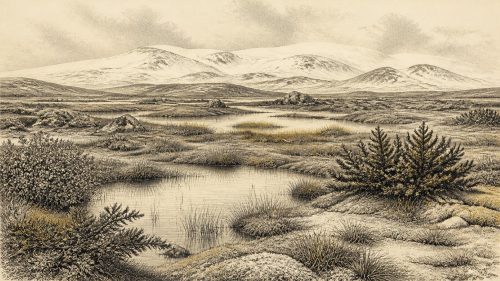
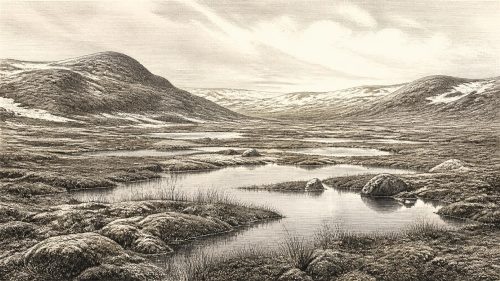
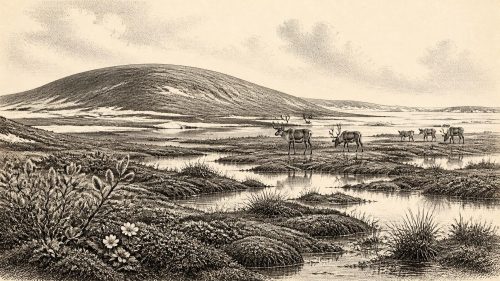
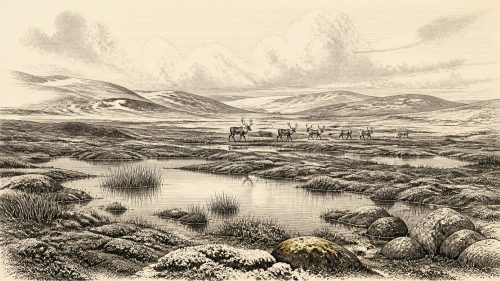
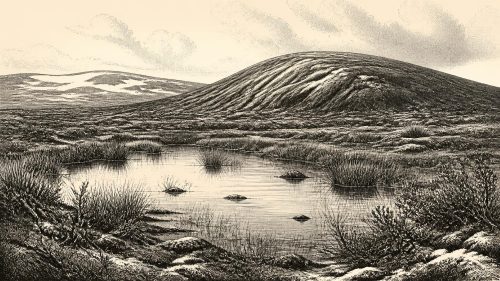
Derryvree was not forested Ireland. Pollen, plant macrofossils, mosses and insect remains point instead to an open, treeless, periglacial environment: cold ground affected by freezing and thawing, with wet hollows, shallow pools and mossy or sedge-rich margins. The flora included grasses and sedges alongside plants associated with Arctic or alpine settings, notably mountain-avens (Dryas octopetala), dwarf willow, alpine clubmoss and bogbean. Water-milfoil and other aquatic remains indicate standing or slow-moving fresh water.
This combination matters. It rules out both a simple image of an unbroken ice sheet and the equally misleading picture of a mild, wooded refuge. Around the time represented by the deposit, at least one Fermanagh basin supported a cold freshwater mosaic: open water, saturated ground, low vegetation and exposed mineral soils. Summers may have allowed a brief but real burst of plant growth; winters were severe enough for periglacial processes to disturb soils and restrict trees.
That conclusion must not be extended mechanically to every valley and coast. Derryvree is a local archive. County Fermanagh’s sheltered hollows, limestone geology and drainage differed from the uplands, Atlantic margins and southern lowlands. Yet its evidence is a vital correction to older generalisations about an empty, uniformly frozen Ireland. This was a country in which habitats could exist between episodes of glaciation, but where those habitats were vulnerable to climatic reversal.
Animals in the Cork Caves
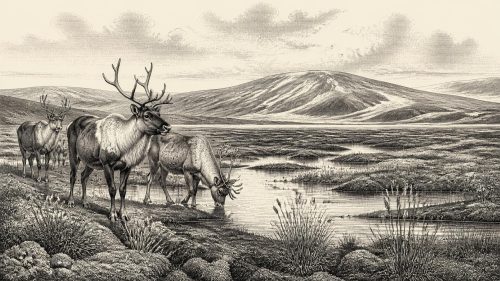
The broader animal world is most vividly represented at Castlepook Cave, also known as Mammoth Cave, in the Awbeg valley near Doneraile in north County Cork. The cave deposits and collections include remains of woolly mammoth, reindeer, giant deer, brown bear, wolf, Arctic fox, mountain hare, collared lemming, Norwegian lemming and spotted hyaena. This is not a single herd frozen in time. The bones derive from deposits accumulated over a long period, and much of the material was collected during early twentieth-century excavations, before the detailed stratigraphic recording expected today.
Even so, the fauna confirms that Ireland participated in the wider north-west European Ice Age animal world. Reindeer and lemmings imply cold, open habitats; wolves and foxes were predators and scavengers within that landscape; hyaena remains show that the cave could also have functioned as a carnivore den. Large mammals did reach the island or the landmass that would become Ireland. Their presence is direct evidence of ecological connection, though it does not reveal one simple route of arrival. Lower sea levels exposed more continental shelf than exists today, but the exact pattern of coastlines, water, seasonal ice and possible passages changed through time. It is unsafe to turn this into a claim of a permanent land bridge or an easy road from Britain or continental Europe.
The animal record also cautions against treating the Ice Age as a uniform age of extinction. The abundance and composition of fossils varied sharply with climate and preservation. A cave is especially selective evidence: animals may have died there, been carried in by predators, or entered through other natural processes. Castlepook tells us that a distinctive fauna was present in southern Ireland during the wider cold-stage interval; it does not provide a complete census of Irish wildlife in 31,095 BCE.
The Reindeer-Bone Question
Castlepook is also central to the question of people. A fragment of reindeer femur has been reported as about 33,000 years old and as carrying a deep incision interpreted by zooarchaeologist Ruth Carden as a cut made with a sharp stone tool during butchery. If that interpretation is sustained, it is potentially the earliest evidence of human activity in Ireland, far earlier than the securely established Mesolithic settlement of the island after the final retreat of the ice.
The conditional language is essential. The radiocarbon result dates the animal bone, not an exact moment when a mark was made. Identifying the incision as a stone-tool cut is a taphonomic judgement made from the bone surface; carnivore damage, trampling, sediment movement, excavation disturbance and later handling must all be considered. Nor has Castlepook yielded a securely associated hearth, stone-tool assemblage, dwelling floor, burial, occupation surface or group of repeatedly butchered animals from this age.
Accordingly, the bone cannot demonstrate a settled population, continuous occupation, a named people, language, ancestry or migration route. At most, and importantly, it raises the possibility that mobile Upper Palaeolithic hunter-gatherers briefly reached Ireland and processed a reindeer carcass. Such visitors may have been hunting, scavenging or moving through a much wider north-west European range. That is a plausible interpretation, not an established narrative. The National Museum of Ireland’s more cautious summary still notes that no clear Palaeolithic human presence has yet been demonstrated.
Society Without a Settlement Record
There is no responsible basis for describing political affairs, diplomacy, warfare, chiefs or territories in Ireland at this date. No settlement, communal structure, weapon assemblage or human burial is securely known from the relevant interval. There is likewise no evidence for agriculture, livestock, pottery, metallurgy, monuments, formal shrines, writing, schools, markets or long-distance trade based in Ireland.
If people did visit, their everyday life would have depended on mobility, weather, freshwater, animal behaviour and access to fuel and shelter. The reported cut mark suggests carcass processing with a sharp implement, not a village economy. It cannot tell us how many people were present, whether they hunted the animal, how long they stayed, what they believed, or whether they returned. In this context, absence of evidence is not proof that every human activity was absent: later ice, erosion and rising seas have removed, buried or submerged many potential traces. But possibilities must not be written as facts.
Religion and culture are similarly beyond recovery. Cave use by carnivores is evidenced at Castlepook; ritual cave use by humans is not. The people who may have passed through were biologically modern humans living in an Upper Palaeolithic Europe rich in technologies, social relationships and symbolic practices, but no Irish object of this date demonstrates which traditions, if any, reached the island. Ireland’s cultural history here is consequently a history of evidence rather than identity: a marked bone, uncertain in implication, beside a rich but non-human fossil assemblage.
Iceward Change
The principal development around this notional year was environmental. Derryvree records a cold wetland between glacial episodes; Castlepook records animals adapted to a variable open landscape; wider ice-sheet research shows that the best-established Last Glacial Maximum lay later, broadly after this period. Ice subsequently expanded across much of Ireland and the surrounding shelf, scouring terrain, redirecting drainage and entombing older deposits beneath till.
That advance had historical consequences even though it had no human chronicler. It contracted habitable ground, disrupted animal ranges and made any occasional human presence exceptionally precarious. It also shaped the archive available today: the Derryvree mud survived because later ice buried it, while the later remodelling of the landscape may have destroyed many other traces. For 31,095 BCE, then, Ireland’s story is not of kingdoms or founding ancestors. It is the story of a mountain-avens and bogbean wetland beneath a future drumlin, Ice Age animals in a Cork limestone cave, and one contested reindeer incision that may preserve a fleeting human act.
Primary Sources
- A Middle Midlandian Freshwater Series at Derryvree, Maguiresbridge, County Fermanagh, Northern Ireland
- Palaeoecology: Irish Quaternary Association Field Guide No. 16
- Trimlines, Blockfields and the Vertical Extent of the Last Ice Sheet in Southern Ireland
- Exploring the Chronology of the Last British-Irish Ice Sheet: A Review of Previous Dating Attempts and New Constraints
- Growth and Retreat of the Last British–Irish Ice Sheet, 31,000 to 15,000 Years Ago: The BRITICE-CHRONO Reconstruction
- Timing, Pace and Controls on Ice Sheet Retreat: An Introduction to the BRITICE-CHRONO Transect Reconstructions of the British–Irish Ice Sheet
- The Timing and Magnitude of the British–Irish Ice Sheet Between Marine Isotope Stages 5d and 2
- Pattern and Timing of Retreat of the Last British-Irish Ice Sheet
- Dimensions and Chronology of the Last Ice Sheet in Western Ireland
- The IntCal20 Northern Hemisphere Radiocarbon Age Calibration Curve (0–55 cal kBP)
- Aghnadarragh ASSI
- Irish Pleistocene Biostratigraphy
- Proceedings: Postglacial Colonisation Conference
- Dryas octopetala
- Archaeological Heritage of County Cork
- Prehistoric Details
- Learn About: The Ice Age
- Ice Age Ireland: Cool Fossils!
- Spotted Hyena Skull
- The Mesolithic in Ireland: When Was It?
- Anthropogenic Changes to the Holocene Nitrogen Cycle in Ireland
- What Was on the Menu in Prehistoric Ireland?
- Introduction: The Irish Stone Age