
Derryvree’s Mountain Avens31600 BCE
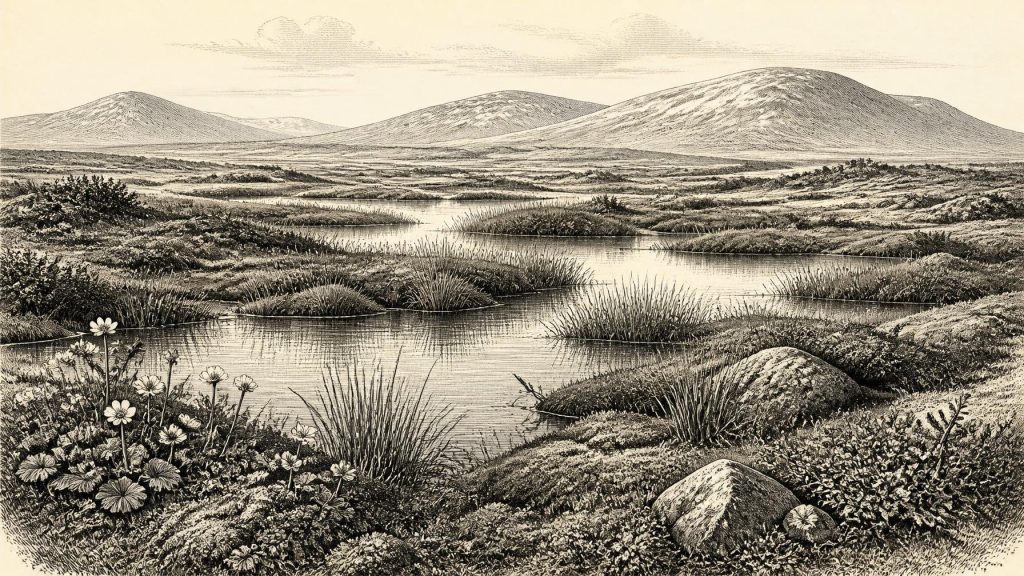
Around 31,600 BCE, a modern label within later Marine Isotope Stage 3, Ireland experienced fluctuating glacial conditions before the Last Glacial Maximum. Derryvree, County Fermanagh, preserves freshwater sediments between tills, showing cold, treeless wetlands with arctic-alpine plants including mountain avens during an ice-free interval. Castlepook Cave, County Cork, contains remains of mammoth, reindeer, giant deer, predators and other cold-adapted fauna, though complex deposits limit certainty. A cut-marked reindeer femur may indicate Upper Palaeolithic butchery, but provides no proof of settlement. Ireland’s evidence chiefly records changing ice, habitats and animals; human presence at this remote date remains possible, contested and uncorroborated.
Dateline
A Date Beyond the Calendar
“31,600 BCE” is a useful modern label, not a year that can be recovered from the Irish archaeological record. No written calendar existed, and no deposit, bone or landform can be assigned responsibly to that single year. In the conventional archaeological system, the date falls about 33,550 calendar years before present, where “present” is fixed at 1950. It belongs to the later part of Marine Isotope Stage 3 (MIS 3), within the last glacial period. Radiocarbon ages from this depth of time must be calibrated, and their ranges are often broad because atmospheric carbon changed markedly. The evidence can therefore illuminate Ireland across centuries or millennia around this point, but cannot narrate events on a particular day, season or year.
This was not yet the Ireland of farms, monuments, kingdoms or even securely demonstrated permanent human settlement. It was an Ice Age landscape in transition. The great Last Glacial Maximum, when the British–Irish Ice Sheet became most extensive, still lay ahead; modern reconstructions generally place its principal maximum later, roughly between 27,000 and 21,000 years ago. Yet ice was already an active and growing force in the wider region. Ireland’s geography, coastlines, habitats and possible routes of movement were changing with climate, ice build-up and sea level.
An Unstable Glacial Landscape
At this time Ireland was not uniformly buried beneath a single unbroken ice sheet. The record instead indicates marked regional variation and repeated environmental shifts. Recent work on the British–Irish Ice Sheet supports ice growth and dynamic advance–retreat behaviour before the full glacial maximum, while acknowledging that the precise extent of ice in particular Irish districts remains difficult to reconstruct. Some high ground and western or northern sectors may have supported ice caps or been affected by nearby ice margins, while other areas retained ice-free terrain for at least parts of MIS 3.
Lower global sea level altered the surrounding shelf, but it must not be turned automatically into a simple land bridge between Ireland and Britain or continental Europe. Ice loading, relative sea level, changing shorelines and the Irish Sea basin made local geography complicated. The important historical point is more modest: Ireland was part of a north-west European environmental zone whose animal populations and, potentially, small groups of people could move as conditions allowed. Any crossing would have depended on the particular configuration of land, water, weather and ice at the time, not on a permanently open route.
Derryvree’s Buried Wetland
The clearest Irish environmental evidence relevant to this broad period comes from Derryvree near Maguiresbridge in County Fermanagh. There, roadworks exposed freshwater silts and sands sealed between two layers of glacial till within a drumlin. The sequence is exceptionally important because its order records a profound alteration in local conditions: glacier ice deposited the lower till; a non-glacial freshwater environment subsequently developed; and later ice covered the deposit with upper till. It is evidence for an interval of open ground and water between glacial episodes, not a snapshot of all Ireland.
Organic material from Derryvree produced a radiocarbon determination of approximately 30,500 radiocarbon years before present. Modern calibration places the deposit broadly between about 36,900 and 31,700 calibrated years before present, a range which includes the modern label 31,600 BCE. Plant macrofossils, pollen and insect remains indicate a cold, treeless, periglacial setting. Mosses, sedges, grasses, herbs, dwarf shrubs and arctic-alpine plants belonged to a wet, open landscape sometimes described as muskeg: waterlogged ground with pools, abundant plant matter and mossy margins.
That evidence is stronger than a picturesque reconstruction of a frozen wilderness. Derryvree does not show a forest, a settled village, cultivated fields or domesticated animals. It indicates freshwater habitats amid cold open vegetation. The presence of such plants as mountain avens among the macrofossils underscores the arctic-alpine character of the flora. Seasonal snow, frozen ground and severe winters are reasonable inferences; exact temperatures, annual snowfall and the appearance of any individual valley are not.
Castlepook and the Animal World
Far to the south-west, Castlepook Cave near Doneraile in north County Cork provides the principal Irish archive for Ice Age mammals of comparable antiquity. Excavations begun by Richard J. Ussher in the early twentieth century recovered a striking mixture of animal remains from the cave system: woolly mammoth, reindeer, giant deer, brown bear, wolf, fox, mountain hare, lemmings and spotted hyaena have all been reported. The assemblage makes Ireland’s later MIS 3 fauna appear considerably richer than the familiar post-glacial island fauna.
Its meaning nevertheless requires care. Castlepook was excavated long before modern excavation standards, its deposits were complex, and bones could have been moved by water, scavengers or carnivores. The cave was evidently used by animals as much as, or more than, by people. Spotted hyaenas could carry and accumulate bones in dens; tooth damage and mixed contexts make it hazardous to treat every specimen as evidence of a living herd outside the cave at one moment. Improved ultrafiltration and radiocarbon pretreatment have also shown that several earlier cave-bone dates from southern Ireland were substantially too young. Re-dating has placed parts of the Castlepook fauna firmly in MIS 3 and suggests that giant deer and spotted hyaena may have disappeared locally before the Last Glacial Maximum.
The ecological picture is nonetheless substantial. Reindeer and lemmings are consistent with cold, open habitats; mammoth, giant deer, wolves and hyaenas point to a landscape capable, at intervals, of sustaining large herbivores and their predators. It was not necessarily a uniform “mammoth steppe” across the island. Rather, the most defensible interpretation is a shifting mosaic of open ground, wetlands, exposed mineral soils, sheltered limestone country and changing grazing. Animal ranges would have expanded, contracted and moved seasonally as climate and snow cover changed.
A Single Mark and a Large Claim
A reindeer femur from the Castlepook collection has become especially significant because Ruth Carden identified a deep incision interpreted as a cut mark made by a sharp stone tool during butchery. County Cork’s heritage publication presents the specimen as dating to about 31,000 BCE. If that interpretation is sustained, it would be an extraordinarily early indication that Upper Palaeolithic people processed a reindeer in Ireland, perhaps within the broad period represented by this article.
It remains a narrow piece of evidence, rather than proof of an inhabited Ice Age Ireland. A radiocarbon date on the bone dates the animal’s death within a statistical range, not the precise instant of cutting, the location where it was killed, or the duration of any human visit. No securely associated stone toolkit, hearth, dwelling floor, burial, art or repeated domestic rubbish has been recovered from Castlepook. A 2022 excavation found surviving cave sediments but no cultural artefacts. The National Museum of Ireland accordingly continues to state that no clear evidence has emerged for human presence in Ireland during the Palaeolithic. That institutional caution is important: the Doneraile femur is a consequential, contested proxy for activity, not a basis for inventing a settled population.
Society Beyond Recovery
There is no evidence from Ireland around 31,600 BCE for political communities, rulers, warfare between human groups, diplomacy, formal religion, named languages, learning institutions or long-distance trade networks. Nor can archaeologists identify households, gender roles, kinship systems or seasonal camps on the basis of a single possible butchery mark. These absences are not proof that a brief human party could not have arrived; they are limits on what the evidence can responsibly say.
If people did reach Ireland during this interval, comparison with contemporary Upper Palaeolithic communities elsewhere in north-west Europe suggests small, mobile hunter-gatherer groups rather than agricultural settlers. Reindeer could have supplied meat, hides, sinews, bone and antler, and stone-edged tools would have been crucial for carcass processing. But this is comparative context, not direct Irish evidence. It cannot establish the tools carried, the route taken, whether the animal was hunted or scavenged, or whether the visitors stayed for hours, weeks or generations.
An Island Before Its Human History
The most important development around this nominal year was environmental possibility rather than a recorded human event. Ireland contained, or was reachable by, cold-adapted animals during a period of severe climatic oscillation before the full expansion of the last ice sheet. Derryvree preserves a northern freshwater tundra environment; Castlepook preserves a southern cave archive of large mammals and carnivore activity; the reindeer femur raises the possibility of a fleeting human encounter with that world.
That is a compelling beginning, but not yet an origin story. The responsible history of Ireland at 31,600 BCE is one of calibrated ranges, buried wetlands, cave bones and uncertainty. The evidence reveals an island repeatedly reshaped by ice and inhabited by animals adapted to open, cold country. Whether people briefly stood among them remains an important question posed by one marked bone, awaiting corroboration from securely excavated artefacts and contexts.
Primary Sources
- A Middle Midlandian Freshwater Series at Derryvree, Maguiresbridge, County Fermanagh, Northern Ireland
- A Reconsideration of the Radiocarbon Dating of the Marine Isotope Stage 3 Fauna from Southern Ireland
- The Irish Quaternary Fauna Project
- New Insights on the Fauna of Ireland's Younger Dryas and Early Holocene Caves
- The Subdivision of the Quaternary Period in Ireland
- ESCR Site Summary: Quaternary of Northern Ireland
- Dryas octopetala
- Prehistoric Details
- Heritage Artefacts of County Cork
- 2022:564 — Castlepook Cave, Castlepook South, Cork
- Extent and Timing of the Last Glacial Maximum (LGM) in Britain and Ireland: A Review
- Pattern and Timing of Retreat of the Last British-Irish Ice Sheet
- Growth and Retreat of the Last British–Irish Ice Sheet, 31,000 to 15,000 Years Ago: The BRITICE-CHRONO Reconstruction
- The Timing and Magnitude of the British–Irish Ice Sheet Between Marine Isotope Stages 5d and 2
- Behavioural Tendencies of the Last British–Irish Ice Sheet Revealed by Data–Model Comparison
- Last Glacial Maximum Cirque Glaciation in Ireland and Implications for Reconstructions of the Irish Ice Sheet
- Maximum Extent and Dynamic Behaviour of the Last British–Irish Ice Sheet West of Ireland
- The IntCal20 Northern Hemisphere Radiocarbon Age Calibration Curve (0–55 cal kBP)
- IntCal Publications
- Pleistocene Vertebrates in the British Isles
- Irish Caves Database: Mammoth Cave
- Reindeer Bone Found in Cork Cave Shows Human Activity in Ireland 33,000 Years Ago