Castlepook Femur Reconsidered31305 BCE
Circa 31,305 BCE, Ireland lay within the unstable, cold later MIS 3, not a recoverable historical year. Derryvree in Fermanagh preserves freshwater and organic sediments between glacial tills, indicating locally ice-free, tundra-like wetlands during a broadly dated interval. Castlepook Cave in Cork yielded diverse Ice Age fauna, including mammoth, reindeer and predators, accumulated over many episodes. A marked reindeer femur may record butchery by Upper Palaeolithic people, potentially Ireland’s earliest human trace, but lacks secure context and precise dating. Evidence supports at most brief visits, not permanent settlement, trade, or later cultural identities, amid changing ice, water and sparse ecosystems.
Dateline
The label 31,305 BCE is a modern chronological convenience, not a year that can be recovered from Ireland’s prehistoric record. No calendar, written account, named ruler or datable event existed on the island. In conventional archaeological arithmetic, it falls about 33,254 years before AD 1950, the reference point used for “before present” (BP). Yet evidence of this age is expressed in broad calibrated ranges, frequently with substantial uncertainty, rather than in single calendar years. The responsible subject is therefore Ireland during the later part of Marine Isotope Stage 3 (MIS 3), a cold, unstable interval of the Late Pleistocene broadly dated c. 57,000–29,000 years ago.
At this depth of time, Ireland’s story is principally environmental. It survives in cave bones, freshwater muds, pollen, mosses, insects, mineral deposits and glacial sediments. Those materials can establish that particular animals lived in or reached the island, that water lay in a basin, or that ice later crossed a landscape. They cannot furnish a continuous narrative of settlement. Ireland around the notional date was not a country of tribes, territories, diplomacy or monuments in the historical sense. If people arrived, the present evidence suggests fleeting activity on a difficult north-western fringe of Upper Palaeolithic Europe, not an enduring population whose political or cultural institutions can be described.
A Date Within a Range
The best Irish environmental sequence close to this point comes from Derryvree near Maguiresbridge, County Fermanagh. Roadworks in 1969 cut through a drumlin and revealed fine sands, silts and organic mud between two tills: compact deposits left by separate phases of glacial activity. The organic horizon produced the radiocarbon determination BIRM-166, 30,500 ± 1,100 radiocarbon years BP. Later discussion using calibrated chronologies has placed it broadly within c. 36,900–31,700 calendar years BP. In BCE terms, that is approximately 34,950–29,750 BCE. The requested year lies inside this wide span, but cannot be singled out within it.
This distinction is more than technical. Radiocarbon years are not calendar years because atmospheric carbon-14 levels have varied through time. Calibration curves translate a measurement into probability ranges, and uncertainty grows markedly in the deep past. Moreover, BIRM-166 dates carbon within a deposit rather than a precisely observed moment when a named landscape existed. It nevertheless gives Derryvree exceptional value: it demonstrates that freshwater and organic sediments accumulated in part of Fermanagh during a cold middle-Midlandian interval before later ice sealed the evidence beneath glacial material.
Wet Ground Between the Ice
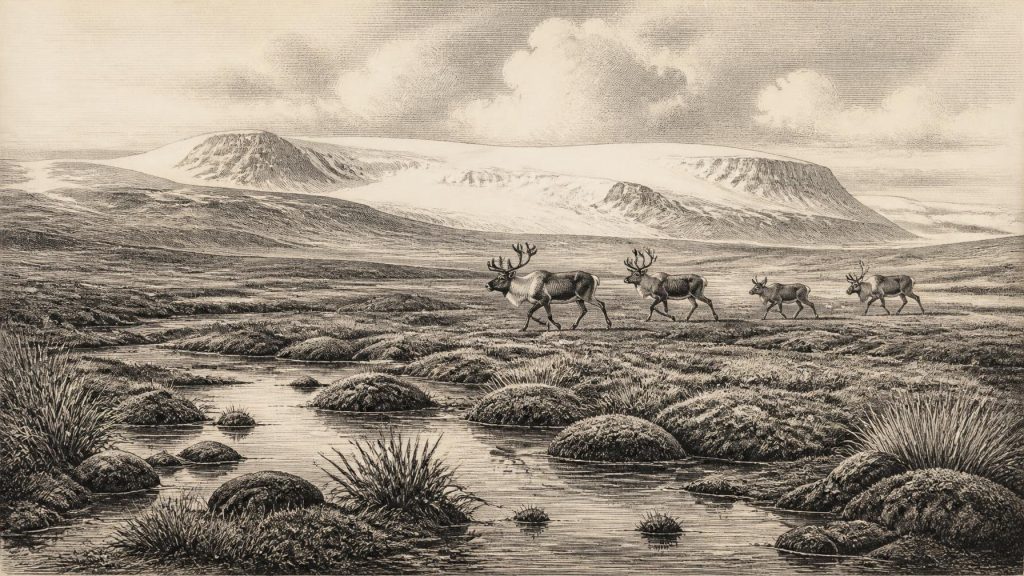
Derryvree was no verdant prehistoric homeland. Its plant and animal traces indicate a periglacial, largely treeless setting: open tundra-like vegetation, wet hollows, shallow or slow-moving freshwater, mossy ground and sparse herb-rich land beyond. Pollen was poorly preserved, but macrofossils and insect evidence included plants associated with cold conditions. Sedges and freshwater species show that some basins held water long enough to support aquatic and marginal vegetation. The evidence does not mean that every part of Ireland looked identical. It is a local record, and the island’s relief, coasts and ice margins created regional variation. But it decisively corrects any image of an island uniformly buried beneath ice or covered in modern-style woodland.
The climate was severe and variable. MIS 3 contained abrupt shifts recorded more widely in Atlantic and Greenland climate archives. In Ireland, the fragmentary terrestrial evidence means that short warmings and renewed cold cannot always be matched securely to particular decades or centuries. Still, Derryvree’s position between tills shows the larger sequence clearly: an earlier ice advance, an interval in which water and tundra biota occupied the locality, and a later advance that overrode or buried the ground. The landscape was not static. Ice and meltwater repeatedly altered drainage, soils and routes across the country.
At the scale of the island, the growth of the last Irish component of the British–Irish Ice Sheet remains an active research question. Some reconstructions infer that north-central Ireland remained ice-free until at least about 34,000 calendar years ago, while ice expanded greatly during the millennia that followed. Other evidence points to a complex, regionally asynchronous ice history around Ireland and Britain. It would be unsafe to claim that all Ireland was ice-free in 31,305 BCE, or that all of it was already ice-covered. What can be said is that a cold, partly ice-free landscape existed in Fermanagh within the broad dated interval represented at Derryvree, while major glaciation was becoming an increasingly important force in Ireland’s environmental future.
Castlepook’s Animal World
In north County Cork, Castlepook Cave near Doneraile provides the most striking faunal evidence for Ireland before the Last Glacial Maximum. Its older name, Mammoth Cave, reflects the remarkable collection made there by Richard J. Ussher and colleagues in the early twentieth century. The cave has yielded remains of woolly mammoth, reindeer, giant deer, brown bear, wolf, Arctic fox, hare, lemmings and spotted hyaena. Direct radiocarbon determinations from the broader assemblage span a long period, extending from more than 45,000 to roughly 20,000 radiocarbon years BP. These animals did not necessarily share the cave, valley or season at one time. Castlepook is an archive accumulated across many episodes, not a snapshot of one Ice Age day.
Even so, the fauna is powerful evidence for the ecological possibilities of Pleistocene Ireland. Reindeer are compatible with cold, open and often highly seasonal country. Lemmings and Arctic foxes reinforce the northern aspect of parts of the faunal record. Mammoths and giant deer show that, during favourable phases, extensive plant resources sustained large herbivores. Wolves and hyaenas indicate predators and scavengers able to exploit that prey base. Caves complicate the picture: carnivores can drag in bones, animals can die in cavities, water can move remains, and early excavation often disturbed or mixed deposits. Thus an animal bone proves presence or transport; it does not automatically prove hunting, a camp or a human meal.
The Reindeer Femur
One Castlepook reindeer femur fragment has made this period unusually important for Irish human history. Public reporting in 2021 described the bone as about 33,000 years old and identified deep marks interpreted by zooarchaeologist Ruth Carden as cuts or chops made on fresh bone with a stone implement during butchery. If that interpretation is sustained by further study, it would be the earliest known indication of human activity in Ireland, far earlier than the island’s well-attested Mesolithic settlement after the Ice Age.
The qualification matters. The relevant Castlepook deposits were excavated long before modern recording standards, and the femur is not presently accompanied by a securely stratified hearth, stone-tool assemblage, dwelling floor, human bone or burial of the same age. A radiocarbon measurement dates the animal’s death, not necessarily the instant a mark was made; recognising a cut mark also requires the exclusion of carnivore damage, sediment abrasion, breakage and excavation damage. Nor should a newspaper-style phrase such as “33,000 years old” be silently converted into the exact modern year 31,305 BCE. Without a fully published laboratory determination and calibrated interval for this particular specimen, annual equivalence would imply a precision the evidence does not possess.
People, If Present
If the Castlepook mark was made by people, the action it records was practical: the processing of a reindeer carcass. It may represent hunting, scavenging or the dismemberment of an animal obtained elsewhere. A single bone cannot decide between those possibilities. It does, however, make a short visit by Upper Palaeolithic hunter-gatherers conceivable. Such people elsewhere in north-west Europe used stone tools, moved through seasonally changing territories and maintained social links across much wider areas than any one camp. Ireland was then separated from Britain and continental Europe by sea, but sea levels were lower than today and the geography of the Irish Sea basin differed greatly. Reaching the island may have involved crossings across narrower water gaps, coastal movement or watercraft; Ireland’s evidence does not yet identify which.
No Irish evidence of this age reveals a community’s language, ancestry, population size, kinship rules, clothing, shelters, ornament, art, music or ritual. Nor are there grounds for projecting later Gaelic identities, “Celtic” culture, kingdoms or religious traditions into this world. The wider European Upper Palaeolithic demonstrates that humans were capable of elaborate symbolic behaviour, but that is comparison, not proof of Irish cave art or ceremony. There is likewise no evidence for political affairs, diplomacy, warfare, agriculture, markets, mining or regular overseas trade in Ireland around this time. Absence of evidence is not proof that no individual ever crossed the island; it is a firm limit on what can responsibly be reconstructed.
Economy Without Settlement
The only economy visible here is ecological and, at most, episodic subsistence. Reindeer, mammoth and other herbivores converted the sparse productivity of open ground into meat, fat, hide, bone and antler: resources valued by Upper Palaeolithic communities elsewhere. Yet no Irish tool kit, kill site or camp securely demonstrates their systematic exploitation at 31,305 BCE. “Trade” should not be used merely because people may have travelled. Exchange requires evidence for repeated movement of materials or goods between communities, and none has been identified in Ireland for this interval.
Settlement must be treated equally carefully. Derryvree documents a wetland environment; Castlepook documents a cave faunal archive and a possible act of butchery. Neither establishes a village, a permanent cave occupation or continuous habitation of the island. Ireland’s acid soils, later glaciation, coastal inundation and the limited survival of Pleistocene deposits have all reduced the chances of discovery. Future work in undisturbed cave sediments, offshore landscapes and buried terrestrial deposits may change the picture. For now, the most historically meaningful development is not the foundation of a society but the recognition that Ice Age Ireland was an ecologically inhabited frontier, and perhaps, briefly, a humanly visited one.
That is enough to make the period significant. Around the modernly numbered year 31,305 BCE, the Irish landscape was being shaped by cold, water and advancing ice; tundra wetlands survived in Fermanagh; large mammals ranged through suitable districts; and at Castlepook a reindeer bone may preserve the earliest trace of human hands on the island. The evidence is sparse, geographically separate and chronologically broad. Its power lies precisely in that restraint: not a lost Irish kingdom, but a rare glimpse of a changing Ice Age world from which later Ireland eventually emerged.
Primary Sources
- The Irish Quaternary Fauna Project
- The Irish Quaternary Fauna Project
- A Middle Midlandian Freshwater Series at Derryvree, Maguiresbridge, County Fermanagh, Northern Ireland
- Early Midlandian–Middle Midlandian, Pleistocene, Northern Ireland
- Palaeoecology
- Trimlines, Blockfields and the Vertical Extent of the Last Ice Sheet in Southern Ireland
- Growth and Retreat of the Last British–Irish Ice Sheet, 31,000 to 15,000 Years Ago: The BRITICE-CHRONO Reconstruction
- The Timing and Magnitude of the British–Irish Ice Sheet Between Marine Isotope Stages 5d and 2
- British–Irish Ice Sheet and Polar Front History of the Goban Spur, Offshore Southwest Ireland Over the Last 250,000 Years
- Exploring Controls of the Early and Stepped Deglaciation on the Western Margin of the British Irish Ice Sheet
- First Evidence of a Late Upper Palaeolithic Human Presence in Ireland
- New Insights on the Fauna of Ireland's Younger Dryas and Early Holocene from Alice & Gwendoline Cave
- The IntCal20 Northern Hemisphere Radiocarbon Age Calibration Curve (0–55 cal kBP)
- The Earliest Evidence for Anatomically Modern Humans in Northwestern Europe
- Guide to the National Museum of Ireland
- The Archaeological Heritage of County Cork
- Our Ancient Landscapes: Hunter-Gatherers in Ireland
- Archaeological Excavations at Killuragh Cave, Co. Limerick: A Persistent Place in the Landscape from the Early Mesolithic to the Late Bronze Age
- Ireland's Palaeolithic Archaeology – Fleeting Footprints in a Frozen Land
- What Was on the Menu in Prehistoric Ireland?
- Reindeer Bone Found in Cork Cave Shows Human Activity in Ireland 33,000 Years Ago
- The Tolsta Interstadial, Scotland: Correlation with D–O Cycles GI-8 to GI-5?