
The Castlepook Faunal Puzzle31304 BCE
31,304 BCE is a retrospective label for a Late Pleistocene, MIS 3 period, not a recoverable Irish year. Castlepook Cave, County Cork, preserves a valuable but disturbed pre-Last Glacial Maximum fauna, including reindeer, mammoth, giant deer, carnivores, hares and lemmings, indicating cold, open, variable habitats and wider ecological connections. Revised radiocarbon dating places key animals earlier than initial results suggested, without establishing an event in that year. A marked reindeer femur may indicate Upper Palaeolithic butchery, yet mixed deposits and absent associated artefacts preclude claims of settlement. Ireland’s ice extent, routes and human presence remain uncertain; environmental change defined life.
Dateline
31,304 BCE is a modern, retrospective label, not a year that can be recovered from an Irish record. There was no written calendar in Ireland, no named ruler, settlement register or annual chronicle. Even the scientific dates relevant to this era are ranges, derived from radiocarbon measurements, stratigraphy and other environmental methods, then calibrated against changing atmospheric carbon. The point designated here falls broadly within the Late Pleistocene and Marine Isotope Stage 3 (MIS 3), a long, climatically unstable phase of the last Ice Age. It can illuminate an Ireland of ice, exposed ground, caves and animals; it cannot responsibly yield a year-specific political event or a biography.
The most important Irish evidence for this deep period is concentrated in a small number of difficult archives, especially cave bone collections. Castlepook Cave near Doneraile, County Cork, is central because it has produced one of Ireland’s richest assemblages of pre-Last Glacial Maximum animal remains. Yet it is also a warning against easy narratives. Much of the material was excavated between 1904 and 1913, before modern standards of recording, sediment analysis and sampling. Bones from different episodes could have been disturbed, moved or accumulated together. Castlepook is therefore extraordinarily valuable, but it cannot be treated as a neatly sealed snapshot of one afternoon, one herd, or one exact year.
A Date Without an Anniversary
A simple conversion places 31,304 BCE roughly 33,250 years before the conventional radiocarbon ‘present’ of 1950. That arithmetic should not be confused with a calibrated archaeological date. A radiocarbon age of about 33,000 years BP is not identical to 33,000 calendar years before 1950, because the concentration of atmospheric radiocarbon has varied over time. For periods this remote, calibration intervals can be broad, and laboratories express results with statistical uncertainty. The sensible historical frame is thus not ‘Ireland in the precise year 31,304 BCE’, but Ireland sometime around the later part of MIS 3, approximately 45,000–30,000 years ago in the wider chronology used by Irish Quaternary research.
This distinction matters greatly at Castlepook. An early radiocarbon measurement on a woolly mammoth femur gave 33,500 ± 1,200 radiocarbon years BP. Later programmes, using improved bone pretreatment and accelerator dating, re-examined the chronology of the cave fauna. Their results showed that several earlier determinations had made specimens appear substantially younger than they were. The revised work places important Castlepook animals firmly in MIS 3 and indicates that some species may have disappeared locally before the Last Glacial Maximum. It does not create a precise event dated to 31,304 BCE.
Animals at the Edge of Ice
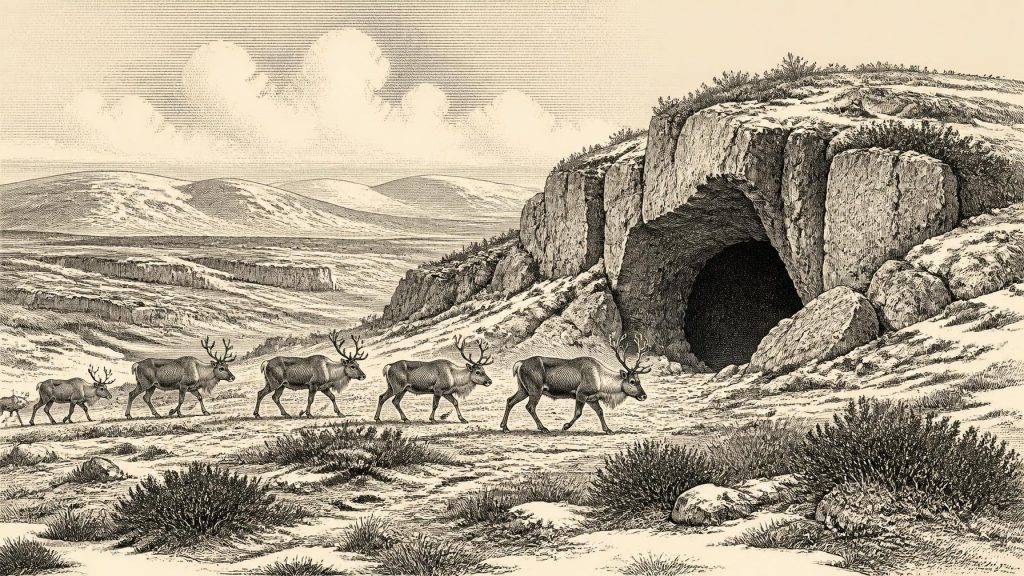
What Castlepook does demonstrate is that southern Ireland supported, or was reached by, a striking Pleistocene fauna during parts of MIS 3. The cave collection includes remains attributed to reindeer, woolly mammoth, giant deer, brown bear, wolf, Arctic fox, mountain hare, lemmings and spotted hyaena. Such a list immediately rules out any image of a modern green, wooded Ireland. Reindeer, Arctic fox and lemmings are particularly strong indications of cold, open habitats; mammoth and hyaena likewise belong to a wider north-west European Ice-Age fauna quite unlike Ireland’s later historic animal communities.
That said, a species list is not a complete landscape painting. Cave assemblages are shaped by the behaviour of predators and scavengers, by animals using caves, by water and sediment movement, and by the choices of excavators. A hyaena might drag portions of prey into shelter; a bear might die during hibernation; floodwater might redeposit bone. Individual fossils prove presence or access to an area, not the size of a breeding population or the appearance of every valley in Ireland. The reasonable interpretation is a cold and largely open mosaic, with grassland, herb-rich ground, sparse shrub cover, exposed limestone and wet places varying with local relief and climatic oscillation. It is not evidence for a uniform, continent-wide ‘mammoth steppe’ across the island.
The creatures themselves imply ecological connections beyond Ireland. Reindeer, mammoth and hyaena did not evolve in isolated Cork caves. Their presence shows that routes existed by which large mammals could reach the island or the landmass that then included it. Lower global sea levels altered coastlines, but Ireland’s precise physical connections to Britain and mainland Europe remain a matter requiring care. The Irish Sea basin, changing ice margins, sea level and crustal movement made access variable and may have left water barriers even when shorelines lay far beyond those of today. Animals and, potentially, people could have crossed under circumstances that have not survived in detail.
Ice Sheets and Uneven Country
Ireland around this period was not necessarily either wholly ice-covered or wholly ice-free. Research on the British–Irish Ice Sheet increasingly portrays the last glacial cycle as dynamic: ice expanded, contracted and altered its flow routes over long timescales. The strongest reconstruction for the major late glacial build-up begins around 31,000 years BP, considerably later than the nominal BCE label used for this article. Other work argues for substantial earlier ice growth and retreat–advance phases during MIS 3. These models should not be forced into false agreement, because the direct dating control for pre-Last Glacial Maximum ice in Ireland remains incomplete.
The most defensible conclusion is regional variation and uncertainty. Upland centres and northern districts could have supported ice while some southern or western areas retained ice-free terrain at certain times; marine margins could have advanced or calved into cold seas. Raised-beach deposits along the south coast, dated by optically stimulated luminescence to MIS 4–3, add evidence that changes in ice loading and relative sea level had already reshaped Irish coasts. Castlepook’s animal record is especially significant because it shows that suitable terrestrial habitat existed in southern Ireland during at least some episodes of this generally harsh age.
Environmental change was therefore the dominant ‘public affair’ of this Ireland. Advancing ice could erase soils, reroute drainage and remove habitats. Retreat or local thinning could expose fresh ground that plants and grazing animals recolonised. Seasonal snow, frozen ground, wind and short growing seasons would have constrained food availability. Across a few centuries—or even several millennia—conditions could change enough to alter the viability of a route, a herd range or a temporary human visit. This is a history of mobile ecological frontiers rather than stable regions.
The Reindeer Bone Question
Castlepook has particular importance because a reindeer femur bears a deep linear modification that has been interpreted as a cut or chopping mark made with a sharp stone implement while the bone was fresh. If that interpretation is confirmed, it would be evidence that a person processed a reindeer carcass in Ireland during the Upper Palaeolithic, many millennia earlier than the island’s formerly accepted terminal-Pleistocene human evidence. It would not prove a permanent settlement, a village, a named community or continuous occupation.
The limits are as important as the possibility. No securely associated hearth, stone-tool assemblage, dwelling floor, human burial or stratified campsite of comparable MIS 3 age has been recovered at Castlepook. The current excavations have also found that parts of the cave have complex, mixed deposits, while charcoal samples from some recent investigations proved modern or medieval. A date on an animal bone establishes when that animal died within a statistical range; it does not automatically date every surface modification, the place where the animal was killed, or the duration of any human activity. The marked femur is therefore an important hypothesis in Irish prehistory, not a completed account of ‘the first Irish’.
Should people have visited, their everyday life would have resembled that of highly mobile Upper Palaeolithic foragers elsewhere in north-western Europe: small groups, portable equipment, close attention to animal movement and weather, and a capacity to use carcasses efficiently. But those are comparative possibilities, not direct observations from Ireland. There is no Irish evidence at this date for agriculture, pottery, metalwork, permanent timber houses, monuments, organised trade networks or formal political institutions. Nor is there evidence from which religion, language, kinship rules, diplomacy or warfare can be reconstructed. It would be misleading to invent them merely to make the past seem familiar.
What Can Be Said of Society
For this period, ‘society’ is best approached through absence as well as presence. There are no known towns, territories or leaders. There is no material basis for identifying rival polities, alliances or battles. If humans were present, their dealings with one another were on a scale and in forms beyond recovery from the existing Irish record. The primary relationships that archaeology can presently address are between animals, landscape, climate and the possible actions of people.
Caves were not necessarily homes. At Castlepook they were places where bone survived unusually well, and where carnivores, natural processes and later excavators all contributed to what is now in museum collections. The survival of a mammoth bone or reindeer femur is partly a geological accident. Most open-air traces from this period would have been vulnerable to later glaciation, erosion, soil formation, rising seas and thousands of years of human land use. The scarcity of evidence cannot prove that no person ever crossed Ireland, but neither can it justify turning a single altered bone into a settled population.
The historical significance of 31,304 BCE is consequently methodological. It directs attention to an Ice-Age Ireland that is older, ecologically richer and less certain than older textbook accounts allowed. Castlepook’s fossils demonstrate a northern European cold-fauna presence. Its reindeer femur raises a serious question about human activity. New dating, taphonomic study, sediment micromorphology and carefully recorded excavation may yet refine the answer. Until then, the most truthful picture is of a changing Irish landscape, intermittently available to formidable animals and perhaps briefly to people, whose individual stories remain beyond the resolution of the evidence.
Primary Sources
- A Reconsideration of the Radiocarbon Dating of the Marine Isotope Stage 3 Fauna from Southern Ireland
- The Irish Quaternary Fauna Project
- New Insights on the Fauna of Ireland’s Younger Dryas and Early Holocene from Alice & Gwendoline Cave
- The Exploration of Castlepook Cave, County Cork
- Dublin Radiocarbon Dates II
- Heritage Artefacts of County Cork
- Castlepook Caves Project: Archaeology Research Excavation Grant 2022 Final Report
- Castlepook Cave Geophysical Survey: Archaeology Research Excavation Grant 2023 Report
- Castlepook Cave, Castlepook South, County Cork: Excavation Report 2022
- Growth and Retreat of the Last British–Irish Ice Sheet, 31,000 to 15,000 Years Ago: The BRITICE-CHRONO Reconstruction
- The Timing and Magnitude of the British–Irish Ice Sheet Between Marine Isotope Stages 5d and 2
- A Marine Isotope Stage 4 Age for Pleistocene Raised Beach Deposits Near Fethard, Southern Ireland
- Character of Advance and Retreat of the Southwest Sector of the British-Irish Ice Sheet During the Last Glaciation
- Maximum Extent and Readvance Dynamics of the Irish Sea Ice Stream and Irish Sea Glacier Since the Last Glacial Maximum
- Exposure-Age Constraints on the Extent, Timing and Rate of Retreat of the Last Irish Sea Ice Stream
- Pattern and Timing of Retreat of the Last British-Irish Ice Sheet
- Maximum Extent and Dynamic Behaviour of the Last British–Irish Ice Sheet West of Ireland
- Phylogeographic, Ancient DNA, Fossil and Morphometric Analyses Reveal Ancient and Modern Introductions of a Large Mammal: The Complex Case of Red Deer in Ireland
- Advice to the Public on the Archaeological Potential of Caves
- Access to and Deposit of Collections