Mammoth Cave’s Butchery Mark30374 BCE
Around 30,374 BCE, Ireland lay within the unstable Late Pleistocene, marked by cold, variable conditions and growing glacial influence. Derryvree in Fermanagh preserves freshwater deposits between tills, indicating an ice-free or ice-distal interval with open tundra-steppe, wetlands and sparse Arctic-alpine vegetation. Castlepook Cave in Cork produced remains of reindeer, mammoth and other cold-adapted fauna, although their contexts and dates are uncertain. A cut-marked reindeer femur may represent Ireland’s earliest human butchery, but proves neither settlement nor a local hunting economy. Ice expansion destroyed or buried much evidence. Thus this period is understood through broad dates, environmental traces and cautious interpretation.
Dateline
Modern calendar-year precision is not available for Ireland in 30,374 BCE. No community on the island left a calendar, writing, named ruler, settlement sequence or event that can be assigned to that year. The label is a point on a modern chronological scale, roughly 32,323 years before AD 1950, rather than an ancient date. The responsible setting is the later Late Pleistocene, within Marine Isotope Stage 3: an unstable stretch of the last Ice Age that preceded the fullest growth of the Last Glacial Maximum.
Accordingly, the history of Ireland at this point is not a narrative of kings, wars or villages. It is reconstructed from scattered environmental deposits, cave fauna, radiocarbon measurements and the physical traces of glaciers. The evidence is local, often disturbed, and generally capable of dating broad intervals rather than individual lifetimes. Its value lies precisely in showing what can be known—and in defining what cannot.
A Date Within Ranges
Archaeologists conventionally distinguish radiocarbon years BP, counted backwards from AD 1950, from calibrated calendar years. Atmospheric carbon-14 has varied through time, so a radiocarbon measurement must be converted with a calibration curve and expressed as a probability range. The conversion is particularly important this far back. A quoted age is not a pinpoint, and revised methods or calibration datasets can alter its calendar placement by centuries or more.
The closest well-known Irish environmental date is from Derryvree, near Maguiresbridge in County Fermanagh. Roadworks in 1969 exposed freshwater silts, sands and organic deposits within a drumlin: they lay above one glacial till and below another. Organic material yielded a conventional radiocarbon determination of 30,500 radiocarbon years BP, with a substantial uncertainty of plus 1,170 and minus 1,030 years. Calibrated estimates therefore form a broad span, not a single year; commonly cited ranges encompass roughly 36,900–31,700 calibrated years BP. The notional year 30,374 BCE lies towards the later part of that wide window.
Derryvree cannot tell us that conditions were identical across all Ireland in 30,374 BCE. It records one place over an interval. Yet its stratigraphy supplies a vital ordering of events: ice had already laid down a lower till; an ice-free or ice-distal phase then permitted freshwater sediment and organic matter to accumulate; later glacial activity buried the deposit beneath a second till. That sequence makes the site a rare witness to an Irish landscape that existed before the island was extensively remodelled by later ice.
The Derryvree Landscape
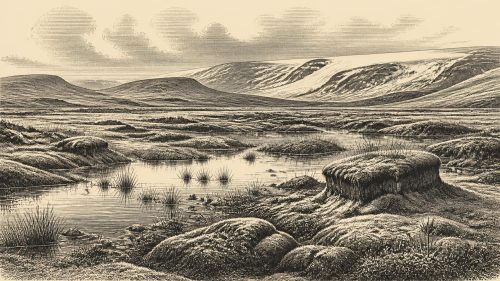
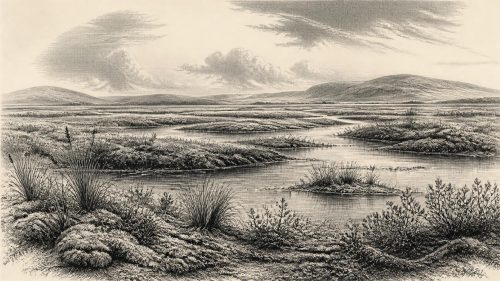
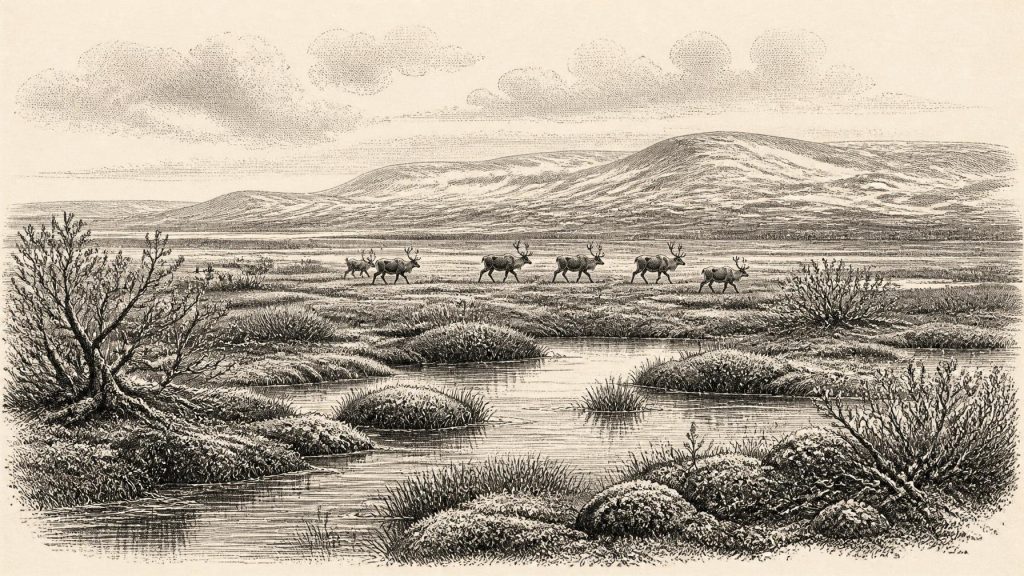
The plant and insect remains from Derryvree point to open tundra or tundra-steppe conditions and a periglacial climate. Pollen was poorly preserved, but the assemblage included herbaceous plants; plant macrofossils included numerous mosses, while sedges, grasses, dwarf shrubs and Arctic-alpine herbs are consistent with a largely treeless terrain. Aquatic and wet-ground species show that this was not simply a dry plain: shallow pools, wet mossy ground and plant-rich water fringes occurred within a cold landscape.
The resulting scene should not be mistaken for a modern Irish bog transposed into deep time. It was a harsh, seasonal world, with long winters, short growing seasons and frozen or frost-affected ground. Sparse vegetation probably left much soil vulnerable to wind and frost action. The Derryvree deposits suggest a mosaic of sedge-rich wetland, open water and low vegetation rather than continuous woodland. They are direct evidence for the local environment; extending them to every valley, coast and upland remains interpretation.
Climate in the North Atlantic did not change smoothly. Greenland ice cores show repeated abrupt stadial and interstadial shifts during this phase of the last glacial period. Ireland’s position on the Atlantic fringe made it especially sensitive to changes in temperature, moisture, sea ice and the behaviour of neighbouring ice masses. Around this date, it is safer to speak of cold, variable conditions and expanding glacial influence than of one unchanging “Ice Age climate”. The Last Glacial Maximum, when the British–Irish Ice Sheet reached its later great extent, belongs principally to the succeeding period, after about 26,500 calibrated years BP.
Animals in a Changing Country
Caves in the limestone country of north Cork preserve a complementary record. Castlepook Cave, near Doneraile—also known as Mammoth Cave—yielded a large assemblage collected chiefly during excavations in the early twentieth century. Reindeer, woolly mammoth, brown bear, wolf, Arctic fox, hare, lemming, spotted hyaena and giant deer are among the animals represented in the wider southern Irish Late Pleistocene record. They demonstrate that Ireland, during overlapping parts of Marine Isotope Stage 3, could support a more varied cold-climate fauna than the modern island.
Such lists need careful handling. The cave collection accumulated through more than one process and probably across more than one period. Carnivores could have dragged carcass parts into the cave; animals may have died there; water could have moved bones; and antiquarian excavation did not preserve the fine-grained contexts expected today. Re-dating has shown that some earlier determinations from Castlepook and nearby caves understated the age of the bones. The animals therefore illuminate broad ecological possibilities, not a census of what grazed together on a particular day in 30,374 BCE.
Nonetheless, reindeer are especially important. Their presence implies forage over open ground and seasonally mobile herds. Large herbivores and their predators linked Ireland to wider north-west European ecological systems, even though the exact routes by which animals and perhaps people arrived remain uncertain. Lower sea levels altered coastlines, but it would be wrong to invent a known land route, crossing point or migration corridor for this date. The sea, ice and exposed shelf lands changed repeatedly, and the palaeogeography remains debated.
The Castlepook Question
The most consequential possible human trace is a reindeer femur from Castlepook Cave bearing a deep linear mark. Zooarchaeologist Ruth Carden has interpreted the damage as a cut made by a sharp stone tool during carcass processing. County Cork heritage material presents the bone as dating to about 31,000 BC. If that interpretation and broad chronology are upheld, it is potentially Ireland’s earliest evidence that people handled an animal: a remarkable extension of the island’s known human story beyond the much better-attested post-glacial settlement record.
Its implications, however, must not be exaggerated. The bone is not a sealed occupation floor. No securely associated stone-tool assemblage, hearth, built shelter, human burial, art, or substantial cluster of contemporary butchered remains has yet demonstrated a permanent Upper Palaeolithic settlement in Ireland. Nor can one incision tell us whether people killed the reindeer, found it already dead, butchered it near the cave, travelled in a small party, stayed overnight or returned in later seasons. The cave itself may have been a carnivore den rather than a human camp.
This distinction changes how society and everyday life should be described. A person using a stone edge to cut fresh tissue would have possessed practical knowledge of animal anatomy, sharp tools and survival in a severe environment. Beyond that, the evidence is silent. There is no basis for naming a people, estimating a population, assigning language, reconstructing families or asserting permanent occupation. The most responsible possibility is intermittent human presence, perhaps by highly mobile hunter-gatherers whose wider technological traditions lay in north-west Europe; even that remains an inference awaiting securely excavated context.
No Polities, No Proven Trade
Political affairs, warfare and diplomacy leave no identifiable record in Ireland at this date. There were no known states, territories, chiefs, boundaries or monuments through which authority can be reconstructed. Likewise, there is no direct evidence for trade, exchange networks or sea travel by people in Ireland around 30,374 BCE. Animal movement and environmental connectivity are not evidence of commerce.
Religion, ceremony, visual culture and formal learning are equally beyond recovery here. The absence of such finds does not prove that visiting people had no beliefs, stories, skills or social obligations; it means that Irish evidence has not preserved them. The enduring culture visible in the record is instead one of landscape processes: water laying down silt, mosses growing at wet margins, animals moving through open country, carnivores accumulating bones, and later ice sealing or removing evidence.
The economic foundation of any temporary human activity, if it occurred, would have been direct engagement with wild resources rather than farming. Reindeer meat, fat, hide, sinew and bone were potentially valuable materials to Late Palaeolithic hunter-gatherers elsewhere in Europe, but Castlepook’s single marked bone does not establish a local hunting economy. There were no domesticated crops, livestock, fields, houses or managed woodland demonstrated in Ireland. “Economy” at this depth is best understood as ecological opportunity, not a documented Irish system of production.
Approaching the Ice Maximum
The long-term story is one of contraction and erasure. During the millennia after the Derryvree interval, the British–Irish Ice Sheet expanded and later covered much of Ireland. Ice scoured bedrock, transported sediment and overrode older surfaces; meltwater and rising seas subsequently altered the landscape again. This helps explain why evidence for early people is so scarce. It may genuinely have been slight, but later glaciation also made it exceptionally difficult to find.
For 30,374 BCE, then, Ireland should be imagined neither as a familiar green island nor as a featureless white blank. The evidence supports a cold, open and locally wet landscape, inhabited by Ice Age animals and shaped by climatic volatility. Derryvree offers the clearest environmental window; Castlepook presents an arresting but still limited possibility of human action. Together they give Ireland a deep prehistory measured not in annual events, but in calibrated ranges, sediments, bones and carefully qualified conclusions.
Primary Sources
- A Middle Midlandian Freshwater Series at Derryvree, Maguiresbridge, County Fermanagh, Northern Ireland
- Palaeoecology: Field Guide 16
- A Reconsideration of the Radiocarbon Dating of the Marine Isotope Stage 3 Fauna from Southern Ireland
- The Irish Quaternary Fauna Project
- Archaeology Research Excavation Grant 2022: Castlepook Cave, Co. Cork
- 2022:564 – Castlepook Cave, Castlepook South, Cork
- Heritage Artefacts of County Cork
- On the Cave of Castlepook, Near Doneraile, Co. Cork
- The Timing and Magnitude of the British–Irish Ice Sheet Between Marine Isotope Stages 5d and 2
- Early Deglaciation of the British-Irish Ice Sheet on the Atlantic Shelf Northwest of Ireland Driven by Glacioisostatic Depression and High Relative Sea Level
- Dimensions and Chronology of the Last Ice Sheet in Western Ireland
- Pleistocene Glaciations in Ireland
- The Problem of a Late Quaternary Landbridge Between Britain and Ireland
- Ireland: Submerged Prehistoric Sites and Landscapes
- A Stratigraphic Framework for Abrupt Climatic Changes During the Last Glacial Period Based on Three Synchronized Greenland Ice-Core Records
- The IntCal20 Northern Hemisphere Radiocarbon Age Calibration Curve (0–55 cal kBP)
- Independent Tephrochronological Evidence for Rapid and Synchronous Oceanic and Atmospheric Temperature Rises Over the Greenland Stadial-Interstadial Transitions Between ca. 32 and 40 ka b2k
- Irish Pleistocene Biostratigraphy
- New Insights on the Fauna of Ireland's Younger Dryas and Early Holocene from Alice & Gwendoline Cave
- Archaeological Heritage of County Cork