Doneraile’s Reindeer Femur31226 BCE
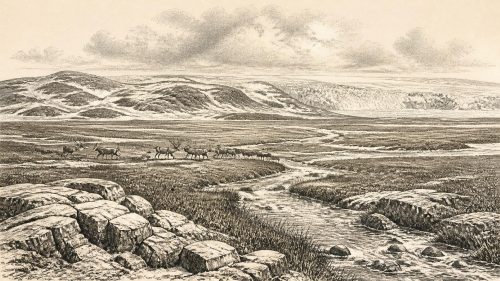
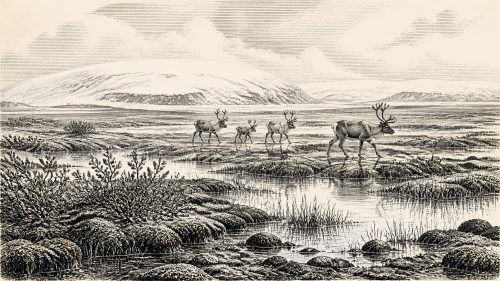
At around 31,226 BCE, Ireland lay within the fluctuating cold environments of Marine Isotope Stage 3. Castlepook Cave near Doneraile preserves a reindeer femur broadly dated to this period, bearing a linear mark interpreted as possible stone-tool butchery. If confirmed, it could be Ireland’s earliest evidence of human activity, but cannot prove permanent settlement. The cave’s mixed collection and later disturbance prevent secure conclusions about where or when processing occurred. Ireland then contained shifting combinations of ice, open steppe-tundra, wetlands and mobile mammals, during changing sea levels and climates. Later glaciation may have erased evidence, leaving only a tentative clue.
Dateline
31,226 BCE is not a date to which Irish prehistory can be assigned with calendar-year precision. No community in Ireland used a calendar resembling the modern BCE system, and neither archaeology nor environmental science can identify a particular event, season or individual in this numbered year. Mechanically converted to the archaeological convention of years before AD 1950, it falls about 33,176 years before present. The responsible setting is therefore a broad one: the later part of Marine Isotope Stage 3 (MIS 3), during the Last Glacial period and before the fullest expansion of the Last Glacial Maximum ice sheet.
That broad placement matters because conditions changed rapidly on geological timescales. Radiocarbon determinations have statistical uncertainty and must be calibrated; cave deposits and ice-margin reconstructions commonly have resolutions of centuries or millennia, not individual years. The closest Irish evidence is a reindeer femur from Castlepook Cave, near Doneraile in north County Cork, publicly presented as dating to about 31,000 BCE and carrying a mark interpreted as the trace of a sharp stone tool. It makes this notional year unusually significant, but it cannot support a story of a dated hunt, an established village or a named first settler.
A Cave Find Near the Date
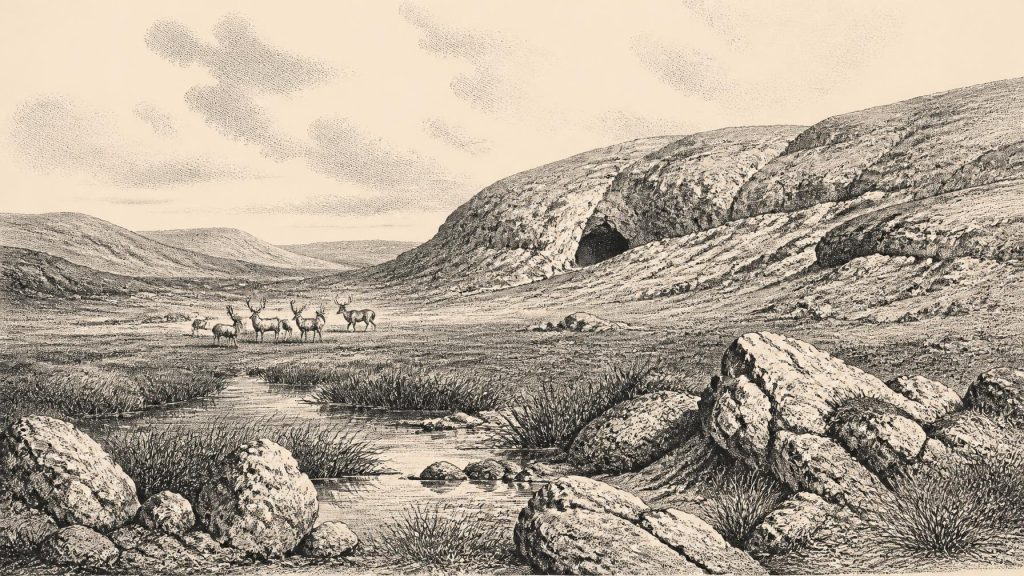
Castlepook Cave, also called Mammoth Cave, has long been recognised as one of Ireland’s most important Pleistocene faunal sites. Excavations undertaken in the early twentieth century recovered a large, varied bone assemblage. Later work on the National Museum of Ireland collections, including the Irish Quaternary Fauna Project and subsequent re-dating, demonstrated that the cave contained animal remains from very different phases of the last glacial cycle. This is both its value and its difficulty: Castlepook preserves evidence from deep time, but it is not a neatly sealed snapshot of one occupation.
The reindeer femur is central to the human question. Ruth Carden has interpreted a deep linear modification on it as a cut or chopping mark made with a sharp stone implement while the bone was fresh. County Cork heritage material dates the specimen broadly to c. 31,000 BCE. If that diagnosis is sustained, the bone indicates that a person or people processed a reindeer in Ireland in the Upper Palaeolithic, far earlier than the long-established evidence for the island’s Mesolithic settlement.
Yet the limits of the claim are as important as its promise. The old excavations pre-date modern recording standards, and cave bones can be moved by carnivores, water, frost, collapse, digging and earlier excavation. A radiocarbon date measures the age of the bone’s organic material: it does not independently date the incision, name its maker, establish where the animal was killed or show how long people stayed. No securely associated stone-tool assemblage, hearth, shelter floor, burial, human bone or repeated food-waste deposit of comparable age has been recovered in Ireland. The most cautious conclusion is possible human carcass processing, not proven permanent occupation.
An Island in a Changing Ice-Age World
At about 33,000 years ago, Ireland was not the fully ice-covered landscape often imagined from the peak of the last glaciation. The British–Irish Ice Sheet was developing unevenly, and the extent of ice varied considerably between regions and through time. Modern reconstructions can model growing ice over northern and upland parts of Ireland by about 31,000 years before present, but constraints become sparse further back. They do not license a precise national map for 31,226 BCE. Ireland may have contained glaciers, icefields, periglacial ground and ice-free lowlands at different times; its geography was dynamic rather than uniform.
Sea level was much lower than today because vast quantities of water were stored in continental ice. The Irish Sea basin and neighbouring shelves consequently had a different appearance, although lower sea level did not automatically create a simple, dry land bridge from Ireland to Britain or continental Europe. Any movement of animals or people depended on the changing arrangement of sea, ice, coasts, channels and weather. The presence of large mammals in Ireland proves that routes existed during favourable intervals; it does not reveal whether a human visitor came by a short crossing, along exposed coastal terrain or by a more complex sequence of movements.
Environmental archives offer local, carefully bounded evidence. At Derryvree near Maguiresbridge in County Fermanagh, organic sediments sealed between tills record an earlier ice-free interval with freshwater and wetland habitats. Plant macrofossils, pollen and insects point to a cold, treeless, muskeg-like environment in which sedges, grasses, herbs, dwarf shrubs and hardy aquatic plants could survive. The dated organic horizon cannot serve as a daily weather record for County Cork, nor can it be pinned confidently to this exact BCE year. It nevertheless demonstrates an essential point: the last glacial period included intervals when parts of Ireland held open, biologically productive landscapes between advances of ice.
Further south-west, uranium-thorium dates from Crag Cave in County Kerry show that calcite formed episodically during MIS 3. Since stalagmite growth requires liquid water to circulate through shallow cave systems, these deposits provide independent evidence for milder episodes without permanent frozen ground at that locality. They reinforce a picture of abrupt climatic fluctuations rather than one endless, unchanging winter. But a warm episode registered by a stalagmite is not a guarantee that all of Ireland was habitable, nor does it date human activity at Castlepook.
Reindeer, Carnivores and Open Country
The Castlepook fauna is the soundest guide to the living landscape around this remote horizon. Reindeer are strongly associated with cold, open environments and seasonal mobility. Other Castlepook finds, re-dated and reassessed over several decades, include remains attributed to woolly mammoth, giant deer, brown bear, Arctic fox, lemmings and spotted hyaena, alongside smaller mammals and carnivores. Not every species necessarily lived together at the same moment: the cave collection accumulated across long periods, while revised dating has shown that some older measurements underestimated the true age of specimens. Still, the assemblage establishes that Ireland periodically supported a far richer Late Pleistocene mammal community than the later, isolated island would possess.
Open grassland, herb-rich steppe-tundra, damp hollows and patchy scrub are reasonable environmental interpretations, especially for areas used by grazing animals. Such terrain could sustain reindeer and, at intervals, larger browsers and predators. Hyaenas and other carnivores may themselves have transported carcass parts into caves. This possibility is particularly relevant at Castlepook: even if the reindeer femur bears a human-made cut, the bone need not show that butchery took place inside the cave. A kill or processing site may have been elsewhere, with the discarded limb later scavenged and carried underground.
People: A Possibility, Not a Population
If people reached Ireland around this period, they were Upper Palaeolithic hunter-gatherers. Across north-west Europe, groups of this broad kind relied on stone, bone and wooden equipment, moved according to season and resources, and maintained social connections over landscapes much larger than later farming territories. That wider comparison helps explain how a brief visit to Ireland is possible. It must not be mistaken for direct evidence that particular continental cultural traditions, cave art, costume, language or ritual practice existed in Ireland.
There is no basis for discussing Irish political affairs, diplomacy or organised warfare in 31,226 BCE. There were no known states, rulers, frontiers, written agreements or monuments on the island. A solitary modified bone cannot reveal kinship rules, leadership, gender roles, language or beliefs. Nor is there evidence for religious sites, formal burial, art, schooling, farming, herding, metalwork, markets or exchange networks in Ireland at this date. Silence on these subjects is not a failure of imagination; it is the consequence of a record too slight to bear them.
Everyday life can be approached only at its narrowest. If the femur’s mark is anthropogenic, it implies the practical knowledge to use a sharp-edged tool on a large animal carcass. It may reflect the recovery of meat, marrow, hide or sinew, but the single mark does not demonstrate which product was sought. A visiting party might have travelled lightly, carried portable tools and followed animals through seasonal terrain. Those are plausible interpretations, not excavated facts. The absence of tools and hearths may reflect brief use, later glacial erosion, burial beneath sediments or simple failure to find the relevant site; none of those explanations can be chosen with confidence.
What Survives of This Moment
The later expansion of the British–Irish Ice Sheet profoundly reworked Irish landscapes. Glacial erosion, deposition and subsequent sea-level change probably destroyed, buried or displaced many fragile traces that a short-lived Palaeolithic visit might have left: campsites, footprints, hearths and exposed coastal activity areas. This helps explain why Ireland’s record is so sparse, but it cannot turn absence into proof of an unseen population. Archaeology must distinguish what ice may have erased from what has actually been demonstrated.
The strongest historical statement for Ireland around 31,226 BCE is therefore modest but consequential. The island formed part of a cold, fluctuating Late Pleistocene world in which ice, water, open vegetation and mobile animal herds repeatedly reshaped opportunities for life. Castlepook Cave preserves a reindeer femur close to this broad date, possibly marked during human butchery. If confirmed by further microscopic study and securely excavated evidence, it may represent the earliest known human activity in Ireland. For now, it is a compelling threshold: not the foundation of an Irish society, but a fragile clue that people may have entered an Ice-Age Ireland long before settlement became archaeologically visible.
Primary Sources
- Heritage Artefacts of County Cork
- A reconsideration of the radiocarbon dating of the Marine Isotope Stage 3 fauna from southern Ireland
- The Irish Quaternary Fauna Project
- Growth and retreat of the last British–Irish Ice Sheet, 31,000 to 15,000 years ago: the BRITICE-CHRONO reconstruction
- Extent and timing of the Last Glacial Maximum (LGM) in Britain and Ireland: a review
- Episodic speleothem deposition tracks the terrestrial impact of millennial-scale last glacial climate variability in SW Ireland
- First evidence of a Late Upper Palaeolithic human presence in Ireland
- New insights on the fauna of Ireland’s Younger Dryas and Early Holocene from Alice & Gwendoline Cave
- The IntCal20 Northern Hemisphere radiocarbon age calibration curve (0–55 cal kBP)
- Spatio-temporal dynamics of speleothem growth and glaciation in the British Isles
- A Middle Midlandian freshwater series at Derryvree, Maguiresbridge, County Fermanagh, Northern Ireland
- Palaeoecology: Quaternary Palaeoecology in Northern Ireland
- Exploring controls of the early and stepped deglaciation on the western margin of the British-Irish Ice Sheet
- Maximum extent and readvance dynamics of the Irish Sea Ice Stream and Irish Sea Glacier since the Last Glacial Maximum
- Dimensions and chronology of the last ice sheet in Western Ireland
- Ireland: Submerged Prehistoric Sites and Landscapes
- Deglaciation, Earth crustal behaviour and sea-level changes in the determination of insularity: A perspective from Ireland
- The Mesolithic in Ireland: when was it?
- Ireland’s Palaeolithic Archaeology – Fleeting Footprints in a Frozen Land
- The IntCal20 Northern Hemisphere radiocarbon age calibration curve (0–55 kcal BP)