
Maguiresbridge’s Road-Cut Tundra31005 BCE
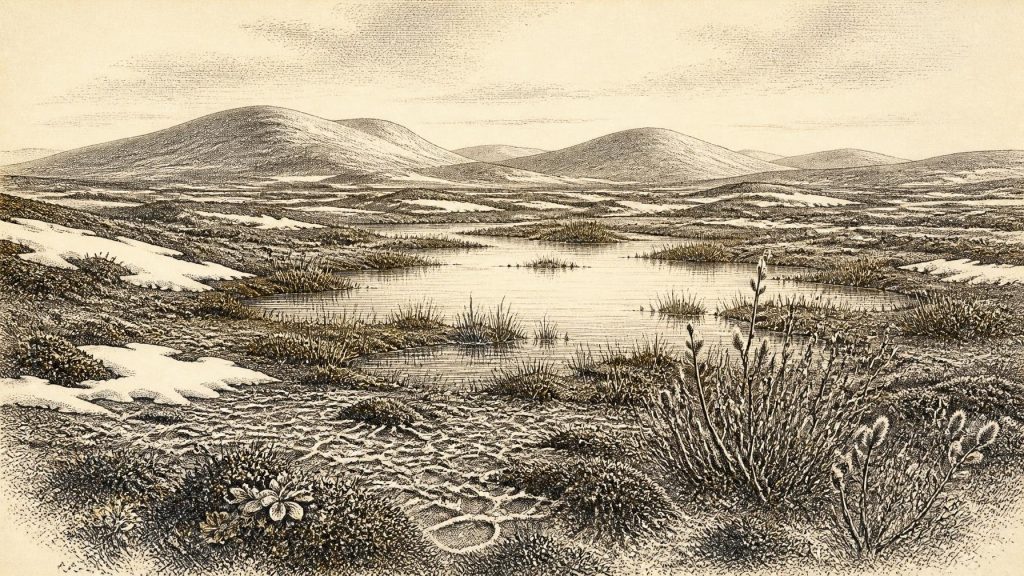
Around 31,005 BCE, Ireland has no recoverable human history, but geological and biological evidence illuminates a changing Late Pleistocene environment. At Derryvree, County Fermanagh, freshwater sediments between glacial tills record an ice-free interval, broadly dated to encompass this nominal year. Pollen, plants, mosses and insects indicate a cold, treeless tundra wetland of pools, sedges, herbs and damp ground. Castlepook Cave, County Cork, preserves wider Marine Isotope Stage 3 fauna, including mammoth, reindeer, hyaena and bear, though not necessarily contemporaneously. No secure evidence proves human settlement; later ice advances buried or destroyed much of the earlier record across the island’s landscapes.
Dateline
The label 31,005 BCE gives a useful place in a modern timeline, but it cannot identify a recoverable Irish year in the way that it can for literate history. No calendar, settlement sequence or event record exists for this point in the Late Pleistocene. The evidence is instead geological and biological: layers of sediment, pollen, seeds, mosses, insects, cave bones and the traces left by advancing ice. These materials are dated in ranges, often with substantial uncertainty, and they describe environments lasting generations or millennia rather than a single season.
The most informative Irish evidence close to this notional date comes from Derryvree near Maguiresbridge in County Fermanagh. There, a 1969 road cutting through a drumlin exposed freshwater silts and fine sands sealed between two sheets of glacial till. Organic material from this deposit produced a conventional radiocarbon determination of 30,500 +1,170/−1,030 years BP. Later calibration places the deposit broadly at about 36,900–31,700 calibrated years BP: approximately 34,950–29,750 BCE when expressed against the conventional 1950 “present” used in radiocarbon dating. That wide interval includes 31,005 BCE, but does not establish the precise appearance of Derryvree, much less all Ireland, in that exact year.
A Wetland Between Ice Advances
Derryvree is important because its organic bed lies between deposits made by ice. It demonstrates that this part of Fermanagh was ice-free long enough for freshwater sediments, plants and small animals to accumulate, before a later ice advance buried the evidence beneath till. The site therefore preserves a local interval of exposed ground within the fluctuating cold of Marine Isotope Stage 3, the long climatic phase preceding the coldest extent of the last glaciation.
The deposits do not show a wooded Ireland. Their pollen, plant macrofossils and insect remains point instead to a cold, largely treeless, periglacial wetland: a patchwork of shallow pools, waterlogged ground, mosses, sedges, grasses and herbs. Recorded plants include species associated with northern or alpine settings, among them mountain-avens and bogbean. Moss remains and aquatic indicators show that this was not simply a dry grassland; standing or slow-moving freshwater and damp organic ground mattered greatly. Sparse dry-land vegetation probably occupied better-drained patches around the pools.
Such a landscape should not be pictured as an unchanging white wilderness. “Tundra” describes an open ecological character, not a uniform scene. Seasonal thaw could create wet hollows, muddy margins and short-lived growth. Summers were cool and brief, while winters were severe. Frost action, snow cover, frozen ground and meltwater would have shaped the terrain. The low productivity of the land placed firm limits on the numbers of large animals it could support, yet wetland plants, insects and sheltered watercourses created small but significant ecological refuges.
Not Yet the Maximum Ice Sheet
At this time Ireland was moving towards, rather than already experiencing everywhere, the greatest extent of the last British–Irish Ice Sheet. Modern reconstructions emphasise that ice growth was neither instantaneous nor uniform. Different sectors of Ireland, Britain and the continental shelf responded differently to climate, topography and the supply of snow. A local freshwater deposit in Fermanagh cannot be transformed into a map of an entirely ice-free island; equally, later widespread glacial landforms must not be projected backwards to make every part of Ireland ice-covered at once.
Derryvree’s position beneath later till gives the regional change particular force. It records living wet ground before ice overrode or approached the area. The later ice sheet would erode, transport and bury vast quantities of older sediment, destroying many possible archaeological and environmental sites. This is one reason Ireland’s evidence for the deeper Palaeolithic is so sparse. Absence of campsites now is not proof that no person ever passed through the wider region, but it does mean that permanent occupation cannot responsibly be asserted.
Sea level was much lower than it is today because large volumes of water were locked in northern ice sheets. The outline of the modern island was therefore not the relevant geography. Exposed shelves and changing coastal plains altered routes between Ireland, Britain and mainland Europe. Yet neither lowered sea level nor animal movement proves a stable, easily crossed land bridge at every moment. Routes could have opened and closed, and the evidence is too incomplete to reconstruct a single reliable journey for 31,005 BCE.
Cork’s Cave Fauna
Another window on this broad period lies far to the south-west at Castlepook Cave, near Doneraile in County Cork, historically called Mammoth Cave. Its collections contain remains of a striking Pleistocene fauna, including woolly mammoth, reindeer, giant deer, brown bear, Arctic fox and spotted hyaena. Revised radiocarbon work has shown that some of the cave material belongs to Marine Isotope Stage 3, before the Last Glacial Maximum. The National Museum of Ireland’s spotted-hyaena skull from the cave is a particularly vivid reminder that Ireland’s animal communities were once unlike those of any later historical age.
These bones illuminate ecological possibility, not a single simultaneous animal community. Cave deposits may accumulate over long periods; bones can be moved by scavengers, water or excavation, and individual specimens have different histories. It would be unsafe to place mammoth, hyaena and reindeer together in one precisely dated Irish scene, or to suppose that Castlepook’s fauna inhabited Fermanagh at the same time as the Derryvree wetland. The responsible conclusion is narrower but still remarkable: cold-stage Ireland could intermittently support, or be reached by, large herbivores and formidable carnivores during this wider pre-maximum interval.
Reindeer and mammoth indicate open habitats with substantial grazing or browsing resources across parts of the landscape. Hyaena is evidence of a predator and scavenger capable of exploiting large carcasses and of using caves or sheltered places. Such animals also suggest recurrent ecological connections beyond Ireland, because their populations could not have arisen in isolation. But fossils reveal presence more readily than population size, seasonality or migration route. They cannot tell us whether a herd crossed a particular valley, nor how long any species persisted locally.
The Human Question
There is no securely dated house, hearth, stone-tool assemblage, burial or occupation surface in Ireland that can be assigned to around 31,005 BCE. Consequently, there is no basis for naming an Irish community, describing leaders, territories, warfare, diplomacy, language, ritual or artistic tradition in this period. Nor is there evidence for farming, managed livestock, pottery, metalworking, long-distance exchange or a settled economy. The ordinary political and social categories of a year-by-year history simply do not yet apply.
A reindeer femur from Castlepook has attracted attention because a mark on the bone has been interpreted as possible fresh-bone modification by a stone tool. If ultimately confirmed as a human butchery mark and securely tied to the bone’s age, it would be important evidence for a brief Upper Palaeolithic human presence far earlier than Ireland’s better-established terminal-Pleistocene evidence. At present, however, one disputed or incompletely contextualised bone cannot demonstrate a camp, a resident population or a human event in this particular calendar-labelled year. Dating the animal and identifying the cause and timing of a surface mark are separate evidential questions.
The earliest published, directly dated Irish evidence widely accepted as humanly modified remains much later: the cut-marked brown-bear patella from Alice and Gwendoline Cave in County Clare, dated to about 12,810–12,590 calibrated BP. That discovery establishes Late Upper Palaeolithic activity after the maximum glaciation, not settlement at Derryvree’s much earlier horizon. It also illustrates the value of museum collections, whose reassessment can alter long-held ideas about Ireland’s past.
What Can Be Said Responsibly
For the human history of Ireland around 31,005 BCE, the honest account is chiefly one of limits. No known evidence supports a polity, conflict, diplomacy, religion, trade network or enduring settlement. If people entered the Irish landscape during the broader period, they would have been small mobile hunter-gatherer groups operating in a harsh, thinly productive environment; that is an inference from wider north-west European prehistory, not a demonstrated Irish fact. It must not be converted into a story of named bands, camps or ceremonies.
What the evidence does reveal is a country in profound environmental transition. At Derryvree, a cold freshwater tundra wetland flourished for part of an ice-free interval. In Cork, cave deposits preserve traces of a wider cold-stage fauna whose members arrived through changing northern landscapes. Later glacial expansion erased much of the ground on which people or animals might once have left clearer traces. The history of this nominal year is therefore not a dated human episode, but a fragile environmental archive: wetland life, open country, mobile fauna and ice advancing towards a landscape that would soon be transformed.
Primary Sources
- A Middle Midlandian Freshwater Series at Derryvree, Maguiresbridge, County Fermanagh, Northern Ireland
- Palaeoecology: Irish Quaternary Association Field Guide
- Growth and Retreat of the Last British–Irish Ice Sheet, 31,000 to 15,000 Years Ago: the BRITICE-CHRONO Reconstruction
- BRITICE-CHRONO Maps and GIS Data of the Last British-Irish Ice Sheet 31 to 15 ka
- The Timing and Magnitude of the British–Irish Ice Sheet Between Marine Isotope Stages 5d and 2
- Trimlines, Blockfields and the Vertical Extent of the Last Ice Sheet in Southern Ireland
- Exploring Controls of the Early and Stepped Deglaciation on the Western Margin of the British Irish Ice Sheet
- Episodic Speleothem Deposition Tracks the Terrestrial Impact of Millennial-Scale Last Glacial Climate Variability in SW Ireland
- A Reconsideration of the Radiocarbon Dating of the Marine Isotope Stage 3 Fauna from Southern Ireland
- The Irish Quaternary Fauna Project
- Spotted Hyena Skull
- Heritage Artefacts of County Cork
- Mammoth Cave, Castlepook
- First Evidence of a Late Upper Palaeolithic Human Presence in Ireland
- New Insights on the Fauna of Ireland's Younger Dryas and Early Holocene from Alice & Gwendoline Cave
- Menyanthes trifoliata L.
- Dryas octopetala L.
- BRITICE-CHRONO Project Aims
- Project Findings Provide Essential Insight into the Last British–Irish Ice Sheet
- The IntCal20 Northern Hemisphere Radiocarbon Age Calibration Curve (0–55 cal kBP)
- Exposure-Age Constraints on the Extent, Timing and Rate of Retreat of the Last Irish Sea Ice Stream