Derryvree’s Clubmoss Silt31071 BCE
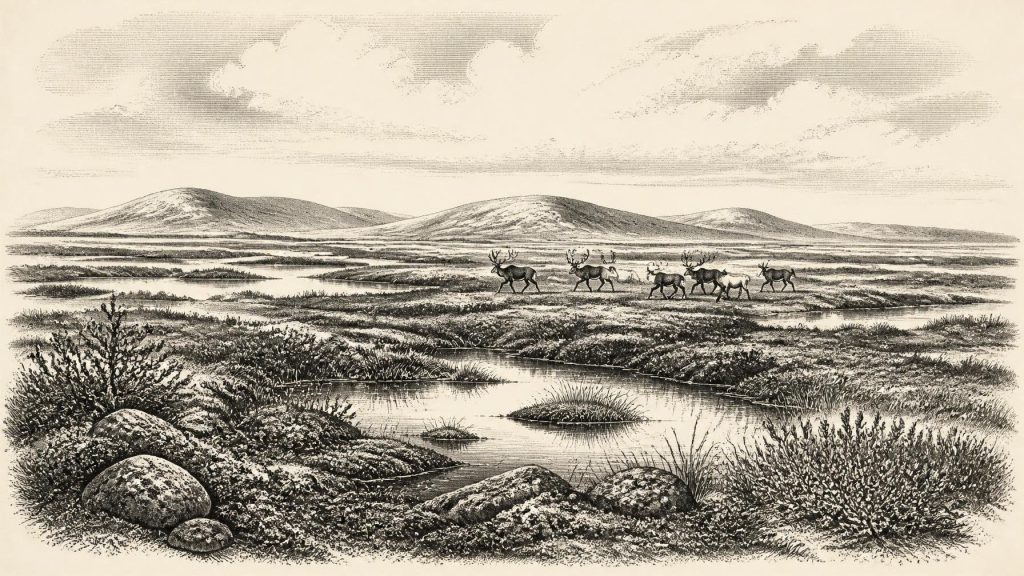
31,071 BCE is best understood as a broad Late Pleistocene interval, not a datable Irish event. At Derryvree, County Fermanagh, organic silts beneath glacial till preserve evidence of cold, open, locally wet tundra vegetation, including clubmoss, sedges, mosses and insects. Comparable deposits confirm intermittent ice-free conditions between glacial advances. Castlepook Cave, County Cork, yielded remains of reindeer, mammoth, predators and other cold-adapted animals, though these need not represent one community or time. A marked reindeer bone may indicate human activity, but remains unconfirmed. No settlements or institutions are known. Growing ice sheets later repeatedly transformed and buried these changing landscapes.
Dateline
The modern label 31,071 BCE cannot identify an event in Ireland in the way that it can for a medieval battle or a parliamentary session. It is a retrospective point in a calendar that did not exist for the people, animals or landscapes of the Late Pleistocene. In conventional calendar arithmetic it lies about 33,020 years before AD 1950, the reference point used for ‘BP’ dating, but that is not itself a radiocarbon determination. Archaeology cannot resolve Irish evidence of this age to a single calendar year. The responsible view is therefore of a broad interval within Marine Isotope Stage 3, using calibrated ranges and carefully dated deposits rather than an invented annual chronicle.
At this point, the land now called Ireland was part of a climatically volatile north-west European world. Temperatures, snowfall, sea level, vegetation and ice margins changed repeatedly over millennia. The great expansion of the last British–Irish Ice Sheet lay ahead rather than being a single instantaneous event: evidence indicates major growth after roughly 32,000 years ago, with extensive ice reaching its maximum limits later, during the Last Glacial Maximum. Conditions around the island were consequently precarious and regionally varied. It is misleading to picture either a uniformly ice-covered Ireland or a stable, fully habitable country.
An Interval Preserved Beneath Till
The most revealing Irish evidence for the wider period comes from Derryvree, near Maguiresbridge in County Fermanagh. Roadworks in 1969 cut through a drumlin and exposed organic freshwater silts and fine sands trapped between two substantial layers of glacial till. This was an exceptional survival. Later glaciers had overridden much of Ireland, eroding, mixing and burying older ground surfaces; at Derryvree, a small environmental archive endured beneath the younger ice-borne sediment.
The original radiocarbon determination from the organic deposits was 30,500 +1,170/−1,030 radiocarbon years BP. That result is not equivalent to a precise BCE year. With its wide laboratory uncertainty and the non-linear nature of radiocarbon calibration at this antiquity, it denotes a broad calendar-age window in the mid-30,000s cal BP, rather than a date capable of confirming conditions on 31,071 BCE itself. The nominal year belongs near the end of the broad time horizon to which Derryvree is relevant, but the deposit is evidence for an interval, not a diary.
Its fossils nevertheless say a great deal. Freshwater mosses, sedges and other plant remains, together with cold-adapted insect evidence, indicate open tundra-like vegetation and a periglacial regime. Clubmoss spores are among the small but evocative traces recovered from the sediments. There was standing or slow-moving freshwater locally, vegetated margins and seasonally productive wet ground, but no evidence for a closed temperate forest. Grasses, sedges, herbs, low shrubs, mosses and sparse patches of hardy vegetation better fit the record. Frost, short growing seasons and exposed ground constrained life even where ice was absent.
Cold Country, Not Empty Country
Derryvree should not be turned into a panoramic reconstruction of all Ireland. It records one locality in what is now northern Ireland, and its flora and fauna were deposited under particular hydrological conditions. Yet comparable inter-till deposits at Hollymount near Maguiresbridge and Greenagho near Belcoo support the larger conclusion that parts of Fermanagh experienced cold, non-glacial episodes between advances of ice. The evidence is especially important because it demonstrates environmental change rather than simple permanence: open land and freshwater habitats could exist, then be buried by renewed glaciation.
South-western Ireland supplies a different kind of record. Castlepook Cave, also known as Mammoth Cave, near Doneraile in north County Cork, produced an important collection of Late Pleistocene animal remains. Reindeer, brown bear, wolf, Arctic fox, mountain hare, lemmings, spotted hyaena and woolly mammoth have all been identified from the wider cave assemblage. The collection shows that Ireland supported, at various times before the Last Glacial Maximum, a far richer large-mammal fauna than the island has known in recent millennia.
That qualification — at various times — is essential. A cave deposit is not automatically a single living community. Bones may be carried in by predators, water or sediment movement; material from separate episodes may be mixed by excavation; and antiquarian investigations at Castlepook, undertaken principally between 1904 and 1913, did not meet modern recording standards. Direct dating has also transformed the chronology. Improved pretreatment and accelerator radiocarbon methods have shown that some earlier dates from Irish cave bones were thousands of years too young. Castlepook is therefore invaluable, but its assemblage cannot responsibly be presented as a crowd of mammoths, hyaenas and reindeer sharing one valley in one year.
Animals, Predators and Possible Visitors
Even with that caution, the animal record illuminates the economy of nature. Reindeer were well adapted to open cold-country habitats, moving through landscapes in which grazing and browsing opportunities were unevenly distributed. Hares, lemmings and Arctic foxes point towards severe conditions. Wolves and spotted hyaenas indicate competing large predators and scavengers. Mammoth remains attest to the presence, at least in the broader pre-maximum interval, of animals associated with extensive open grassland or steppe-tundra mosaics. Such evidence supports a picture of mobile animal populations following food, shelter and seasonal routes, rather than a permanently settled ecological balance.
One Castlepook object has made the question of people especially consequential: a reindeer femur reported to carry a deep mark interpreted as a cut or chop made by a sharp stone tool. The bone has been publicised as roughly 33,000 years old and as possible evidence of carcass processing by a human visitor. If the interpretation is confirmed through fuller publication, microscopic study, secure dating and contextual evidence, it would extend the known story of human activity in Ireland dramatically earlier than the firmly investigated terminal-Pleistocene evidence from Alice and Gwendoline Cave in County Clare.
For 31,071 BCE, however, the mark must remain a proposition, not a foundation for a settled population. There is no securely associated hearth, stone-tool assemblage, dwelling floor, burial, food store or settlement site of this age in Ireland. A modified bone cannot establish whether one or more people arrived briefly to hunt or scavenge, whether they travelled as a small group, or whether they returned repeatedly. Nor does it prove that descendants remained after the climate deteriorated. The evidence permits possible human presence; it does not permit a named hunting party, an origin story or an unbroken occupation.
No Polities, No Proven Trade
There were consequently no recoverable political affairs for this notional year. Archaeology supplies no Irish chiefdoms, territories, diplomatic relationships, organised armies or formal institutions at this date. Conflict can only be discussed in the ecological sense: carnivores competed over carcasses, while cold, hunger and changing access routes imposed relentless pressures on every animal. Likewise, there is no evidence for agriculture, herding, metallurgy, markets, long-distance exchange systems, monuments, formal religious sites or writing. To assign any of these to Ireland around 31,071 BCE would be invention.
If people did reach the island or its then-expanded margins, their social world would have been that of highly mobile Palaeolithic foragers, not later Irish farming communities. Their knowledge, if present, would have resided in practical skills: reading animal movements, choosing shelter, using fire, making and maintaining tools, and navigating dangerous seasonal ground. None of those capacities is directly documented in an Irish assemblage of this age. They are reasonable inferences from contemporary human populations elsewhere in Europe, but they must not be mistaken for discoveries at Derryvree or Castlepook.
Travel itself remains unresolved. Global sea level was lower than today, exposing areas of the continental shelf, but the practical geography of movement depended on ice margins, rivers, marine channels, boggy ground and changing coastlines as much as on lowered water. Ireland’s connection with Britain and continental Europe cannot be reconstructed as a simple, permanent land bridge for this particular moment. Animal remains demonstrate that mammals reached Ireland during parts of the Late Pleistocene; they do not map the exact route, season or conditions of each crossing.
The Approaching Ice
The chief historical development appropriate to this date was environmental instability. Derryvree records a cold freshwater landscape available between glacial advances. Castlepook preserves evidence that a diverse fauna occupied Ireland during the longer Marine Isotope Stage 3 interval. Subsequent growth of the Irish component of the British–Irish Ice Sheet would reshape the land, erase or bury many older surfaces and sharply alter the prospects for plants, animals and any human visitors. The future ice advance is why these fragmentary deposits matter: they preserve a world that was neither modern Ireland nor a timeless frozen void.
Thus the best account of Ireland around 31,071 BCE is deliberately modest. The firm evidence is for open, cold and locally wet landscapes; for animals suited to a harsh Pleistocene environment; and for climate and ice sheets that repeatedly changed the available territory. The possible evidence is a humanly modified reindeer bone from County Cork. Between the two lies the discipline of prehistoric history: treating silt, spores, bones and dates as powerful witnesses, while refusing to make them say more than they can.
Primary Sources
- A Middle Midlandian Freshwater Series at Derryvree, Maguiresbridge, County Fermanagh, Northern Ireland
- Early Midlandian–Middle Midlandian, Pleistocene, Northern Ireland
- Middle Midlandian Interstadial Deposits at Greenagho, Near Belcoo, County Fermanagh, Northern Ireland
- Freshwater Organic Deposits and Stratified Sediments Between Early and Late Midlandian (Devensian) Till Sheets, at Aghnadarragh, County Antrim, Northern Ireland
- The Irish Quaternary Fauna Project
- A Reconsideration of the Radiocarbon Dating of the Marine Isotope Stage 3 Fauna from Southern Ireland
- Late Pleistocene Chronostratigraphy and Ice Sheet Limits, Southern Ireland
- Growth and Retreat of the Last British–Irish Ice Sheet, 31,000 to 15,000 Years Ago: the BRITICE-CHRONO Reconstruction
- The Deglaciation of the Western Sector of the Irish Ice Sheet from the Inner Continental Shelf to its Terrestrial Margin
- Trimlines, Blockfields and the Vertical Extent of the Last Ice Sheet in Southern Ireland
- Exploring Controls of the Early and Stepped Deglaciation on the Western Margin of the British Irish Ice Sheet
- New Insights on the Fauna of Ireland's Younger Dryas and Early Holocene from Alice & Gwendoline Cave
- First Evidence of a Late Upper Palaeolithic Human Presence in Ireland
- Castlepook Cave, Castlepook South, Cork: 2022 Excavation Report
- Archaeology Research Excavation Grant 2022: Final Report, Castlepook Cave
- Heritage Artefacts of County Cork
- The Castlepook Cave Project
- Ireland's Palaeolithic Archaeology – Fleeting Footprints in a Frozen Land
- The IntCal20 Northern Hemisphere Radiocarbon Age Calibration Curve (0–55 cal kBP)
- The Subdivision of the Quaternary Period in Ireland
- Introduction to the Glacial Sand and Gravel Landscapes of Northern Ireland
- Ireland Through Geological Time