
Derryvree’s Trifoliate Fen31034 BCE
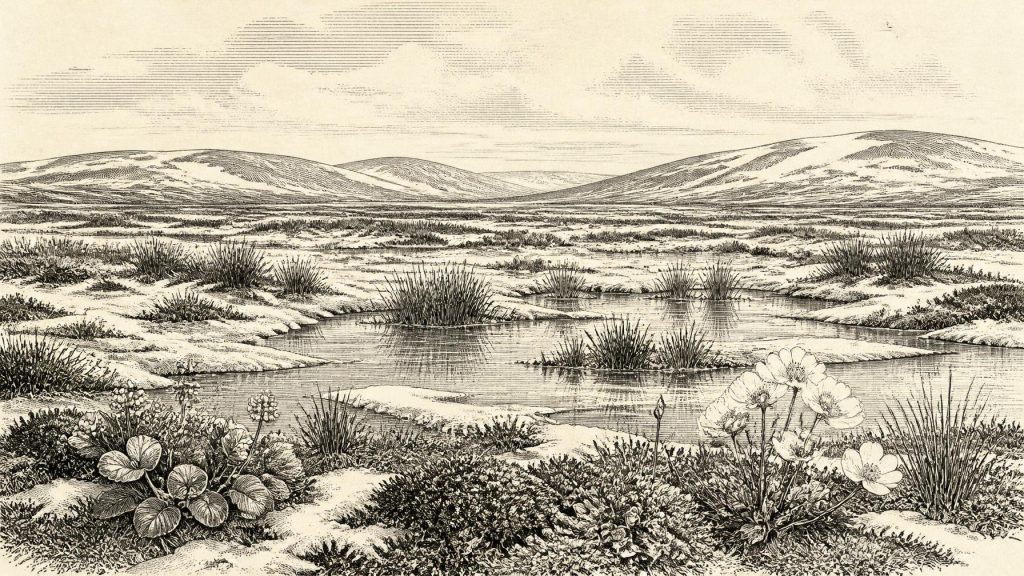
31,034 BCE is a modern label for a variable late Ice Age interval, rather than a recoverable Irish year. At Derryvree, County Fermanagh, sediments between tills document an ice-free episode, dated broadly to 36,900–31,700 calibrated years BP. Pollen, plants, mosses and insects indicate cold, open wetland with shallow freshwater, sedges, grasses, bogbean and mountain avens. Ireland was approaching, but had not reached, the Last Glacial Maximum; ice, sea levels and access routes remained changeable. Cave fauna confirms mammal presence, but chronology is fragmentary. A marked Castlepook reindeer bone may indicate human activity, yet cannot establish settlement. Environmental history remains strongest.
Dateline
The label 31,034 BCE is a modern chronological convenience, not a date anyone living in Ireland could have recognised. There was no written calendar, no recorded event and no means of identifying a particular season, individual or community in that notional year. At this depth of time, responsible history must work with calibrated ranges, deposits and probabilities. The date falls at roughly 32,984 years before the radiocarbon convention of AD 1950, in the later part of Marine Isotope Stage 3 (MIS 3), a highly variable interval of the last Ice Age. It was before the Last Glacial Maximum, when the British–Irish Ice Sheet reached its greatest known extent.
The closest Irish chronological anchor is not a settlement but a buried wetland at Derryvree, near Maguiresbridge in County Fermanagh. Organic freshwater sediments there returned a conventional radiocarbon age of 30,500 +1,170/−1,030 years BP. Calibration converts this into a broad calendar range, approximately 36,900–31,700 calibrated years BP. Thus 31,034 BCE falls within the possible span of the deposit, but it cannot be treated as the date of its beginning, end or any single layer. The evidence illuminates an interval around this point, not a year-by-year chronicle.
A Wetland Between Glaciers
Derryvree was exposed during road works in 1969, when investigators found fine sands and organic silts enclosed between two beds of till: the unsorted rock, clay and debris left by glacier ice. Its basic sequence is unusually eloquent. Ice had crossed the locality; subsequently the site supported fresh water, wet ground and plant growth; later ice again overran or expanded across it, sealing the evidence beneath a younger till. Much of Ireland’s older land surface was removed, distorted or hidden by later glaciation, which makes this modest road-cut archive exceptionally valuable.
The fossils do not portray modern green Ireland. Pollen, plant macrofossils, mosses and insects indicate an open, predominantly treeless, cold-stage landscape. Sedges, grasses and herbs grew around shallow pools and saturated ground. The record includes bogbean (Menyanthes trifoliata), an aquatic plant whose three-part leaves gave this article its title, and mountain avens (Dryas octopetala), a plant now associated in Ireland with limestone uplands and cold-climate floras. Moss-rich ground, wet hollows and sparse vegetation support the interpretation of a tundra or muskeg-like environment, subject to seasonal frost and a short growing season.
This was not necessarily a white desert in every month, nor was it continuous fenland across the island. Derryvree records one local basin, and fossil pollen can travel beyond the place where a plant grew. The defensible conclusion is narrower: during an ice-free phase at this north-eastern locality, freshwater and wetland habitats sustained cold-adapted vegetation. Open ground and shallow water existed between episodes of glaciation. It does not follow that every Irish region had the same conditions, or that the whole island was simultaneously ice-free.
Ice, Water and Changing Coasts
At 31,034 BCE, Ireland lay within the long build-up to the Last Glacial Maximum rather than at the maximum itself. The timing and extent of ice before the maximum remain subjects of active research. Reviews of the British–Irish Ice Sheet commonly place its major MIS 2 build-up after about 35,000–32,000 years ago, with maximum extent broadly between about 27,000 and 21,000 years ago. Derryvree therefore belongs to a transitional world in which local ice-free environments could coexist with an expanding glacial system on the wider Irish and British landscape.
Sea level was lower than today because much water was stored in global ice sheets, but it would be misleading to picture an automatic dry-land bridge from continental Europe to Ireland. The Irish Sea basin, shifting ice margins, changing shorelines and possible marine barriers made access complicated. Animal movements demonstrate that mammals did reach Ireland during parts of the Late Pleistocene, yet the precise routes, frequency and duration of those movements cannot be reconstructed simply from a map of lower sea level. For people, the same uncertainty is still greater.
Environmental change was the principal force shaping regional life. Later ice would scour landscapes, reroute drainage and remove many traces of anything left on the surface. Caves, sheltered pockets of sediment and deposits sealed beneath tills are consequently disproportionate sources of evidence. Their survival explains both why the record is so fragmentary and why a few locations in Fermanagh, Antrim and Cork matter so greatly in discussions of Ireland at this time.
Animals in a Sparse Record
The Late Pleistocene fauna of Ireland was more varied than the later island fauna. Cave collections, especially from southern Ireland, contain remains attributed to animals including reindeer, giant deer, wolf, arctic fox, brown bear, lemmings, cave hyaena and, in some contexts, mammoth. Such finds show that cold-adapted and open-country mammals reached Ireland during the wider late-ice-age period. They offer an important corrective to any assumption that the island was always biologically isolated in the modern sense.
Yet these bones should not be assembled into a single, timeless menagerie. Cave deposits accumulated over long periods; carnivores carried remains into dens; water and sediment disturbed deposits; and many nineteenth- and early twentieth-century excavations did not record contexts to modern standards. Improved collagen pretreatment and radiocarbon methods have also shown that some older dates need reassessment. The Irish Quaternary Fauna Project established the broad importance of the cave evidence, while more recent work has emphasised the need to revisit dates obtained before current laboratory protocols. Species from one cave may belong to different millennia, rather than a single living community.
For the period around 31,034 BCE, reindeer are especially evocative but should not be romanticised into vast herds crossing an unbroken plain. Their bones establish presence at some point within a broad chronology, not population size, migration season or the reliability of a particular hunting ground. The same caution applies to giant deer and predators. Faunal evidence is strong evidence for animal presence; it is weaker evidence for the precise ecology, abundance or human use of any given species.
The Castlepook Question
Castlepook Cave near Doneraile, County Cork, has become central to the question of whether people reached Ireland in this earlier part of the Upper Palaeolithic. The cave produced a substantial assemblage of Late Pleistocene animal bone, including reindeer. A reindeer femur from the historic collection has been publicly reported as carrying a deep mark interpreted as a cut or chop made by a sharp stone tool during carcass processing. County Cork heritage publications place the bone at roughly 33,000 years old, close in broad terms to the date considered here.
If that interpretation is upheld, it would be remarkable evidence that one or more people handled a reindeer in Ireland during MIS 3, much earlier than the well-established post-glacial settlement record. It would not, however, demonstrate a permanent colony, a village, a named people or a continuous ancestry to later Irish populations. The specimen derives from an old cave collection, not from a recently excavated occupation floor. No securely associated toolkit, hearth, constructed shelter, human burial or repeated concentration of butchered animals has yet been published for this episode.
There are two separate questions. Radiocarbon dating concerns when the animal died; surface modification analysis concerns what made the mark and when. A sharp incision can be consistent with stone-tool use, but the history of a cave bone also requires attention to carnivore action, sediment movement, breakage, excavation damage and later handling. The cautious formulation is therefore that Castlepook presents a potentially transformative indication of brief human activity, not settled proof of resident human society in Ireland in 31,034 BCE.
What Cannot Be Recovered
There is no evidence for political affairs, rulers, diplomacy, formal conflict, religion, language, art, learning, trade networks or social institutions in Ireland at this date. There is likewise no basis for describing houses, clothing, family structure, gender roles, ritual or diet as specifically Irish. These absences are historically meaningful. They reflect not merely a lack of writing, but the destruction and non-survival of fragile material during tens of millennia of climatic change and glaciation.
If people did visit, the practical setting suggests a mobile and precarious existence: an environment in which shelter, fuel, food and safe movement would have been seasonal problems. That is an inference from climate and landscape, not direct evidence from an Irish camp. It is safer to say that a fleeting party might have exploited an animal carcass than to supply them with a culture, route, economy or belief system for which Ireland has no surviving proof.
The strongest history of Ireland around this point is consequently environmental. Derryvree’s buried freshwater bed records life persisting in a cold, open wetland during an interval between ice advances. Castlepook’s fauna shows that large mammals reached the island, while a marked reindeer bone raises the serious but unresolved possibility of human contact. Together they reveal an Ireland shaped above all by ice, water, sparse vegetation and animal movement: a place with a deep past, but not yet a past that can responsibly be told as an annual human story.
Primary Sources
- A Middle Midlandian Freshwater Series at Derryvree, Maguiresbridge, County Fermanagh, Northern Ireland
- The Irish Quaternary Fauna Project
- A Reconsideration of the Radiocarbon Dating of the Marine Isotope Stage 3 Fauna from Southern Ireland
- New Insights on the Fauna of Ireland’s Younger Dryas and Early Holocene from Alice & Gwendoline Cave
- The Subdivision of the Quaternary Period in Ireland
- References and Recommended Reading
- Exploring Controls of the Early and Stepped Retreat of the Last British-Irish Ice Sheet
- Extent and Timing of the Last Glacial Maximum in Britain and Ireland: A Review
- Growth and Retreat of the Last British–Irish Ice Sheet, 31,000 to 15,000 Years Ago: the BRITICE-CHRONO Reconstruction
- The Timing and Magnitude of the British–Irish Ice Sheet Between Marine Isotope Stages 5d and 2
- Timing and Pace of Ice-sheet Withdrawal Across the Marine–Terrestrial Transition West of Ireland During the Last Glaciation
- Trimlines, Blockfields and the Vertical Extent of the Last Ice Sheet in Southern Ireland
- Stratigraphic and Palaeo-geomorphological Evidence for the Glacial-deglacial History of the Last British-Irish Ice Sheet in the North-western Irish Sea
- Aghnadarragh
- The IntCal20 Northern Hemisphere Radiocarbon Age Calibration Curve (0–55 cal kBP)
- The IntCal20 Approach to Radiocarbon Calibration Curve Construction: A New Methodology Using Bayesian Splines and Errors-in-Variables
- Menyanthes trifoliata L.
- Dryas octopetala L.
- Heritage Artefacts of County Cork
- Archaeological Heritage of County Cork
- Dimensions and Chronology of the Last Ice Sheet in Western Ireland
- A Stratigraphic Investigation of the Celtic Sea Megaridges Based on Seismic and Core Data from the Irish-UK Sectors