Reindeer Femur, No Hearth31035 BCE
31,035 BCE is a modern label for a broad Late Pleistocene interval, not a recorded Irish year. During MIS 3, before the Last Glacial Maximum, Ireland contained varied conditions as ice expanded. At Derryvree, Fermanagh, freshwater sediments between glacial tills preserve evidence of treeless periglacial wetland, with sedges, mosses, aquatic plants and Arctic-alpine vegetation. Castlepook Cave, Cork, preserves a complex, mixed-age fauna including reindeer, mammoth and predators, indicating cold open habitats. A marked reindeer femur may indicate human carcass processing, but lacks associated tools or settlement evidence. Ireland’s record chiefly documents changing environments, animal movements, advancing ice, and unresolved visitation.
Dateline
31,035 BCE is a modern chronological label, not a year that anyone in Ireland could have named or recorded. There was no writing, calendar, state, dynasty or recoverable oral history on the island from which to construct an annual narrative. Indeed, modern calendar-year precision is not available at this depth of time. The label corresponds roughly to 33,000 calendar years before AD 1950, the conventional ‘present’ used in radiocarbon reporting. What can responsibly be described is Ireland in the later part of the Late Pleistocene, during Marine Isotope Stage 3 (MIS 3): a long, unstable phase of the last Ice Age that preceded the fullest expansion of the British–Irish Ice Sheet.
A Date Inside Broad Ranges
Radiocarbon ages are not calendar years and must be calibrated against changing atmospheric carbon levels. At ages beyond 30,000 years, the resulting ranges can be particularly wide. The important Derryvree deposit near Maguiresbridge, County Fermanagh, produced a conventional radiocarbon determination of 30,500 +1,170/−1,030 radiocarbon years BP. Scholarship has placed its calibrated age broadly in the later 30,000s to early 30,000s calendar years BP, a span that encompasses the modern label 31,035 BCE. That does not mean a particular layer, plant, animal or human action can be dated to that numbered year. It means that the deposit is a rare Irish archive for the environmental world broadly relevant to it.
Nor should the period be imagined as a single, island-wide climatic condition. Ice sheets advanced and retreated over very long timescales, while local terrain, altitude, exposure and drainage shaped conditions from one district to another. The latest large reconstruction of the British–Irish Ice Sheet identifies ice growth between about 31,000 and 26,000 years ago, followed by its greatest total volume around 23,000 years ago. Thus Ireland around this notional date stood before, rather than at, the Last Glacial Maximum. Northern uplands may already have supported substantial ice, while other places retained ice-free or intermittently ice-free landscapes.
Derryvree’s Buried Wetland
The most informative evidence comes from a road cutting made through a drumlin at Derryvree in 1969. Excavators found freshwater silts and fine sands sealed between two distinct tills: unsorted sediments laid down by glacier ice. The sequence supplies a powerful relative history. A glacier deposited the lower till; thereafter, at least locally, water and organic sediment accumulated in an environment not overridden by ice; finally, another glacial advance covered the deposit with upper till. It is not a photograph of all Ireland, but it proves profound landscape change at one carefully located Fermanagh site.
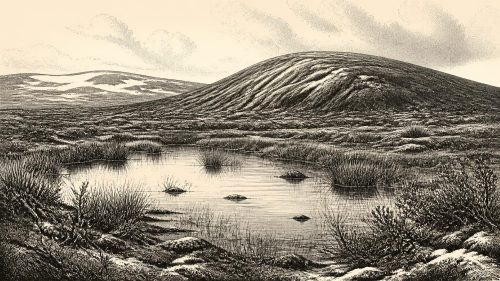
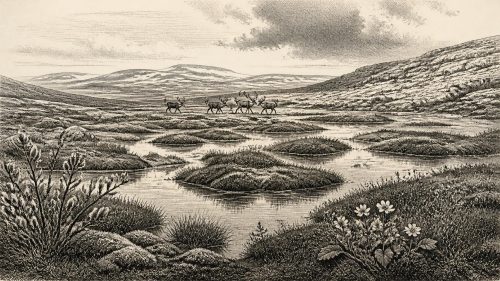
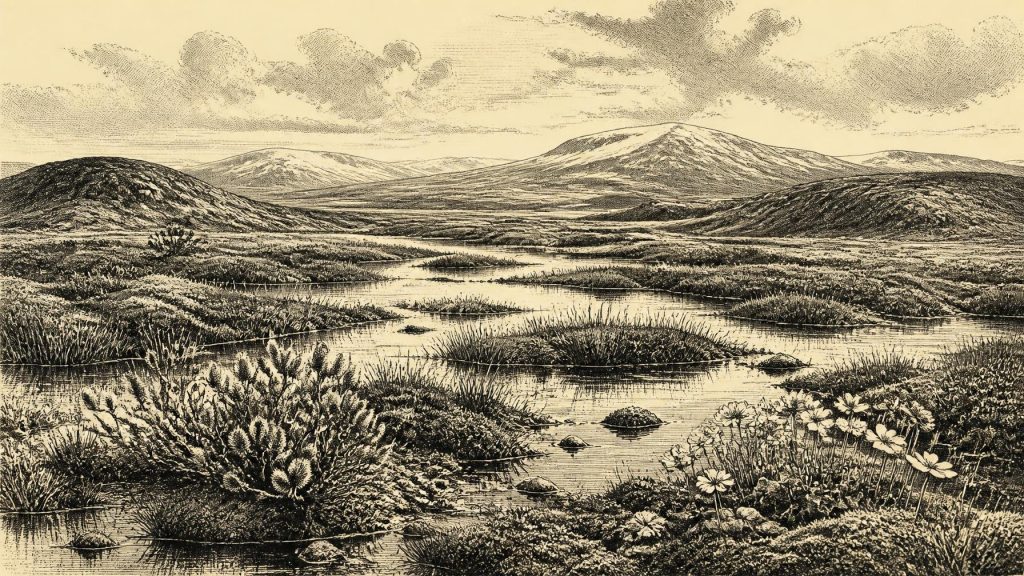
Pollen, plant macrofossils, mosses and animal remains from the inter-till sediments point to open, treeless tundra or muskeg-like wetland under periglacial conditions. Sedges, mosses, bogbean, water-milfoil, dwarf willow, mountain-avens and Arctic-alpine plant associates help reconstruct a mosaic of shallow freshwater, damp ground and sparsely vegetated drier surfaces. Pollen was poorly preserved, so individual species identifications and their abundance require caution. Yet the combined evidence is stronger than any single grain of pollen: Derryvree was neither temperate woodland nor a featureless field of ice when these sediments formed.
This was an austere but living landscape. Short growing seasons, frozen or seasonally frozen ground, strong winds and limited tree cover would have constrained plant growth. Pools and seepages could nevertheless support aquatic vegetation, invertebrates and birds, while mosses and sedges occupied saturated ground. The evidence supports ecological patchiness rather than an empty wasteland. It does not yield an exact annual temperature, snowfall total or season-by-season weather record, and it should not be stretched into one.
Caves and Cold-Stage Fauna
Southern Irish caves add a second kind of evidence. Castlepook Cave, also called Mammoth Cave, near Doneraile in north County Cork, yielded an exceptionally important but complicated collection of Ice Age animal remains. Reindeer, giant deer, woolly mammoth, brown bear, wolf, fox, Arctic fox, mountain hare, collared lemming, Norwegian lemming and spotted hyaena are among the animals represented in the wider pre-Last Glacial Maximum record. Together they support the inference that open, cold grassland and tundra environments existed in parts of Ireland during MIS 3, capable of sustaining large herbivores and their predators.
The cave archive must not be treated as a single contemporaneous animal community. Early twentieth-century excavations removed very large quantities of bone, often before modern standards of stratigraphic recording, sieving and taphonomic analysis. Some deposits were disturbed or reworked, and individual specimens have different ages. Improved radiocarbon pretreatment has also demonstrated that several earlier Castlepook dates were substantially too young. The value of the cave lies in its accumulated record of changing Pleistocene fauna, but that same complexity limits claims about a particular moment or event.
The Marked Reindeer Bone
Castlepook is especially relevant because a reindeer femur has been publicly identified as dating to about 31,000 BCE and as carrying a deep mark interpreted by palaeozoologist Ruth Carden as having been made with a sharp stone tool during carcass processing. If both the age attribution and the interpretation of the mark are upheld, it would be remarkable evidence that Upper Palaeolithic people handled a reindeer in Ireland during the broad period represented by this article. County Cork heritage material appropriately presents the find as a potentially transformative clue rather than a complete prehistoric settlement story.
The limits are as important as the possibility. A radiocarbon determination dates the death of the animal represented by the bone, within a range; it does not automatically date a surface mark. Identifying a cut mark requires separate zooarchaeological judgement, including distinction from carnivore damage, trampling, sediment abrasion, excavation damage or later handling. Most importantly, Castlepook has not produced a securely associated stone-tool assemblage, hearth, dwelling floor, burial, repeatedly used camp or intact kill site of this age. A bone could have entered a cave after scavenging or other natural movement. It cannot by itself establish where an animal was killed, how many people were present, whether they were resident, or whether they returned.
This caution matters because the National Museum of Ireland has long described the Palaeolithic human record as lacking clear evidence, whereas the re-examined Castlepook femur has reopened that question. The more securely published evidence for human activity in Ireland remains much later: a butchered brown-bear patella from Alice and Gwendoline Cave, County Clare, dated to about 12,810–12,590 calibrated BP. The Castlepook specimen should therefore be understood as an important, currently limited indication of possible much earlier human visitation, not evidence for a continuous Irish population from 31,035 BCE onward.
No Polities, but a Connected Fauna
There is no evidence from Ireland at this date for political institutions, rulers, warfare, diplomacy, collective monuments, organised religion, formal learning or trade. Nor is there evidence for farming, pottery, metalworking, built villages or a settled economy. If people did visit, the marked femur would suggest hunting or carcass processing by mobile foragers using a sharp stone edge. It would not reveal their language, kinship system, beliefs, ancestry, route of arrival or relations with other groups. Those subjects belong to interpretation, not recoverable Irish evidence.
Animal movement does show that Ireland was not biologically isolated throughout the broader MIS 3 interval. Mammals reached the island during phases of lower sea level and changing ice configuration, but the exact routes varied and remain debated. Lower sea level alone does not prove a walkable land bridge at this particular point in time: ice, rivers, coastlines and sea channels all mattered. The faunal record demonstrates connections over long spans, not a mapped crossing on a specific day. It also warns against projecting the geography of modern Ireland backwards without qualification.
An Environmental History
The central development around 31,035 BCE was therefore environmental. In Fermanagh, freshwater sediment accumulated amid cold open vegetation during an interval between glacial episodes. In the south, cave deposits preserve evidence of a cold-adapted fauna whose members included both herbivores and formidable scavengers or predators. Across the wider region, ice was building towards a later maximum that would remodel landscapes, bury deposits and erase much of the archaeological record. Ireland’s deep past here is not silent because nothing happened; it is difficult because ice, time and later disturbance preserved only fragments.
Those fragments still matter. Derryvree supplies direct evidence for a periglacial wetland; Castlepook preserves a changing faunal archive and a provocative marked reindeer bone. They allow a responsible reconstruction of habitats and possibilities, while setting firm limits on what is known about people. For this point in prehistory, the honest history of Ireland is one of tundra waters, migrating animals, advancing ice and an unanswered human question.
Primary Sources
- A Middle Midlandian Freshwater Series at Derryvree, Maguiresbridge, County Fermanagh, Northern Ireland
- Palaeoecology
- Figure 6.— The Subdivision of the Quaternary Period in Ireland
- Growth and Retreat of the Last British–Irish Ice Sheet, 31,000 to 15,000 Years Ago: The BRITICE-CHRONO Reconstruction
- BRITICE-CHRONO Maps and GIS Data of the Last British-Irish Ice Sheet 31 to 15 ka
- A Reconsideration of the Radiocarbon Dating of the Marine Isotope Stage 3 Fauna from Southern Ireland
- The Irish Quaternary Fauna Project
- Prehistoric Details
- Heritage Artefacts of County Cork
- Archaeological Heritage of County Cork
- The IntCal20 Northern Hemisphere Radiocarbon Age Calibration Curve (0–55 cal kBP)
- IntCal Publications
- The Exploration of Castlepook Cave, Co. Cork. With 3 Plates.
- Occurrence of Mammalia Relicts at Site Castlepook Cave
- Dublin Radiocarbon Dates II
- First Evidence of a Late Upper Palaeolithic Human Presence in Ireland
- New Insights on the Fauna of Ireland's Younger Dryas and Early Holocene from Alice & Gwendoline Cave
- Last Glacial Maximum Cirque Glaciation in Ireland and Implications for Reconstructions of the Irish Ice Sheet
- Advances in Irish Quaternary Studies
- Pleistocene Vertebrates in the British Isles
- The Mesolithic in Ireland: When Was It?
- Ireland: Submerged Prehistoric Sites and Landscapes