
Derryvree’s Mosses and Mammoths31004 BCE
31,004 BCE is a modern label within a broad, uncertain Ice Age interval, not a recoverable historical year. At Derryvree, County Fermanagh, freshwater silts between glacial tills indicate a locally ice-free episode, preserving mosses, sedges, aquatic plants and tundra vegetation in wet, treeless conditions. Castlepook Cave, County Cork, contains a long, mixed fauna including mammoth, reindeer, giant deer, hyena and other cold-adapted animals, demonstrating intermittent ecological connections with north-west Europe. A cut-marked reindeer bone may indicate early human butchery, but proves neither settlement nor continuous occupation. Subsequent ice expansion buried or destroyed many landscapes, leaving fragmentary regional evidence for historians.
Dateline
A Date Without a Calendar
“31,004 BCE” is a modern chronological label, not a year that anyone in prehistoric Ireland could have named or recorded. No calendar, settlement sequence or historical event permits precision to a single year at this depth of time. The responsible question is therefore not what happened in Ireland in that exact year, but what evidence can illuminate the broad interval in which it falls.
In calendar terms, 31,004 BCE lies roughly 32,950 years before AD 1950, the conventional reference point for radiocarbon dating. The crucial Irish evidence is the Derryvree freshwater deposit near Maguiresbridge, County Fermanagh. Its organic silts yielded a conventional radiocarbon determination of 30,500 +1,170/−1,030 radiocarbon years BP. Calibration converts radiocarbon measurements into calendar-age ranges rather than exact dates; published discussion places Derryvree broadly at about 36,900–31,700 calibrated years BP, approximately 34,950–29,750 BCE. The numbered year in this article sits inside that range, but cannot be attached to a particular season, animal death, human visit or climatic episode.
This was the later part of Marine Isotope Stage 3, during the Midlandian, Ireland’s last major glacial period. It was before the fullest expansion of the Last Glacial Maximum, when the British–Irish Ice Sheet later occupied much of the island and its surrounding shelves. Conditions were unstable on long timescales: colder phases, episodes of relative amelioration, advancing ice and locally ice-free ground succeeded one another. Ireland at this point was not a timeless white wilderness, nor can it be reconstructed as a uniformly habitable country. Its environments varied sharply by place and changed over centuries and millennia.
Water Between Two Ice Advances
Derryvree is exceptionally important because a road cutting exposed freshwater silts and fine sands trapped between two thick till sheets in a drumlin. Till is debris laid down directly by glacier ice. The sequence shows that ice had affected the locality before the freshwater sediments accumulated, and that a later ice advance sealed them beneath further glacial material. It is firm evidence for a locally ice-free interval in this part of Fermanagh; it is not proof that all Ireland was simultaneously free of ice.
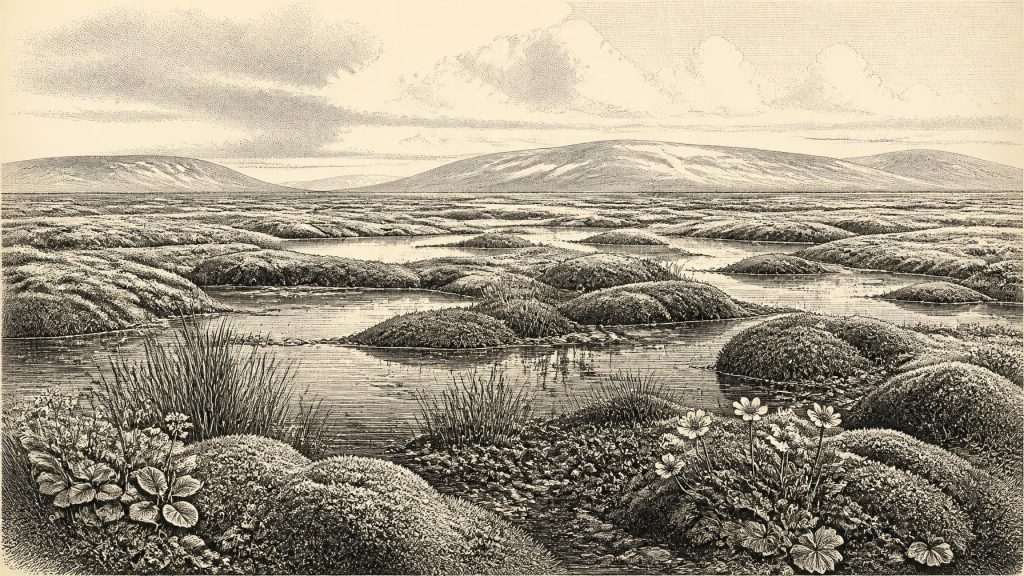
The fossils within those sediments offer the clearest direct picture of an Irish landscape relevant to this date. Pollen was dominated by herbaceous plants, while macrofossils included mosses, sedges and cold-adapted plants such as mountain avens, dwarf willow and bogbean. Beetle and other invertebrate evidence added ecological detail. Together, these remains indicate open, treeless tundra or muskeg: wet, mossy ground with sedge-rich vegetation, shallow pools and patches of drier exposed terrain. Plant cover was sufficient to sustain a living ecosystem, but the climate was harsh, with severe winters and little resemblance to modern wooded Fermanagh.
The word “muskeg” is useful because it prevents an overly simple picture of dry grassland. Derryvree was a watery, organic landscape. Standing or slowly moving freshwater allowed fine sediment, plant remains and small animal evidence to gather. Mosses and sedges occupied wet ground; aquatic plants signal pools or quiet water. Yet this was still an open cold-stage setting, vulnerable to frost action, short growing seasons and sudden environmental change. The deposit preserves an ecological moment, not a map of an entire island.
Its chronology also demonstrates why caution matters. The original radiocarbon result has a substantial uncertainty, and calibration across the older part of the radiocarbon timescale produces broad ranges. More recent Irish cave and speleothem research confirms that climatic conditions in the region could shift markedly during Marine Isotope Stage 3. Crag Cave in County Kerry preserves episodes of calcite growth requiring liquid water and temperatures favourable to it, interspersed with colder intervals when growth stopped. Such records support the view that Ireland’s climate responded to rapid North Atlantic fluctuations, but they do not allow the weather of 31,004 BCE to be specified.
Castlepook’s Animal Archive
Far to the south-west, Castlepook Cave near Doneraile in north County Cork provides a different sort of evidence. Also called Mammoth Cave, it is Ireland’s richest known archive of vertebrate remains from the period leading towards the Last Glacial Maximum. Excavations begun in the early twentieth century recovered more than 2,000 bones from complex limestone passages and chambers. Subsequent radiocarbon work has shown that the assemblage spans a long period, rather than representing one brief occupation or one perfectly contemporaneous animal community.
Its fauna includes woolly mammoth, giant deer, reindeer, brown bear and spotted hyena, with wolf, Arctic fox, lemmings and hares represented among later cold-stage material. These finds establish that, during parts of the wider Ice Age interval, Ireland supported or was visited by large herbivores and formidable carnivores suited to open, cold environments. They make the Derryvree tundra tangible: reindeer and mammoth were not imagined additions to an Irish Ice Age scene, but animals known from the fossil record.
There are important limits. Cave deposits are not ordinary settlements and are often mixtures created by carnivores, water movement, natural deaths, excavation practices and later disturbance. The Castlepook bones have dates ranging across many thousands of years. It would be misleading to place every recorded species together in a single landscape in 31,004 BCE, or to assume that a mammoth bone, a hyena skull and a reindeer femur document one encounter. What the cave securely supplies is a long, uneven record of fauna in southern Ireland during a changing glacial world.
Spotted hyenas deserve particular attention. Their presence at Castlepook is evidence not only of a carnivore but of processes of accumulation. Hyenas may have carried or modified bones; other remains may have entered through water or collapsed sediment. The cave is therefore a record of animal movement, predation, scavenging and geological sorting. It is not a royal hunting lodge, a battlefield or a human village. The surviving evidence is richer in animals than in people.
The Human Question
The most provocative object associated with this broad horizon is a reindeer femur from Castlepook reported to bear a deep mark interpreted as having been made by a sharp stone tool during butchery. County Cork heritage material dates the specimen to about 31,000 BCE and presents it as potentially very early evidence of human handling of an animal in Ireland. If the mark is anthropogenic and contemporary with the fresh bone, it would indicate that at least one Upper Palaeolithic person, or a small travelling group, may have processed a reindeer in Ireland long before the final retreat of the last ice sheet.
That is an important possibility, not a licence to invent a settled Palaeolithic population. A radiocarbon measurement dates the animal bone, not automatically the instant at which a mark was made. Nor has a securely associated hearth, stone-tool assemblage, dwelling floor, burial, food store or repeatedly occupied camp of this age been established at Castlepook. The cave’s complicated collection history and sedimentary disturbance demand restraint. The femur can support discussion of a possible human action; it cannot establish a village, a migration route, a population size or a continuous occupation of Ireland.
Consequently, political affairs, conflict, diplomacy, religion, named leaders and formal institutions are beyond recovery for this date. There is no evidence for tribes, territories, alliances or ceremonial places in Ireland around 31,004 BCE. Nor is there evidence for trade in the usual archaeological sense. If people were present, their material world has not yet been recovered in an assemblage capable of describing their tools, social organisation, beliefs or exchange networks. Silence in the record does not prove that none existed, but it does set strict limits on historical reconstruction.
Connections and Approaching Ice
The animal record nevertheless shows that Ireland was not ecologically isolated in every phase of the Ice Age. Mammals reached the island during periods when changing sea levels, ice margins and exposed continental shelves allowed movement from neighbouring lands. Exactly how particular species travelled cannot simply be read from a cave bone, and the geography altered repeatedly. The safest conclusion is connectivity: reindeer, hyenas and other mammals found routes into Ireland during suitable intervals, demonstrating that its fauna formed part of the wider north-west European world.
At the same time, the future held severe disruption. Large-scale reconstructions of the British–Irish Ice Sheet show major growth after this general interval and eventual ice expansion across Ireland and offshore shelves. Derryvree’s upper till is local testimony to renewed glaciation. Later ice erosion and deposition destroyed or buried many older landscapes, helping to explain why evidence for human activity before the Last Glacial Maximum is so sparse.
A careful portrait of Ireland around this point is therefore one of regional evidence rather than national certainty: wet tundra pools and mosses beneath the later drumlins of Fermanagh; cave passages in Cork collecting bones from a cold-adapted fauna; climate fluctuating on scales far longer than a human year; and perhaps, but not demonstrably, a fleeting human encounter with a reindeer. The history is not empty. It is simply geological, ecological and fragmentary—and it must remain more precise about its evidence than about its stories.
Primary Sources
- A Middle Midlandian Freshwater Series at Derryvree, Maguiresbridge, County Fermanagh, Northern Ireland
- Irish Pleistocene Biostratigraphy
- A Reconsideration of the Radiocarbon Dating of the Marine Isotope Stage 3 Fauna from Southern Ireland
- The Irish Quaternary Fauna Project
- Castlepook Cave: County Geological Site Report
- Spotted Hyena Skull
- 2022:564 – Castlepook Cave, Castlepook South, Cork
- Episodic Speleothem Deposition Tracks the Terrestrial Impact of Millennial-Scale Last Glacial Climate Variability in SW Ireland
- Growth and Retreat of the Last British–Irish Ice Sheet, 31,000 to 15,000 Years Ago: the BRITICE-CHRONO Reconstruction
- BRITICE-CHRONO Maps and GIS Data of the Last British-Irish Ice Sheet 31 to 15 ka
- Dimensions and Chronology of the Last Ice Sheet in Western Ireland
- Oscillating Retreat of the Last British-Irish Ice Sheet on the Continental Shelf Offshore Galway Bay, Western Ireland
- Sedimentology and Chronology of the Advance and Retreat of the Last British-Irish Ice Sheet on the Continental Shelf West of Ireland
- Timing, Pace and Controls on Ice Sheet Retreat: an Introduction to the BRITICE-CHRONO Transect Reconstructions of the British–Irish Ice Sheet
- The IntCal20 Northern Hemisphere Radiocarbon Age Calibration Curve (0–55 cal kBP)
- New Insights on the Fauna of Ireland’s Younger Dryas and Early Holocene from Alice & Gwendoline Cave
- The Exploration of Castlepook Cave, Co. Cork. With 3 Plates.
- Palaeoecology
- Figure 6—The Subdivision of the Quaternary Period in Ireland
- Menyanthes trifoliata (Bogbean)
- Dryas octopetala (Mountain Avens)
- Occurrence of Mammalia Relicts at Site Castlepook Cave