
BIRM-166’s Arctic Marsh30958 BCE
Labelled 30,958 BCE, this period cannot be dated precisely in Ireland, but falls within late Marine Isotope Stage 3. Derryvree, County Fermanagh, preserves freshwater sediments between glacial tills, dated broadly to 36,900–31,700 cal BP, proving a local ice-free interval before renewed glaciation. Mosses, sedges, aquatic plants and insects indicate cold, open tundra wetland. Cave evidence from Cork and Kerry confirms climatic fluctuations and a varied fauna, including reindeer, giant deer, predators and possibly mammoth. A marked reindeer bone may suggest Palaeolithic butchery, yet human occupation remains unproven. No political or social history is recoverable; climate, ice and ecology dominate record.
Dateline
The label 30,958 BCE is a modern point on a modern calendar, not a date that can be recovered from Ice Age Ireland itself. No Irish community then used a written calendar, left an annal, or can be tied to an individual year. In archaeological terms it falls at roughly 32,900 calibrated years before present (cal BP, where “present” is 1950), late in Marine Isotope Stage 3. The appropriate evidence is therefore not an event narrative but a set of deposits, bones and cave minerals dated in broad ranges. The most relevant Irish archive is a buried freshwater sequence at Derryvree near Maguiresbridge, County Fermanagh, while caves in Cork and Kerry reveal the wider ecological and climatic setting.
A Wetland Beneath a Drumlin
Derryvree was exposed during roadworks in 1969, when a cutting through a drumlin revealed a remarkable sandwich of deposits. A lower glacial till – stony sediment laid down by ice – was overlain by organic muds, silts and fine sands, which were themselves sealed below a later till. This order matters. It demonstrates that an earlier phase of glaciation was followed locally by an interval in which ice had withdrawn or disappeared, allowing water, plants and animals to occupy the ground, before a later glacier overrode and buried the landscape.
Organic material from the Derryvree freshwater bed returned a conventional radiocarbon determination of about 30,500 BP, with a large uncertainty. Later calibration places the deposit broadly within about 36,900–31,700 cal BP. The modern label 30,958 BCE lies inside that wide bracket, but it cannot identify a particular season, pool, plant or animal in that precise year. The range is the evidence; the numbered year is merely a useful place from which to describe it. Radiocarbon dating measures the age of organic material, and calibration converts it into an estimated calendar range because atmospheric carbon levels have changed through time.
The Derryvree sequence is consequently one of the strongest reasons not to picture all of Ireland as permanently buried beneath ice at this point in the last glacial cycle. It shows that part of north-central Ireland experienced an ice-free freshwater and periglacial phase during later MIS 3. It does not prove that every region of the island was ice-free simultaneously. Ice extent changed repeatedly, and much earlier evidence was later eroded, reworked or concealed by the expanding British–Irish Ice Sheet. The deposits instead provide a carefully limited but precious view of one local landscape before a subsequent glacial advance.
Cold Water, Open Ground
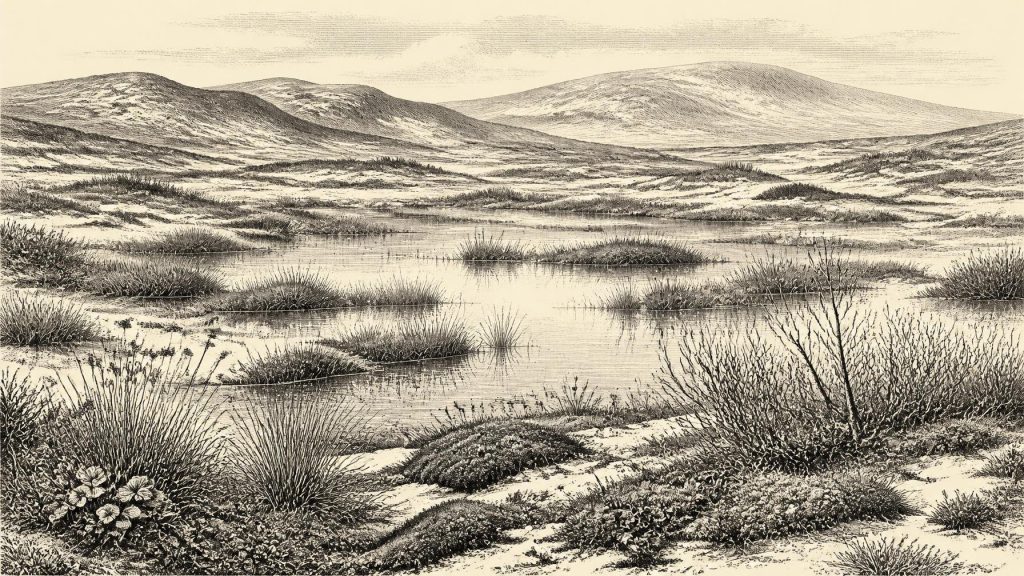
The buried muds contain an assemblage consistent with cold, open tundra-like country. Mosses and sedges grew on wet ground, while plant remains include bogbean (Menyanthes trifoliata), an aquatic or marsh plant, and water-milfoil, indicating standing or slow-moving freshwater. Mountain-avens and lesser clubmoss point towards exposed, cold conditions. Insects also suggested a northern, periglacial environment. This was not the wooded Ireland familiar from later prehistory: there is no basis for imagining oak forest, farmland, hedges or settled valleys. It was a severe landscape of shallow water, sedge margins, mineral-rich silt, low vegetation and seasonal freezing.
Yet “tundra” should not be mistaken for empty ground. The Derryvree evidence records a functioning wetland ecosystem. Plants rooted, decayed and became trapped in sediment; insects occupied terrestrial and aquatic niches; water carried fine sand and organic matter through the basin. A nineteenth-century image of a desolate frozen plain would be as misleading as a modern green pastoral view. The available evidence supports a patchwork: wet hollows and pools within broader treeless terrain, subject to intense winter cold and brief growing seasons.
Climate in MIS 3 was unstable on a scale difficult to grasp from a single date. Greenland ice cores record abrupt shifts between colder stadials and relatively milder interstadials. Irish evidence cannot resolve every one of those changes at Derryvree, but the sequence accords with a climate capable of altering ice cover, drainage and vegetation markedly over millennia. At Crag Cave in County Kerry, uranium-thorium dating of stalagmites shows repeated episodes of cave-mineral growth during the last glacial period. Because such growth requires liquid water percolating through the cave, it independently indicates intervals of climatic amelioration, though not modern warmth.
Animals at Europe’s Western Edge
The broader Irish animal record makes this landscape more tangible, but it must also be handled cautiously. Cave collections, especially from Castlepook Cave near Doneraile in north County Cork, preserve remains attributed to mammoth, reindeer, giant deer, wolf, Arctic fox, lemmings, brown bear and spotted hyaena. The Irish Quaternary Fauna Project showed that a varied mammal fauna reached Ireland at different points between at least about 45,000 and 20,000 years ago. These animals did not necessarily all live together, and a cave assemblage may combine bones accumulated over long spans by predators, water, collapse and excavation.
Re-dating has made this caution more important. Improved pretreatment of bone samples demonstrated that several older radiocarbon determinations from Castlepook were thousands of years too young. The revised work confirms that elements of the south-Irish cave fauna belong in MIS 3, but it also warns against treating an old museum collection as a neatly sealed campsite. At around 30,958 BCE, reindeer, giant deer and cold-adapted smaller mammals are reasonable components of the wider late-Pleistocene world illuminated by Irish evidence; it is not responsible, however, to assert that a particular herd stood at a named place in that year.
The presence of large herbivores and carnivores is significant for the environment rather than for any supposed Irish “kingdom” or population. Reindeer and lemmings favour open, cold habitats. Hyaenas, wolves and bears show that Ireland could support a complex food web during suitable phases of the glacial period. Mammoth and giant deer remains speak to an open-country fauna whose ranges depended on forage, migration and changing access across north-west Europe. Lower sea levels made surrounding coasts very different, but the exact routes by which animals reached Ireland, and whether crossings were continuous, seasonal or episodic, remain matters for reconstruction rather than certainty.
The Human Question
Human presence is the most debated subject. A reindeer femur from Castlepook has been reported as bearing a deep mark interpreted by zoologist Ruth Carden as damage from a sharp stone tool used during butchery. County Cork heritage material presents the find as possible evidence for Palaeolithic hunters in Ireland around 31,000 BCE. If the interpretation is sustained, it would be exceptionally important: it would imply that people reached Ireland much earlier than the securely accepted terminal-Pleistocene evidence from County Clare.
But the claim must not be enlarged beyond the object. The bone comes from an older cave collection, rather than an undisturbed excavation containing a hearth, stone-tool assemblage, shelter floor, butchered refuse and repeated occupation layers. Its radiocarbon age dates the animal’s death within a range, not automatically the making of the surface mark. Nor does one possibly modified bone establish a resident population, a settlement, or continuous occupation. Carnivore action, sediment movement, weathering and old excavation practices all complicate cave taphonomy. The responsible conclusion is that Ireland may have been visited by Upper Palaeolithic people in this broad period, while permanent human occupation at this date remains unproven.
No Politics, but Real Connections
There is no evidence from which to describe political affairs, diplomacy, organised conflict, religion, named languages, formal learning, trade networks or social ranks in Ireland around this date. Those are not omissions in the record waiting to be filled with imagination; they are questions for which the surviving evidence does not yet provide answers. If people did visit, comparisons with Upper Palaeolithic communities elsewhere in north-west Europe suggest small, mobile hunter-gatherer groups using stone technology and exploiting seasonal resources. That is a contextual inference, not a demonstrated description of an Irish community.
Likewise, no Irish settlement, house, grave, shrine, exchanged object or cultivated field can responsibly be assigned to 30,958 BCE. The economy visible in the evidence is ecological: wetland plants growing and dying, herbivores feeding in open country, predators scavenging or hunting, and ice, water and sediment reshaping the ground. The most important regional change was climatic and glacial. During the following millennia the last Irish ice sheet would expand dramatically, transforming landscapes and destroying or entombing many older traces. Derryvree survived because its short-lived freshwater world was sealed between tills. Its value lies precisely in that accident of preservation: a small archive of life from an Ireland that was cold, open, changeable and only intermittently accessible to the creatures – perhaps including people – moving along Europe’s far western margin.
Primary Sources
- A Middle Midlandian Freshwater Series at Derryvree, Maguiresbridge, County Fermanagh, Northern Ireland
- Early Midlandian–Middle Midlandian, Pleistocene, Northern Ireland
- A Reconsideration of the Radiocarbon Dating of the Marine Isotope Stage 3 Fauna from Southern Ireland
- The Irish Quaternary Fauna Project
- New Insights on the Fauna of Ireland's Younger Dryas and Early Holocene from Alice & Gwendoline Cave
- Episodic Speleothem Deposition Tracks the Terrestrial Impact of Millennial-Scale Last Glacial Climate Variability in SW Ireland
- The IntCal20 Northern Hemisphere Radiocarbon Age Calibration Curve (0–55 cal kBP)
- IntCal Publications
- Dansgaard–Oeschger Events in Climate Models: Review and Baseline Marine Isotope Stage 3 Protocol
- The Marine δ18O Record Overestimates Continental Ice Volume During Marine Isotope Stage 3
- Response of the Irish Ice Sheet to Abrupt Climate Change During the Last Deglaciation
- Early Deglaciation of the British-Irish Ice Sheet on the Atlantic Margin of North-West Ireland
- Timing and Pace of Ice-Sheet Withdrawal Across the Marine–Terrestrial Transition West of Ireland During the Last Glaciation
- Dimensions and Chronology of the Last Ice Sheet in Western Ireland
- Figure 6: The Subdivision of the Quaternary Period in Ireland
- Irish Quaternary Association Field Guide: Quaternary Palaeoenvironments of Northern Ireland
- Menyanthes trifoliata L. (Bogbean)
- Dryas octopetala L. (Mountain-avens)
- Heritage Artefacts of County Cork
- Spatio-Temporal Dynamics of Speleothem Growth and Glaciation in the British Isles