

The Castlepook Femur Inquiry31195 BCE
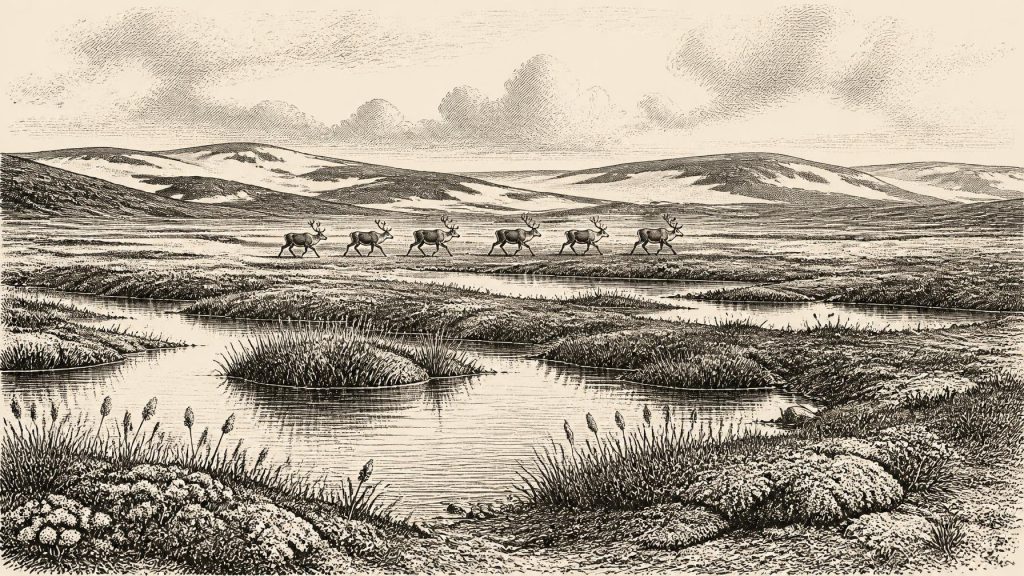
Around 31,195 BCE, Ireland was a cold, changing north-western margin of Europe, with uneven ice cover, lowered seas and tundra-like habitats rather than familiar coastlines. Derryvree, County Fermanagh, preserves freshwater sediments dated broadly to this period, indicating treeless, periglacial wetlands supporting plants, pools and seasonal productivity. Castlepook Cave, County Cork, yielded MIS 3 fauna including reindeer, mammoth, giant deer, predators and scavengers, although its deposits span long periods and have disturbed contexts. An incised reindeer femur may record stone-tool butchery, suggesting episodic human visits. However, no secure settlement, tools, structures or continuous population is known; the evidence remains provisional overall.
Dateline
The label 31,195 BCE is useful only as a modern point of reference. No Irish community recorded years at this depth in time, and archaeology cannot identify an event, individual or season corresponding to it. In radiocarbon convention it falls roughly 33,145 calendar years before AD 1950, within the later part of Marine Isotope Stage 3 (MIS 3), a fluctuating cold phase of the Late Pleistocene. The responsible evidence is therefore regional and range-based: lake and wetland sediments, glacial deposits, animal bones and the difficult archaeology of caves. Together they illuminate an Ireland of tundra-like habitats, mobile animals and changing ice margins, not a country with traceable annual history.
A Landscape Before the Maximum Ice
This was not yet the Last Glacial Maximum, the period when the British–Irish Ice Sheet achieved its greatest overall extent. Nor was Ireland uniformly free of ice. The ice sheet was dynamic and regionally uneven: glaciers advanced, stagnated and retreated in response to shifts in snowfall, temperature, sea level and ocean conditions. Reconstructions indicate rapid growth of ice masses across parts of the British–Irish region after about 31,000 years ago, but they also stress that there was no single moment when every sector reached its maximum. Conditions in Cork, Fermanagh, the Irish Sea basin and the Atlantic shelf could differ sharply.
At this date, modern coastlines, islands and travel routes did not exist in their familiar form. Much seawater was locked in continental ice sheets, lowering global sea level and exposing broad areas of the continental shelf. Ireland’s eventual insularity belongs to a much later phase of deglaciation and sea-level change. Yet lower sea level did not automatically make movement easy: routes across the wider Irish Sea region could still have involved cold water, broken ground, glaciers and dangerous weather. For animals and any people present, Ireland was a marginal north-western extension of a larger European landscape, not the settled island known from later prehistory.
Derryvree’s Long Environmental Window
The best Irish environmental evidence broadly relevant to this notional year comes from Derryvree near Maguiresbridge, County Fermanagh. Roadworks in 1969 exposed organic freshwater silts and sands enclosed between two layers of till, the unsorted sediment deposited by glacier ice. This sequence establishes a relative order: an earlier glaciation, an interval in which freshwater and organic material accumulated at the locality, and a later ice advance that sealed the deposit. It does not establish that every part of Ireland was ice-free at once.
Organic material from the Derryvree bed produced a conventional radiocarbon determination of about 30,500 ± 1,200 radiocarbon years BP. Calibration converts this into a broad calendar range, commonly expressed as approximately 36,900–31,700 calibrated years BP. The requested year sits within that range, but not at a pinpointed horizon. A calibrated range dates the sampled material and its deposition within limits; it does not date a particular pool, plant, animal movement or human visit to 31,195 BCE.
Even so, the deposit is exceptionally informative. Plant macrofossils, pollen and spores indicate open, treeless vegetation under periglacial conditions. The record includes bogbean (Menyanthes trifoliata) and lesser clubmoss (Selaginella selaginoides), plants consistent with wet ground and cold, open settings. Sedges, herbs, low shrubs, shallow pools and waterlogged channels probably made up a varied local mosaic. The old description of such ground as muskeg should not invite a picture of a mild peat bog: this was a severe climate with frost, short growing seasons and little shelter from trees. Nevertheless, wetland edges could be biologically productive during favourable months.
This matters because it corrects two opposite misconceptions. Ireland was not a continuously wooded refuge, but it was not necessarily a featureless white desert throughout the whole glacial cycle either. Derryvree preserves evidence for freshwater life and tundra vegetation in a locality later overridden by ice. Such deposits are rare precisely because subsequent glaciation eroded, mixed or buried so much of the earlier landscape.
Reindeer, Carnivores and Cave Evidence
Animal remains from southern Irish caves demonstrate that a richer Pleistocene fauna reached Ireland during parts of MIS 3. Castlepook Cave, also known as Mammoth Cave, near Doneraile in north County Cork, has yielded bones of reindeer, woolly mammoth, giant deer, brown bear, wolf, Arctic fox, hare and spotted hyaena. These animals did not necessarily all live together at one time, and a cave collection is not a census of a single valley or year. Cave deposits may accumulate over millennia; bones can be carried in by carnivores, water or people, while nineteenth- and early twentieth-century excavation methods often left incomplete stratigraphic records.
Modern redating has made this caution more important. Improved radiocarbon pretreatment has shown that several Castlepook specimens are substantially older than determinations obtained in the 1990s. The revised evidence places significant elements of the fauna in MIS 3 and suggests that species including giant deer and spotted hyaena may have vanished locally before the Last Glacial Maximum. The result is not a settled chronology of every specimen, but a firmer warning against treating older museum labels or single dates as final.
Reindeer are particularly relevant to the landscape around 31,195 BCE. They could exploit open, cold-country vegetation and would have been part of a food web including large predators and scavengers. Mammoths and giant deer indicate that, at least during suitable intervals, enough grazing and browsing resources existed to sustain very large herbivores. Hyaenas, whose remains and coprolites are known from Castlepook, show that caves could be carnivore dens as well as potential shelters. A bone recovered from a cave may therefore record hunting, scavenging, carnivore transport, natural death or several processes combined.
The Reindeer Femur and the Human Question
One object makes Castlepook unusually important to Irish prehistory: a reindeer femur bearing a deep surface incision, interpreted by zooarchaeologist Ruth Carden as a cut made by a sharp stone tool during carcass processing. Public accounts have associated the bone with roughly 31,000 BC, and it has the potential to move evidence for human activity in Ireland far earlier than the long-accepted terminal-Pleistocene record. If the cutmark interpretation is sustained, it would show that people were capable of reaching Ireland’s cold north-western margin and processing animal carcasses during MIS 3.
Its significance should not be overstated. The bone is not a securely excavated camp floor with tools, hearths, shelters and refitting butchered remains. It derives from an old cave collection whose deposits were disturbed by animals, sediment movement and historic excavation. A radiocarbon result dates the death of the reindeer, while identification of a human-made mark is a separate taphonomic judgement. Nor can one marked bone demonstrate permanent occupation, a resident population, a named group or continuous settlement. Recent excavation at Castlepook has sought better contextual evidence, but the inquiry remains open.
The most defensible conclusion is therefore modest but consequential: a reindeer lived in, or reached, north Cork during this broad cold-stage interval; one bone may preserve evidence of human butchery; and the case deserves continued testing. It is more accurate to speak of possible episodic Upper Palaeolithic activity than of an established Irish population. Any visitors may have been highly mobile hunter-gatherers following animal movements and exploiting short-lived opportunities, rather than inhabitants of a village or territory.
Life Without Political History
There is no evidence from which to reconstruct political affairs, diplomacy, warfare, law, religious institutions, language, art or learning in Ireland at this date. No graves, buildings, ornaments, inscriptions, monuments, campsites or stone-tool assemblages securely attributable to 31,195 BCE have been identified. Equally, there is no basis for assigning an ethnic or national identity to any possible visitors. Later Irish traditions, medieval origin stories and modern ideas of nationhood have no evidential reach into MIS 3.
Everyday life can only be discussed conditionally, through wider Upper Palaeolithic comparison. If people processed the Castlepook reindeer, they would have needed portable cutting tools, knowledge of animal anatomy, warm clothing and flexible ways of moving through exposed country. Such inferences describe practical requirements, not finds from a documented Irish camp. A temporary hunting or scavenging episode is plausible; a permanent settlement remains unproven.
Economy and trade must likewise be approached with restraint. There is no evidence for farming, herding, metalworking, pottery, formal exchange networks or maritime commerce in Ireland at this time. The central economy was ecological: plants capturing a brief summer’s growth, herbivores converting it into meat and movement, and predators or scavengers following them. For hypothetical human parties, animal resources may have supplied food, hide, sinew, bone and antler. Whether carcasses were hunted, found or contested with carnivores at Castlepook cannot yet be demonstrated.
A Record of Possibility
Ireland around 31,195 BCE is best understood through the tension between rich natural evidence and sparse human traces. Derryvree records an ice-free freshwater and tundra environment during a broad interval that includes this date. Castlepook confirms a cold-adapted fauna in the south and raises a serious, though unresolved, possibility of human carcass processing. Beyond those points, certainty falls away. The historical importance of the period lies not in invented chiefs or battles, but in the emergence of evidence that Ireland, long thought archaeologically empty before the end of the Ice Age, may have been visited at its glacial edge far earlier than once believed.
Primary Sources
- A Reconsideration of the Radiocarbon Dating of the Marine Isotope Stage 3 Fauna from Southern Ireland
- New Insights on the Fauna of Ireland’s Younger Dryas and Early Holocene from Alice & Gwendoline Cave
- Growth and Retreat of the Last British–Irish Ice Sheet, 31,000 to 15,000 Years Ago: The BRITICE-CHRONO Reconstruction
- Trimlines, Blockfields and the Vertical Extent of the Last Ice Sheet in Southern Ireland
- Maximum Extent and Dynamic Behaviour of the Last British–Irish Ice Sheet West of Ireland
- New Data for the Last Glacial Maximum in Great Britain and Ireland
- The Irish Quaternary Fauna Project
- The Brown Bear (Ursus arctos L.) in Ireland
- Prehistoric Details
- Heritage Artefacts of County Cork
- Archaeological Heritage of County Cork
- Castlepook Cave, Co. Cork: Excavation Report 2022
- The Subdivision of the Quaternary Period in Ireland
- Palaeoecology
- North of Ireland: Field Guide
- Field Guides
- Menyanthes trifoliata
- Selaginella selaginoides
- Ireland’s Palaeolithic Archaeology – Fleeting Footprints in a Frozen Land
- Archaeology
- Radiocarbon Constraints on Readvances of the British–Irish Ice Sheet in the Northern Irish Sea Basin During the Last Deglaciation
- Landscapes and Environments of the Last Glacial-Interglacial Transition: A Time of Amazingly Rapid Change in Ireland