
Castlepook’s Iceward Herds30866 BCE
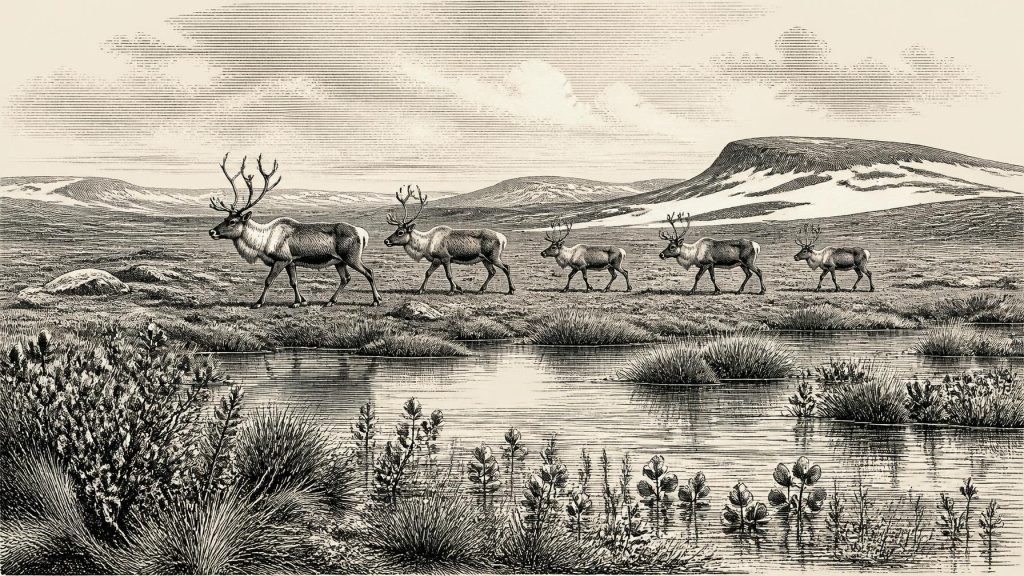
Around 30,866 BCE, Ireland lay within the unstable Marine Isotope Stage 3, before the Last Glacial Maximum. Evidence cannot describe a single year, but fossil deposits indicate severe, treeless tundra-steppe landscapes with seasonal wetland refuges. Derryvree, County Fermanagh, preserves plants and animals showing sedges, grasses and freshwater habitats amid periglacial conditions. Castlepook Cave, County Cork, yielded mammoth, reindeer, giant deer, predators and cold-adapted fauna, demonstrating links with wider European ecosystems. A marked reindeer bone may indicate early human butchery, but remains inconclusive. Later glaciation and rising seas destroyed much evidence, leaving fragmentary records of ecological survival and transient human presence.
Dateline
30,866 BCE is not a date at which Irish history can be narrated year by year. It is a modern calendar label for a point roughly 32,800 years before the conventional radiocarbon reference year of AD 1950. No calendar, written testimony, named community or dated event survives from Ireland at this depth of time. The responsible history of this moment is therefore one of ranges, deposits and probabilities. It belongs to the later part of Marine Isotope Stage 3, a highly unstable interval of the last Ice Age, and precedes the fullest expansion of the Last Glacial Maximum by several millennia.
Calibrated ages rather than single BCE years are the appropriate measure. Irish evidence relevant to this broad period comes from fossil-bearing caves, buried freshwater sediments, pollen and plant remains, glacial landforms, and the reassessment of old museum collections. These do not provide a complete picture of one year. They do, however, show that parts of Ireland could support a cold-adapted animal world before the island was overwhelmed or reshaped by the later British–Irish Ice Sheet.
A Changing Ice-Age Island
At this time Ireland was neither the familiar green island of later prehistory nor necessarily a single, uniform ice sheet. The wider North Atlantic climate swung sharply between colder stadials and comparatively milder interstadials. Ice had already formed and advanced in parts of the British–Irish region, but the timing, thickness and exact limits of ice across Ireland during Marine Isotope Stage 3 remain debated. Recent syntheses stress that ice-sheet growth and retreat were dynamic, uneven and not identical in every district. The later maximum, generally placed broadly between about 27,000 and 21,000 years ago, lay ahead.
That uncertainty matters. It is wrong to imagine every Irish valley as open tundra at once, but equally wrong to picture a habitable land of woods, farms and settled shores. The evidence points to a severe, largely treeless environment with seasonal contrasts, strong winds and ground affected by frost. Permafrost may have occurred locally or seasonally; water could nevertheless gather in ponds, marshy hollows and channels during thaw. Ice, snow, frozen ground and bare mineral soils would have made the landscape highly changeable. Coastlines were also profoundly different because global sea level was lower, though the exact routes between Ireland, Britain and continental Europe cannot safely be reduced to a simple, permanent land bridge.
Derryvree’s Northern Analogue
The most vivid Irish environmental evidence comes from Derryvree near Maguiresbridge, County Fermanagh. Roadworks there exposed freshwater silts and fine sands trapped between glacial deposits. An organic horizon produced a conventional radiocarbon age of 30,500 ± 1,170 BP. That is not a precise equivalent of 30,866 BCE: radiocarbon years must be calibrated, and the uncertainty is measured in centuries or more. Yet the deposit is a crucial regional analogue for the cold stages around this part of the late Pleistocene.
Derryvree preserved mosses, pollen, seeds and small animal remains. The assemblage indicates open tundra or tundra-steppe vegetation rather than forest. Sedges and grasses were important; recorded plants include mountain avens, dwarf willow, lesser clubmoss and bogbean. The last of these is particularly revealing. Bogbean is now associated with wet ground, and its fossil seed demonstrates that sheltered freshwater habitats could exist amid a generally periglacial landscape. Sparse vegetation on drier ground probably alternated with wetter pockets where meltwater and groundwater accumulated.
Such evidence does not mean that Derryvree was typical of every part of Ireland, or that every identified species grew together at every moment. Pollen can travel, deposits can be disturbed, and each sediment layer represents an interval rather than an instant. But the combined plant and animal evidence firmly supports a cold, open Fermanagh landscape. Around the notional year in question, this is a better guide to Ireland’s ecological possibilities than any modern political map or later archaeological landscape.
Castlepook’s Cave Fauna
In the south, Castlepook Cave near Doneraile in north County Cork, long known as Mammoth Cave, is the outstanding archive of pre-Last Glacial Maximum mammals in Ireland. Excavations early in the twentieth century recovered large quantities of bone, later dispersed through museum collections. Subsequent study has identified a striking Ice-Age fauna including woolly mammoth, reindeer, giant deer, brown bear, wolf, fox, hare, Arctic lemming and spotted hyaena. The National Museum of Ireland describes Castlepook as the country’s most important site for mammal remains from the last cold stage.
This list should be handled carefully. A cave assemblage is not a census of animals standing together outside its entrance in 30,866 BCE. Bones may have arrived through hyaena activity, natural deaths, water movement and excavation disturbance; direct dates show that specimens from the same cave can differ greatly in age. Even so, the presence of cold-adapted herbivores and formidable carnivores demonstrates that Ireland formed part of wider north-west European ecological networks during portions of this period. Reindeer herds could exploit open country, while hyaenas and wolves followed prey and scavenged carcasses. Mammoths, if present in the relevant interval, imply broad grazing landscapes capable of supporting very large herbivores.
There was no agricultural economy. The food web was sustained by wild vegetation and migratory or shifting animal populations, not by crops or domestic livestock. In this sense, the crucial ‘economy’ was ecological: plant growth in brief summers, access to unfrozen water, and the movement of grazing animals determined what predators—and any visiting people—could do.
The Human Question
Castlepook is also central to the question of whether people reached Ireland before the Last Glacial Maximum. A reindeer femur from the cave has been reported as about 33,000 radiocarbon years old and as carrying a deep surface mark interpreted by zooarchaeologist Ruth Carden as damage made by a stone implement while fresh bone was being processed. If that interpretation is sustained, it could indicate Upper Palaeolithic people butchering a reindeer in Ireland during the broad millennia surrounding this article’s date.
It is an important possibility, not a licence to invent a settlement. The bone is not accompanied by a securely associated hearth, stone-tool assemblage, shelter floor, human burial, artwork or occupation surface of equivalent date. Its date is the age of the animal bone, while the identification of a cut mark is a separate taphonomic judgement. Castlepook’s older excavations also make original stratigraphic relationships difficult to reconstruct. The evidence can therefore support a cautious statement of possible human activity or carcass processing; it cannot demonstrate a resident population, a named hunting party, or a continuous Irish Palaeolithic society.
The contrast with later evidence is instructive. A brown-bear kneecap from Alice and Gwendoline Cave in County Clare bears convincing butchery traces and has calibrated to roughly 12,810–12,590 cal BP. That later find remains the more securely contextualised evidence for a human presence in late-glacial Ireland. Castlepook may greatly extend the story, but it requires continuing direct dating, microscopic analysis and fresh excavation.
No Polities, No Recorded Conflict
Political affairs, diplomacy and organised warfare cannot be recovered for Ireland around this point. There are no known chiefs, territories, monuments, weapons caches, fortifications or exchange systems attributable to a resident human community. Nor is there evidence for religion, ceremonial practice, language, art or formal learning in Ireland at this date. Silence on these themes is not a gap to fill with familiar images of ‘tribes’; it is the honest limit of the record.
If people did reach the island, comparison with contemporary Upper Palaeolithic groups elsewhere in Europe suggests small, mobile hunter-gatherer parties rather than states or villages. They may have travelled through landscapes shaped by animal migration and seasonal opportunity, carrying portable stone tools and knowledge of carcass processing. But this is an inference from the wider European period, not a demonstrated social description of Castlepook visitors. We do not know their numbers, origins, routes, duration of stay, language or whether they returned.
An Archive of Survival
The significance of Ireland around 30,866 BCE lies not in a recorded event but in a threshold. Derryvree shows that cold-stage Ireland contained marshes and tundra vegetation beneath a severe climate. Castlepook shows that sizeable mammals and predators entered, lived or died within the island’s Ice-Age environments. The debated reindeer femur raises the possibility that people, too, briefly reached this north-western edge of Europe before later ice-sheet expansion transformed or destroyed many traces.
These remains are also a warning about survival of evidence. Later glaciers eroded landscapes, shifted sediments and removed many potential sites; rising seas subsequently drowned former coastal plains and travel corridors. What remains is uneven: a fossil seed, a moss assemblage, a cave bone, a mark on a femur. Taken together, they do not tell us what happened in one modern-style year. They illuminate a colder Ireland in motion, where life persisted in ecological pockets and where the earliest possible human footprint is still being tested.
Primary Sources
- A Reconsideration of the Radiocarbon Dating of the Marine Isotope Stage 3 Fauna from Southern Ireland
- Phylogeographic, Ancient DNA, Fossil and Morphometric Analyses Reveal Ancient and Modern Introductions of a Large Mammal: The Complex Case of Red Deer (Cervus elaphus) in Ireland
- New Insights on the Fauna of Ireland’s Younger Dryas
- First Evidence of a Late Upper Palaeolithic Human Presence in Ireland
- Extent and Timing of the Last Glacial Maximum (LGM) in Britain and Ireland: A Review
- Growth and Retreat of the Last British–Irish Ice Sheet, 31,000 to 15,000 Years Ago: The BRITICE-CHRONO Reconstruction
- The Timing and Magnitude of the British–Irish Ice Sheet Between Marine Isotope Stages 5d and 2: Implications for Glacio-Isostatic Adjustment, High Relative Sea Levels and ‘Giant Erratic’ Emplacement
- Maximum Extent and Dynamic Behaviour of the Last British–Irish Ice Sheet West of Ireland
- Trimlines, Blockfields and the Vertical Extent of the Last Ice Sheet in Southern Ireland
- Palaeoecology
- Menyanthes trifoliata
- Salix herbacea
- Spotted Hyena Skull
- Heritage Artefacts of County Cork
- Archaeological Heritage of County Cork
- Our Ancient Landscapes: Hunter-Gatherers in Ireland
- Prehistoric Details
- Radiocarbon Dates I
- Ireland’s Palaeolithic Archaeology – Fleeting Footprints in a Frozen Land
- The Antiquity of Man in Ireland
- The Irish Quaternary Fauna Project