
Castlepook’s Reindeer Signal30865 BCE
Around 30,865 BCE, Ireland can be understood only within a broad, uncertain Late Pleistocene chronology, not through dated events or communities. Derryvree, County Fermanagh, preserves freshwater sediments beneath glacial tills, indicating an ice-free periglacial tundra wetland with sedges, mosses and cold-adapted plants. Castlepook Cave, County Cork, yielded mammals including reindeer, mammoth, giant deer, hyaena and Arctic fox, demonstrating intermittent ecological links with Britain and continental Europe during lower sea levels. A cut-mark-like reindeer femur may indicate early human butchery, but cannot prove settlement. Later glaciation disturbed evidence; no social, political or cultural history is recoverable for this notional year alone.
Dateline
Modern calendar-year precision is not available for Ireland in 30,865 BCE. This is a modern label imposed on a period for which there are no written records, named communities, political events or annually dated archaeological deposits. In relation to the conventional reference year of 1950, it falls roughly 32,800 calendar years before present. At that depth of time, radiocarbon determinations require calibration and normally produce probability ranges rather than a date capable of identifying a particular season, journey or generation. Ireland can therefore be discussed only through evidence from a broader Late Pleistocene horizon.
That horizon belongs to Marine Isotope Stage 3, a long and climatically unstable part of the last glacial period. It preceded the coldest and most extensive phase of the last British–Irish Ice Sheet, but it was not a mild age. Conditions alternated sharply between colder stadials and comparatively less severe interstadials. The best evidence relevant to this notional year comes not from a settlement, but from buried freshwater sediments at Derryvree in County Fermanagh and from animal remains recovered at Castlepook Cave near Doneraile in County Cork. Together, they show an Ireland that could, at intervals, support cold-adapted plants and large mammals. They do not yield a conventional history of a people or a country.
A Date Without an Event
It would be misleading to attach a specific occurrence to 30,865 BCE. The island’s archaeological record has been heavily altered by later ice movement, erosion, changing sea levels and the destructive methods of some early cave excavations. Much of what survives consists of deposits accumulated over centuries or millennia, subsequently displaced or mixed. A bone can date the death of an animal; it cannot by itself date the instant it entered a cave, identify the season of death, or prove that people were present at the time.
The distinction matters especially at Castlepook Cave. The cave’s rich faunal assemblage was largely recovered during excavations directed by the naturalist Richard J. Ussher in the early twentieth century, with further discoveries in later work. Modern reassessment, including improved accelerator radiocarbon dating, has shown that some older dates from Irish cave bones were unreliable because earlier preparation methods could leave contaminating material in samples. The revised chronology is valuable, but it also makes context crucial: cave collections are archives of animal lives, carnivore activity, sediment movement and human investigation, not straightforward occupation layers.
The modern year in this article is thus best treated as a point within a wide chronological landscape. A conventional radiocarbon age of 30,500 ± c.1,100 radiocarbon years before present from Derryvree calibrates broadly across several millennia. The margin of uncertainty is far larger than a named BCE year. Calibration is not a technical afterthought: it is why responsible accounts of this period use ranges, phases and cautiously framed connections rather than claiming that an identifiable event happened in Ireland in 30,865 BCE.
Derryvree’s Buried Wetland
In 1969 a road cutting through a drumlin at Derryvree, about two kilometres north-east of Maguiresbridge, exposed an exceptional sequence. Organic silts and fine sands lay between two thick tills: deposits left by ice at different times. The freshwater material had been sealed beneath later glacial sediment, preserving a brief environmental record from the Middle Midlandian, Ireland’s regional term for part of the last glacial cycle.
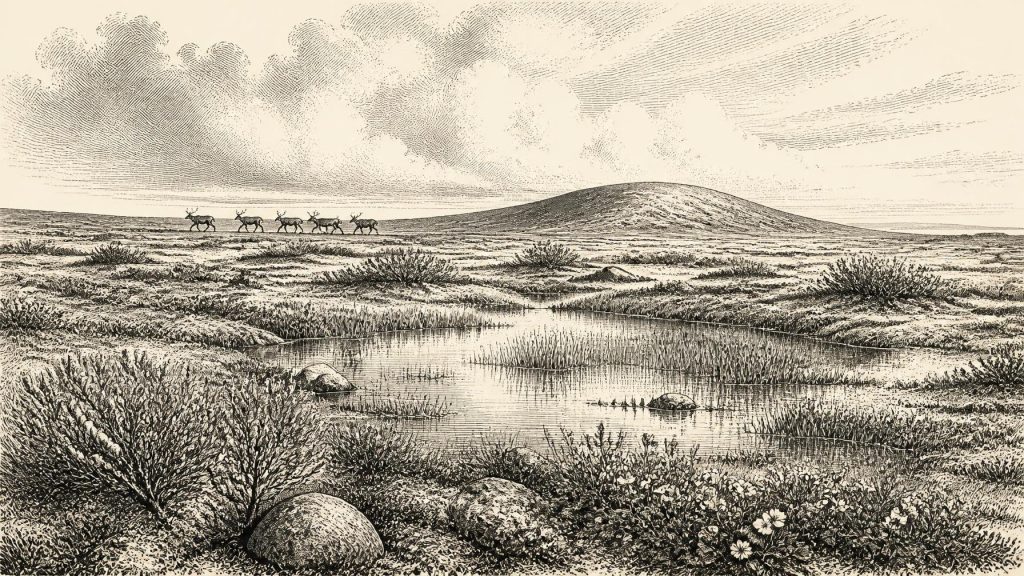
The deposit produced pollen, seeds, mosses, insect remains and other biological evidence, as well as its radiocarbon determination, Birm-166. Its assemblage indicates a periglacial environment: ground subject to intense frost processes near, but not necessarily under, an ice margin. The landscape around the deposit supported open tundra vegetation rather than woodland. Herbaceous pollen predominated, while the few grains of tree pollen were too sparse and poorly contextualised to demonstrate a local forest. Mosses, sedges and aquatic plants speak instead of damp hollows, shallow water and sparse ground cover in a cold, exposed country.
Among the more vivid finds was a seed of bogbean, Menyanthes trifoliata, a plant of wet ground and shallow freshwater. Mountain avens, dwarf willow, clubmosses and other cold-tolerant taxa also help reconstruct the local ecological mosaic. These are not a complete inventory of all plants growing across Ireland at one instant. They represent what entered and survived in one small depositional basin. Yet they demonstrate that at least part of Fermanagh was ice-free long enough for a freshwater wetland and its surrounding tundra flora to exist before later ice overrode or buried the area.
The Derryvree sequence also corrects an easy misconception. Ice-age Ireland was neither uniformly entombed beneath a permanent ice sheet nor a familiar green island simply made colder. Local conditions varied with shifting ice margins, altitude, season, drainage and climate. In a low, waterlogged basin, a pool or sedge-rich fen could persist; beyond it lay open, wind-exposed terrain, frost-shattered ground and limited vegetation. Winter darkness, hard frosts and short growing seasons would have imposed severe constraints on animals and any people who entered the island.
Castlepook and the Animal World
Castlepook Cave provides a complementary, though differently complicated, record from the south. Its Late Pleistocene fauna includes woolly mammoth, reindeer, giant deer, brown bear, wolf, Arctic fox, hare, lemmings and spotted hyaena. Not every animal need have lived there simultaneously, and the cave assemblage cannot be projected uncritically across the whole island. Nevertheless, it establishes that Ireland was reached by a striking range of cold-stage mammals during the wider period before the Last Glacial Maximum.
Reindeer are particularly pertinent. They were suited to open, treeless landscapes and could exploit seasonal vegetation unavailable to forest deer. Mammoth and giant deer evoke a substantial herbivore community, while hyaenas, wolves and bears reveal predators, scavengers and competitors at the top of the food web. A mammoth bone from Castlepook bears damage consistent with hyaena feeding, a useful reminder that caves were not simply shelters waiting for human occupants. They could be dens, traps, scavenging places or channels through which water and sediment moved bones from elsewhere.
This evidence supports a picture of intermittent ecological connection with Britain and continental north-west Europe when lower sea levels exposed more land on the surrounding shelves. It does not establish a simple, continuously walkable route, nor does it show that every species migrated by the same path or at the same time. Ice, sea, river systems and changing coastlines made access variable. The island was part of a wider glacial-world network, but its position at Europe’s western edge made colonisation difficult and probably episodic.
The Reindeer Femur Question
A reindeer femur from Castlepook has made this period especially important for Irish prehistory. Ruth Carden’s re-examination identified a deep linear mark interpreted as having been made by a sharp stone implement while the bone was fresh. The bone has been reported as approximately 33,000 years old, close in broad terms to the chronological horizon represented by 30,865 BCE. If the modification is confirmed as human butchery and contemporary with the animal’s death, it would be evidence that one or more Upper Palaeolithic people processed a reindeer in Ireland far earlier than the island’s previously accepted human record.
Its importance should not be inflated into proof of settlement. The marked femur is a single object from an old cave assemblage, not a securely excavated camp floor. No associated hearth, stone-tool assemblage, dwelling, burial, human bone, food store or dense concentration of butchered remains of equivalent age has yet been recovered. The date belongs directly to the animal, while interpretation of the surface modification depends on taphonomic and microscopic assessment. Nor can one bone tell us whether people killed the reindeer, scavenged it, paused at the cave for hours, travelled in a small party, or returned repeatedly.
For comparison, the better established evidence for Upper Palaeolithic activity in Ireland is much later: a cut-marked brown-bear kneecap from Alice and Gwendoline Cave in County Clare, independently dated to around 12,810–12,590 calibrated years before present. That later find demonstrates the value of careful re-examination and direct dating, but it cannot fill the immense gap between the terminal Pleistocene and the possible Castlepook signal. The Castlepook femur remains a serious and potentially transformative clue, not a licence to write a settled population into Ireland around 30,865 BCE.
What Cannot Be Recovered
There is no evidence from this time for Irish political affairs, leaders, territories, warfare, diplomacy or formal institutions. There is equally no basis for describing a domestic economy, trade routes, religious rites, language, art, learning or social hierarchy. Such subjects require artefacts, settlement plans, burials, repeated activity areas or inscriptions; none is presently available from Ireland for this narrow horizon. A hypothetical visiting hunting party would have needed knowledge of animal behaviour, weather, stone tools and movement through dangerous terrain, but that is an inference from wider Upper Palaeolithic Europe, not an observed fact about a named Irish group.
The strongest conclusion is environmental. Around the broad period represented by 30,865 BCE, parts of Ireland were capable of sustaining a cold, open tundra-and-wetland ecosystem populated by large herbivores, carnivores and small Arctic-adapted mammals. Derryvree preserves the plants and waters of one such setting; Castlepook preserves fragments of its animal world and a tantalising possible trace of human action. Later glaciation reshaped much of the island and destroyed or concealed untold evidence. The absence of a camp is therefore not proof that nobody ever came. It is, however, a reason to distinguish firmly between what the deposits show and the larger histories that archaeology has not yet earned the right to tell.
Primary Sources
- A Middle Midlandian Freshwater Series at Derryvree, Maguiresbridge, County Fermanagh, Northern Ireland
- The Irish Quaternary Fauna Project
- A Reconsideration of the Radiocarbon Dating of the Marine Isotope Stage 3 Fauna from Southern Ireland
- First Evidence of a Late Upper Palaeolithic Human Presence in Ireland
- New Insights on the Fauna of Ireland’s Younger Dryas and Early Holocene from Alice & Gwendoline Cave
- Palaeoecology: Irish Quaternary Association Field Guide
- Menyanthes trifoliata L. in Fermanagh: Fossil Record
- Dryas octopetala L. in Fermanagh
- Heritage Artefacts of County Cork
- 2022:564 – Castlepook Cave, Castlepook South, Cork
- Archaeology Research Excavation Grant 2022: Castlepook Cave Final Report
- The Archaeology of Caves in Ireland
- Irish Quaternary Vertebrates
- Growth and Retreat of the Last British–Irish Ice Sheet, 31,000 to 15,000 Years Ago: the BRITICE-CHRONO Reconstruction
- Geology of Ireland
- Ireland Through Geological Time
- The IntCal20 Northern Hemisphere Radiocarbon Age Calibration Curve (0–55 cal kBP)
- IntCal Publications
- The Nature of MIS 3 Stadial–Interstadial Transitions in Europe: New Insights from Model–Data Comparisons
- Mid-to-Late Marine Isotope Stage 3 Mammal Faunas of Britain: A New Look
- Ireland: Submerged Prehistoric Sites and Landscapes