
Derryvree’s Juniper Waters30864 BCE
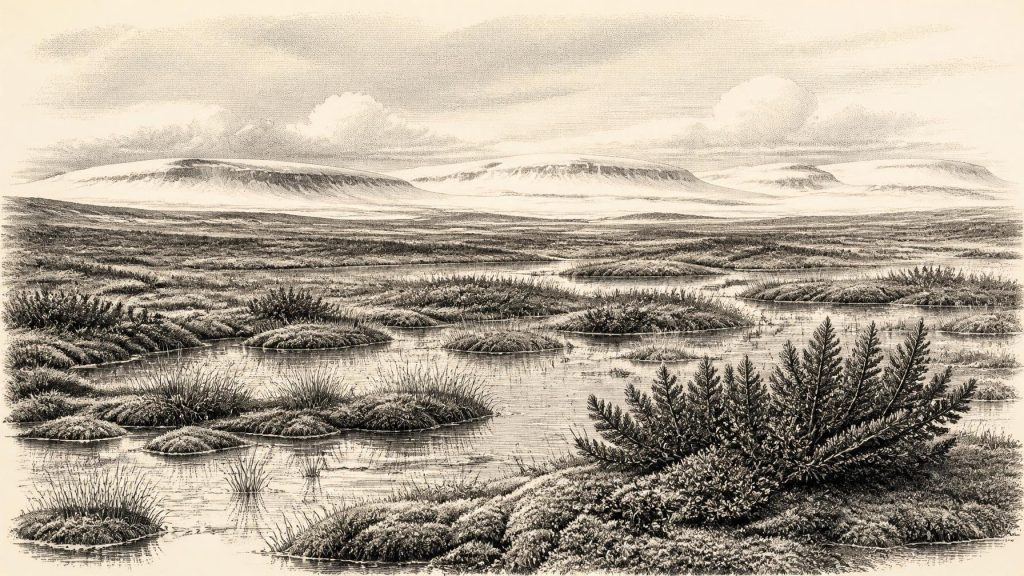
About 30,864 BCE, Ireland lay within Marine Isotope Stage 3, not a date associated with identifiable events or communities. Derryvree, County Fermanagh, preserves freshwater sediments deposited between ice advances, calibrated broadly to encompass this year. Plant and faunal remains indicate a cold, open, periglacial landscape of wet hollows, sedges, mosses, juniper and sparse vegetation. Climatic conditions shifted abruptly, while ice distribution remained regionally variable. Cave finds demonstrate Ice-Age mammals, including reindeer, mammoth and hyaena, occupied viable habitats. A possibly tool-marked Castlepook reindeer bone suggests, but cannot prove, human presence. No secure evidence establishes settlement, society or sustained occupation in Ireland.
Dateline
“30,864 BCE” is a modern numerical label, not a date that anyone then living in Ireland could have recognised. No event, ruler, battle or settlement can be assigned to that calendar year. At this depth in time, the responsible historical approach is to place the date within an archaeological and environmental range. It falls in the Late Pleistocene, during Marine Isotope Stage 3, tens of millennia before the Last Glacial Maximum and immensely earlier than Ireland’s first securely sustained post-glacial communities. The closest useful Irish chronology is a radiocarbon determination from Derryvree, near Maguiresbridge in County Fermanagh: its organic freshwater deposits have been calibrated broadly to about 36,900–31,700 years before present, or roughly 34,950–29,750 BCE. The named year therefore lies within the uncertainty range of that archive, not at an identifiable moment within it.
A Wetland Between Glaciers
Derryvree is important because roadworks in 1969 exposed a rare sequence through a drumlin. A lower layer of till, the unsorted sediment left by glacier ice, was overlain by fine sands and organic silts, themselves sealed beneath a later till. This order matters. It demonstrates that a freshwater environment formed after one ice advance and before another, preserving a short geological window later concealed by ice and sediment. The organic material produced a conventional radiocarbon age of 30,500 years BP, with a substantial laboratory uncertainty. Modern calibration turns that single measurement into a wide date range rather than a neat historical timestamp.
The Derryvree deposit is evidence for conditions in a particular lowland basin in south Fermanagh, not a complete weather report for Ireland. Yet its plant remains, pollen and small faunal evidence are unusually revealing. They indicate an open, treeless tundra or muskeg-like landscape under periglacial conditions: ground shaped by severe seasonal freezing and thawing close to, but not necessarily beneath, glacier ice. Mosses, grasses, sedges, herbaceous plants, juniper, lesser clubmoss and bogbean point to wet hollows, shallow freshwater and patches of low vegetation. A few grains of tree pollen cannot securely prove nearby woodland; pollen may travel long distances or be reworked from older material. The dominant signal is of sparse, cold-adapted cover rather than forest.
Climate, Ice and Changing Ground
For Ireland around this point in the Late Pleistocene, climate was not stable background scenery. Greenland ice-core records show that the wider North Atlantic world underwent abrupt millennial-scale shifts between colder stadials and relatively milder interstadials. Irish cave deposits and speleothems likewise show that liquid water and vegetation could return during warmer episodes, only for harsher conditions and expanding ice to follow. Calcite growth in Crag Cave, County Kerry, offers independent evidence that parts of south-west Ireland experienced episodes suitable for infiltrating water during Marine Isotope Stage 3.
The Derryvree sediments were laid down before the later expansion of the British–Irish Ice Sheet that would eventually transform the island. They show that north-central Ireland was ice-free when the freshwater basin existed, although they do not show how much ice stood elsewhere at exactly the same time. Recent reconstructions make clear that the growth of the ice sheet was regionally uneven and that the pre-30,000-year history remains less securely known than its later maximum and retreat. It would be wrong, therefore, to picture either an entirely ice-covered Ireland or a uniformly hospitable one in 30,864 BCE. The best reconstruction is a varied and rapidly changing cold-stage landscape, with wet basins and open ground in some places, ice margins or older glacial deposits in others, and an increasingly severe climatic trajectory.
An Ice-Age Animal World
Caves in southern Ireland provide a complementary, though complicated, record of animals that used or died in Irish landscapes before the Last Glacial Maximum. The Irish Quaternary Fauna Project demonstrated that a wider range of mammals occurred in Ireland between at least about 45,000 and 20,000 years ago than survived into later periods. The assemblages include reindeer, woolly mammoth, giant deer, brown bear, wolf, fox, mountain hare, lemmings and spotted hyaena. They should not be imagined as one perfectly contemporary community: bones from caves may represent different episodes, and nineteenth- and early twentieth-century excavations often disturbed the original deposits. Nevertheless, the record shows that portions of Ireland could support cold-open-country fauna during Marine Isotope Stage 3.
Castlepook Cave near Doneraile in County Cork is especially relevant. Reassessment of animal bones there with improved radiocarbon pretreatment has pushed elements of its fauna much further back than some earlier determinations suggested. Reindeer and mammoth remains evoke an exposed environment with enough grazing vegetation to sustain large herbivores, while hyaenas and other carnivores reveal a food web very unlike that of later Ireland. Such animals may have moved through broad seasonal ranges rather than occupied every Irish district continually. Their presence is evidence of viable habitats and access routes, not proof that the whole island was a single, unbroken grassland.
The Human Question
The evidence for people at this time is far weaker than the evidence for animals and environment. A reindeer femur from Castlepook has been presented as bearing a deep mark made by a sharp stone tool during butchery, and its age has been publicised as roughly 33,000 years old. If that interpretation is sustained, it may represent a remarkably early human intervention in Ireland, perhaps close in time to the range relevant to 30,864 BCE. But it is one modified bone from an old cave collection, not a camp.
No securely associated hearth, stone-tool assemblage, dwelling surface, human burial or repeated deposit of butchered animals has been found in Ireland for this period. The bone’s radiocarbon age dates the animal, while the cave’s disturbed history limits what can be said about the exact timing and setting of the mark. It cannot demonstrate permanent occupation, a named group, a migration, or a particular journey across the western edge of Europe. The claim should be treated as a significant possibility under continuing scrutiny, not as licence to populate Ireland with an imagined Palaeolithic society.
There is a useful contrast with the later Upper Palaeolithic evidence from Alice and Gwendoline Cave in County Clare. A butchered brown-bear patella there has direct calibrated dates around 12,810–12,590 cal BP, demonstrating human activity far later than the Derryvree horizon. Even that later evidence has required careful reassessment of cave sediment, bone movement and antiquarian excavation records. The lesson applies even more strongly to 30,864 BCE: Ireland’s record is sparse, its deposits are often reworked, and confidence must follow the evidence rather than the drama of a first discovery.
No Kingdoms, No Recorded Culture
There were no political institutions, diplomatic relations, named peoples or documented conflicts in Ireland that can be recovered for this date. There is no evidence for agriculture, animal husbandry, metalworking, pottery, long-distance exchange networks, monuments, ritual sites, writing or formal learning. Nor is there evidence from which religious belief, language, kinship rules, gender roles or social hierarchy can responsibly be inferred. If people did reach Ireland during this cold interval, they were most likely mobile foragers operating within wider north-west European landscapes, but this is an analogy drawn from contemporary regions, not a demonstrated Irish social history.
Lower sea levels altered coastlines and enlarged land areas around Ireland and Britain, but this does not make access straightforward or certain. Routes across the Irish Sea basin depended on shifting ice, water, terrain and season. The absence of a known settlement may partly reflect later glacial erosion, drowned palaeolandscapes and the survival bias of archaeology; it cannot by itself prove that no people ever arrived. Still, responsible history must distinguish that possibility from evidence.
A Narrow Window
What can be said about Ireland around 30,864 BCE is both modest and remarkable. Derryvree preserves a cold freshwater world of sedges, mosses, juniper and shallow wet ground in a phase between ice advances. Cave assemblages show that Ice-Age mammals ranged through parts of Ireland during the broader period. Castlepook offers a tantalising but unconfirmed-scale indication of human butchery. Beyond that, the archive falls silent. The history of this notional year is not one of kings or communities, but of an unstable northern landscape whose buried muds, bones and cave calcites are only beginning to disclose their story.
Primary Sources
- A Middle Midlandian Freshwater Series at Derryvree, Maguiresbridge, County Fermanagh, Northern Ireland
- The Irish Quaternary Fauna Project
- A Reconsideration of the Radiocarbon Dating of the Marine Isotope Stage 3 Fauna from Southern Ireland
- Episodic Speleothem Deposition Tracks the Terrestrial Impact of Millennial-Scale Last Glacial Climate Variability in SW Ireland
- Growth and Retreat of the Last British–Irish Ice Sheet, 31,000 to 15,000 Years Ago: the BRITICE-CHRONO Reconstruction
- The Timing and Magnitude of the British–Irish Ice Sheet Between Marine Isotope Stages 5d and 2: Implications for Glacio-Isostatic Adjustment, High Relative Sea Levels and ‘Giant Erratic’ Emplacement
- Maximum Extent and Dynamic Behaviour of the Last British–Irish Ice Sheet West of Ireland
- Exploring the Chronology of the Last British–Irish Ice Sheet in the Southern Irish Sea
- Extent and Deglacial Chronology of the Last British–Irish Ice Sheet: Implications of Exposure Dating Using Cosmogenic Isotopes
- New Insights on the Fauna of Ireland’s Younger Dryas and Early Holocene from Alice & Gwendoline Cave
- First Evidence of a Late Upper Palaeolithic Human Presence in Ireland
- Ireland: Submerged Prehistoric Sites and Landscapes
- Phylogeographic, Ancient DNA, Fossil and Morphometric Analyses Reveal Ancient and Modern Introductions of a Large Mammal: the Complex Case of Red Deer (Cervus elaphus) in Ireland
- Spatio-Temporal Dynamics of Speleothem Growth and Glaciation in the British Isles
- A Stratigraphic Framework for Abrupt Climatic Changes During the Last Glacial Period Based on Three Synchronized Greenland Ice-Core Records: Refining and Extending the INTIMATE Event Stratigraphy
- The IntCal20 Northern Hemisphere Radiocarbon Age Calibration Curve (0–55 cal kBP)
- European Middle and Upper Palaeolithic Radiocarbon Dates Are Often Older Than They Look: Problems with Previous Dates and Some Remedies
- Radiocarbon Dates from the Oxford AMS System: Archaeometry Datelist 34
- The Middle Midlandian Palaeoenvironment of South Fermanagh
- Selaginella selaginoides
- Menyanthes trifoliata
- Heritage Artefacts of County Cork