
Derryvree’s Tundra Testament30873 BCE
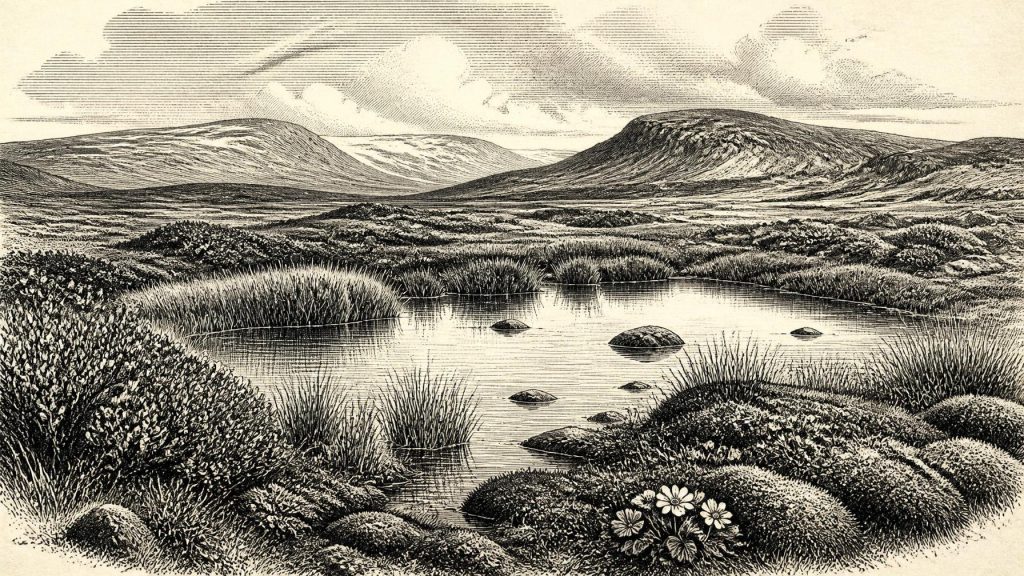
Thirty thousand eight hundred and seventy-three BCE is not a precise historical date but falls within MIS 3, a climatically unstable Late Pleistocene period. Derryvree, County Fermanagh, preserves freshwater sediments between glacial tills, indicating an ice-free interval with damp tundra, shallow pools and sparse vegetation before renewed glaciation. Castlepook Cave, County Cork, records diverse cold-stage fauna, although disturbed deposits and revised dating prevent species being assigned confidently to one moment. Ireland was undergoing expanding glaciation, with uncertain routes from Britain. No human settlement exists; a possibly cut-marked reindeer bone suggests possible Upper Palaeolithic visitation. Evidence chiefly reconstructs environment, not society.
Dateline
The label “30,873 BCE” creates a precision that the evidence cannot sustain. No community in Ireland recorded a calendar year, and archaeology cannot identify an event that happened in this particular year. The responsible approach is to place it within a much wider Late Pleistocene setting. In modern chronological terms, this notional point falls around 32,800 years before present, within Marine Isotope Stage 3 (MIS 3), a climatically unstable part of the last Ice Age. The most relevant Irish evidence comes not from a settlement or grave but from sediments, fossils and caves, each preserving a fragment of an ancient landscape.
The strongest local environmental guide is Derryvree, near Maguiresbridge in County Fermanagh. In 1969, roadworks cut through a drumlin and exposed freshwater silts and fine sands lying between two separate sheets of glacial till. Organic material in the sediments produced a conventional radiocarbon determination of 30,500 years BP, with a substantial uncertainty range. When considered with modern calibration, the Derryvree deposit is broadly placed at about 36,900–31,700 calibrated years BP, or approximately 34,950–29,750 BCE. Thus 30,873 BCE lies within the broad chronological window represented by the deposit, but cannot be fixed to a particular season, generation or layer within it.
A Landscape Between Ice Advances
Derryvree’s sequence is important because its order is unambiguous even where its dates are broad. A glacier deposited the lower till; an interval without local overriding ice allowed freshwater sediments and organic remains to accumulate; then a later glacier covered the deposit with a second till. The record therefore proves that part of Fermanagh was ice-free long enough for standing or slow-moving freshwater and tundra vegetation to develop before a renewed advance transformed the landscape again.
This was not the temperate, wooded Ireland familiar today. Plant macrofossils, pollen, mosses and insect evidence point to open, cold ground under a periglacial climate: a landscape shaped by frost, seasonal thaw and sparse vegetation. Mountain avens, dwarf willow, sedges, bogbean, water-milfoil and a range of mosses are among the remains reported from the freshwater beds. Such species do not recreate a complete photograph of the locality, but together they support the interpretation of damp tundra and shallow pools amid exposed ground. Trees were absent locally or extremely scarce. A few pollen grains of pine and hazel do not demonstrate nearby woodland; pollen can travel far, and the investigators stressed the poor preservation of the pollen record.
In this setting, water mattered. Even in a cold period, the Derryvree hollow held a freshwater environment capable of preserving delicate botanical evidence. Sedge-fringed pools, marshy patches and wet ground would have contrasted with drier, wind-exposed surfaces nearby. The drumlin itself did not yet have its modern form: it was a landscape repeatedly made, buried and remodelled by ice. What survives is not a settlement landscape but an accidental archive, sealed beneath later glacial deposits.
MIS 3 and a Changing Climate
Ireland around this notional date belonged to MIS 3, conventionally dated from about 59,400 to 27,800 years ago. Across the North Atlantic world, that was an age of abrupt swings between colder stadials and relatively milder interstadials. Greenland ice-core records show that some warmings were remarkably rapid on geological timescales, while cooling episodes lasted far longer. Ireland’s fragmentary terrestrial record cannot simply be matched, year for year, to Greenland, but Derryvree demonstrates that these large climatic oscillations had tangible consequences at the western edge of Europe.
The later Last Glacial Maximum was still ahead. Reviews of the British–Irish Ice Sheet generally place its major build-up after roughly 35,000–32,000 years ago and its maximum extent around 27,000–21,000 years ago; newer offshore work places ice at the Atlantic shelf edge by about 29,000–27,000 calibrated years BP. This means that 30,873 BCE lay during a critical transition, when Irish ice masses were expanding but the island was not uniformly entombed beneath their eventual maximum cover. Derryvree records one locally open interval; it should not be taken to mean that every region was similarly habitable or ice-free.
Coasts and crossings are equally uncertain. Sea level was lower than today because vast quantities of water were locked in global ice sheets, but the geography of the Irish Sea was shaped by changing sea level, land movement and, increasingly, glacier ice. A simple claim that people or animals could freely walk from Britain to Ireland is not justified. Scholarship on a Late Quaternary land bridge finds no persuasive continuous southern or Irish Sea land route, while northern connections remain a more complicated question. Any movement to Ireland during MIS 3 would have depended on conditions that changed across long periods, not on a permanent, easily crossed bridge.
Castlepook and the Animal Record
County Cork provides the other principal window onto Ireland’s earlier Late Pleistocene world. Castlepook Cave, near Doneraile, produced a rich but complicated collection of bones and teeth during excavations in the early twentieth century. The cave fauna includes reindeer, woolly mammoth, giant deer, brown bear, wolf, fox, Arctic fox, stoat, mountain hare, collared lemming, Norway lemming and spotted hyaena, along with birds. These remains show that Ireland supported a far more varied cold-stage fauna than its later historic fauna, and that the island contained open habitats capable of sustaining both large herbivores and major predators or scavengers.
Yet Castlepook must be read carefully. Early excavations removed much of the original sediment, and bones from caves need not all be contemporary. Some deposits were disturbed; some species may derive from later contamination; and later radiocarbon work has revised several earlier determinations markedly upwards. A 2020 reassessment concluded that some Castlepook animal remains were between roughly 5,000 and 12,000 radiocarbon years older than earlier results had suggested, and proposed that giant deer and spotted hyaena may have disappeared locally before the Last Glacial Maximum, around 40,000 calibrated years BP. The cave therefore establishes a broad MIS 3 animal world, not a guarantee that every listed species stood together in Cork in 30,873 BCE.
Nevertheless, the comparison is illuminating. Derryvree supplies plants, wetland conditions and stratigraphic proof of an ice-free interval in the north; Castlepook supplies the southern animal record of a cold, open Irish environment. Reindeer and lemmings are especially consistent with the idea of tundra or steppe-tundra conditions, while mammoth, giant deer and hyaena indicate complex food webs rather than an empty polar desert. The image is one of regional ecological variety within a generally cold climate: wetlands and shallow water in Fermanagh, limestone caves and open grazing country in the south, and advancing ice capable of erasing or burying much of what existed between them.
The Human Question
There is no secure settlement, hearth, house, tool assemblage or burial in Ireland that can responsibly be assigned to 30,873 BCE. This absence is historically important. It means that no political communities, leaders, territorial boundaries, diplomatic contacts or wars can be reconstructed for the island at this date. Nor is there evidence for Irish ritual sites, art, language, teaching traditions, clothing, boats, exchange systems or domestic life. The silence is not proof that people could never have visited; it is a limit on what the surviving record permits historians to say.
A single Castlepook reindeer femur has made that limit particularly intriguing. A mark on the bone has been interpreted as a possible incision made by a stone tool during butchery, and the discovery has been presented as potential evidence for a human presence in Ireland around 33,000 years ago. If further work securely confirms that interpretation and its relationship to the dated bone, it would push evidence for human activity in Ireland far back into the Upper Palaeolithic. But one marked bone from an old cave collection is not a camp site. It cannot identify a named population, prove continuous occupation, or show whether a visit lasted hours, days or longer.
The caution is reinforced by recent fieldwork. Excavations at Castlepook in 2022 sought surviving Pleistocene deposits but found no cultural artefacts; the recovered bone assemblage was small and mixed, and some charcoal proved recent or medieval rather than Ice Age. This does not disprove an earlier human visit. It does show why the claim must remain distinct from the more securely documented terminal-Pleistocene human evidence at Alice and Gwendoline Cave in County Clare, where a cut-marked brown-bear patella was directly dated to about 12,810–12,590 calibrated years BP.
Society Without a Social Record
If people did reach Ireland during this phase of MIS 3, they would have been mobile hunter-gatherers operating in a demanding northern environment, not farmers or inhabitants of permanent villages. That is an inference from contemporary Upper Palaeolithic lifeways elsewhere in north-west Europe, not direct evidence from Ireland. Hunting, carcass processing, use of hides and exploitation of seasonal animal movements are plausible possibilities, especially where reindeer were present, but they remain possibilities. Ireland itself has not yielded the tools, hearths, worked bone, dwellings or repeated activity areas needed to describe an economy or a social organisation.
Accordingly, the best history of Ireland at this date is environmental and evidential. Its “politics” were the movements of ice and sea; its conflicts were ecological pressures between grazing animals, predators and rapidly changing habitats; its economy, if humans were present at all, cannot yet be recovered beyond a possible episode of animal processing. Religion and learning leave no trace. The archaeology instead asks a more basic question: when conditions briefly permitted life and movement, who or what crossed this cold, unstable island?
What This Date Represents
Thirty thousand eight hundred and seventy-three BCE should therefore not be imagined as a frozen instant in a neat national narrative. It is a point inside wide calibrated ranges, a date illuminated most clearly by Derryvree’s buried freshwater tundra and more broadly by the contested but compelling animal archive of Castlepook Cave. The evidence shows an Ireland repeatedly altered by glaciation, locally capable of sustaining cold-adapted plants and animals, and perhaps visited by people long before the better documented post-glacial settlement of the island. It does not yet allow a year-by-year human story. Its value lies in showing how much of Ireland’s deepest past is preserved not in chronicles, but in a thin seam of silt between two glaciers.
Primary Sources
- A Middle Midlandian Freshwater Series at Derryvree, Maguiresbridge, County Fermanagh, Northern Ireland
- Palaeoecology: Late Quaternary Environmental Change and Archaeology, Case Studies in the Lower Bann Valley and Belfast District
- A Reconsideration of the Radiocarbon Dating of the Marine Isotope Stage 3 Fauna from Southern Ireland
- The Irish Quaternary Fauna Project
- The Exploration of Castlepook Cave, County Cork
- Occurrence of Mammalia Relicts at Site Castlepook Cave
- Pleistocene Vertebrates in the British Isles
- Extent and Timing of the Last Glacial Maximum (LGM) in Britain and Ireland: A Review
- Last Glacial Maximum Cirque Glaciation in Ireland and Implications for Reconstructions of the Irish Ice Sheet
- Trimlines, Blockfields and the Vertical Extent of the Last Ice Sheet in Southern Ireland
- Stratigraphic and Palaeo-Geomorphological Evidence for the Glacial-Deglacial History of the Last British-Irish Ice Sheet in the North-Western Irish Sea
- Timing and Pace of Ice-Sheet Withdrawal Across the Marine–Terrestrial Transition West of Ireland During the Last Glaciation
- Marine Geophysical Evidence for Late Pleistocene Ice Sheet Extent and Recession off Northwest Ireland
- The Problem of a Late Quaternary Landbridge Between Britain and Ireland
- Ireland: Submerged Prehistoric Sites and Landscapes
- The IntCal20 Northern Hemisphere Radiocarbon Age Calibration Curve (0–55 cal kBP)
- Dansgaard–Oeschger Events in Climate Models: Review and Baseline Marine Isotope Stage 3 (MIS3) Protocol
- First Evidence of a Late Upper Palaeolithic Human Presence in Ireland
- New Insights on the Fauna of Ireland's Younger Dryas and Early Holocene from Alice & Gwendoline Cave
- 2022:564 — Castlepook Cave, Castlepook South, Cork
- Heritage Artefacts of County Cork