Derryvree’s Threeleaf Basin30124 BCE
About 32,000 calibrated years before AD 1950, Ireland lay within the climatically unstable Late Pleistocene. Derryvree, County Fermanagh, preserves freshwater organic sediments between glacial tills, demonstrating an interval of ice-free, treeless wetland amid advancing ice. Its plants indicate sedges, mosses and hardy herbs in tundra-like, periglacial conditions. Cave remains show that cold-adapted fauna, including reindeer, giant deer, mammoth and hyaena, reached Ireland during wider MIS 3, though not necessarily together. A potentially cut-marked Castlepook reindeer bone suggests, but does not establish, Upper Palaeolithic human presence. Evidence supports environmental change and episodic animal movement, not settlement, society, trade or recorded events.
Dateline
The modern label 30,124 BCE does not identify a year that anyone in Ireland could have recorded, named or remembered. There was no calendar, writing, settlement sequence or event horizon capable of resolving activity at this depth of time to a single year. In archaeological terms, it lies roughly 32,000 calendar years before AD 1950, within the Late Pleistocene and broadly within Marine Isotope Stage 3 (MIS 3), the long and climatically volatile middle part of the last glacial cycle. The responsible history of Ireland at this point is therefore one of calibrated ranges, physical traces and carefully limited conclusions.
The nearest exceptionally informative Irish archive is not a palace, grave or camp, but a buried wetland at Derryvree near Maguiresbridge, County Fermanagh. It cannot tell us what happened in one nominal year. It can, however, illuminate the sort of country that existed in at least part of Ireland during a broad interval embracing this date: cold, treeless, watery, seasonally severe and vulnerable to the return of glacier ice.
A Wetland Between Ice Advances
Roadworks in 1969 cut through a drumlin at Derryvree and exposed an extraordinary sequence. Freshwater silts and fine sands, including organic material, lay between two thick sheets of till: stony sediment deposited by glacier ice. The sequence matters because it records change rather than a single timeless “Ice Age” landscape. Ice had occupied the locality before the wetland formed; later ice or glacial sediment sealed it. For an interval in between, however, water pooled and plants grew in an ice-free basin.
A radiocarbon determination from the organic deposit, BIRM-166, gave 30,500 radiocarbon years before present, with a substantial laboratory uncertainty of +1,170 and −1,030 years. Radiocarbon years are not calendar years. Because atmospheric radiocarbon has varied through time, they must be calibrated against independently constructed curves. Modern calibration places the Derryvree horizon broadly across a long range, commonly expressed as roughly 36,900–31,700 calibrated years before present. The notional date in question, around 32,000 calibrated years before present, falls within that wide window, but cannot be pinned to a particular layer, season or episode in the basin.
That distinction is more than technical. Derryvree establishes that south Fermanagh was not continuously ice-covered throughout this part of the last glacial cycle. It does not establish that every part of Ireland was simultaneously open, that climate remained constant for centuries, or that a present-day map of lakes, rivers and coastlines can simply be projected backwards. The island’s relief, drainage and shorelines were being remade by frost, meltwater, sediment and ice.
Treeless Country, Living Water
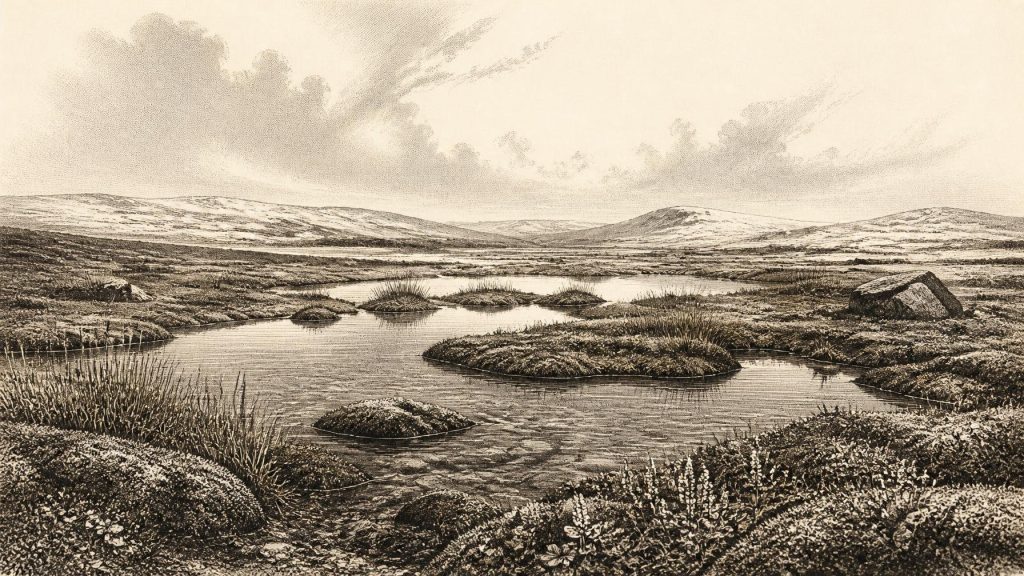
The Derryvree fossils describe a severe but inhabited environment. Pollen was poorly preserved, yet the surviving assemblage was predominantly herbaceous. Plant macrofossils and moss remains point to open wet ground and shallow freshwater. Sedge-rich margins, mosses, bogbean and water plants could occupy mud, pools and waterlogged hollows, while hardy herbs and low shrubs found footholds on better-drained patches. The evidence is consistent with tundra or muskeg-like terrain: a mosaic of damp ground, standing water, sparse vegetation and exposed mineral soil, not an unbroken sheet of snow and not a forest.
In practical terms, the growing season would have been short and conditions demanding. Periglacial climate means a landscape strongly affected by freezing and thawing outside the margins of permanent ice. Frost could disrupt soils; meltwater could shift channels and pond in hollows; vegetation would have responded quickly to small changes in temperature and moisture. Trees were absent locally, so there is no basis for imagining the oak, ash and hazel woods of later Ireland. The environmental record instead offers a glimpse of small, resilient plant communities at the edge of climatic possibility.
Derryvree also reveals why Irish deep history is often patchy. Organic deposits survive only under favourable circumstances. Here, later glacial sediment sealed a fragile freshwater archive beneath the drumlin. Elsewhere, advancing ice, erosion, redeposition and rising seas could remove or scramble traces of soils, camps and animal deaths. Absence of an excavated site is therefore not proof that no living creature or person ever passed through a district; equally, it cannot be used as permission to invent a lost population.
Animals in a Changing Island
Cave collections, especially from Castlepook Cave near Doneraile in north County Cork, show that Ireland supported a much richer cold-stage fauna during the wider MIS 3 period than later historical Ireland did. The assemblages include reindeer, red deer, giant deer, brown bear, wolf, Arctic fox, mountain hare, lemmings, woolly mammoth and spotted hyaena. These species were not necessarily present in one place at one time. Cave deposits can accumulate over thousands of years through carnivore activity, natural deaths, water movement, roof collapse and excavation disturbance. Their value lies in demonstrating that a broad variety of open-country and cold-adapted animals reached Ireland during the period, rather than in providing a single frozen tableau for 30,124 BCE.
Direct dating has sharpened this picture while also making it more cautious. Reassessment of old Irish cave collections using improved radiocarbon pretreatment has revised several ages substantially older. Some red-deer remains from Waterford caves date to approximately 32,930–31,280 calibrated years before present, overlapping the broad chronological neighbourhood of this article. At Castlepook, evidence indicates that certain mammals, including giant deer and spotted hyaena, belonged to a pre-Last Glacial Maximum fauna. Such dates make clear that Ireland was, at intervals, biologically connected to wider north-west European ecosystems.
Yet animal presence does not automatically describe human subsistence. Reindeer, deer and hares were potential food sources for people, but the Irish evidence does not demonstrate a regular hunting economy, seasonal rounds, hide-working area or established camp at this time. Nor does it demonstrate animal domestication, herding or farming. All of those belong to far later histories. For 30,124 BCE, the strongest economic evidence is ecological: wild animals and hardy plants exploiting open habitats in a landscape whose resources were seasonal and uncertain.
The Castlepook Human Question
The most consequential possible human trace relevant to this era is a reindeer femur from Castlepook Cave. Zooarchaeologist Ruth Carden has identified a deep mark on the bone as potentially made by a sharp stone tool while the carcass was fresh, and the specimen has been publicly associated with an age of about 33,000 years ago. If the modification is confirmed as human butchery and broadly contemporary with the animal’s death, it would indicate that people processed a reindeer in Ireland during the Upper Palaeolithic, dramatically earlier than the long-established post-glacial record.
The claim must remain narrowly framed. The bone derives from an old cave collection, not a modern excavation of an intact occupation floor. No securely associated hearth, stone-tool assemblage, dwelling, burial, human bone, art object or repeated sequence of occupation has been published for Castlepook at this age. A radiocarbon date on an animal bone dates the animal’s life, not necessarily the exact moment when a surface mark was made. Caves are especially complicated archives: carnivores, water, sediment movement and earlier collecting practices can disturb original relationships between objects.
The femur is therefore possible evidence of a brief human encounter with an animal carcass, not proof of a settled Irish population. People might have hunted a reindeer, scavenged a carcass, removed meat or sinew, or processed it elsewhere before the bone reached the cave. Those are interpretations to be tested, not established facts. The more securely dated butchered brown-bear patella from Alice and Gwendoline Cave in County Clare belongs much later, around 12,810–12,590 calibrated years before present, and cannot be used to fill the enormous chronological gap between these episodes.
No Polities, No Recorded Culture
There is no responsible basis for describing political affairs, diplomacy, warfare, named peoples, religion or formal learning in Ireland around this point. No chief, clan, sanctuary, weapon hoard, monument or exchange network can be assigned to the thirty-first millennium BCE. Comparisons with Upper Palaeolithic societies elsewhere in Europe show that hunter-gatherers could possess sophisticated stone technologies, tailored clothing, social ties across large areas and rich symbolic cultures. But those wider capacities cannot be converted into facts about Ireland without Irish material evidence.
Nor can trade be demonstrated. Lower sea levels and altered coasts changed the geography of the Irish Sea region, but the precise accessibility of Ireland varied through time and remains a subject for geological reconstruction. The environmental and faunal evidence shows that movements of animals into Ireland were possible during wider cold-stage intervals. It does not identify a human route, a boat crossing, a land connection at this exact date, or regular contact between communities.
The central development, then, was environmental instability. Around the broad span represented by 30,124 BCE, Ireland contained at least some ice-free terrain capable of sustaining cold-adapted vegetation and fauna, while glacier ice was an increasingly decisive regional force. Derryvree’s freshwater silts preserve a rare pause between glacial episodes; Castlepook’s bones preserve fragments of a vanished animal world; the debated reindeer femur raises the possibility of a fleeting human presence. Together they offer a vivid but deliberately incomplete history: not an annal of a year, but an evidence-based view of Ireland at the edge of ice, water and survival.
Primary Sources
- Middle Midlandian Freshwater Series at Derryvree, Maguiresbridge, County Fermanagh, Northern Ireland
- Palaeoecology: Irish Quaternary Association Field Guide
- Early Midlandian–Middle Midlandian, Pleistocene, Northern Ireland
- The Irish Quaternary Fauna Project
- A Reconsideration of the Radiocarbon Dating of the Marine Isotope Stage 3 Fauna from Southern Ireland
- Phylogeographic, Ancient DNA, Fossil and Morphometric Analyses Reveal Ancient and Modern Introductions of a Large Mammal: The Complex Case of Red Deer (Cervus elaphus) in Ireland
- First Evidence of a Late Upper Palaeolithic Human Presence in Ireland
- New Insights on the Fauna of Ireland's Younger Dryas and Early Holocene from Alice & Gwendoline Cave
- The Colonization of Ireland: A Human Ecology Perspective
- Growth and Retreat of the Last British–Irish Ice Sheet, 31,000 to 15,000 Years Ago: The BRITICE-CHRONO Reconstruction
- The Timing and Magnitude of the British–Irish Ice Sheet Between Marine Isotope Stages 5d and 2
- Early Deglaciation of the British-Irish Ice Sheet on the Atlantic Shelf Northwest of Ireland Driven by Glacioisostatic Depression and High Relative Sea Level
- Deglaciation Chronology of the Donegal Ice Centre, North-West Ireland
- Trimlines, Blockfields and the Vertical Extent of the Last Ice Sheet in Southern Ireland
- BRITICE Glacial Map, Version 2: A Map and GIS Database of Glacial Landforms of the Last British–Irish Ice Sheet
- The IntCal20 Northern Hemisphere Radiocarbon Age Calibration Curve (0–55 cal kBP)
- IntCal Publications
- Exhibition Galleries: National Museum of Ireland – Natural History
- The Archaeological Heritage of County Cork
- UCD School of Archaeology Research Day 2022
- Irish Quaternary Association