Hyenahall’s Reindeer Question30851 BCE
30,851 BCE is an imprecise modern label within MIS 3, not a recoverable Irish year. Derryvree, County Fermanagh, preserves freshwater sediments between glacial tills, indicating a locally ice-free, cold tundra wetland interval amid fluctuating ice conditions. Castlepook Cave, County Cork, contains chronologically mixed animal remains, including mammoth, reindeer and spotted hyaena, showing intermittent cold-stage fauna rather than a single community. A cut-marked reindeer femur may indicate Upper Palaeolithic butchery, but lacks secure archaeological context and cannot prove settlement. No evidence establishes polities, permanent population or routes. Fragmentary records instead portray dynamic Late Pleistocene Ireland, with uncertain, possibly transient human presence.
Dateline
30,851 BCE is a modern chronological label, not a recoverable year in Ireland’s past. No calendar, written account, settlement sequence or dated event allows historians to say what happened on this island in that particular year. In archaeological terms it falls roughly 32,800 years before AD 1950, within the Late Pleistocene and Marine Isotope Stage 3 (MIS 3), a long and climatically unstable part of the last Ice Age. The responsible subject is therefore an interval rather than an annual chronicle: a changing Irish environment known from buried sediments, cave bones, glacial landforms and a very small, debated body of possible evidence for people.
A Point Within a Broad Range
Calendar conversion must not be mistaken for precision. Radiocarbon laboratories conventionally measure ages in years “before present”, where present means AD 1950, but the concentration of atmospheric carbon-14 has changed through time. Results must consequently be calibrated against independently dated records, and the resulting calendar estimates are ranges, not single dates. At more than 30,000 years ago those ranges can be broad. The modern label 30,851 BCE may therefore be used to locate this article in time, but not to assign an animal death, a journey, a hunting episode or an ice advance to a named twelve-month period.
The nearest particularly informative Irish environmental archive is at Derryvree, near Maguiresbridge in County Fermanagh. Roadworks in 1969 cut through a drumlin and revealed freshwater silts and fine sands trapped between two thick tills: unsorted material laid down directly by glacier ice. Organic material from these intervening sediments produced the radiocarbon determination BIRM-166, 30,500 radiocarbon years BP, with a substantial uncertainty. Later discussion places the calibrated age broadly at about 36,900–31,700 cal BP. Thus 30,851 BCE sits close to the younger end of a wide range that can illuminate the period, not at a precise point within the Derryvree deposit.
Freshwater Beneath a Drumlin
The Derryvree sequence is important because its order tells a clear environmental story. An earlier phase of ice laid down the lower till. Afterwards, in this locality, standing or slow-moving freshwater accumulated silts, sands and organic remains. A later glacier then covered the site with the upper till. The deposit is direct evidence for an ice-free interval at Derryvree between separate ice advances. It is not proof that every part of Ireland was simultaneously free of ice, nor that conditions remained unchanged throughout the period represented by the sediments.
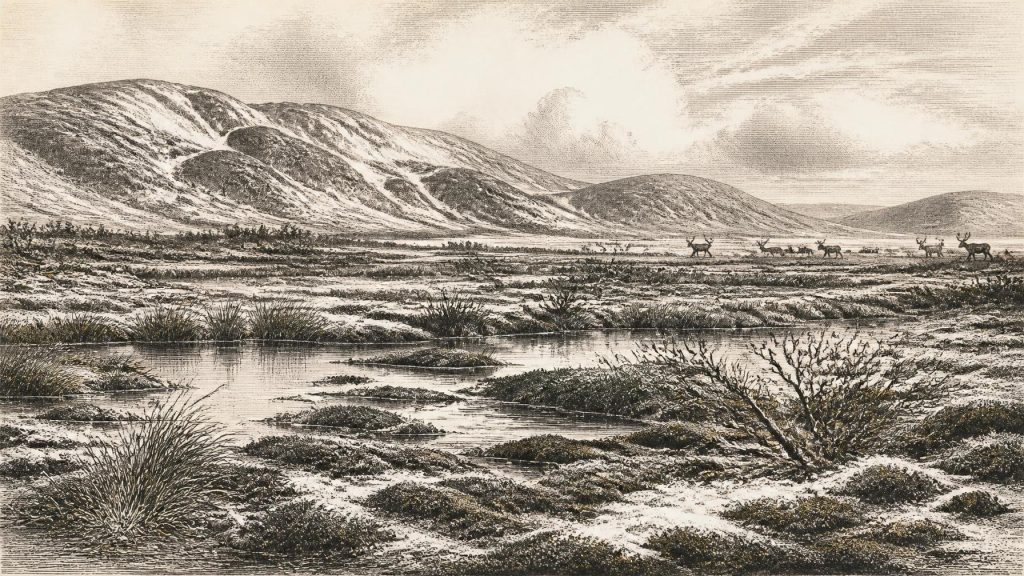
Its plant and insect evidence indicates open tundra vegetation and a periglacial regime: ground exposed to persistent cold, freeze-thaw action and a brief growing season. Rather than the familiar wooded and pasture-rich Ireland of the modern era, the local setting included wet ground, pools and plant-rich muskeg, surrounded by sparse, treeless vegetation. Such evidence supports a landscape where mosses, sedges and low-growing cold-adapted plants could occupy sheltered wet hollows. It does not justify imagining a uniform blanket of tundra across the island. Local relief, drainage, proximity to ice and the timing of climatic shifts would have made conditions highly varied.
For everyday life, Derryvree supplies an ecological baseline rather than a human one. The freshwater deposit shows that there were habitats capable of supporting insects, plants and animals during cold phases of the Ice Age. It says nothing directly about houses, clothing, language, kinship or food preparation. Yet its very survival matters: later glacier movement eroded or buried much of Ireland’s older ground surface, so such protected pockets are rare witnesses to a lost landscape.
Ice in Motion, Not a Frozen Island
MIS 3 was neither a stable mild interval nor the Last Glacial Maximum itself. Greenland ice-core records show repeated abrupt shifts between colder stadials and comparatively milder interstadials on millennial timescales. Ireland lay on the north-western edge of Europe, where Atlantic weather, sea ice, changing sea level and the behaviour of the British–Irish Ice Sheet could all affect local conditions. The Derryvree deposits fit this unstable wider world: they record an interruption in glaciation, followed by renewed ice activity.
Researchers differ over the extent and timing of pre-maximum Irish ice, because direct, securely dated deposits are scarce. Recent reviews nevertheless support a picture of ice-sheet growth, retreat and renewed advance during the last cold stage, while stressing the uncertainties before MIS 2. The great expansion of the British–Irish Ice Sheet is generally placed later, with its maximum extent around 27,000–21,000 years ago. At the date represented here, Ireland should not be described simply as either wholly ice-covered or wholly ice-free. It was a shifting mosaic whose regional histories cannot be compressed into one national weather report.
Castlepook’s Time-Mixed Fauna
In north County Cork, Castlepook Cave near Doneraile preserves the island’s richest known archive of vertebrate remains from the period leading towards the Last Glacial Maximum. The cave’s early excavators gave galleries evocative names including Hyenahall and Elephant Hall. More than 2,000 bones have been recovered, and modern radiocarbon work indicates that individual specimens span a long period, reported by Geological Survey Ireland as roughly 45,700 to 19,950 years BP. Castlepook is therefore not a snapshot of a single season or a single animal community. It is a repository into which bones entered by different routes over many millennia.
Its fauna includes woolly mammoth, giant deer, reindeer, brown bear and spotted hyaena; other later cold-stage finds include Arctic fox, wolf and lemmings. These remains demonstrate that Ireland was reached, at different times, by animals associated with cold, open environments and by predators able to exploit them. Spotted hyaenas are especially significant because caves can serve as carnivore dens, places where prey remains are accumulated, gnawed, scattered and later disturbed by water or excavation. A bone in Castlepook proves that an animal, or part of one, reached the cave; it does not automatically identify the place where it died, grazed or was killed.
The fauna makes a reindeer-centred food web plausible in parts of Ice Age Ireland, with large herbivores supporting scavengers and predators. But it would be misleading to arrange every identified species together in one imagined procession across the Doneraile landscape in 30,851 BCE. The cave collection is chronologically mixed. Its strongest contribution is to show the range of mammals that intermittently occupied or reached Ireland during a long and variable cold-stage history.
The Mark on a Reindeer Femur
Castlepook has acquired wider historical importance through one reindeer femur. Zooarchaeologist Ruth Carden identified a deep linear mark interpreted as damage made by a sharp stone tool while the bone was fresh. County Cork heritage material has associated the specimen with about 31,000 BC and suggested that mobile Stone Age hunters butchered reindeer in the region. If the mark is securely anthropogenic, it would be a remarkably early trace of human activity in Ireland and would place a human encounter with a reindeer broadly near the era considered here.
That possibility must be distinguished from established fact. The specimen comes from an older cave collection, not a newly excavated and securely sealed occupation surface. No tool demonstrably responsible for the mark has been recovered beside it. Nor are there associated hearths, dwelling floors, human remains, burials, ornaments, art, repeated camps or a substantial concentration of butchered waste of comparable age. The bone’s scientific date concerns the animal’s death, not necessarily the exact moment of marking or the location of carcass processing. Carnivore action, sediment movement, breakage and old excavation practices make cave assemblages difficult to interpret.
The evidence can therefore support a carefully framed hypothesis: one or more people may have handled or processed a reindeer in Ireland during the Upper Palaeolithic. It cannot demonstrate permanent colonisation, the size of any group, a regular migration route, a named people or an unbroken ancestry to later inhabitants. The National Museum of Ireland has long stated that no clear evidence had emerged for human presence in Ireland during the Palaeolithic; the Castlepook femur is an important challenge to that older consensus, but remains far too slight to turn this date into the foundation year of an Irish population.
No Polities, No Proven Ritual Landscape
There is no evidence at this depth of time for Irish political affairs, diplomacy, warfare between organised communities, trade networks, farming settlements or social institutions comparable to those of later prehistory. There were no known kingdoms, chiefs, monuments or formal territories. Nor can religion, learning or artistic culture be reconstructed from Derryvree’s silts and Castlepook’s bones. This is not a claim that a visiting person would have lacked beliefs, skills or social ties; rather, the Irish record cannot recover them.
If people did reach the island, they would have belonged to mobile Upper Palaeolithic worlds elsewhere in north-west Europe, in which knowledge of animals, seasonality, stone and shelter was vital. That is a reasonable comparative interpretation, not direct Irish evidence. No Irish lithic assemblage of this age has been found to show toolmaking, no occupation deposit demonstrates a domestic economy, and no secure route across the Irish Sea has been established. Lower global sea levels altered coasts, but ice, water and changing relative sea levels make any simple land-bridge narrative unsafe.
A Landscape Known by Fragments
Regional contrast is the main lesson of the evidence. Fermanagh’s buried freshwater sediments illuminate a cold wetland between ice advances. Cork’s limestone cave preserves bones from repeated episodes in a faunal landscape shaped by herbivores, carnivores and scavenging. Speleothem research in south-west Ireland records episodes when water could circulate through caves during MIS 3, adding another indication that climatic conditions changed repeatedly. None of these archives supplies an island-wide map for one year, but together they establish that Late Pleistocene Ireland was environmentally dynamic and occasionally hospitable to complex animal communities.
For 30,851 BCE, the most defensible Irish history is thus one of exposed cold ground, freshwater hollows, animal movement and advancing or retreating ice margins. Derryvree provides the strongest local environmental window; Castlepook offers an exceptional but time-layered animal archive; and the marked reindeer femur poses a major, unresolved question about human presence. The year itself cannot be recovered. The landscape around it can—cautiously, unevenly and with the uncertainties left visible.
Primary Sources
- A Middle Midlandian Freshwater Series at Derryvree, Maguiresbridge, County Fermanagh, Northern Ireland
- A reconsideration of the radiocarbon dating of the Marine Isotope Stage 3 fauna from southern Ireland
- The Irish Quaternary Fauna Project
- Castlepook Cave, County Geological Site Report
- Spotted Hyena Skull
- Heritage Artefacts of County Cork
- Archaeology Research Excavation Grant 2022: Final Report
- Prehistoric Details
- The Mesolithic in Ireland: when was it?
- Extent and timing of the Last Glacial Maximum (LGM) in Britain and Ireland: a review
- The timing and magnitude of the British–Irish Ice Sheet between Marine Isotope Stages 5d and 2: implications for glacio-isostatic adjustment, high relative sea levels and ‘giant erratic’ emplacement
- Pattern and timing of retreat of the last British-Irish Ice Sheet
- Timing, pace and controls on ice sheet retreat: an introduction to the BRITICE-CHRONO transect reconstructions of the British-Irish Ice Sheet
- Sedimentology and chronology of the advance and retreat of the last British-Irish ice sheet on the continental shelf west of Ireland
- Dimensions and chronology of the last ice sheet in Western Ireland
- The IntCal20 Northern Hemisphere Radiocarbon Age Calibration Curve (0–55 cal kBP)
- IntCal Publications
- A stratigraphic framework for abrupt climatic changes during the Last Glacial period based on three synchronized Greenland ice-core records: refining and extending the INTIMATE event stratigraphy
- Dansgaard–Oeschger events in climate models: review and baseline Marine Isotope Stage 3 (MIS3) protocol
- Episodic speleothem deposition tracks the terrestrial impact of millennial-scale last glacial climate variability in SW Ireland
- New insights on the fauna of Ireland's Younger Dryas and Early Holocene from Alice & Gwendoline Cave