
Awbeg’s Cave Fauna30850 BCE
About 30,850 BCE, Ireland lay within the climatically unstable Late Pleistocene MIS 3, not a precisely datable historical year. Ice, sea levels and routes changed repeatedly, leaving fragmentary evidence. Derryvree, County Fermanagh, preserves freshwater silts between tills, indicating open, treeless, wet tundra with grasses, sedges, juniper, mosses and insects. Castlepook Cave, County Cork, yielded reindeer, mammoth, giant deer, predators and lemmings, suggesting cold steppe or tundra. A marked reindeer femur may indicate human carcass processing, but cannot prove hunting, settlement or continuous occupation. No contemporary Irish evidence demonstrates communities, culture, economy or institutions; environmental and faunal remains provide the record.
Dateline
The label 30,850 BCE is useful only as a modern marker on a very deep prehistoric timescale. No person in Ireland recorded such a year, and archaeology cannot isolate an event, journey or season to this point with calendar-like precision. In the conventional system measured backwards from AD 1950, it falls roughly 32,800 years before present. It belongs to the Late Pleistocene, within Marine Isotope Stage 3 (MIS 3), a climatically volatile part of the last Ice Age. Evidence from Ireland must therefore be discussed through radiocarbon ranges, stratigraphy and environmental sequences, not as an annual chronicle.
A Changing Ice-Age Landscape
Ireland around this broad horizon was neither the familiar green, wooded island of later prehistory nor necessarily a single, uniformly frozen wilderness. The later maximum of the British–Irish Ice Sheet is generally placed after this period, reaching its fullest extent around 27,000 years ago and persisting into the following millennia. Before that maximum, ice margins, sea levels and climates changed repeatedly. Some areas were glaciated at particular times; others supported open ground, freshwater and animal life. Subsequent ice advances eroded or buried much of the evidence, which is a major reason why the Irish record is so fragmentary.
Lower sea level transformed the geography of north-west Europe. Land now beneath the Irish Sea and continental shelf was exposed in places, while the precise arrangement of land, water, ice and seasonal routes altered over long periods. It would be unsafe, however, to picture a permanent, easy land bridge connecting Ireland to Britain or continental Europe in 30,850 BCE. The palaeogeography was dynamic, and the evidence does not establish how animals—or any possible people—crossed at a particular moment. What can be said is that Ireland was less isolated than it became after post-glacial sea-level rise, allowing intermittent colonisation by cold-stage mammals.
Derryvree’s Buried Wetland
The clearest Irish environmental evidence relevant to this general age comes not from a settlement but from Derryvree, near Maguiresbridge in County Fermanagh. Roadworks in 1969 cut through a drumlin and exposed fine sands and freshwater silts sealed between two thick layers of till, the unsorted debris left by glacial ice. The sequence records an interval in which a wetland or shallow freshwater setting existed after one ice advance and before another. Its survival beneath later glacial deposits is an extraordinary accident of preservation.
The original radiocarbon determination from the organic deposit was 30,500 radiocarbon years before present, with a substantial uncertainty of +1,170 and −1,030 years. That is not the same as a calendar date. Radiocarbon ages of this antiquity require calibration against changing atmospheric carbon-14 levels, and calibrated results are ranges rather than one exact year. Modern calibration work reaches back to 55,000 calibrated years before present, but uncertainty necessarily increases at this depth in time. Derryvree should therefore be used to illuminate the wider MIS 3 world near the requested date, not as proof that a particular pool or plant stood there in 30,850 BCE.
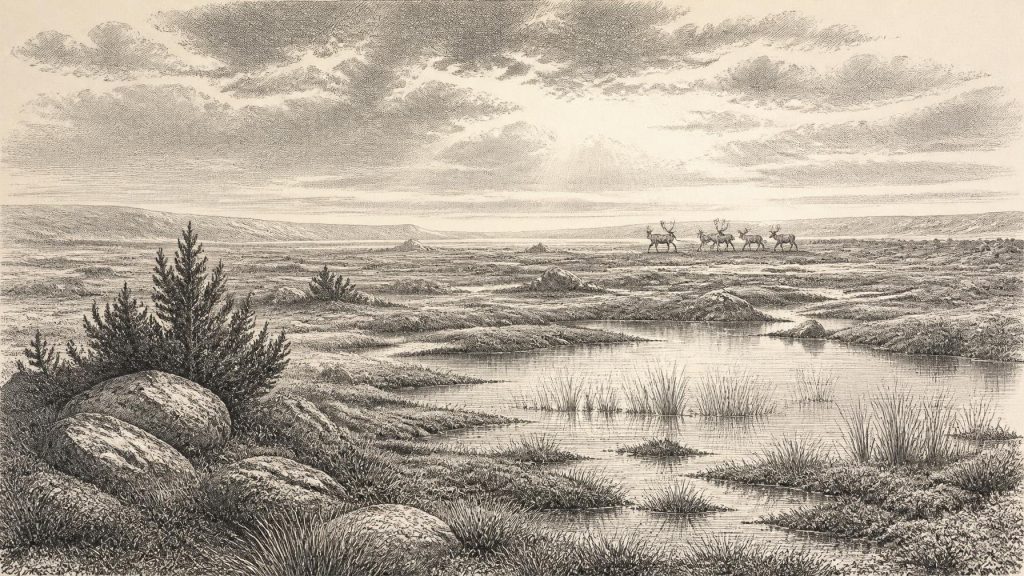
Its fossils nevertheless offer a rare view of living conditions. Poorly preserved pollen was dominated by herbaceous plants, while plant macrofossils included grasses, sedges, juniper and a notably rich moss flora. Aquatic and wet-margin plants indicate freshwater rather than a sterile ice sheet. Insect remains likewise point to plant-rich wet ground, pools and mossy margins. Researchers interpret the combined evidence as open, largely treeless tundra or muskeg-like terrain: waterlogged ground shaped by frost, short growing seasons and sparse vegetation. It was a landscape of local ecological niches, not woodland or farmland.
This evidence matters because it corrects two misleading extremes. Ireland was not continuously habitable in the way it became in the Holocene, but nor was every part of it permanently entombed beneath ice throughout the whole last glacial period. Derryvree shows that, during one cold interval of MIS 3, freshwater habitats and low-growing plant communities could exist in Fermanagh. It cannot demonstrate that conditions were identical across the island, still less that the same conditions obtained century after century.
Animals of the Awbeg Valley
For southern Ireland, Castlepook Cave near Doneraile in north County Cork is the most important archive. Also known historically as Mammoth Cave, it lies in the Awbeg Valley below the Ballyhoura Hills. Excavations undertaken mainly in the early twentieth century recovered a large and complicated collection of animal remains. Later reassessment and radiocarbon dating through the Irish Quaternary Fauna Project showed that a range of mammals reached Ireland between at least about 45,000 and 20,000 years ago, though individual cave deposits were often disturbed and cannot be treated as single, neatly dated layers.
Castlepook’s pre-Last Glacial Maximum fauna includes reindeer, woolly mammoth, giant deer, brown bear, wolf, Arctic fox, mountain hare, collared lemming, Norwegian lemming and spotted hyaena. The association is highly informative, but it is not a snapshot of one day or one season. Bones could have accumulated through repeated animal deaths, carnivore scavenging, transport by water, cave sediment movement and excavation practices that long pre-dated modern archaeological recording. Some were chewed by hyaenas. A cave may act as den, refuge, trap, drainage passage and sediment store over thousands of years.
Even so, the assemblage supports a cautious picture of open cold-steppe or tundra conditions in parts of southern Ireland. Reindeer and lemmings are consistent with cold, exposed habitats; mammoth and giant deer indicate that sufficient vegetation supported large herbivores; predators and scavengers followed those herbivores. The conspicuous absences are also of interest. The Irish fossil record of this phase is poorer in species than broadly contemporary British records, and certain familiar continental animals, including woolly rhinoceros and steppe bison, are not securely represented at Castlepook. This was not simply Britain or mainland Europe transplanted intact across the sea.
The Reindeer Bone Question
A single Castlepook object gives this broad period unusual historical importance: a reindeer femur carrying a deep linear mark interpreted by the zooarchaeologist Ruth Carden as having been made by a sharp stone edge during carcass processing. County Cork heritage material dates the specimen broadly to about 31,000 BC and presents it as possible evidence that Stone Age hunters butchered reindeer in Ireland. If that diagnosis is confirmed, it would push human activity in Ireland dramatically earlier than the better-established Late Upper Palaeolithic evidence from Alice and Gwendoline Cave, County Clare, where a cut-marked brown-bear bone dates to about 12,800–12,600 calibrated years before present.
The claim must be stated conditionally. The femur comes from an old cave collection, not a modern excavation of a sealed occupation surface. Radiocarbon dating can establish the age of the animal bone’s collagen; it does not independently date the incision, identify its maker or establish where the animal died. No securely associated hearth, stone-tool assemblage, shelter, burial, human remains or concentrated butchery floor of comparable age has been found at Castlepook. Distinguishing stone-tool damage from carnivore action, trampling, breakage, weathering or excavation damage requires detailed taphonomic study. Recent excavation and post-excavation work at the cave may improve the evidence, but it has not yet supplied a demonstrated settlement.
The responsible conclusion is important but modest. The marked femur may record a brief human encounter with a reindeer carcass in Ice-Age Ireland. It does not prove that people hunted the animal, that they butchered it inside the cave, that they lived nearby, or that Ireland possessed a continuous human population at this date. A small mobile party might have taken meat or other useful material from a carcass before carnivores brought bones into the cave; equally, the route by which people, if present, reached the island remains unknown.
Society Beyond Recovery
There is no evidence from Ireland around 30,850 BCE for political communities, named territories, chiefs, warfare, diplomacy, law or institutions. There are no written records, and no securely dated Irish settlement evidence from which to reconstruct households, population size, social rank or kinship. It would be misleading to supply these absences with general knowledge about Upper Palaeolithic Europe. Communities elsewhere in Europe used sophisticated stone technologies, clothing, fire and long-distance social networks, but no artefacts securely demonstrate those practices in Ireland at this time.
The same restraint applies to religion, culture and learning. Ireland has yielded no securely dated ritual place, burial, art, musical instrument, ornament or symbolic object of this age. No language can be assigned, no belief system recovered and no artistic tradition identified. The cave fauna may show that people were potentially present for a short time; it does not reveal what they thought, said, wore or remembered.
Subsistence Without an Economy
If the cut-mark interpretation is accepted, the only direct economic inference is exceedingly narrow: somebody used a sharp edge on fresh reindeer bone or meat-bearing tissue. Reindeer could provide meat, fat, hide, sinew, antler and bone, but the femur alone cannot show which resources were taken. Nor can it establish hunting methods, seasonal migration, food storage, trade or an organised exchange economy. There is no evidence for agriculture, herding, pottery, metalworking, permanent buildings or maritime trade. Those developments belonged to immensely later chapters of Irish history.
The most substantial history available for this notional year is environmental. Ireland was part of a changing north-west European Ice-Age world in which ice advanced and retreated, wetlands formed briefly between glacial episodes, and cold-adapted animals reached terrain that later sea and ice would remake. Derryvree preserves a northern freshwater tundra environment; Castlepook preserves the more dramatic bone archive of southern mammals and perhaps a single humanly modified reindeer bone. Together they offer evidence, not a lost national story: a landscape capable of supporting life, but one from which almost every trace of any human visitor has been erased or remains undiscovered.
Primary Sources
- A Middle Midlandian Freshwater Series at Derryvree, Maguiresbridge, County Fermanagh, Northern Ireland
- Palaeoecology: The Middle Midlandian Palaeoenvironment of South Fermanagh
- A Reconsideration of the Radiocarbon Dating of the Marine Isotope Stage 3 Fauna from Southern Ireland
- The Irish Quaternary Fauna Project
- The Exploration of Castlepook Cave, County Cork, Being the Third Report from the Committee Appointed to Explore Irish Caves
- The Exploration of Castlepook Cave, Co. Cork. With 3 Plates
- Archaeology Research Excavation Grant 2022: Castlepook Cave Final Report
- 2022:564 – Castlepook Cave, Castlepook South, Cork
- Heritage Artefacts of County Cork
- Dimensions and Chronology of the Last Ice Sheet in Western Ireland
- Trimlines, Blockfields and the Vertical Extent of the Last Ice Sheet in Southern Ireland
- Late Pleistocene Chronostratigraphy and Ice Sheet Limits, Southern Ireland
- Pattern and Timing of Retreat of the Last British-Irish Ice Sheet
- Deglaciation Chronology of the Donegal Ice Centre, North-West Ireland
- Oscillating Retreat of the Last British-Irish Ice Sheet on the Continental Shelf Offshore Galway Bay, Western Ireland
- First Evidence of a Late Upper Palaeolithic Human Presence in Ireland
- The Colonization of Ireland: A Human Ecology Perspective
- New Insights on the Fauna of Ireland's Younger Dryas and Early Holocene from Alice & Gwendoline Cave
- The IntCal20 Northern Hemisphere Radiocarbon Age Calibration Curve (0–55 cal kBP)
- Pleistocene Vertebrates in the British Isles
- Occurrence of Mammalia Relicts at Site Castlepook Cave