
Doneraile’s Reindeer Passage30852 BCE
Dateline
30,852 BCE is a modern chronological label, not a date that can be matched to a recorded Irish event. No calendar, writing system or year-count survives from this depth of time, and neither archaeology nor palaeoclimate research can identify what happened on the island in one particular year. The responsible approach is to place this nominal year within the later part of Marine Isotope Stage 3 (MIS 3), the long, climatically unstable phase before the Last Glacial Maximum. Evidence relevant to Ireland comes in calibrated ranges, radiocarbon measurements, cave deposits, fossil assemblages, pollen and sediments. Those records illuminate changing environments over centuries or millennia, not a day, season or named generation in 30,852 BCE.
An Island Approaching Maximum Ice
This date falls during a major transformation in north-west Europe. The British–Irish Ice Sheet was building towards its greatest overall volume, reached much later, around 23,000 years before present, while its different sectors advanced and retreated at different times. Reconstructions indicate sustained ice-sheet growth from about 31,000 to 26,000 years ago. Ireland was therefore not uniformly, permanently entombed beneath ice at 30,852 BCE, but it was entering an increasingly severe glacial world in which the extent of ice, exposed ground, coastlines and routes through the Irish Sea changed substantially by region and through time.
Lower global sea level altered the outlines of the surrounding seas, but it does not license a simple picture of a reliable dry land bridge between Ireland and Britain. The precise geography depended on ice, sea level, crustal movement and local topography. Scholars continue to debate possible connections and crossings at different stages of the Late Pleistocene. For this period, it is safest to say that Ireland was part of a changing western European physical system, periodically accessible to cold-adapted mammals, while the exact routes by which animals—and any people—reached it cannot be reconstructed from the existing evidence.
Open Ground, Wet Hollows and Cold Water
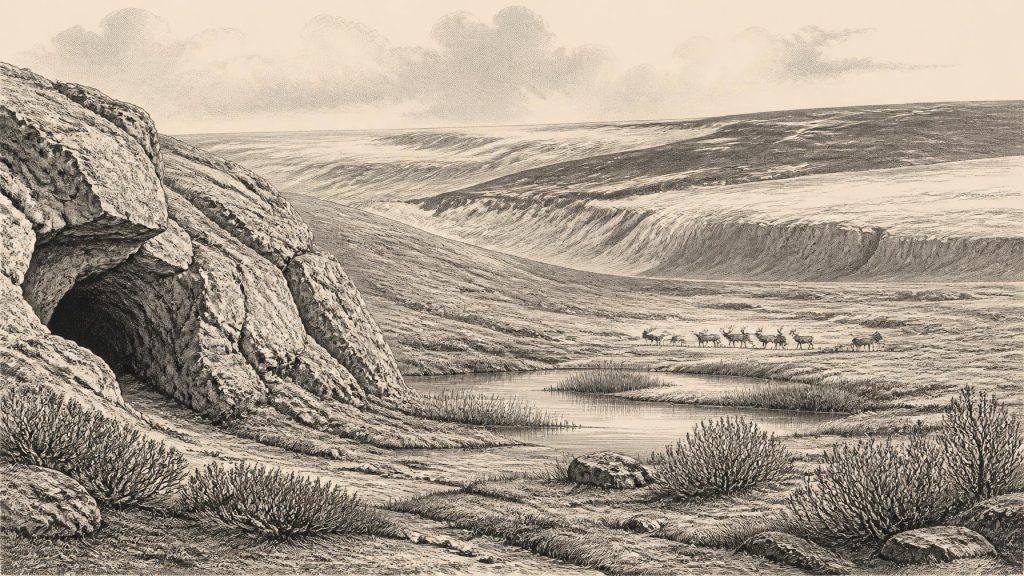
The best terrestrial environmental evidence does not provide a weather report for the numbered year. At Derryvree near Maguiresbridge in County Fermanagh, however, organic silts and sands preserved between two tills record a treeless freshwater and muskeg environment from an earlier cold-stage interval. Pollen, plant macrofossils, mosses and small invertebrate remains point to open ground with wet hollows, sedges and cold-tolerant vegetation rather than woodland. Plants recorded from the sequence include dwarf willow, mountain-avens, bogbean, water-milfoil and lesser clubmoss. Such evidence is valuable for understanding the kinds of periglacial habitats that existed in Pleistocene Ireland, although it must not be treated as proof that every part of the island looked identical in 30,852 BCE.
In southern and south-eastern Ireland, cave faunas add another line of evidence. The animal record includes reindeer, woolly mammoth, giant deer, brown bear, wolf, Arctic fox, mountain hare, lemmings and spotted hyaena. Together these remains indicate that at suitable times parts of Ireland supported, or were visited by, a cold-climate fauna comparable with that of neighbouring north-west Europe. This was not a green, forested Ireland. It was a sparse and exposed landscape, shaped by frost, wind, seasonal water and expanding ice. Yet it was not biologically empty: grazing animals, predators and scavengers could exploit its shifting mosaics of grassland, herb-rich ground, wetland and rocky shelter.
Caves as Archives, Not Villages
Castlepook Cave, also called Mammoth Cave, near Doneraile in north County Cork is especially important. Antiquarian excavations in the early twentieth century recovered a large quantity of Ice Age bone from its passages. Later re-examination and modern radiocarbon dating have transformed the significance of these old collections. Improved pretreatment has shown that some earlier measurements from Castlepook substantially underestimated the antiquity of specimens, by several thousand radiocarbon years. The cave preserves evidence from both before and after the Last Glacial Maximum, an unusual and important survival in Ireland, where later glaciation destroyed or disturbed much earlier ground surface evidence.
A cave assemblage nevertheless requires caution. Bones may have accumulated through carnivore activity, natural death, falling rock, water movement, repeated use of the cave or excavation disturbance. A mammoth bone does not demonstrate a mammoth hunt; a hyaena tooth does not demonstrate a hyaena den in every phase of the cave’s history. Nor does a fossil animal prove a contemporaneous human community. The scientific value of Castlepook lies partly in its capacity to show that an Ice Age fauna reached southern Ireland, but also in the questions its disturbed deposits pose about chronology, behaviour and preservation.
The Reindeer Femur
One Castlepook object matters particularly for an account centred on this broad period: a reindeer femur reportedly about 33,000 years old, with a deep surface modification interpreted by zooarchaeologist Ruth Carden as a cut or chopping mark made by a sharp stone tool while the bone was fresh. If that interpretation is upheld, it would be the earliest known indication that people processed an animal in Ireland, placing a human visit in the Upper Palaeolithic world tens of millennia before the island’s better-established terminal Pleistocene and Mesolithic records.
That is an important possibility, but not yet evidence for a settled population, a camp or a continuous Irish occupation. The femur came from an old cave collection rather than a modern excavation of an intact living surface. Its radiocarbon determination dates the animal’s death, not automatically the exact making of the mark, the location of butchery or the duration of a human presence. No securely associated hearth, stone-tool assemblage, dwelling, human burial or repeated food-processing deposit of comparable age has been recovered from Ireland. Current investigations at Castlepook have sought surviving Pleistocene deposits precisely because the question deserves testing with modern field methods.
People, If Present
Should the femur represent genuine human butchery, the most defensible reconstruction is modest. One or a few mobile hunter-gatherers may have encountered, killed or scavenged a reindeer and removed meat, marrow or other useful tissues with a sharp lithic edge. Reindeer would have supplied food, hide, sinew, bone and antler; however, none of these uses can be demonstrated from Ireland for this particular episode. It would be unwarranted to assign the visitors an archaeological culture, language, ethnicity or homeland, or to assume that they left behind families, winter camps or descendants on the island.
There is likewise no direct Irish evidence for political institutions, leaders, warfare, diplomacy, formal trade networks, religion, art or learning at this date. Those are not gaps to be filled by borrowing better-known cave art, graves or tool traditions from France, Iberia or Britain. Upper Palaeolithic societies elsewhere in Europe certainly possessed sophisticated technologies, social ties and symbolic practices, but their existence elsewhere does not make them Irish facts. In Ireland, the archaeological record for around 30,852 BCE remains far too slight to identify a polity, a ritual site or even a lasting settlement.
Economy Without Agriculture
Any human economy indicated by Castlepook would have been based wholly on wild resources. There was no farming, livestock, cereal cultivation, pottery, metalworking or built monument tradition known from Ireland at this date. The relevant evidence instead concerns the seasonal availability of animals and the practical value of sheltered limestone caves within an open cold landscape. Hunting, scavenging and the movement of people through resource patches are reasonable general possibilities; long-distance exchange, seafaring capability and permanent residence remain unproven for Ireland in this phase.
The animal assemblages also emphasise regional difference. The best-known MIS 3 cave evidence is concentrated in the south and south-east, including County Cork and County Waterford, while Derryvree in Fermanagh offers a very different, sedimentary window on northern wetland conditions. Such unevenness reflects both real variations in ancient landscape and the accidents of preservation and discovery. Caves preserve bones better than exposed terrain; road cuttings can reveal buried deposits briefly before they vanish. Ireland’s apparent archaeological silence may therefore record destructive ice, erosion and limited sampling as much as the absence of people.
What Can Be Said Responsibly
For 30,852 BCE, Ireland should be understood not as a country of tribes, kingdoms or monuments, but as a changing Pleistocene landscape on the north-western edge of Europe. Calibrated and revised dating shows that cold-adapted mammals occupied or reached parts of the island during MIS 3, before advancing ice transformed much of the terrain. Castlepook’s reindeer femur raises the serious possibility of a brief Upper Palaeolithic human encounter with that world. Derryvree and other environmental archives reveal open, cold and locally wet habitats that explain how life persisted beyond the ice.
The central historical fact is therefore one of uncertainty disciplined by evidence. There is no year-specific Irish event to narrate. There is, instead, a fragile record of bones, sediments and plant remains, with one potentially momentous modified reindeer bone at Doneraile. It suggests that Ireland may have been visited by people far earlier than once believed, while firmly reminding us that a visit is not colonisation, a cut mark is not a settlement, and a modern calendar year cannot give false precision to an Ice Age past.
Primary Sources
- A Reconsideration of the Radiocarbon Dating of the Marine Isotope Stage 3 Fauna from Southern Ireland
- The Irish Quaternary Fauna Project
- First Evidence of a Late Upper Palaeolithic Human Presence in Ireland
- Phylogeographic, Ancient DNA, Fossil and Morphometric Analyses Reveal Ancient and Modern Introductions of a Large Mammal: the Complex Case of Red Deer (Cervus elaphus) in Ireland
- A Middle Midlandian Freshwater Series at Derryvree, Maguiresbridge, County Fermanagh, Northern Ireland
- Growth and Retreat of the Last British–Irish Ice Sheet, 31,000 to 15,000 Years Ago: the BRITICE-CHRONO Reconstruction
- Growth and Retreat of the Last British–Irish Ice Sheet, 31,000 to 15,000 Years Ago: the BRITICE-CHRONO Reconstruction
- Trimlines, Blockfields and the Vertical Extent of the Last Ice Sheet in Southern Ireland
- Last Glacial Maximum Cirque Glaciation in Ireland and Implications for Reconstructions of the Irish Ice Sheet
- Pattern and Timing of Retreat of the Last British-Irish Ice Sheet
- Timing and Pace of Ice-Sheet Withdrawal Across the Marine–Terrestrial Transition West of Ireland During the Last Glaciation
- The Deglaciation of the Western Sector of the Irish Ice Sheet from the Inner Continental Shelf to its Terrestrial Margin
- The Problem of a Late Quaternary Landbridge Between Britain and Ireland
- Deglaciation, Earth Crustal Behaviour and Sea-Level Changes in the Determination of Insularity: A Perspective from Ireland
- Ireland: Submerged Prehistoric Sites and Landscapes
- Archaeology Research Excavation Grant 2022
- 2022:564 – Castlepook Cave, Castlepook South, Cork
- Heritage Artefacts of County Cork
- New Insights on the Fauna of Ireland's Younger Dryas and Early Holocene from Alice & Gwendoline Cave
- Irish Cave Exploration
- Figure 6.—The Subdivision of the Quaternary Period in Ireland