Rosy Saxifrage at Derryvree30847 BCE
30,847 BCE is a modern chronological label for a poorly dated Late Pleistocene interval, not a recorded Irish year. Derryvree, County Fermanagh, preserves freshwater organic sediments between glacial tills, revealing a cold, treeless wetland with mosses, sedges, rosy saxifrage and other Arctic-alpine plants. Cave deposits, notably Castlepook in County Cork, document mammals including reindeer, mammoth, giant deer, bear, fox and hyaena across MIS 3. A possibly stone-tool-marked reindeer bone may indicate an early human visit, but does not prove settlement. No villages, farming, trade, polities, religion or written record are known. Environmental instability and changing ice cover define this period.
Dateline
30,847 BCE is a useful modern label, not a recoverable Irish calendar year. No people in Ireland then kept a calendar, and archaeology cannot identify an event, ruler or settlement belonging to that single year. In scientific terms it falls roughly 32,800 calendar years before 1950, within the later part of the Late Pleistocene and Marine Isotope Stage 3 (MIS 3), a long interval of abrupt climatic change before the Last Glacial Maximum. The responsible history of Ireland at this depth of time is therefore a history of deposits, fossils and uncertainty: what the evidence directly records, and what may cautiously be inferred from it.
The closest Irish environmental archive is at Derryvree near Maguiresbridge, County Fermanagh. Road cutting through a drumlin exposed organic freshwater silts and fine sands between two deposits of till, the unsorted debris laid down by glacier ice. The sequence gives a firm relative order: ice had previously occupied the locality; an interval without local glacier cover permitted water and organic sediment to accumulate; and later ice sealed the sediments beneath another till. It does not supply a snapshot of all Ireland, still less a diary of one year. Yet it is an exceptional window onto a lost Irish landscape.
A Date Within a Range
Organic material from the Derryvree bed produced a conventional radiocarbon age of about 30,500 radiocarbon years before present, with an uncertainty of around a millennium. Radiocarbon years are not calendar years. Atmospheric carbon-14 has varied through time, so scientists calibrate measurements against independently dated records; at this antiquity, one result commonly converts into a broad, multi-millennial probability range rather than a narrow historical date. Successive improvements to calibration curves can also alter the range.
That is why 30,847 BCE must not be treated as the precise date of the Derryvree pool, its plants or an animal’s visit. Rather, the named year lies in the climatic and chronological neighbourhood illuminated by Derryvree and other Irish MIS 3 evidence. The traditional label for this part of the sequence, the Derryvree Cold Phase, should likewise be understood as a geological shorthand, not as a uniformly frozen episode covering every district at once. Ice-sheet growth and retreat were regional, asynchronous and repeatedly reshaped the available land.
Fresh Water Between the Ice
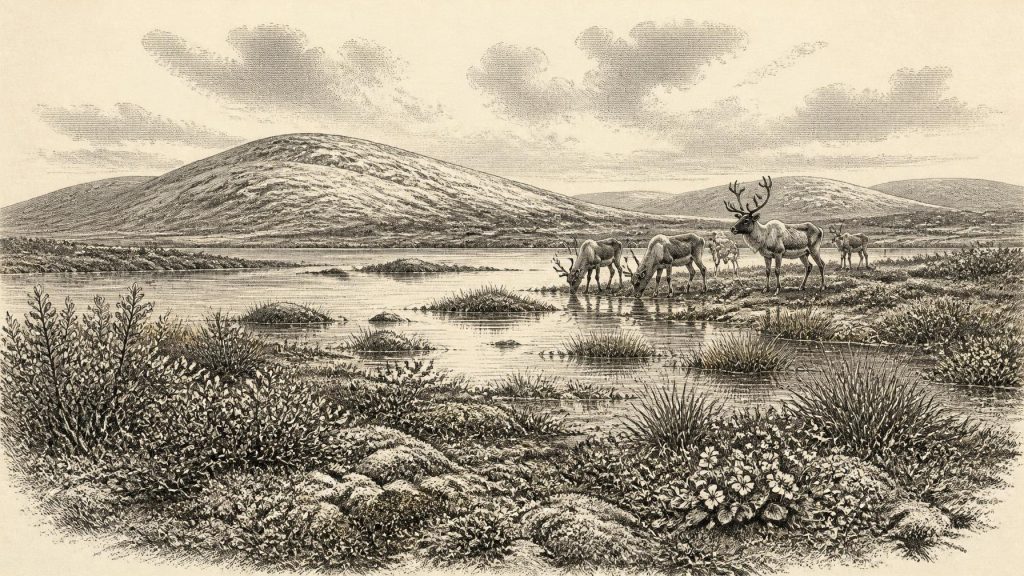
The Derryvree sediments show that a locality now within the drumlin country of Fermanagh supported fresh water and life between glacial advances. Plant remains, pollen, mosses and insects indicate an open, treeless, cold environment often described as muskeg: saturated ground with shallow pools, sedges, mosses and low vegetation. It was not the wooded Ireland of later prehistory, and it was not necessarily a featureless sheet of permanent ice. Seasonal freezing and thaw, wind exposure and a short growing season would have dominated conditions.
The fossil flora is unusually eloquent. It includes plants associated with cool, wet or Arctic-alpine settings, among them mountain-avens, dwarf willow, lesser clubmoss, bogbean and alternate water-milfoil. Rosy saxifrage has also been recorded from the Derryvree deposit. These finds are direct evidence that particular plants, or their propagules, entered the local sedimentary environment. Together they support reconstruction of a low, open wetland mosaic. They do not prove that every Irish valley held the same vegetation, nor that isolated pollen grains of trees represent nearby woodland: pollen can travel far or be redeposited from older material.
In this landscape, water mattered. Pools and slow channels offered different habitats from frost-shattered slopes or dry gravelly ground. Wet soils could preserve plant fragments and tiny invertebrate remains which normally vanish from the archaeological record. The very survival of Derryvree’s organic bed is therefore part of its importance. Later ice and erosion destroyed or buried much evidence from this period, leaving historians dependent upon rare deposits caught between glacial sediments.
Animals at the North-Western Edge
Cave collections, especially those from Castlepook Cave near Doneraile in north Cork, show that Ireland supported a richer cold-stage mammal fauna than its modern fauna suggests. Radiocarbon programmes and later re-dating have documented remains attributable, at different points in MIS 3, to reindeer, woolly mammoth, giant deer, brown bear, hare, fox and spotted hyaena. Castlepook is particularly valuable because it preserves pre- and post-Last Glacial Maximum deposits, though its early excavated collections also demand care: fossils came from caves disturbed by natural processes and by excavation, and specimens from one cave need not be contemporary.
It would consequently be wrong to imagine a single, neatly assembled ‘Derryvree fauna’ roaming Ireland in 30,847 BCE. A mammoth bone, hyaena jaw or reindeer limb is evidence for a species’ presence within a dated range, not proof that all these animals met in one place or season. Nevertheless, the combination is consistent with cold, open habitats capable of supporting grazing and browsing herbivores, scavengers and predators. Reindeer are especially compatible with an open tundra-like setting; carnivores and cave processes may also explain why bones accumulated in limestone chambers.
Faunal presence also demonstrates that Ireland was not biologically isolated in the absolute sense. Large mammals reached this western edge of Europe during favourable phases of the Ice Age. Lower sea levels altered coastlines and the geographical relationship between Ireland, Britain and the continent, but the exact routes varied through time and remain contested. The fossils support connectivity sufficient for animal dispersal; they do not establish a permanent dry-land route at this particular moment, a human migration corridor, or regular sea crossings.
The Castlepook Reindeer Question
One object makes human history relevant, while also defining its limits: a reindeer femur from Castlepook. It has been publicly presented by County Cork heritage authorities and palaeozoologist Ruth Carden as bearing a deep mark consistent with processing by a sharp stone tool, and as dating to about 31,000 BC in broad calendar terms. If that interpretation is sustained, it may represent the earliest known evidence that people handled an animal in Ireland, vastly earlier than the well-attested post-glacial hunter-gatherer record.
Even so, it cannot be converted into an Irish population or a year-specific human event. The date measures the age of the bone, not the instant at which a mark was made; the cave material has complex contexts; and no securely associated hearth, stone-tool assemblage, dwelling floor, burial or repeated butchered assemblage has demonstrated a settlement at Castlepook in this period. Nor can a single modified bone identify the visitors’ language, ancestry, numbers, route or duration of stay. The mark is important precisely because it is such slight and potentially consequential evidence.
Life, Without a Village
If people did reach Ireland during this broader interval, the most economical interpretation is of highly mobile foragers taking advantage of animal resources, not farmers founding villages. A carcass-processing mark would imply knowledge of sharp stone technology and practical use of meat, hide, sinew or marrow. But this remains a conditional inference. Ireland has not produced the camps, hearths, tool scatters, structured burials or occupation layers required to describe everyday routines with confidence at around 30,847 BCE.
There is no evidence for cultivation, domesticated stock, pottery, metalworking, field boundaries or built monuments. Nor is there evidence for trade in the later archaeological sense: no known imported tool assemblage, exchange depot or sustained maritime network can be assigned to this time. Animal movements and potential human visits should not be mistaken for an economy of regular commerce. Survival, where it occurred, would have depended upon fluctuating access to shelter, fuel, stone, water and game within an unstable cold environment.
No Polities, No Recorded Beliefs
Political affairs, diplomacy and organised conflict cannot responsibly be reconstructed for Ireland at this date. There are no named communities, territories, leaders, weapons assemblages or defensive sites. Competition between predators, and perhaps between human groups elsewhere in north-west Europe, belongs to ecological or comparative discussion rather than to demonstrable Irish politics. It is equally impossible to infer a religion from the Derryvree wetland or Castlepook fauna. Ireland has no securely dated ritual structure, grave, portable art or cave art from this interval.
Culture and learning must be framed negatively but not dismissively. Any visitors were fully capable human beings with social knowledge, skilled observation and learned practices, but the Irish evidence does not preserve their stories. The absence of writing is unsurprising; the absence of durable artefacts is the larger historical difficulty. Later prehistoric Ireland is rich in houses, tombs, tools and monuments. At 30,847 BCE, the archive is chiefly environmental, and its silences are as significant as its discoveries.
An Ireland in Transition
The central development around this notional year was not a battle, dynasty or invention. It was environmental instability. Derryvree preserves a period when cold-adapted wetland life occupied ground between episodes of glaciation, while southern cave deposits record large mammals living at the north-western limit of their European ranges. The major expansion and maximum development of the British-Irish Ice Sheet lay ahead, although research increasingly emphasises that ice built up in stages and that different sectors behaved differently.
For Ireland, then, 30,847 BCE is best approached through rosy saxifrage in a buried Fermanagh freshwater deposit, and through the bones of animals found in Cork caves. They establish neither a nation nor a continuous human past. They reveal something more fundamental: a changing, sparsely evidenced Ice Age landscape in which life persisted locally between the ice, and in which the possibility of an early human encounter remains open to further excavation, dating and debate.
Primary Sources
- A Middle Midlandian Freshwater Series at Derryvree, Maguiresbridge, County Fermanagh, Northern Ireland
- The Irish Quaternary Fauna Project
- A Reconsideration of the Radiocarbon Dating of the Marine Isotope Stage 3 Fauna from Southern Ireland
- Phylogeographic, Ancient DNA, Fossil and Morphometric Analyses Reveal Ancient and Modern Introductions of a Large Mammal: the Complex Case of Red Deer in Ireland
- Landscapes and Environments of the Last Glacial-Interglacial Transition: a Time of Amazingly Rapid Change in Ireland
- Figure 6.— The Subdivision of the Quaternary Period in Ireland
- Exploring Controls of the Early and Stepped Deglaciation on the Western Margin of the British Irish Ice Sheet
- Growth and Retreat of the Last British–Irish Ice Sheet, 31,000 to 15,000 Years Ago: the BRITICE-CHRONO Reconstruction
- Stratigraphic and Palaeo-Geomorphological Evidence for the Glacial-Deglacial History of the Last British-Irish Ice Sheet in the North-Western Irish Sea
- The Timing and Magnitude of the British–Irish Ice Sheet Between Marine Isotope Stages 5d and 2: Implications for Glacio-Isostatic Adjustment, High Relative Sea Levels and ‘Giant Erratic’ Emplacement
- The IntCal20 Northern Hemisphere Radiocarbon Age Calibration Curve (0–55 cal kBP)
- IntCal History
- Heritage Artefacts of County Cork
- Ireland's Palaeolithic Archaeology – Fleeting Footprints in a Frozen Land
- The Mesolithic in Ireland: When Was It?
- The Geological Heritage of Clare
- BSBI: Saxifraga rosacea
- BSBI: Myriophyllum alterniflorum
- Pleistocene Vertebrates in the British Isles
- Sedimentary Ancient DNA Reveals Late Pleistocene Faunal Connectivity Between Ireland and Eurasia