A Cut in Cork Limestone30791 BCE
30,791 BCE is an approximate modern label for Ireland’s climatically unstable MIS 3, not a datable historical year. At Derryvree, Fermanagh, organic wetland sediments between glacial tills indicate an ice-free interval with cold, open tundra, shallow freshwater and hardy plants before renewed ice burial. Castlepook Cave, Cork, preserves a mixed, long-spanning fauna including mammoth, reindeer, giant deer, predators and lemmings, demonstrating periodically rich cold-stage habitats. A marked reindeer femur may record stone-tool butchery, but remains unconfirmed and cannot establish settlement. Lower sea levels altered access, while advancing ice, shifting coasts and mobile animals defined this overall fragmentary Ice Age landscape.
Dateline
30,791 BCE is a modern calendar label imposed on a time far beyond the resolution of Ireland’s historical record. There are no annals, named people, settlements or events that can be assigned to this particular year. Even the conversion is only approximate: the label falls about 32,740 calendar years before 1950, while the scientific evidence comes as radiocarbon determinations and broad calibrated ranges. Ireland at this point belonged to the Late Pleistocene, within Marine Isotope Stage 3 (MIS 3), a long and climatically unstable interval before the Last Glacial Maximum.
The responsible way to approach the year is therefore through landscapes, sediments, animal remains and a very small number of possible traces of human activity. The strongest Irish evidence does not describe a nation or a community. It documents a cold, changing island environment in which ice margins, shallow waters, open ground, large herbivores and predators shaped what opportunities existed for life.
A Date Without a Chronicle
Radiocarbon years are not calendar years. The amount of carbon-14 in the atmosphere has varied through time, so laboratory determinations need calibration against independently dated records. IntCal20, the principal Northern Hemisphere calibration curve, extends to 55,000 calendar years before present, but uncertainty becomes substantial at this depth. A sample dated to c. 30,500 radiocarbon years BP may translate into a wide span of calendar ages, rather than one point on a timeline.
This matters especially at Derryvree near Maguiresbridge, County Fermanagh. Organic material from a freshwater deposit there produced the conventional determination BIRM-166, 30,500 radiocarbon years BP, with an uncertainty of +1,170/−1,030 years. Published discussions place the deposit broadly in the middle-to-later part of MIS 3, and calibration gives a span extending roughly from the high 36,000s to the low 31,000s calendar years BP. The modern year 30,791 BCE may lie within that broad interval, but cannot be attached to an identifiable season, generation or event in the deposit.
The Wetland Beneath the Drumlin
Derryvree is valuable because road works in 1969 exposed a sequence normally hidden inside a drumlin. Beneath a later sheet of glacial till lay fine sands, silts and organic muds; below them was an older till. This sequence records a simple but powerful environmental history. Ice had previously reached the locality and left the lower till. Later, during an ice-free episode at Derryvree, standing or slow-moving fresh water accumulated sediment and organic remains. A renewed advance of glacier ice then buried and protected the wetland beneath the upper till.
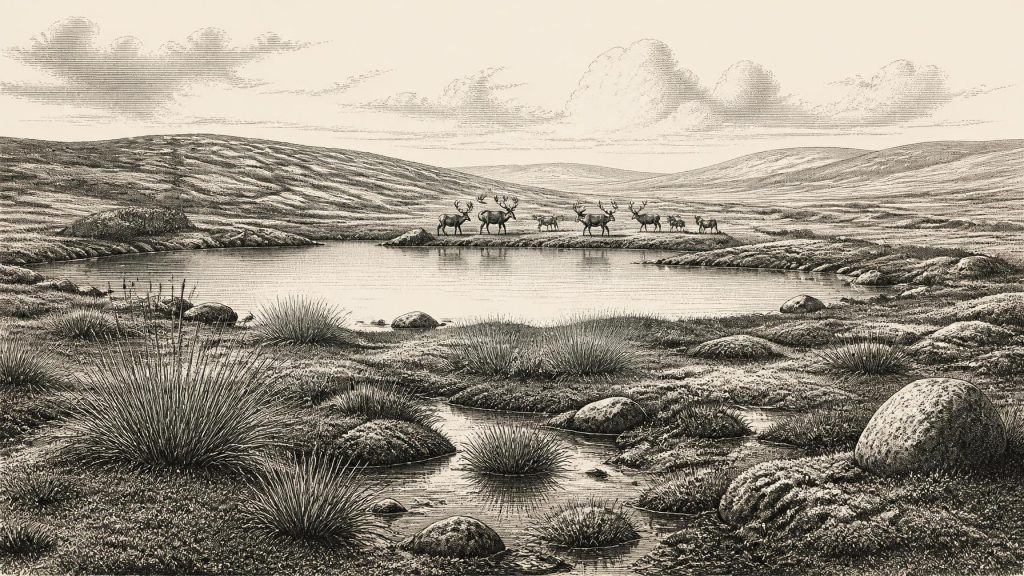
The organic layers provide direct evidence for a cold freshwater setting. Their pollen, plant macrofossils, mosses and insect remains indicate open, treeless tundra or muskeg-like country, rather than the oak and hazel woodland familiar from much later Irish prehistory. Sedges, grasses and hardy herbs could grow around shallow pools and saturated hollows. Fossil records include bogbean, alternate water-milfoil, dwarf willow and mountain avens, alongside mosses suited to severe climates. The water itself was a local refuge: even in a cold landscape, pools and marshes could support distinctive aquatic vegetation.
This was not necessarily a featureless polar desert. The evidence suggests variation between wet hollows, pool margins, drier herb-rich ground and exposed frost-affected surfaces. Yet it does not justify a detailed painted scene of a particular valley in 30,791 BCE. Pollen was poorly preserved, plant remains have different dispersal histories, and a deposit at one Fermanagh wetland cannot stand for every part of Ireland. What it securely demonstrates is that at least one northern locality was ice-free long enough for a cold freshwater ecosystem to form before later ice entombed it.
An Island of Mobile Fauna
Southern Irish caves offer a complementary, though complicated, record. Castlepook Cave, also known as Mammoth Cave, lies in the Awbeg Valley near Doneraile, County Cork. Its passages yielded one of Ireland’s most important Pleistocene collections: mammoth, giant deer, reindeer, bear, wolf, fox, Arctic fox, mountain hare, spotted hyaena and lemmings. Other Irish sites add scattered indications of horse and further cold-stage mammals. Together, they show that Ireland was periodically reached by a much richer large-mammal fauna than survives on the island today.
These are not a single herd photographed in time. Castlepook was excavated mainly in the early twentieth century, and its bones came from different galleries, sediments and disturbed contexts. Later re-dating has shown that several older measurements underestimated the true age of specimens by thousands of radiocarbon years. The cave assemblage consequently spans a long period, rather than a single episode. Reindeer or mammoth bone in the collection proves that the animal, or part of it, reached the cave; it cannot prove that every listed species shared the same patch of ground or the same year.
Nevertheless, the fauna makes ecological sense beside the Derryvree evidence. Reindeer, lemmings and Arctic foxes point towards cold open habitats. Mammoth and giant deer imply extensive grazing or browsing country over a wider landscape, while wolves and spotted hyaenas were formidable consumers and scavengers within that food web. Caves may have served as carnivore dens, traps or places into which bones were dragged, washed or later disturbed. They should not be treated as ordinary homes for people or as neat inventories of a living landscape.
The Marked Reindeer Bone
The most arresting possible human evidence for this broad period is a reindeer femur from Castlepook. It has been described as bearing a deep mark interpreted by palaeozoologist Ruth Carden as having been made by a sharp stone implement during carcass processing. County Cork heritage interpretation associates the bone with about 31,000 BCE. If that reading is confirmed, it would be extraordinarily early evidence for people handling an animal in Ireland, long before the better-established terminal Pleistocene evidence from Alice and Gwendoline Cave in County Clare.
Its importance requires careful limits. The object is not from a modern excavation of a sealed campsite with a securely associated hearth, stone-tool assemblage, dwelling floor, burial or repeated concentration of butchered bones. The cave’s old collections have complex histories. Furthermore, a date on bone establishes the age of the animal’s death within a range, not the precise moment when a surface mark was made. The mark is evidence to be tested through taphonomic and microscopic study, not a licence to invent an Irish hunting camp in a named year.
At most, the femur supports a conditional interpretation: if the incision is indeed a fresh-bone stone-tool mark, one or more people processed part of a reindeer carcass during a cold-stage interval. They may have hunted it, found it dead, removed meat, hide, sinew or marrow, or left remains later taken into the cave by scavengers. It cannot establish how many people were present, whether they were local or visiting, how often they came, what language they spoke, or whether they crossed from Britain, continental Europe or another route through an altered glacial landscape.
No Polities, No Proven Settlement
There is no basis for political history in Ireland at this date. No territory, ruler, alliance, warfare, diplomacy or social hierarchy can be identified. Equally, no graves, shrines, art, monuments, domestic buildings, cultivated fields, boats or exchange goods belong securely to this interval in Ireland. Religion, storytelling, kinship and learning may have mattered to any people who entered the island, as they did among human communities elsewhere, but the Irish evidence cannot recover their form. Silence in the record is not proof of absence; it is a reason not to manufacture a culture from a bone and a wetland.
The economy visible in the evidence is first an ecological one. Plants converted short growing seasons into forage; herbivores moved through available habitat; predators and scavengers followed them. Should the Castlepook mark prove human-made, a mobile foraging economy based partly on animal resources becomes a reasonable possibility. Farming, stock-keeping, metalworking and established trade, however, are excluded by the evidence. There is no demonstrated settlement economy to describe.
Changing Coasts and Approaching Ice
Ireland’s map was also unlike the modern one. Global sea level was lower during the wider glacial period, exposing portions of the continental shelves and changing the relationships of Ireland, Britain and the European mainland. But lower sea level did not automatically create an easy, continuous land route at every stage. Glaciers, meltwater, sea channels, seasonal ice and shifting coastlines made access variable. The precise configuration around 30,791 BCE remains uncertain.
The Last Glacial Maximum lay later, with the principal peak of the British–Irish Ice Sheet generally placed around 26,000–20,000 years ago. At Derryvree, the upper till is tangible evidence that renewed ice eventually overwhelmed the freshwater landscape. Thus the point represented by 30,791 BCE belongs neither to a familiar green Ireland nor simply to an island wholly buried under ice. It belongs to a longer story of unstable margins: locally ice-free ground and wetland life, broader cold-steppe fauna, and advancing ice capable of erasing or burying much of the evidence.
That is the historical significance of this otherwise unknowable year. Ireland was not yet a land of documented peoples, but it was already a place with environmental history: water beneath future drumlins, animals moving through open country, and perhaps a single human action preserved as a mark on reindeer bone. The evidence is fragmentary, but it is enough to replace an empty prehistoric blank with a rigorously bounded picture of an Ice Age Ireland.
Primary Sources
- A Middle Midlandian Freshwater Series at Derryvree, Maguiresbridge, County Fermanagh, Northern Ireland
- A Reconsideration of the Radiocarbon Dating of the Marine Isotope Stage 3 Fauna from Southern Ireland
- The Irish Quaternary Fauna Project
- New Insights on the Fauna of Ireland’s Younger Dryas and Early Holocene from Alice & Gwendoline Cave
- The Colonization of Ireland: A Human Ecology Perspective
- The IntCal20 Northern Hemisphere Radiocarbon Age Calibration Curve (0–55 cal kBP)
- IntCal Publications
- Palaeoecology: Irish Association for Quaternary Studies Field Guide
- The Subdivision of the Quaternary Period in Ireland
- Early Midlandian–Middle Midlandian, Pleistocene, Northern Ireland
- Menyanthes trifoliata
- Dryas octopetala
- Myriophyllum alterniflorum
- Salix herbacea
- Castlepook Cave: County Geological Site Report
- Areas of Scientific Interest in County Cork: Castlepook Caves
- Heritage Artefacts of County Cork 2021
- Castlepook Cave, Castlepook South: Excavation Report 2022
- Occurrence of Mammalia Relicts at Site Castlepook Cave
- British–Irish Ice Sheet and Polar Front History of the Goban Spur, Offshore Southwest Ireland Over the Last 250,000 Years
- Trimlines, Blockfields and the Vertical Extent of the Last Ice Sheet in Southern Ireland
- Exploring Controls of the Early and Stepped Deglaciation on the Western Margin of the British Irish Ice Sheet