
Bogbean and the Reindeer Femur30833 BCE
At the notional date of 30,833 BCE, Ireland lay within the climatically unstable Late Pleistocene, not a recordable historical year. Derryvree, County Fermanagh, preserves freshwater sediments between glacial tills, indicating local ice-free tundra wetlands with cold-adapted plants, insects and seasonal thaw. Castlepook Cave, County Cork, contains a mixed fauna including mammoth, reindeer, giant deer, predators and Arctic species, reflecting open cold landscapes. A marked reindeer femur, reportedly about 33,000 years old, may indicate human butchery, but disturbed contexts preclude claims for settlement. No secure evidence exists for communities, institutions, culture or continuous occupation; substantial settlement evidence begins in the Mesolithic.
Dateline
Modern calendar-year precision is not available for Ireland in 30,833 BCE. No Irish community then kept a calendar, wrote a record or left a settlement sequence that can be tied to one particular year. The label is a modern chronological convenience, roughly 32,800 years before the conventional radiocarbon reference year of AD 1950; it is not itself a radiocarbon date. The responsible setting is the later part of the Late Pleistocene, within Marine Isotope Stage 3 (MIS 3), a long, climatically unstable phase of the last Ice Age. For this period, Irish history is reconstructed from sediments, pollen, plant remains, insects, animal bones and changing ice limits—not from annual events, rulers or named peoples.
A Date Within Broad Ranges
Radiocarbon determinations of this age cannot simply be converted into calendar years. Atmospheric carbon-14 varied markedly in the Pleistocene, and modern calibration curves produce probability ranges rather than exact dates. The distinction matters. A radiocarbon age measures residual carbon-14 in once-living material; a calibrated age estimates where that measurement sits in calendar time. Neither can identify what happened in Ireland in the notional year 30,833 BCE.
The closest major Irish environmental comparison is Derryvree, near Maguiresbridge in County Fermanagh. Road construction exposed organic freshwater silts and sands within a drumlin, trapped between a lower till and a later upper till. Till is unsorted sediment deposited directly by glacier ice. The sequence therefore establishes an important order of events: ice affected the locality; an interval of water, plants and animal life followed; ice later returned and sealed the deposit. Organic material from the bed, BIRM-166, gave a conventional radiocarbon determination of 30,500 years BP, with a large error margin. It is relevant to the broad cold-stage world of this article, but it is not evidence for conditions in a single year and should not be treated as a precise match for 30,833 BCE.
Water Between the Tills
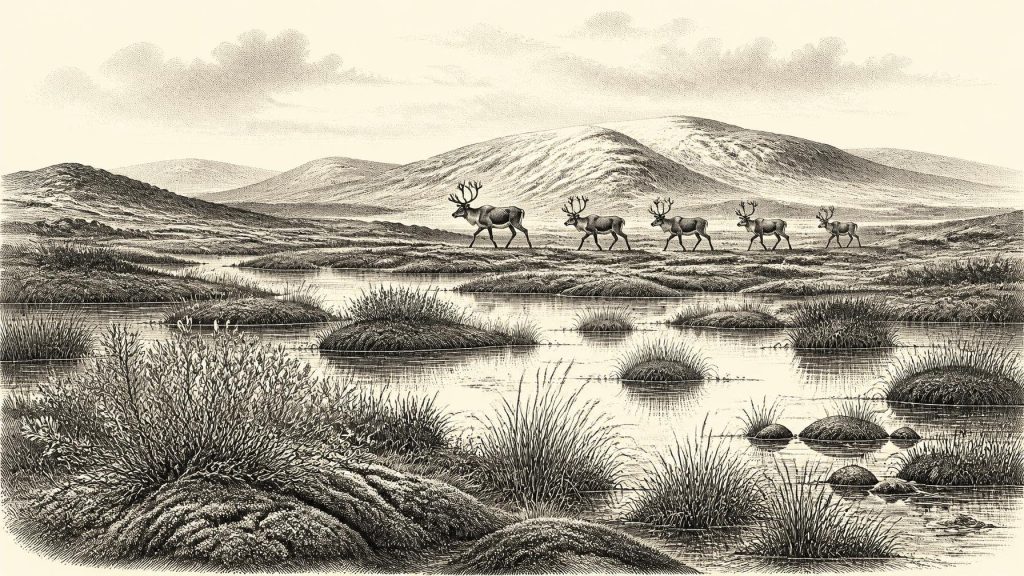
Derryvree is valuable because it overturns two simplistic images of Ice Age Ireland. The island was not continuously buried beneath one unchanging ice sheet, but neither was it a temperate landscape awaiting farmers. The buried basin held fresh water and wet ground during a cold, periglacial interval. Mosses, sedges, grasses, herb pollen, aquatic plants and insect remains point to an open, treeless environment with pools, saturated vegetation and seasonally frozen ground. Fossils reported from the deposit include cold-adapted plants such as dwarf willow, mountain-avens and bogbean, alongside freshwater indicators including alternate water-milfoil.
This evidence supports a tundra or muskeg-like reconstruction: low vegetation around shallow water, exposed mineral ground beyond it, a short growing season and severe winters. It does not prove that every part of Ireland looked the same. A buried wetland records a local habitat shaped by drainage, shelter and sediment as well as regional climate. Yet it demonstrates that at least some ice-free ground could sustain living freshwater communities during the wider glacial cycle. Seasonal thaw, liquid water and plant growth were decisive facts of life in such places.
Castlepook’s Animal World
In north County Cork, Castlepook Cave near Doneraile—once widely called Mammoth Cave—provides the principal Irish record of pre-Last Glacial Maximum large mammals. Its historic excavations recovered a remarkable but difficult collection: woolly mammoth, reindeer, giant deer, brown bear, wolf, foxes, Arctic fox, mountain hare, lemmings and spotted hyaena. Different bones have yielded dates spread across many millennia. The cave was used, altered and reworked over time by animals, water and earlier excavators, so the assemblage must not be imagined as one simultaneous herd or one ordinary day in Cork.
Even with that qualification, the fauna reveals a northern Atlantic landscape connected ecologically to wider north-west Europe. Reindeer and mammoth indicate open country capable of supporting large grazing animals; lemmings and Arctic fox point to cold conditions; hyaenas and wolves show that predators were part of the food web. Caves could become dens, traps, shelters from weather, places where animals died, or channels in which bones were moved. The presence of a bone in Castlepook therefore tells us that an animal belonged to this wider Ice Age world, but not necessarily that it was killed there or lived beside every other species represented in the collection.
The Reindeer Femur Question
The most striking possible human evidence is a reindeer femur from Castlepook, held in the historic collections associated with the National Museum of Ireland. It has been publicly reported as about 33,000 years old and bears a deep linear mark interpreted by zooarchaeologist Ruth Carden as damage made with a sharp stone tool during butchery. If that interpretation is confirmed, it would show that people handled a reindeer carcass in Ireland during the Upper Palaeolithic—far earlier than the island’s long-established Mesolithic settlement record.
Its implications must remain narrow. The original cave investigations did not meet modern standards of stratigraphic recording, and the animal collection is demonstrably mixed and disturbed. A date on the femur establishes the age of the animal, not automatically the moment of the mark or the identity of whoever made it. Nor have a securely associated hearth, stone-tool assemblage, dwelling floor, burial, personal ornament or occupation surface of comparable age been published from Castlepook. The marked bone may record butchery, but it cannot establish a village, a permanent population, a migration route or descent from later Irish communities.
Society Without a Political Record
There is no evidence from Ireland around this time for rulers, tribes with known territories, assemblies, diplomacy, warfare, law or institutions. Political affairs in the usual historical sense cannot be recovered because human presence itself remains uncertain. Nor can archaeology identify a language, ethnic name or social hierarchy. If people did visit, the most cautious interpretation is a small, mobile party whose survival depended on skilled knowledge of weather, terrain and animal movement. That is an inference from the practical demands of a cold Palaeolithic environment, not a documented Irish social system.
Conflict can be discussed only at the ecological level. Carnivores competed with one another and scavenged or hunted prey; harsh winters, fluctuating snow cover and changing vegetation constrained animal populations. There is no Irish evidence for armed conflict between human groups. Likewise, there is no evidence for diplomacy or trade in the archaeological sense: no imported lithic raw material, exchange object or route can yet be assigned securely to Ireland at this date. Any people present would have belonged to wider networks beyond the island, but the character of those networks is unknown.
Food, Movement and Settlement
The reindeer femur, if genuinely cut with a stone edge, gives a plausible glimpse of subsistence rather than a full economy. A reindeer carcass could yield meat, fat, marrow, hide, sinew, bone and antler. Yet the mark cannot show whether people killed the animal, encountered a carcass, took food from a carnivore kill, or processed it elsewhere before the bone entered the cave. Mammoth and giant deer were also present in the wider fauna, but there is no direct Irish evidence that people hunted either at this time.
There is equally no demonstrated settlement pattern. No house, camp, hearth or repeated activity area is known in Ireland from around 30,833 BCE. The country’s later glaciation is part of the explanation: advancing ice eroded surfaces, redeposited sediment and obscured older landscapes. The absence of sites is therefore not proof that no people ever entered Ireland, but it prevents claims for continuous occupation. The secure, substantial archaeological story of settlement begins much later, after the final major ice retreat, with Mesolithic communities represented at places such as Mount Sandel.
Culture and Belief: An Evidential Limit
Upper Palaeolithic communities elsewhere in Europe made sophisticated stone and organic tools, used fire, wore fitted clothing, maintained social contacts and sometimes created striking imagery and burials. Such comparisons show what people potentially capable of reaching Ireland might have known. They do not demonstrate Irish art, ritual, religion, learning or ceremonial practice. No cave art, grave, carved object, musical instrument or teaching tradition can be assigned securely to Ireland in this period. To import continental evidence as an Irish fact would turn possibility into invention.
The most important development around this notional date was therefore environmental. Ireland lay in a volatile Ice Age zone, where cold open habitats and freshwater refuges existed during intervals between glacial advances, while ice masses were growing across parts of the British–Irish region. Later in the glacial cycle, Ireland became extensively ice-covered. Derryvree’s plants and Castlepook’s bones preserve fleeting evidence of the living landscapes that preceded or accompanied that transformation. Together they support a vivid but restrained conclusion: this was an Ireland of wet tundra, mobile animals, predators and perhaps an exceptionally early human encounter, not yet an Ireland of known settlements or historical societies.
Primary Sources
- The IntCal20 Northern Hemisphere Radiocarbon Age Calibration Curve (0–55 cal kBP)
- IntCal20 Northern Hemisphere Radiocarbon Age Calibration Curve PDF
- IntCal: International Radiocarbon Calibration
- Dansgaard–Oeschger Events in Climate Models: Review and Baseline Marine Isotope Stage 3 Protocol
- Growth and Retreat of the Last British–Irish Ice Sheet, 31,000 to 15,000 Years Ago: The BRITICE-CHRONO Reconstruction
- The Timing and Magnitude of the British–Irish Ice Sheet Between Marine Isotope Stages 5d and 2
- Timing and Pace of Ice-Sheet Withdrawal Across the Marine–Terrestrial Transition West of Ireland During the Last Glaciation
- Late Pleistocene Chronostratigraphy and Ice Sheet Limits, Southern Ireland
- Early Midlandian–Middle Midlandian, Pleistocene, Northern Ireland
- The Stratigraphic Position and Age of the Gortian
- Figure 6—The Subdivision of the Quaternary Period in Ireland
- Fermanagh: Ice and the Landscape
- Soils of County Waterford
- The Irish Quaternary Fauna Project
- Irish Pleistocene Biostratigraphy
- Myriophyllum alterniflorum in Fermanagh
- Salix herbacea in Fermanagh
- Heritage Artefacts of County Cork
- 2022:564 – Castlepook Cave, Castlepook South, Cork
- New Insights on the Fauna of Ireland’s Younger Dryas and the Human Presence at Alice and Gwendoline Cave, County Clare
- Ireland’s Palaeolithic Archaeology – Fleeting Footprints in a Frozen Land
- Reindeer Bone Found in Cork Cave Shows Human Activity in Ireland 33,000 Years Ago
- Guide to the National Museum of Ireland
- 1974:0011 – Mount Sandel, Derry