Castlepook’s Spotted Hyenas30809 BCE
Around 30,809 BCE, Ireland lay within the unstable cold conditions of Marine Isotope Stage 3, not a precisely datable historical year. At Derryvree, County Fermanagh, freshwater sediments between glacial tills record an ice-free interval with treeless, periglacial wetlands, sparse vegetation and shallow pools. Castlepook Cave, County Cork, preserves remains of mammoth, giant deer, reindeer, hyena, wolves and other Ice Age animals, though deposits represent different episodes. A marked reindeer femur may indicate Upper Palaeolithic butchery, but cannot prove settlement or sustained occupation. Later glaciation and erosion obscured evidence. The period is chiefly understood through fragmented environmental and faunal archives alone.
Dateline
Modern calendar-year precision is not available for Ireland in 30,809 BCE. This is not a year for which archaeology can identify an event, a ruler, a journey or even a particular generation. It is a modern numerical label imposed on a very distant part of the Late Pleistocene. In radiocarbon terms, it falls roughly 32,758 years before AD 1950, the conventional ‘before present’ reference date; yet radiocarbon results at this age must be calibrated and are expressed as broad probability ranges, not exact historical dates.
The most responsible setting is the later part of Marine Isotope Stage 3 (MIS 3), a climatically unstable interval of the last Ice Age before the Last Glacial Maximum. Ireland was not uniformly frozen, wooded, habitable or uninhabitable throughout this long period. Conditions altered over centuries and millennia, glaciers advanced and withdrew locally, and lowlands, caves, rivers and coasts have since been reworked. The evidence instead offers short, local windows onto a changing country at Europe’s north-western edge.
A Date Within a Buried Interval
The closest Irish environmental evidence is at Derryvree, near Maguiresbridge in County Fermanagh. Roadworks in 1969 cut through a drumlin and exposed fine sands, freshwater silts and organic material lying between two tills: unsorted sediment deposited by glacial ice. The sequence establishes an important order of events. Ice had laid down the lower till; later, an ice-free local basin held water, plants and animals; another glacial advance subsequently covered and preserved those deposits beneath upper till.
Organic material from that freshwater series produced a radiocarbon determination of about 30,500 radiocarbon years before present, with a sizeable uncertainty. Published calibrations place the deposit broadly around 36,900–31,700 calibrated years before present, approximately 34,950–29,750 BCE. The modern label 30,809 BCE lies within that wide span, but that does not date every seed, insect, grain of silt or animal visit to that precise year. Nor does it prove that the whole island had the same climate or ice cover at once. It is evidence for an interval in one Fermanagh basin.
This distinction matters. A till records glacier activity, while the sediment between tills records conditions when that particular locality was not under glacier ice. Together they demonstrate major environmental change; they do not provide an annual diary. The wider timing and extent of pre-Last Glacial Maximum ice in Ireland remain subjects of active geological discussion, and recent reviews stress that evidence for earlier ice-sheet growth is less secure than the record of the later maximum.
Wet Ground in a Treeless Land
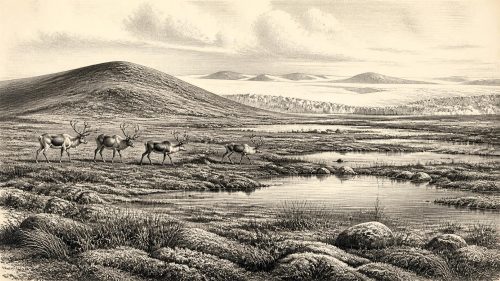
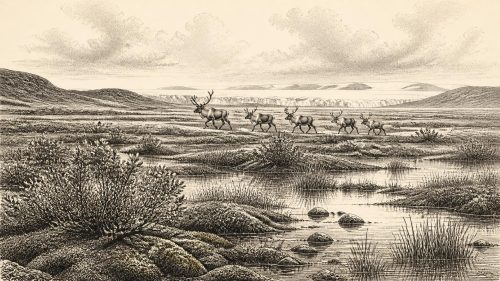
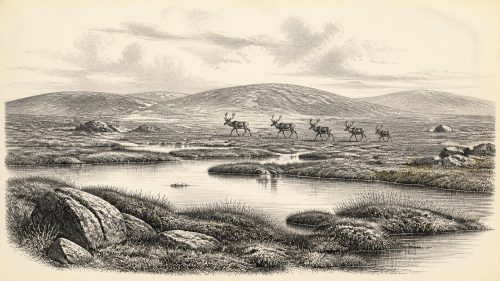
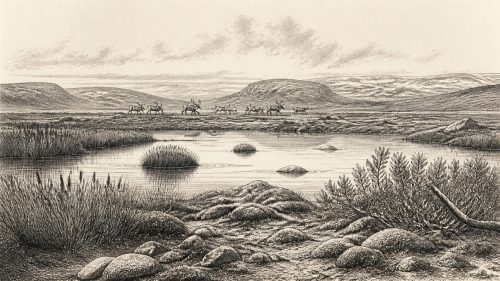
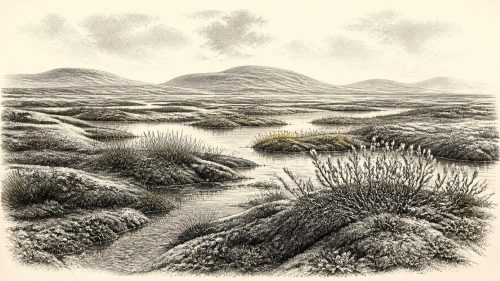
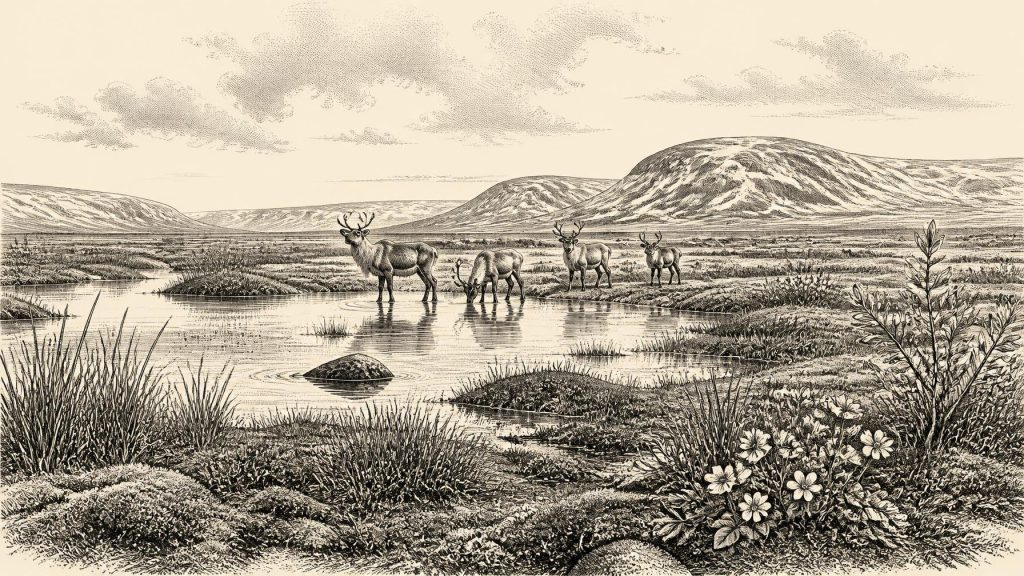
Derryvree nevertheless gives an unusually vivid, if strictly local, picture of life. Plant macrofossils, pollen and other organic remains point to open, cold-country vegetation rather than forest. Mountain avens, dwarf willow, lesser clubmoss and bogbean are among the plants associated with the deposit; aquatic evidence includes alternate water-milfoil. Their presence is direct evidence that suitable wet and freshwater habitats existed at the site. It supports a landscape of shallow pools, sedgy or mossy margins, saturated ground and sparse low vegetation, with a short growing season and frost as a persistent influence.
‘Periglacial’ is the useful word for this setting. It does not mean that Derryvree was necessarily beneath ice. It describes a cold environment strongly affected by seasonal freezing, thaw, frost-shattered ground and proximity to glaciation. In such a setting, a hollow can retain freshwater and plant life even while the broader region is largely treeless, exposed and climatically severe. The Derryvree record therefore corrects any simple image of an Ireland either wholly entombed in ice or wholly hospitable grassland. It was a varied cold-stage terrain whose available habitats could change markedly through time.
There is no evidence here for cultivation, livestock, built houses, pottery, metalwork or managed woodland. Everyday life, in the ordinary human sense, cannot be reconstructed from Derryvree because no contemporary settlement is known there. What can be recovered is an ecological everyday: water collecting in a basin; wetland plants rooting and shedding seeds; insects and small animals using sheltered ground; sediment quietly accumulating until ice returned to bury it.
Castlepook and the Animal World
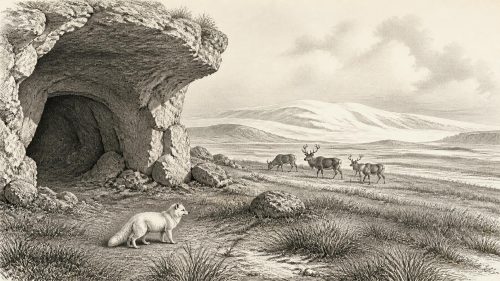
Far to the south, Castlepook Cave near Doneraile in County Cork provides the most striking faunal record relevant to this period. Also known as Mammoth Cave, it was excavated in the early twentieth century and yielded remains attributed to woolly mammoth, giant deer, reindeer, brown bear, wolf, Arctic fox, lemmings and spotted hyena. Castlepook is especially important because spotted hyena is securely known in Ireland from this cave, and some bones show the damage expected where carnivores accumulated or modified remains.
These animals should not be imagined as all standing together in one neat scene. Cave deposits may combine material brought in at different times, and Castlepook’s old excavations, water disturbance and complex stratigraphy limit certainty. Radiocarbon work has also shown that specimens from different parts of the cave can belong to substantially different phases. The cave is consequently a rich archive of Ice Age fauna, not a single momentary census.
Even so, the assemblage establishes that parts of Ireland supported a remarkably different animal community during MIS 3. Mammoth, reindeer and giant deer imply open habitats capable of sustaining large herbivores, while hyenas, wolves and foxes indicate a food web with substantial predators and scavengers. Their occurrence also shows that Irish animal populations were intermittently connected to wider north-west European ranges. Lower sea levels altered the geography of the Irish Sea basin, but the exact routes, timing and conditions by which each population reached Ireland cannot be recovered from the cave bones alone.
The Reindeer Femur Question
Castlepook has a further, more tentative importance for human history. A reindeer femur in the National Museum of Ireland’s collections has been interpreted by palaeozoologist Ruth Carden as carrying a deep mark made by a sharp stone implement on fresh bone. County Cork heritage material assigns the specimen broadly to about 31,000 BCE. If that interpretation is sustained, it is potential evidence that people processed a reindeer in Ireland during the Upper Palaeolithic, vastly earlier than the previously accepted post-glacial human record.
Potential is the essential word. The object is one bone from a cave assemblage, not a sealed camp floor. There is no securely associated stone-tool collection, hearth, dwelling, burial, human bone, repeated occupation surface or concentration of butchered remains of equivalent age. A date on animal bone establishes the age of the animal, not an exact moment at which a surface mark was made. Nor can a single marked femur tell us whether people killed the reindeer, scavenged it, butchered it elsewhere, travelled as a family or small party, or returned to Ireland at all. The cave may instead have received discarded remains through carnivore activity.
It would therefore be irresponsible to describe 30,809 BCE as the year when Ireland was ‘settled’, or to supply an imagined hunting band, language, tribe or migration route. The femur raises an important archaeological possibility: a brief human encounter with an animal in an Irish landscape. It does not demonstrate a resident population. Further microscopic study, dating, excavation and the discovery of securely contextualised tools or occupation deposits would be needed to move from possibility to a fuller account.
No Polities, No Proven Institutions
Political affairs, diplomacy and organised warfare leave no identifiable trace in Ireland at this depth of time. There were no written records, named peoples, rulers, borders, assemblies or institutions that can be responsibly attached to this date. Likewise, no Irish evidence of this age allows us to identify formal religious practice, art, teaching, ritual, exchange networks or social rank. Upper Palaeolithic societies elsewhere in Europe made sophisticated tools and images, but those wider comparisons cannot fill the gaps in Ireland’s own record.
If people did briefly reach Ireland, the reindeer femur suggests an economy based on immediate access to wild animal resources rather than farming. Reindeer could in principle provide meat, marrow, hide, sinew, bone and antler, but Castlepook’s evidence does not show which products were taken or how they were used. No trade can be demonstrated. No permanent settlement can be mapped. The strongest conclusion is more modest and more valuable: cold-stage Ireland had habitats able to sustain large mammals, and perhaps on at least one occasion people moved within that world.
A Landscape Soon Reworked
The environmental record itself explains why the human record is so thin. Later ice advances eroded surfaces, redistributed sediment and concealed older ground beneath till. Rising seas after the Ice Age drowned former coastal plains, while rivers, caves and soil processes disturbed or removed deposits. The absence of known camps cannot prove that people never arrived; equally, it cannot be replaced by a confident narrative of lost settlements. Archaeology must keep both possibilities in view.
For 30,809 BCE, then, Ireland’s history is principally the history of a cold and fluctuating landscape. At Derryvree, a freshwater wetland developed between glacial episodes; at Castlepook, the remains of herbivores and predators accumulated in a limestone cave. These are separate regional archives, not a national tableau. Together they illuminate a treeless, ecologically active Ireland before the Last Glacial Maximum—and preserve a cautious question, rather than a proven chapter, about the earliest human presence on the island.
Primary Sources
- A Middle Midlandian Freshwater Series at Derryvree, Maguiresbridge, County Fermanagh, Northern Ireland
- Palaeoecology: Irish Quaternary Association Guide 16
- The Irish Quaternary Fauna Project
- A Reconsideration of the Radiocarbon Dating of the Marine Isotope Stage 3 Fauna from Southern Ireland
- Castlepook Cave: County Geological Site Report
- Spotted Hyena Skull
- The Exploration of Castlepook Cave, County Cork
- Occurrence of Mammalia Relicts at Site Castlepook Cave
- Quaternary Site Descriptions
- An Inventory of the Areas of Scientific Interest in County Cork
- Our Ancient Landscapes: Hunter-Gatherers in Ireland
- Heritage Artefacts of County Cork
- The Timing and Magnitude of the British–Irish Ice Sheet Between Marine Isotope Stages 5d and 2
- Dimensions and Chronology of the Last Ice Sheet in Western Ireland
- Trimlines, Blockfields and the Vertical Extent of the Last Ice Sheet in Southern Ireland
- Timing and Pace of Ice-Sheet Withdrawal Across the Marine–Terrestrial Transition West of Ireland During the Last Glaciation
- IntCal20 Northern Hemisphere Radiocarbon Age Calibration Curve (0–55 cal kBP)
- BSBI: Menyanthes trifoliata
- BSBI: Dryas octopetala
- The Exploration of Castlepook Cave, Co. Cork: National Library of Ireland Catalogue Record