The Derryvree Road-Cut30747 BCE
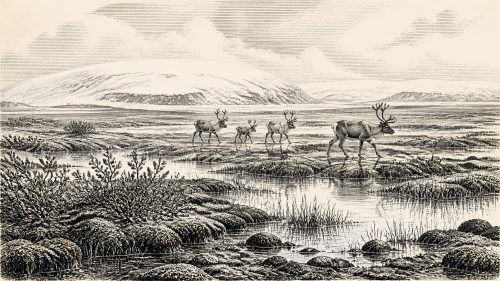
Around 30,747 BCE, Ireland experienced unstable Late Pleistocene conditions rather than a recoverable historical year. At Derryvree, County Fermanagh, freshwater sediments between glacial tills show a cold, ice-free interval with tundra vegetation, wetlands and northern insects before later ice advance. Cave remains at Castlepook, County Cork, demonstrate wider MIS 3 fauna including mammoth, reindeer, giant deer, predators and smaller cold-adapted animals, though deposits mix different periods. A marked reindeer bone may suggest brief human activity, but cannot establish settlement. Ireland’s changing ice, sea and land connections supported intermittent ecological connectivity. Evidence reveals climatic volatility, animal movement and substantial archaeological uncertainty.

Dateline
“30,747 BCE” is a modern chronological label, not a recoverable Irish year. No community in Ireland then used a calendar from which an event, ruler, journey or season can be assigned to that point. In scientific terms, the label falls about 32,700 calendar years before AD 1950, in the Late Pleistocene, broadly within Marine Isotope Stage 3 (MIS 3), a climatically unstable part of the last Ice Age. The responsible way to approach this date is therefore through dated deposits, fossil remains and their uncertainties—not through an invented episode of prehistoric Irish life.
A Date Within a Range
The closest particularly informative Irish record is at Derryvree, near Maguiresbridge in County Fermanagh. In 1969, a road cutting exposed a drumlin—a streamlined hill shaped by glacier ice—with thick glacial tills above and below a bed of freshwater silts, fine sands and organic matter. The organic layer produced the radiocarbon determination BIRM-166, 30,500 +1,170/−1,030 radiocarbon years BP. That is an age for material within a deposit accumulated over time, not a timestamp for one day, one generation or even one century.
Radiocarbon years are not calendar years. Calibration of this legacy determination produces a broad range, commonly expressed at roughly 36,900–31,700 calibrated years BP, though the breadth of the result and the age of the measurement require caution. The notional year 30,747 BCE lies within that calibrated span. Derryvree can therefore illuminate Ireland around this point, but cannot prove exactly what was happening across the island in that numbered year. More recent assessments continue to treat the deposit principally as evidence that part of northern Ireland was ice-free before the major MIS 2 ice advance, rather than as a precisely dated climate marker.
A Wetland Between Ice Advances
The great value of Derryvree is stratigraphic. The lower till records an earlier glacial episode, while an upper till demonstrates that ice later returned and overrode the site. Between them lies evidence of a cold, non-glacial interval: water was able to pond, fine sediment settled, and plants and insects lived around a shallow freshwater environment. Thus Ireland was not simply either wholly frozen or wholly temperate throughout the Ice Age. Its conditions changed repeatedly, and local landscapes could become available to plants and animals between glacial advances.
The fossil assemblage indicates open tundra or tundra-steppe rather than woodland. Mosses and sedges grew at the water’s edge; aquatic and wet-ground plants included bogbean, water-milfoil and other species compatible with cold freshwater habitats. Pollen was scarce and poorly preserved, but largely herbaceous. Small numbers of tree pollen grains do not demonstrate an Irish forest: they may have travelled long distances or been redeposited. The stronger evidence is for a mostly treeless setting, with sparse vegetation on better-drained ground and wetter mossy margins around pools and channels.
Insect remains reinforce that interpretation. They point to a northern, cold-climate fauna and to conditions in which summer warmth was limited, winters severe and seasonality pronounced. This was not necessarily a blank sheet of snow and ice. During the growing season, low vegetation could provide forage, and freshwater basins would have concentrated plant and animal life. Yet the landscape was environmentally demanding: exposed ground, frost action, thin or immature soils and marked shifts in water level were likely features of many localities.
An Island of Changing Connections
At this depth in time, “Ireland” should not be imagined with modern coastlines or political boundaries. Sea level was lower than today because much water was locked in continental ice sheets, but the geography of land and sea between Ireland, Britain and north-western Europe changed over long intervals. Faunal evidence shows that mammals did reach Ireland during the Late Pleistocene. It does not, however, allow a simple claim that a permanent land bridge existed at precisely 30,747 BCE, or that every animal species travelled by the same route.
Research on the British–Irish Ice Sheet and on Irish cave deposits instead suggests a shifting regional mosaic. Ice margins, sea level, exposed shelves, river valleys and coastal barriers altered over millennia. The Derryvree deposit establishes local ice-free ground in Fermanagh during a cold stage. Speleothems in Crag Cave, County Kerry, grew episodically during Greenland interstadial warmth, showing that conditions in south-west Ireland could also cross the threshold needed for liquid water to percolate through shallow karst. Neither archive permits the weather of a particular year, but together they reveal a country highly responsive to abrupt North Atlantic climate changes.
Castlepook’s Animal Archive
Farther south, Castlepook Cave near Doneraile in north County Cork preserves Ireland’s most important pre-Last Glacial Maximum cave-fauna archive. Its collections include remains of woolly mammoth, reindeer, giant deer, brown bear, wolf, Arctic fox, hare, lemmings and spotted hyaena. This combination makes clear that Ireland could sustain, at different times, a rich cold-stage animal community. Reindeer and lemmings evoke open northern habitats; mammoths and giant deer point to extensive grazing landscapes; hyaenas, wolves and bears show that large carnivores also moved through the region.
That list should not be converted into a single reconstructed scene. Cave deposits may accumulate through carnivore activity, natural deaths, water movement, collapse and later excavation. Bones from different centuries or millennia can become mixed. Modern re-dating has also shown that earlier radiocarbon results from Irish caves could be substantially too young when compared with dates obtained using improved collagen pretreatment. The important conclusion is not that every species stood together outside Castlepook in 30,747 BCE, but that an ecologically connected Late Pleistocene Ireland supported diverse animal populations over the wider MIS 3 interval.
Newer sedimentary ancient-DNA work from Castlepook is consistent with this wider connectivity, detecting a broad range of Late Pleistocene animals and linking Irish mammoth and hyaena lineages with Eurasian populations. As a 2026 preprint, that research is promising rather than final authority. It nevertheless complements the older bone record: Ireland’s fauna was not isolated in a biological vacuum, even if the exact routes and duration of particular incursions remain unresolved.
The Human Question
The most provocative object relevant to this period is a reindeer femur from Castlepook, recovered during early twentieth-century work. Ruth Carden’s reassessment identified a deep linear mark interpreted as damage from a sharp stone tool while the bone was fresh. A radiocarbon result of around 33,000 radiocarbon years BP for the bone has led to the possibility that people butchered reindeer in Ireland long before the better-established terminal-Pleistocene evidence for human activity.
This is an important possibility, but it remains a possibility rather than a demonstrated settlement. The bone came from an old and disturbed cave collection, not a sealed living floor. It has no securely associated hearth, stone-tool assemblage, dwelling, human remains, burial, repeated butchered bone concentration or occupational surface. The date concerns the death of the animal, while the interpretation of the incision depends separately on taphonomic and microscopic judgement. Future excavation and analysis may strengthen, modify or reject the case.
Accordingly, no settled human population can responsibly be described for Ireland around 30,747 BCE. If people reached the island, the evidence is more compatible with brief, small-scale visits by highly mobile Upper Palaeolithic hunter-gatherers than with a known permanent community. Such visitors could have sought meat, hides, sinew, bone, antler or information about animal movements. But these are inferences from wider European hunter-gatherer practice, not facts demonstrated by an Irish camp.
No Polities, No Recorded Conflict
There is no evidence for political institutions, named groups, diplomacy, organised warfare, formal religion, monuments, farming, trade networks or specialised learning in Ireland at this date. Nor is there evidence for houses, villages, fields, pottery or metalwork. Silence on these subjects is not an assertion that Ice-Age people elsewhere lacked social lives, beliefs or knowledge. It is a statement about what the Irish record can support. A possible butchered bone and environmental sediments cannot recover kinship, language, ritual or authority.
The most tangible “economy” was ecological. Animals moved through landscapes shaped by seasonal plant productivity, water and predation; any human visitors would have depended on hunting and gathering rather than agriculture. Exchange or diplomacy across sea and land corridors cannot be evidenced. The relevant regional change was climatic and geographical: short-lived ice-free habitats such as Derryvree existed within a longer trajectory towards more extensive glaciation. Later ice advance buried, eroded and rearranged much of the evidence, helping to explain why the archaeological record is so fragmentary.
What Derryvree Can Tell Us
Ireland around this notional date was a cold but living place, not an empty abstraction between glaciers. Derryvree records freshwater pools and mossy, sedge-rich tundra beneath a later drumlin; Castlepook records an animal world that included reindeer, mammoth and predators. Those are firm foundations. A human presence remains an intriguing but unconfirmed interpretation, and all claims of year-specific events must be resisted. The history of 30,747 BCE is therefore one of wetland sediment, animal movement, climatic volatility and the limits of the surviving evidence.
Primary Sources
- A Middle Midlandian Freshwater Series at Derryvree, Maguiresbridge, County Fermanagh, Northern Ireland
- The Geology of Northern Ireland—Our Natural Foundation
- Soils of Co. Waterford
- Exploring Controls of the Early and Stepped Deglaciation on the Western Margin of the British-Irish Ice Sheet
- A Reconsideration of the Radiocarbon Dating of the Marine Isotope Stage 3 Fauna from Southern Ireland
- The Irish Quaternary Fauna Project
- New Insights on the Fauna of Ireland's Younger Dryas and Early Holocene from Alice & Gwendoline Cave
- Heritage Artefacts of County Cork
- Ireland's Palaeolithic Archaeology – Fleeting Footprints in a Frozen Land
- Middle Midlandian Interstadial Deposits at Greenagho, Near Belcoo, County Fermanagh, Northern Ireland
- Freshwater Organic Deposits and Stratified Sediments Between Early and Late Midlandian (Devensian) Till Sheets, at Aghnadarragh, County Antrim, Northern Ireland
- Irish Pleistocene Biostratigraphy
- The Horse in Late Pleistocene Britain and Ireland
- Pattern and Timing of Retreat of the Last British-Irish Ice Sheet
- Growth and Retreat of the Last British–Irish Ice Sheet, 31,000 to 15,000 Years Ago: the BRITICE-CHRONO Reconstruction
- Timing, Pace and Controls on Ice Sheet Retreat: an Introduction to the BRITICE-CHRONO Transect Reconstructions of the British–Irish Ice Sheet
- Episodic Speleothem Deposition Tracks the Terrestrial Impact of Millennial-Scale Last Glacial Climate Variability in SW Ireland
- Oscillating Retreat of the Last British-Irish Ice Sheet on the Continental Shelf Offshore Galway Bay, Western Ireland
- The Geomorphology of Ireland’s Continental Shelf
- Sedimentary Ancient DNA Reveals Late Pleistocene Faunal Connectivity Between Ireland and Eurasia
- Palaeoecology