Reindeer Femur Between Tills30782 BCE
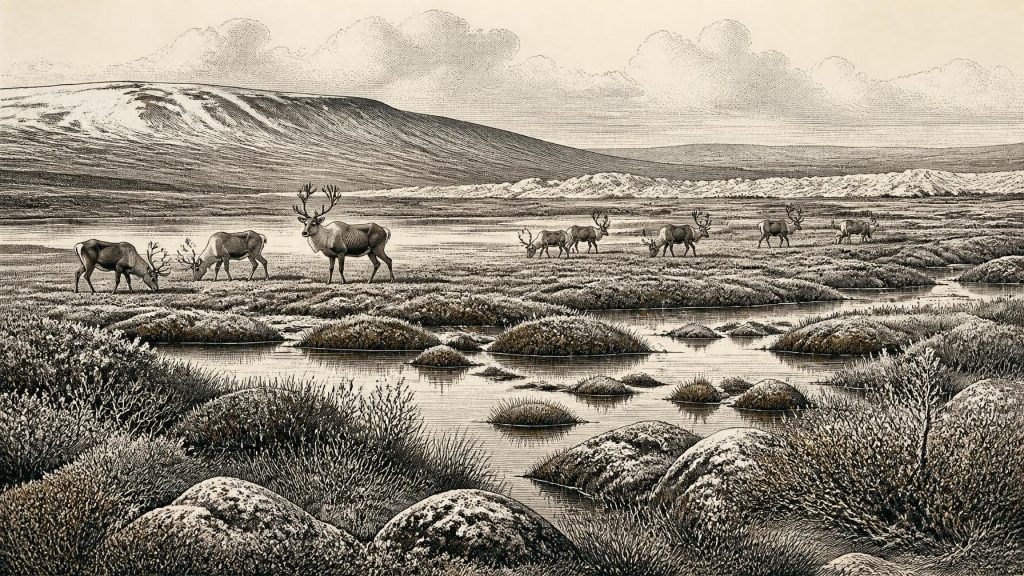
Around 30,782 BCE, Ireland was an environmentally unstable part of Ice Age Europe, not a landscape documented by annual history. At Derryvree, County Fermanagh, freshwater silts between glacial tills show a broad ice-free interval, with cold, treeless wetland vegetation including mosses and sedges. Castlepook Cave in Cork preserves bones from changing cold-stage faunas, including mammoth, giant deer, reindeer, bear and hyena. A marked reindeer femur may indicate Upper Palaeolithic human handling, but cannot demonstrate settlement, hunting grounds or a particular culture. Lower sea levels altered connections around Ireland, while advancing ice reshaped terrain. Evidence supports environmental change, not island-wide conclusions.
Dateline
30,782 BCE is not a date at which Ireland can be described year by year in the ordinary historical sense. It is a modern calendar label applied to a time roughly 32,730 years before AD 1950, the conventional “present” used in radiocarbon chronology. No written calendar, named individual, settlement sequence or event record can identify what happened in that particular year. The responsible picture is therefore a broad one: Ireland during the Late Pleistocene, within Marine Isotope Stage 3 and the unstable middle portion of the Midlandian glacial cycle. Its evidence comes from buried sediments, fossil plants and insects, animal bones, cave deposits and the record left by advancing and retreating ice.
The closest especially informative Irish deposit is at Derryvree, near Maguiresbridge in County Fermanagh. Organic-rich freshwater silts and fine sands were exposed there beneath a drumlin, sealed between two substantial layers of glacial till. The sequence records a simple but powerful order: ice laid down the lower till; a period without ice at that particular place allowed wetland sediment to accumulate; later ice covered and preserved it beneath upper till. Organic material from the freshwater beds yielded a conventional radiocarbon age of 30,500 +1,170/−1,030 radiocarbon years BP. Calibration places the deposit broadly around 36,900–31,700 calibrated years BP. The notional year 30,782 BCE falls within that wide span, but cannot be matched to one sediment layer, animal death or season.
A Local Window on an Ice-Age Ireland
Derryvree is not a photograph of the whole island. It is a highly local archive from north-central Ireland, and its date range is measured in millennia. Yet it decisively challenges any simple image of Ireland as continuously buried beneath a single unchanging ice sheet. The plants and insects preserved between the tills indicate cold, open conditions beside freshwater. Mosses and sedges grew in wet ground; the insect assemblage has a distinctly northern, cold-climate character. Plant remains include species suited to damp pools, marshy margins and exposed ground. Together they suggest a treeless, tundra-like wetland mosaic rather than the dense, green woodland often imagined as Ireland’s natural landscape.
This was not necessarily an utterly barren country. Shallow water, sedge beds, mossy ground, herbs and low-growing shrubs would have created varied small habitats. But winters were severe, the growing season short, and periglacial processes—freezing and thawing of waterlogged soils—would have shaped the ground. The modern drumlin landscape conceals this earlier episode. The landform itself was later moulded or overridden by glacier ice, while its enclosed freshwater bed survived as a rare record of conditions before the fuller expansion of the last British–Irish Ice Sheet.
Other deposits in Fermanagh, including Hollymount near Maguiresbridge and Greenagho near Belcoo, support the wider conclusion that cold, non-glacial intervals occurred in this region during the Midlandian. Their dating and correlation are not equally secure, and they should not be forced into a single island-wide timetable. Still, alongside Derryvree, they show that the approach of the Last Glacial Maximum was uneven. Ice margins, drainage routes, lakes, tundra vegetation and exposed terrain changed over long spans rather than according to a uniform national pattern.
Before the Greatest Ice Advance
The date lies before the maximum development of the last British–Irish Ice Sheet, though ice-sheet growth was already part of the larger North Atlantic story. Modern reconstructions show that the timing of advance and maximum extent varied markedly between sectors. It is therefore unsafe to say that all Ireland was either ice-free or ice-covered in 30,782 BCE. The sounder conclusion is narrower: the Derryvree record demonstrates ice-free freshwater conditions at one Fermanagh locality during a broad interval encompassing this date, while regional glaciation was capable of changing dramatically over centuries and millennia.
Lower sea levels altered the geography around Ireland as well. Much more of the continental shelf lay exposed than today, and the shorelines familiar to modern people did not exist. Ireland was not yet the permanently separated island of the later post-glacial world. Connections across the Irish Sea region changed with sea level, ice extent and coastal terrain. Such changes mattered to animals and, potentially, to people: they determined where herds could move and where a travelling party might pass. They do not, however, prove a regular route, a settled population or a particular crossing in this year.
Castlepook’s Animal World
The strongest animal evidence relevant to this era comes from Castlepook Cave, also called Mammoth Cave or Doneraile Cave, in north County Cork. Its narrow limestone galleries, including the evocatively named Hyenahall and Elephant Hall, have yielded more than 2,000 bones. The collection represents a long and complicated history of deposition rather than one simultaneous community. Individual remains from the cave span roughly 45,700 to 19,950 radiocarbon years BP, and water movement, carnivore activity and early twentieth-century excavation disturbed parts of the deposit.
Nevertheless, Castlepook shows that Ireland supported an impressive cold-stage fauna before the Last Glacial Maximum. Woolly mammoth, giant deer, reindeer, brown bear and spotted hyena occur among its Ice Age remains; later material includes Arctic fox, wolf and lemmings. These animals should not be pictured as all standing together outside the cave on a single day. Their bones accumulated through many phases. What they demonstrate is that suitable habitats repeatedly existed in Ireland for large grazers and browsers, predators, scavengers and smaller cold-adapted mammals.
For a general landscape reconstruction, the combination of Derryvree and Castlepook is revealing. Open ground, wetland vegetation and a mobile large-animal fauna are consistent with a patchy cold environment, not a closed forest. Reindeer in particular would have been an important source of meat, hide, sinew, fat and bone to any hunters who encountered them. Yet the archaeological evidence does not establish organised reindeer hunting grounds in Ireland, nor does it tell us whether carcasses entered the cave through human action, carnivore transport, natural death or a mixture of processes.
An Important but Incomplete Human Clue
One object makes this period unusually significant for Irish prehistory: a reindeer femur from Castlepook which has been reported as dating to about 33,000 years ago and bearing a deep mark interpreted as damage from a sharp stone tool while fresh bone was processed. If that specialist interpretation is confirmed, it would be the earliest known evidence of human activity in Ireland by a very large margin. It would indicate that at least one person handled a reindeer carcass in Ireland during the Upper Palaeolithic.
That is an important possibility, but it is not a licence to invent an Irish Palaeolithic tribe, camp or migration. The bone is not accompanied by a securely associated hearth, dwelling floor, stone-tool assemblage, burial, artwork or settlement deposit of comparable age. A radiocarbon result dates the death of the animal, not independently the moment when the surface mark was made; nor does it establish the place where the animal was killed. Castlepook’s old excavations and complicated cave formation add further caution. Current excavations have demonstrated that deposits survive, but have not yet produced a secure Upper Palaeolithic habitation horizon.
The most defensible interpretation is one of possible fleeting presence. Small, mobile hunter-gatherer groups certainly lived elsewhere in north-west Europe in this broad period. If people reached Ireland, they may have followed animal movements, taken advantage of a carcass, sought short-term shelter, or moved through a landscape that was accessible only during favourable environmental intervals. All such suggestions remain analogies from wider Upper Palaeolithic life, not established facts about a named Irish group. There is no basis for assigning the Castlepook evidence to a particular archaeological culture.
No Polities, No Proven Trade
Political history is absent here in the literal sense. There are no chiefs, territories, alliances, battles, diplomatic exchanges or institutions identifiable in Ireland around 30,782 BCE. Nor is there evidence for farming, stockkeeping, permanent villages, metalworking, markets or long-distance trade networks on the island. If a human visit occurred, daily life would have depended on immediate skills: finding shelter, maintaining fire, making and using stone tools, reading weather and animal tracks, and sharing food within a very small travelling group. But those are reasonable possibilities drawn from Upper Palaeolithic practice elsewhere, not discoveries from an excavated Irish camp.
The same restraint applies to religion, culture and learning. No Irish cave art, figurine, engraved object, ceremonial monument or human burial is securely dated to this period. The absence of such evidence does not prove that visitors had no beliefs, stories, customs or technical knowledge; it means that archaeology cannot responsibly recover them. At this depth of time, environmental adaptation is the visible history. The surviving record is made chiefly by water, mud, plants, bones and ice.
What This Date Can Mean
The year label is useful only as a point within a much larger chronological range. Around it, Ireland was an environmentally volatile western edge of Ice Age Europe: locally ice-free in places represented by the Fermanagh freshwater sediments, home at intervals to cold-adapted animals recorded in Cork caves, and moving towards more extensive glaciation. Derryvree’s buried wetland and Castlepook’s reindeer femur should be held together precisely because they illuminate different things. One documents a cold freshwater landscape; the other raises, but does not finally settle, the question of human presence.
That distinction is the real history of 30,782 BCE. Ireland can be known here not through annual events but through evidence with different strengths: sediments securely show an ice-free interlude at Derryvree; fossils securely show a changing Ice Age fauna; the marked reindeer bone may show people. Future dating, microscopic analysis and carefully controlled excavation may sharpen the picture. For now, the honest account is of a brief archaeological window into a land of sedges, cold water, mobile herds and approaching ice.
Primary Sources
- A Middle Midlandian Freshwater Series at Derryvree, Maguiresbridge, County Fermanagh, Northern Ireland
- Early Midlandian–Middle Midlandian, Pleistocene, Northern Ireland
- Middle Midlandian Interstadial Deposits at Greenagho, Near Belcoo, County Fermanagh, Northern Ireland
- Freshwater Organic Deposits and Stratified Sediments Between Early and Late Midlandian (Devensian) Till Sheets, at Aghnadarragh, County Antrim, Northern Ireland
- References and Recommended Reading: Irish Association for Quaternary Studies Field Guide
- Figure 6—The Subdivision of the Quaternary Period in Ireland
- Growth and Retreat of the Last British–Irish Ice Sheet, 31,000 to 15,000 Years Ago: the BRITICE-CHRONO Reconstruction
- The IntCal20 Northern Hemisphere Radiocarbon Age Calibration Curve (0–55 cal kBP)
- IntCal Publications
- The Irish Quaternary Fauna Project
- Castlepook Cave: Cork County Geological Site Report
- 2022:564 — Castlepook Cave, Castlepook South, Cork
- Heritage Artefacts of County Cork
- Occurrence of Mammalia Relicts at Site Castlepook Cave
- New Insights on the Fauna of Ireland’s Younger Dryas and Early Holocene from Alice & Gwendoline Cave
- Quaternary Site Descriptions
- Guide to the National Museum of Ireland — Natural History
- Exhibition Galleries: National Museum of Ireland — Natural History
- Mammals: National Museum of Ireland Natural History Collections
- Ireland’s Palaeolithic Archaeology — Fleeting Footprints in a Frozen Land
- The Mesolithic in Ireland: When Was It?
- Mammoth Cave, County Cork: Irish Caves Database
- Dating Constraints on the Last British-Irish Ice Sheet: a Map and Database
- Exploring Controls of the Early and Stepped Deglaciation on the Western Margin of the British-Irish Ice Sheet