Doneraile’s Mid-Glacial Fauna30781 BCE
Around 30,781 BCE, Ireland lay within the climatically unstable Marine Isotope Stage 3, before maximum glaciation. Castlepook Cave near Doneraile preserves evidence of recurring animal presence, including reindeer, mammoth, giant deer, bears, wolves, Arctic foxes, lemmings and hyaenas, indicating open, cold habitats with varied food webs. Its mixed, disturbed deposits cannot represent a single moment. Derryvree, County Fermanagh, preserves freshwater sediments and tundra vegetation from a milder interval. A marked reindeer bone from Castlepook may suggest early human butchery, but remains unconfirmed and demonstrates neither settlement nor society. Later ice erosion explains the scarcity of securely dated Irish Palaeolithic evidence.
Dateline
Modern calendar-year precision is not available for Ireland at this depth of time. “30,781 BCE” is therefore best treated as a modern chronological peg—about 32,730 years before 1950—rather than as a recoverable year in which a named event occurred. No Irish settlement, person, political community or dated action can responsibly be assigned to it. What can be discussed is the wider phase: Marine Isotope Stage 3, a climatically volatile part of the Late Pleistocene, before the Last Glacial Maximum transformed much of the island.
The strongest evidence relevant to this point comes not from a contemporary chronicle or a settlement floor, but from caves, buried organic deposits and ice-sheet landforms. These records are uneven, often disturbed, and dated with ranges rather than calendar-year certainty. Their value lies precisely in showing what was possible in Ireland: episodes of open, cold-country habitat; a surprisingly varied large-mammal fauna; and, at most, a still-unresolved possibility of very early human activity.
A Landscape Before Maximum Ice
Around this broad period, Ireland was part of the changing north-west European ice-age world, not the green, wooded island familiar today. Climate oscillated sharply on millennial scales. Greenland ice-core terminology records alternating stadials and interstadials, while Irish terrestrial evidence is too discontinuous to match every shift confidently to a particular short-lived event. It is safer to say that conditions were generally cold, dry and highly seasonal, punctuated by less severe intervals, rather than to attach a precise Irish weather history to a single numbered year.
The island’s outline was also different in practical terms. Global sea level was much lower than today, exposing extensive coastal plains and narrowing or altering marine passages. Yet low sea level does not automatically demonstrate a simple, continuously usable land bridge into Ireland. Ice margins, rivers, estuaries, marshes and changing sea channels all mattered; their exact arrangement shifted through time. Mammals evidently reached Ireland during parts of the Middle Midlandian, but the routes, frequency and seasonality of those movements remain matters of reconstruction rather than direct observation.
Ireland had not yet reached the Last Glacial Maximum, conventionally placed broadly between about 26,500 and 19,000 years ago. Later ice was capable of eroding landscapes, redistributing sediment and removing or burying much earlier evidence. That destructive history helps explain why a large island has yielded no secure Upper Palaeolithic campsite, hearth, lithic assemblage or human skeleton of this age. Absence of such material is important, but it is not proof that no person ever entered the island.
Castlepook and the Animal Record
The central place is Castlepook Cave near Doneraile in north County Cork, a fissure-and-chamber system in limestone country close to the Ballyhoura foothills. Excavations undertaken in the early twentieth century recovered a very large and varied collection of bones, later supplemented by work in newly accessible sections. The National Museum of Ireland holds much of this material. Castlepook is exceptional because it preserves remains from both before and after the Last Glacial Maximum, although it is not a neatly layered, single-period deposit.
Its pre-maximum fauna includes reindeer, woolly mammoth, giant deer, brown bear, wolf, mountain hare, Arctic fox, lemmings and spotted hyaena. These animals should not be imagined as all standing together in one scene or representing one season. Bones accumulated over long spans and in different cave areas. Carnivores brought in food; animals may have died in or near fissures; water and sediment moved remains; early excavation standards recorded context far less fully than modern practice requires. Castlepook is an archive of recurring animal presence, not a census of a single year.
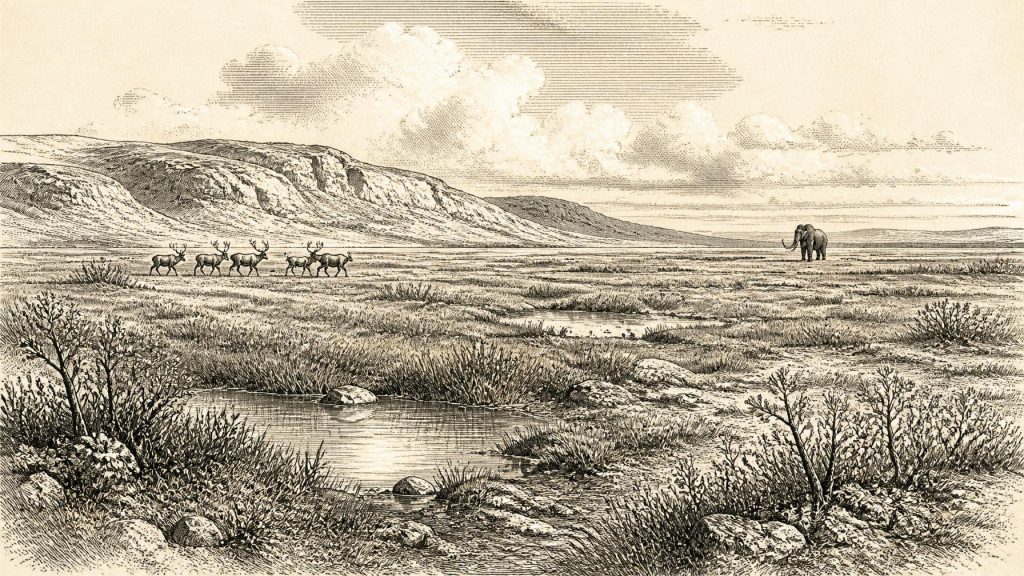
Even so, the combined evidence indicates a productive, open mosaic rather than an unbroken ice desert. Reindeer and lemmings point towards cold conditions; mammoth and large deer imply extensive forage and space; hyaenas, wolves and bears indicate a food web with predators and scavengers as well as herbivores. Sedges, grasses, herbs, low shrubs and patches of sheltered vegetation would be more plausible than closed forest. The appearance of different species at varying dates also cautions against calling the whole landscape simply “mammoth steppe”: that useful continental comparison is not a direct map of every Irish valley.
Radiocarbon dating has complicated, rather than simplified, the picture. The Irish Quaternary Fauna Project established that mammals occupied Ireland between at least about 45,000 and 20,000 radiocarbon years before present. Subsequent redating of southern Irish cave specimens showed that a number of older determinations had been affected by limitations in earlier pretreatment methods. Ruth Carden, Thomas Higham and Peter Woodman concluded that some Castlepook results were between roughly 5,000 and 12,000 radiocarbon years older than first thought, and proposed that giant deer and spotted hyaena may have disappeared locally before about 40,000 calibrated years ago. These findings underline why any apparently exact date must be handled with care.
Wet Ground at Derryvree
A complementary record lies far to the north at Derryvree near Maguiresbridge, County Fermanagh. There, organic freshwater sediments were found between glacial tills: a rare survival of mud, plant remains and microscopic evidence from a milder interval within the long cold stage. The deposit has conventionally yielded an age of about 30,500 radiocarbon years before present, with a substantial uncertainty. It does not date the year under consideration, and it cannot be converted honestly into a calendar-day event. It does, however, demonstrate that liquid freshwater, wetland plants and a tundra-like biota existed in at least one Irish basin before later ice sealed the sequence.
Plant macrofossils and pollen from such deposits are especially valuable because they record vegetation more directly than cave bone assemblages do. Mosses, sedges, dwarf willow, mountain avens, lesser clubmoss, bogbean and alternate water-milfoil have been identified in the Derryvree sequence. Together they suggest shallow water, marshy margins and open ground under cold conditions. The evidence is local: it illuminates the ecology around one former pool, not every part of Ireland. Nonetheless, it makes clear that an Ice Age Ireland could contain biologically rich refuges alongside permafrost-affected ground and advancing ice.
People: A Possibility, Not a Population
The greatest historical question is whether people were present. A reindeer femur from Castlepook has been reported as bearing a deep mark interpreted as having been made by a stone tool during butchery, and it has been publicly associated with an age around 33,000 years ago. If the modification and association are confirmed, it would push evidence for human handling of animal carcasses in Ireland far back into the Upper Palaeolithic. It would be a remarkable find—but it would still document no more than a brief episode of carcass processing.
That distinction matters. The bone is not a house, camp, hearth, tool-kit, burial or occupation layer, and no securely associated lithic tools have been recovered. Castlepook’s complicated formation history makes it particularly unwise to infer a resident group, a hunting territory, a population size or a continuous Irish ancestry from one modified bone. The earliest well-supported evidence for repeated human settlement remains vastly later, in the post-glacial Mesolithic. Responsible history therefore records the Castlepook mark as a proposed early signal, not as proof that Ireland had an established Palaeolithic society at this time.
Across neighbouring north-west Europe, Upper Palaeolithic Homo sapiens groups made sophisticated stone and organic tools, travelled through large territories, used animal resources, and maintained social connections over considerable distances. Such regional evidence makes a short human visit to Ireland conceivable. It does not licence the transfer of continental cave art, ritual, clothing styles or named archaeological cultures into Cork without direct Irish evidence. There is no basis for identifying language, ethnicity, kinship, leadership or religion on the island around this date.
Society Without States
Accordingly, there were no political affairs, diplomacy or warfare that can be described for Ireland in the normal historical sense. No polity, boundary, chief, alliance or conflict has left an identifiable trace. If people did come, they would have travelled in small, mobile hunter-gatherer groups operating within seasonal and ecological constraints. That is an inference from the wider Upper Palaeolithic world, not a demonstrated description of a Castlepook community.
The same restraint applies to economy and trade. Animal movement between Ireland and neighbouring lands shows that access routes existed at intervals, but it does not itself prove human exchange networks. No imported artefact, quarry source, worked ivory, ornament or structured deposit can be assigned to this period in Ireland. Everyday life is more securely approached through ecology: survival would have depended on knowledge of changing terrain, animal behaviour, shelter and weather. Yet the Irish evidence does not reveal whose knowledge that was.
Religion, art and learning are similarly beyond direct recovery. Caves can invite assumptions about ritual, but Castlepook’s value at present is palaeontological and geological. Its chambers preserve animal remains, not demonstrable ceremonial activity. The most important development around this notional date was environmental rather than political: Ireland supported, at least intermittently, a cold-stage fauna and wetland vegetation before renewed glaciation drastically altered the evidence landscape. Doneraile’s bones and Derryvree’s buried mud preserve that narrow but consequential window into an otherwise elusive Ireland.
Primary Sources
- The Irish Quaternary Fauna Project
- A Reconsideration of the Radiocarbon Dating of the Marine Isotope Stage 3 Fauna from Southern Ireland
- The Exploration of Castlepook Cave, Co. Cork. With 3 Plates.
- Archaeological Heritage of County Cork
- Heritage Artefacts of County Cork
- Castlepook Cave, Co. Cork, 2022
- Growth and Retreat of the Last British–Irish Ice Sheet, 31,000 to 15,000 Years Ago: The BRITICE-CHRONO Reconstruction
- Trimlines, Blockfields and the Vertical Extent of the Last Ice Sheet in Southern Ireland
- Dimensions and Chronology of the Last Ice Sheet in Western Ireland
- Radiocarbon Constraints on the Age of the Maximum Advance of the British–Irish Ice Sheet in the Celtic Sea
- A Middle Midlandian Freshwater Series at Derryvree, Maguiresbridge, County Fermanagh, Northern Ireland
- The Late Quaternary History of East-Central Ireland
- The Irish Quaternary Fauna Project (full text copy)
- Spotted Hyena Skull
- Occurrence of Mammalia Relicts at Site Castlepook Cave
- New Insights on the Fauna of Ireland’s Younger Dryas and Early Holocene from Alice & Gwendoline Cave
- First Evidence of a Late Upper Palaeolithic Human Presence in Ireland
- Ireland’s Palaeolithic Archaeology – Fleeting Footprints in a Frozen Land
- The Mesolithic in Ireland: When Was It?
- A Stratigraphic Framework for Abrupt Climatic Transitions During the Last Glacial Period in the North Atlantic Region, Quaternary Science Reviews 106