Meiler Captured at Thurles1208 CE
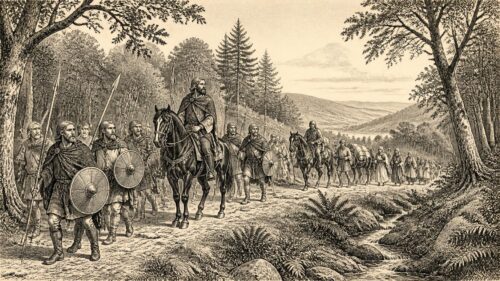
In 1208, conflict within the Anglo-Norman lordship undermined royal authority in Ireland. William Marshal’s allies captured justiciar Meiler fitz Henry at Thurles, prompting King John to restore Marshal’s lands and appoint John de Grey. These settlements strengthened supervision but did not end rivalry among colonial magnates. Gaelic rulers remained independent actors: northern dynasties fought and later negotiated, while English influence shaped succession in Breifne. In Munster, dynastic disputes involved Limerick’s English community and church guarantors, despite breaches of protection. Ecclesiastical life continued amid violence and uncertainty. The year revealed a fragmented Ireland, governed through local alliances, force, charters and negotiation.
Dateline
In 1208, Ireland was not a single political unit moving to a single rhythm. The lordship claimed by King John of England was strongest in the ports, towns, castles and settled estates of the east and south-east; beyond and between them, Gaelic kings, lordly kindreds and church communities retained their own authority. The year is therefore best understood not as a neat stage in an inevitable conquest, but as a moment of sharp instability. A struggle within the Anglo-Norman political order in Leinster and Meath brought down the king’s chief governor, while conflicts in Ulster, Breifne, Connacht and Munster showed that Irish rulers continued to make war, peace and alliances on their own terms.
A crisis among the king’s servants
The most consequential development in the lordship was the collapse of Meiler fitz Henry’s position. Meiler had long served King John as justiciar, the chief royal official in Ireland, but he was also a landholder and an active participant in the rivalries of the colony. That dual role proved dangerous. His dispute with William Marshal, earl of Pembroke and lord of Leinster through his wife Isabel de Clare, had become an armed contest by the winter of 1207–8.
The immediate issue was Offaly, a strategically important portion of the Marshal inheritance. John had encouraged Meiler’s claim there, an intervention that set the king’s governor against one of the greatest magnates of the Angevin world. While Marshal was detained at the royal court in England, Meiler’s followers attacked his Leinster interests; New Ross was raided and Kilkenny was threatened. Such warfare was never merely a quarrel between titled men. It meant damaged crops, seized cattle, interrupted travel and danger for tenants, burgesses, clergy and the smaller landholders whose service sustained castles and estates.
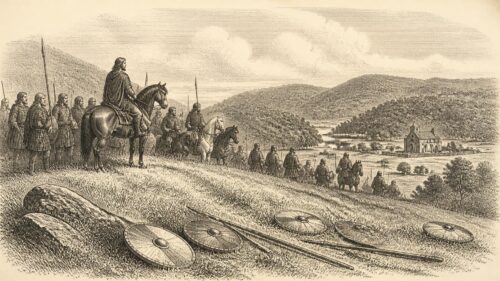
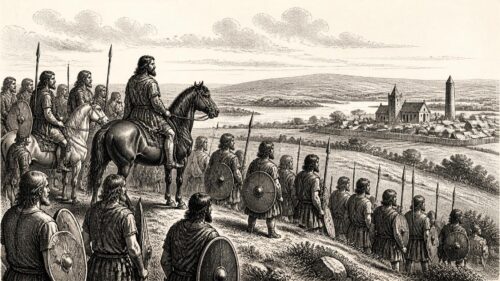
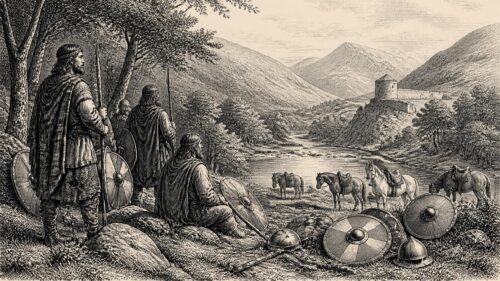
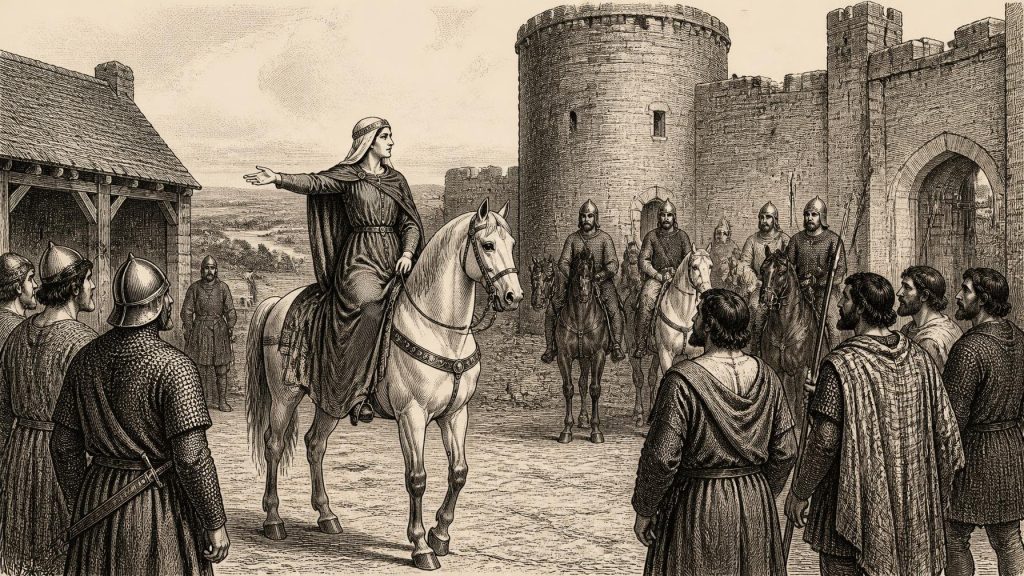
Meiler’s opponents nevertheless prevailed. In February 1208, forces loyal to the Marshal, assisted by Hugh de Lacy, earl of Ulster, Walter de Lacy of Meath, and Geoffrey de Marisco, captured Meiler at Thurles. Isabel Marshal, who had remained in Ireland while her husband dealt with the king, was central to the defence of the Leinster lordship. The episode is an important reminder that aristocratic women could exercise practical political and military authority: Isabel directed the defence of Kilkenny and received Meiler’s submission, demanding hostages for his future conduct.
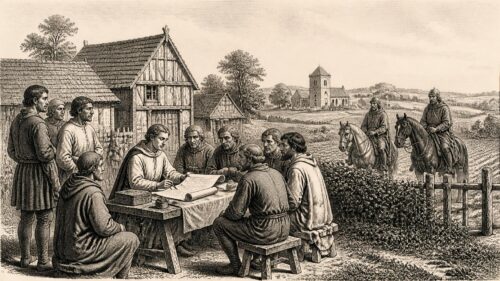
John rapidly altered course. In March he restored William Marshal to favour, returned Offaly, and issued a new charter for Leinster. The settlement did not make the Marshal an independent prince: its terms curtailed aspects of the liberties he could exercise. Yet it acknowledged that an attempt to weaken him through the justiciar had failed. Walter de Lacy also received a new charter for Meath in April and returned to Ireland during the summer. Royal policy was thus conciliatory in form, but it was also corrective and watchful. John wanted his great Irish tenants reconciled, not released from dependence upon the Crown.
A new justiciar, not instant order
Meiler’s removal exposed the limits of royal government. In June John appointed John de Grey, bishop of Norwich, as justiciar. De Grey was a trusted royal administrator rather than an established Irish magnate, and his selection signalled John’s wish for a more direct and dependable instrument of government. The change was important, but it should not be exaggerated into an instant transformation. De Grey was still in England for much of 1208 and is securely attested as acting in Ireland by the end of January 1209. His appointment belongs firmly to 1208; the fuller programme associated with his rule, including the later drive towards Athlone and the Shannon, belongs to subsequent years.
Contemporary Irish annalistic tradition registered the disorder more bluntly. The Annals of Loch Cé describe a great war among the “Foreigners of Ireland” between the sons of Hugh de Lacy, Meiler and Geoffrey de Marisco. The phrase is revealing. It does not treat the incoming aristocracy as a united English power. Their landholdings, family alliances and military followings formed overlapping interests, and Gaelic observers could recognise the fracture. The fighting around Thurles and the contested lordships of Leinster, Meath and Offaly were part of this wider political landscape.
The settlement also opened a more constructive phase for William Marshal in Leinster. From 1208 he spent prolonged periods on his Irish lands, concentrating increasingly on their defence, settlement and commercial development. New Ross, founded before this crisis, was already becoming a significant river port, while Kilkenny, Kildare and Carlow were sites where charters, markets and burgess communities could strengthen lordly revenue. It would be wrong to date every such development to this single year. But the resolution of the Meiler conflict removed an immediate threat to the lordship and made that investment possible.
War and accommodation in the north
Far from Leinster, the year’s annals preserve a different political world. Inis Eógain, the peninsula now known as Inishowen, became the setting for a costly confrontation between Áed Ó Néill of Cenél nÉogain and Domnall Mór Ó Domhnaill of Cenél Conaill. The Annals of Loch Cé and the Annals of the Four Masters associate the fighting with a raid by Ó Néill and record heavy losses on both sides. Named casualties from leading families appear amid the broader report of a great slaughter. Cattle-taking was both a means of provisioning armed followings and a direct challenge to an opponent’s status; it also imposed immediate hardship on the households from which herds were driven.
The later account in the Annals of the Four Masters says that Ó Néill and Ó Domhnaill subsequently made peace and allied against opponents, whether English or Irish. This is plausible as a record of northern diplomacy, but it should be treated with the care due to annals compiled centuries after the events. What can safely be said is that 1208 saw vigorous conflict between two major northern dynasties, not passive submission to power based in Dublin. Their ability to fight, negotiate and redirect their alliances mattered greatly for the future of Ulster.
The annals also show that political change could be imposed through connections with the lordship. Ualgarg Ó Ruairc was displaced as ruler of Breifne, and Art, son of Domnall, was installed in his place “through the influence of the English”, according to the Annals of the Four Masters. The wording does not tell us precisely which settlers or officials acted, nor does it make Breifne an obedient colony. It does, however, show how Anglo-Norman military and political influence could be used within a Gaelic succession dispute. Such arrangements were expedient: they gave outside powers allies and local contenders support, while leaving much scope for renewed conflict.
Munster, church and contested protection
Munster’s evidence underlines the same mixture of violence and religious authority. The Annals of the Four Masters places the killing of David Breathnach, bishop of Waterford, at the hands of an Ó Faeláin of the Déisi in 1208. Yet the Annals of Loch Cé places that death in its following annal, an illustration of the chronological difficulties of medieval Irish records. The killing is securely part of this turbulent period, but an annual account should not pretend that the exact calendar year is beyond dispute. If the Four Masters’ dating is accepted, it starkly reveals that episcopal office did not confer immunity in the contested country around Waterford.
A more firmly year-specific report concerns Muirchertach, son of Domnall Ó Briain, lord of Thomond. The Four Masters state that he was seized by the English of Limerick on the order of his brother Donnchad Cairbrech, despite guarantees given by three bishops. The detail matters. Bishops could act as guarantors in political agreements, lending spiritual and social weight to safe-conduct; their presence did not always prevent a calculated breach. Limerick’s English urban and lordly interests were therefore entangled in the Ó Briain family’s contest for Thomond, rather than standing outside Gaelic politics.
Other ecclesiastical notices offer a quieter view of life. The Annals of Inisfallen record the death of a priest, Ua Cuanacháin, while on pilgrimage at Cluain Uama, and commemorate Gilla Colmáin Ua Riacáin, a noble priest of that community, for piety, pilgrimage and endurance. Such entries are brief, but they show the continued importance of clerical communities, travel to religious sites and learned memorial culture in Munster. They belong beside the accounts of castles and raids: medieval Ireland was shaped as much by churches, households and seasonal husbandry as by the campaigns that dominate the record.
An interdict and an Irish complication
Events across the Irish Sea also cast a shadow over 1208. In March, Pope Innocent III placed England under interdict during his conflict with King John over the archbishopric of Canterbury. John de Grey, the king’s unsuccessful candidate for Canterbury, was now sent to govern Ireland. The Four Masters link his arrival with a claim that the English in Ireland were deprived of mass, baptism, extreme unction and lawful burial for three years. That statement must be handled cautiously. The papal interdict is securely documented for England, while modern scholarship generally treats Ireland as outside its formal scope; De Grey’s Irish appointment may indeed have offered the bishop a place to continue royal service.
The annal nevertheless captures a real contemporary tension. Ecclesiastical sanctions, royal appointments and warfare could not be neatly separated. A bishop who was also a royal governor embodied the overlap of sacred office and secular power, especially in a lordship whose churches, towns and landholders were tied to the wider Angevin realm. For Irish communities, the practical realities of 1208 remained local: the safety of a herd, a road, a church, a market town or a negotiated hostage could matter more immediately than decrees issued in Rome or England.
Thus 1208 was a year of rebalancing rather than resolution. King John replaced a compromised justiciar and repaired relations with powerful lords, but the structure of the lordship remained contested. Gaelic rulers in the north and west retained the capacity to make war and peace; Munster’s dynastic disputes drew in English Limerick and church guarantors; and religious life continued amid insecurity. The year’s significance lies in that uneven reality: royal authority could be asserted through charters and appointments, yet it still depended upon alliances, local force and the willingness of many Irish communities to accept—or resist—the terms offered to them.
Primary Sources
- The Annals of Ulster, Year U1208
- Annals of the Four Masters, Annal M1208
- Annals of Loch Cé, Annal LC1208
- Annals of Inisfallen, Annal AI1208
- Annales Hiberniae
- Meiler fitz Henry
- William Marshal
- John
- John de Grey
- Walter de Lacy
- Hugh de Lacy
- Geoffrey de Marisco
- William de Braose
- John, Lord of Ireland, 1185–1216
- Irish Historic Towns Atlas: Athlone
- A Community in Competition: The Barons of Leinster in Thirteenth-Century Ireland
- The Pope, a Knight and a Bishop on the Edge of Christendom: The Politics of Exclusion in Thirteenth-Century Ireland
- Who Were the Powerful Men Known as ‘Barons of Ireland’?
- Defining Lordships in Angevin Ireland: William Marshal and the King’s Justiciar
- Calendar of Documents Relating to Ireland, Preserved in Her Majesty’s Public Record Office, 1171–1307