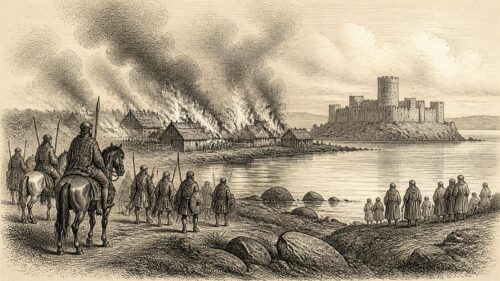
Druim Derg’s Broken Kingship1260 CE
In 1260 Brian Ó Néill’s Gaelic coalition, including forces from Tír Eógain, Connacht and Meath, was defeated by northern English interests at Druim Derg near Downpatrick. Brian and many leading allies died, ending his claim to leadership of Ireland’s Gaels; Áed Buide Ó Néill succeeded in Tír Eógain. Elsewhere, Connacht resisted MacWilliam de Burgh’s raid through defensive deployment and negotiated peace, while Thomond defeated Mac Muiris’s force. A cough affected people and horses. Church offices changed hands, and Kildare’s Franciscan friary may have been founded during this period. The year revealed political fragmentation, regional resilience and religious life amid warfare.

Dateline
In 1260 the most ambitious Gaelic coalition assembled in Ireland for a generation met catastrophe outside Downpatrick. Its defeat at Druim Derg, or Dromderg, cost Brian Ó Néill of Tír Eógain his life and abruptly ended his claim to leadership over the Gaels of Ireland. The battle was not an isolated northern encounter. It exposed how far political alliances could stretch across thirteenth-century Ireland, from Tyrone into Connacht and Meath, while also showing how quickly a defeat could unravel them. Elsewhere, warfare, raiding and negotiated settlements shaped the year; a respiratory sickness troubled people and horses; and ecclesiastical offices changed hands amid continuing monastic expansion.
A Coalition Before Down
Brian Ó Néill had been recognised by important Gaelic rulers as a superior king in 1258, but this was a political achievement rather than the restoration of a universally obeyed high-kingship. His real strength lay in Tír Eógain, in north-western Ulster, and in carefully cultivated alliances. The immediate background to 1260 therefore belongs to the preceding two years: Brian had worked with Áed Ó Conchobair of Connacht and with allies from other Gaelic lordships, while rival branches and neighbouring dynasties remained capable of frustrating him. That broader context explains the scale of the expedition, but should not be mistaken for evidence that Ireland had become a unified kingdom.
The annals firmly place the decisive campaign in 1260. Áed Ó Conchobair, son of Fedlimid, travelled north with many leading men of Connacht to join Brian and the chiefs of Cenél nÉogain. The force also included men connected with Meath. Their destination was Downpatrick, an important ecclesiastical centre and a key settlement in the Anglo-Norman lordship of Ulster. The annalists call the opposing side the Galla, or ‘Foreigners’; in this setting that means the English or Anglo-Norman settlers and their political following in the north, not a homogeneous ethnic army.
The Battle of Druim Derg
The coalition was defeated at Druim Derg near Dún dá Lethglas, medieval Downpatrick, on 16 May 1260 according to modern scholarly reconstruction. The contemporary-style annalistic notices do not offer a tactical narrative: they do not securely tell us the size of either army, its order of battle, or the exact course of the fighting. What they do establish is stark enough. Brian Ó Néill and Áed Ó Conchobair attacked the northern English; the attackers were beaten; and Brian was killed. Later accounts identify Stephen Longespée, the king’s justiciar in Ireland, with the defence of Down, but the Irish annals themselves focus on the communities that suffered the loss.
Those losses were extraordinary because they cut across several lordships. The Annals of Ulster and Annála Connacht name leading figures from Cenél nÉogain, the Uí Catháin, Airgialla and Connacht. Fifteen nobles of Clann Catháin were said to have fallen in one place. Among the Connacht dead was Gilla Críst Mac Diarmata, lord of Magh Luirg, together with members or associates of the Ó Conchobair, Mac Donnchada, Ó Maolruanaid, Mac Gilla Arraith and Ó Gadhra kindreds. The long roll of names is more than an annalist’s lament: it reveals a coalition whose senior households had committed themselves personally to Brian’s venture.
Brian’s death was therefore a political as well as a military disaster. The annals style him ‘king of the Gaels of Ireland’ or ‘chief of Ireland’, titles that express the reach of his claim and the esteem of his supporters, not an uncontested constitutional office. He was beheaded after the defeat, and his head was sent to England. The act asserted the victory of the English lordship and removed the one man around whom the alliance had been organised. Some later Irish chronicles date their equivalent notice to 1261, an example of the differing year-placements found in medieval annals. The converging Ulster and Connacht evidence, and modern historical reference works, support 1260 as the calendar year of the battle.
A Northern Vacuum
The immediate consequences were felt within Ulster. The Annals of Ulster record that Áed Buide Ó Néill was made king of Tír Eógain after Brian’s death. Succession in a Gaelic kingship was not normally automatic inheritance by a single eldest son; election, kinship, military support and the capacity to protect followers all mattered. A new ruler’s installation so soon after the battle demonstrates the urgency of restoring authority, but it also signals how decisively Brian’s wider project had collapsed.
Violence did not subside with the new kingship. The Annals of the Four Masters, compiled much later from earlier material, place an Ó Domhnaill raid into Cenél nÉogain after the battle, reporting widespread plunder and burning. It should be used cautiously because of its late compilation, but its sequence accords with the larger reality: a defeated country, deprived of many aristocratic fighting men, was exposed to rivals. For farming communities, such raiding meant more than a change of lord. Burning could destroy dwellings, stores and fencing, while the seizure of cattle removed both food and portable wealth.
Connacht’s Defended Cattle
The year’s fighting also shows that Anglo-Norman power did not proceed steadily westward. MacWilliam de Burgh led an expedition against Fedlimid Ó Conchobair of Connacht and reached Roscommon. The Connacht annalist says that Roscommon was sacked and its corn destroyed; raiding parties also struck local territories. Yet MacWilliam did not push farther north. Fedlimid and his son, Áed na nGall, were positioned in the Tuatha, with other Connacht forces behind the invaders in the waste land. Crucially, the cattle of Connacht had been placed to the rear.
This was a practical defensive calculation. Cattle were central to wealth, subsistence, tribute and the provisioning of warbands. Removing herds from an invader’s path denied him plunder and reduced the incentive for a deeper advance. The standoff ended not in a conclusive battle but in a peace agreement, after which MacWilliam withdrew. The episode is a useful corrective to any picture of the thirteenth century as a simple contest between two fixed blocs. Both Gaelic rulers and Anglo-Norman lords campaigned, raided, protected resources, made peace and resumed competition according to immediate advantage.
Thomond’s Woodland Victory
In Thomond, a force led by Mac Muiris entered the region to attack Conchobar Ó Briain. The Connacht annalist places the encounter at Coill Bhearáin, ‘the wood of Bhearáin’, rendered Kilbarran in English translations. Conchobar and the chiefs of Thomond met the expedition there, and the attackers were defeated. David Prendergast, described as a distinguished knight, was among the dead, along with the Failgech, the priest of Ardrahan, Thomas Baroid and many others.
The precise topography of the encounter is uncertain, but the reference to a wood matters. Medieval armies moving through wooded country were vulnerable to a force that knew the local ground and could strike from several directions. The annal should not be inflated into proof of a national rising; it records a regional success by an Ó Briain ruler defending Thomond. Nevertheless, together with the settlement in Connacht, it shows that 1260 brought serious limits to external military expeditions in the west as well as victory for the English interest at Down.
Sickness and Church Office
Not every notable development was martial. The Annals of Inisfallen record a ‘common cough’ affecting human beings and horses, called galar na placóide. The brief entry does not permit a modern diagnosis, nor does it reveal mortality or geographical range beyond the annalist’s horizon. It does, however, preserve an unusual glimpse of a disease troubling both people and the animals on which transport, cultivation and war depended. In a society where horses carried riders, hauled loads and linked dispersed settlements, an equine outbreak could have immediate economic as well as military consequences.
Church life likewise continued through loss and renewal. Dáúid Ó Ligáin, chancellor of Clonmacnoise, died. Abraham Ó Conalláin, archbishop of Armagh and successor of Patrick, also died; the office connected its holder to one of Ireland’s greatest ecclesiastical centres and to the wider Latin Church. The Annals of the Four Masters additionally record that the coarb of Patrick conferred episcopal dignity on Máel Sechlainn Ó Conchobair at Dundalk. Such entries remind us that ecclesiastical authority operated through local churches, learned officers, consecrations and networks of patronage even during a year dominated by war.
Greyfriars at Kildare
A tradition assigns the establishment of the Franciscan friary later called Grey Abbey at Kildare to 1260, associating it with William de Vesci and Gerald FitzMaurice. The date and founders are not wholly secure: other evidence points to 1254 or to a broader foundation period between 1254 and 1260. It is therefore safest to connect, rather than unequivocally date, the friary’s early establishment to this year. Its development illustrates a significant change in Irish religious life. Mendicant friars settled near growing towns, depended on patrons and alms, preached to lay communities, and stood alongside the older monastic landscape.
Thus 1260 was not merely the year of one lost battle. Druim Derg destroyed a coalition built to elevate Brian Ó Néill beyond Tír Eógain, while conflict in Connacht and Thomond demonstrated the continuing resilience of regional powers. Coughing people and horses, deaths in major churches, and a cautiously dated Franciscan foundation show a country whose ordinary religious, social and economic life persisted amid political shock.
Primary Sources
- The Annals of Ulster: Year U1260
- Annála Connacht: Annal 1260
- Annals of the Four Masters: Part 9, Annal M1260
- Annals of the Four Masters: Irish Text, Annal M1260
- Annals of Inisfallen: Part 78, Annal AI1260
- Mac Carthaigh’s Book: Part 12
- The Genealogy of Corca Laidhe
- Annales Hiberniae [Grace’s Annals]
- O'Neill (Ó Néill), Brian | Dictionary of Irish Biography
- The Rise and Fall of the Clann Éinrí Aimhréidh Uí Néill: Dynastic Feuding and Geopolitics in the Late Medieval Irish Sea World
- Materials for the History of the Franciscan Province of Ireland, A.D. 1230–1450
- Kildare Franciscan Friary
- Kildare: Irish Historic Towns Atlas Text
- The Medieval Walled Towns of Kildare
- The Abbeys of Kildare
- 2010:400 – Greyabbey, Kildare
- 2004:0831 – Kildare: Grey Abbey, Kildare
- The Annals of Ulster, AD 1202–1378
- Annála Connacht
- Mac Carthaigh’s Book