A Kingdom Negotiated1161 CE
In 1161 Ireland comprised competing provincial kingdoms, lordships, churches and towns rather than a unified state. Muirchertach Mac Lochlainn, dominant northern ruler, and Ruaidrí Ua Conchobair of Connacht negotiated authority through campaigns, hostages and assemblies, dividing influence while preserving Mac Lochlainn’s senior kingship. Meath remained contested, with local dynastic violence continuing despite high-level settlements. Church reform and power were marked by bishops’ deaths, Dublin Archbishop Gregory’s death, Columban privileges secured by Flaithbertach Ua Brolcháin, and written guarantees for Ardbraccan. Rural communities supplied armies and suffered plunder; cattle and silver underpinned wealth. Towns, learning and poetry shaped wider Irish cultural life.
Dateline
In 1161 Ireland was not a single state governed through permanent institutions. It was a network of provincial kingdoms, local lordships, churches and towns, held together—or pulled apart—by personal alliances, military expeditions, tribute and hostages. The most powerful ruler was Muirchertach Mac Lochlainn of Cenél nÉogain, whom contemporary records could call king of Ireland. His principal rival was Ruaidrí Ua Conchobair, king of Connacht. Their contest dominated the year, but it produced negotiation as well as violence. The annals describe campaigns, submissions and assemblies through which authority was repeatedly asserted and redefined.
Two Kings and Their Allies
Ruaidrí began the year in a strong position across the western half of the island. The Annals of the Four Masters record that he took hostages from Toirdelbach Ua Briain of Thomond. Hostages were normally important relatives or dependants of a ruler, delivered as guarantees of obedience. Taking them demonstrated political superiority, although that superiority lasted only while it could be enforced.
Ruaidrí then campaigned in Meath and Leinster with Tigernán Ua Ruairc, king of Bréifne. According to the Annals of Tigernach, he placed rulers over Uí Fáeláin in northern Leinster and Uí Failge in the midlands before carrying away their hostages. The Four Masters identify the appointees as Fáelán Mac Fáeláin and Máel Sechnaill Ua Conchobair Failge. This was more than raiding: Ruaidrí was intervening in local successions and constructing a chain of dependent rulers beyond Connacht.
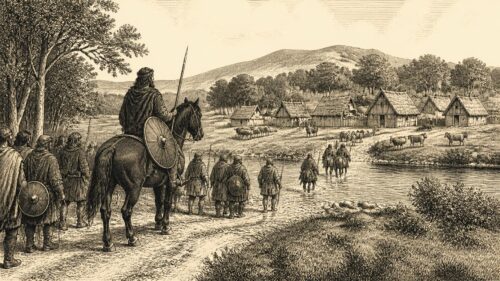
Mac Lochlainn answered with a major hosting into the territories of Uí Briúin. His route brought the northern army through the country around Clones and south into the midlands, ravaging as far as the Slieve Bloom region. Tigernán Ua Ruairc abandoned his camp rather than confront the advancing force. Mac Lochlainn was joined by the Airgialla and Ulaid, by Diarmait Mac Murchada and the Leinstermen, and by a battalion of the ‘Foreigners’—the Hiberno-Norse inhabitants of Dublin or another eastern town. Their presence shows how closely the coastal towns were already involved in Irish political warfare.
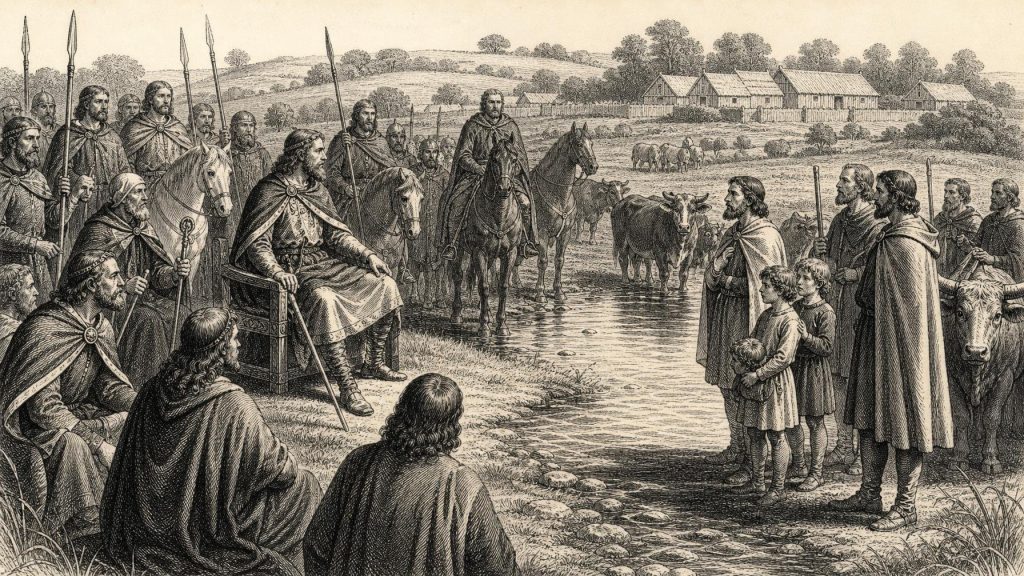
Ruaidrí crossed the Shannon and met Mac Lochlainn rather than risk a decisive battle. The accounts differ in wording, but agree that hostages were delivered and spheres of authority were recognised. Ruaidrí provided four hostages for Uí Briúin, Conmaicne, part of Meath and part of southern Ireland. Mac Lochlainn acknowledged his rule in Connacht and, according to later annalistic interpretation, confirmed him in extensive western territories. Diarmait Mac Murchada was likewise confirmed in Leinster.
The Four Masters consequently describe Mac Lochlainn as king of Ireland ‘without opposition’. That statement should not be read as evidence of uncontested national government. The settlement actually conceded substantial influence to Ruaidrí beyond Connacht. Mac Lochlainn remained the senior king, but Ruaidrí emerged with his position strengthened in Thomond and western Meath. The agreement was a practical division of power between rivals who had failed to destroy one another.
The Politics of Meath
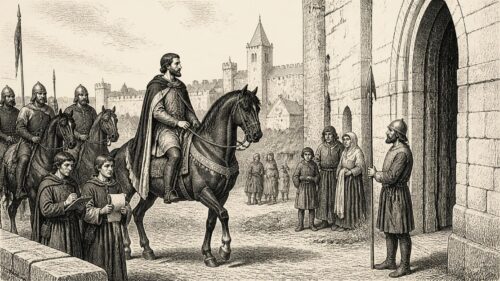
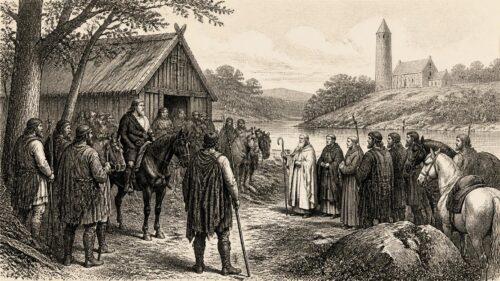
Meath remained the crucial meeting ground between north, west and east. Later in 1161 Mac Lochlainn led another army there for an assembly at Áth na Dairbhrige. Lay and ecclesiastical leaders attended, and the king received their pledges. Such gatherings combined diplomacy, judgement, ceremony and the visible presence of armed power. They allowed an overking to present political settlements as agreements witnessed by the leading men and churches of several regions.
Agreement at the highest level did not end local feuding. At Kells, Gofraid Ua Raghallaigh, ruler of Muintir Máelmórda and Mag Gaileng, and his son Gilla Íosa were killed by Máel Sechnaill, son of Tigernán Ua Ruairc. The Annals of Ulster also report fighting at Slane, where Cathal Ua Raghallaigh attacked a house occupied by Máel Sechnaill Ua Ruairc. Muirchertach Ua Cellaigh, king of Brega, and several nobles were killed, although Máel Sechnaill escaped.
Elsewhere, the chronicles record killings among the ruling families of Kerry, Cork and the midlands. The Annals of Inisfallen give the unusually precise date of 28 June for the deaths of Áed Ua Donnchada, a ruler associated with Eóganacht Locha Léin, and Máel Sechnaill son of Cellachán. These notices reveal a political landscape in which lesser dynasties pursued their own rivalries beneath the larger contest for the kingship of Ireland.
Churches and Political Power
The ecclesiastical history of 1161 was unusually prominent. Ireland’s Church was still absorbing the reforms formalised at the Synod of Kells-Mellifont in 1152, which had recognised four archiepiscopal provinces. Several senior churchmen died during the year. They included Áed Ua hOissín, archbishop of Connacht or Tuam; Tadc Ua Longargáin, bishop of Thomond; Isaac Ua Cuanáin, bishop associated with Roscrea; and Máel Brénainn Ua Rónáin, a western bishop buried at Ardfert. The Annals of Inisfallen place Máel Brénainn’s death on 22 September and praise his piety, charity and celibacy.
Gregory, the first archbishop of Dublin, died on 8 October after an episcopate of about forty years. Dublin’s predominantly Hiberno-Norse church had traditionally looked to Canterbury for episcopal consecration, and Gregory himself had been consecrated at Lambeth in 1121. He had received the pallium as archbishop at Kells in 1152. His death therefore ended an important transitional career and opened the way for the later elevation of Lorcán Ua Tuathail, better known as Laurence O’Toole.
The year also displayed the power of older monastic federations. Flaithbertach Ua Brolcháin, abbot of Derry and successor of Colum Cille, secured the liberation of Columban churches in Meath and Leinster from secular tribute and external jurisdiction. Mac Lochlainn’s assembly at Áth na Dairbhrige provided the political setting in which this freedom was publicly recognised. The episode was both religious reform and institutional consolidation: Derry’s abbot was strengthening his authority over a dispersed network that included important Columban communities.
Flaithbertach also made a visitation of Osraige. The tribute assessed there was seven score oxen, but he accepted their stated equivalent—420 ounces of pure silver. This striking entry shows that cattle remained a standard measure of wealth while weighed silver could substitute for livestock in major transactions. It does not mean that ordinary exchange had become fully monetised. Rather, cattle, precious metal, food renders, hospitality and service all operated together within the economy.
A charter preserved in the Book of Kells and datable to this period records another ecclesiastical settlement. Mac Lochlainn, Diarmait Ua Máelshechlainn of Meath and Áed Ua Cáindelbáin of Loegaire guaranteed the freedom of Ardbraccan. A recurring obligation to provide a night’s hospitality every quarter was permanently purchased for three ounces of gold. The record names royal and clerical guarantors, demonstrating the growing usefulness of written instruments alongside oath, witness and public assembly.
Not every ruler respected ecclesiastical protection. Ruaidrí Ua Conchobair reportedly had Domnall Ua Laeghacháin, chief of Clann Suibne, killed in captivity even though he was under the safeguard of the successor of Ciarán. The annalist’s emphasis on that safeguard suggests disapproval. Sanctuary and clerical guarantees possessed genuine moral and political force, but forceful kings could still violate them.
Work, Wealth and Settlement
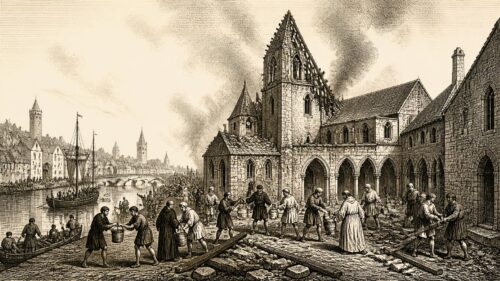
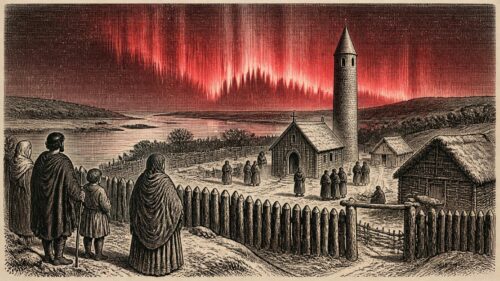
Most people experienced these struggles indirectly. Ireland remained overwhelmingly rural, its population living among farmsteads, ringforts, crannógs and ecclesiastical settlements. Households tended cattle and sheep, raised pigs, cultivated cereals, produced dairy foods and worked wood, leather, iron and textiles. A royal hosting could place heavy demands upon them. Armies required food, fodder, guides, transport and lodging; hostile troops seized cattle and burned stores or buildings. The annals’ repeated references to plundering describe the disruption of livelihoods as well as the movement of kings.
Cattle were food, breeding stock, portable capital and a conventional unit for calculating dues. Silver was increasingly available through trade and the towns, yet wealth continued to be expressed in oxen and cows. Dublin, Waterford, Wexford, Cork and Limerick linked Irish producers with Britain and continental Europe. Archaeological evidence from Dublin reveals craft workers producing wooden vessels, barrels, combs, leather goods and metal objects, while merchants imported pottery and luxury materials.
Dublin remained culturally Hiberno-Norse but was not isolated from Gaelic Ireland. Its warriors could accompany Diarmait Mac Murchada and Mac Lochlainn, while its merchants depended upon produce from the surrounding countryside. Gregory’s archbishopric similarly belonged to both an Irish ecclesiastical structure and a longer maritime relationship with England. Political and cultural boundaries were consequently more permeable than labels such as ‘Gael’ and ‘Foreigner’ might imply.
Poetry and Learning
Ragnall Ua Dálaigh, ollamh of Desmond in poetry, died in 1161. An ollamh was not simply an entertainer but a highly trained professional scholar attached to a courtly world of praise, genealogy, history and law. No surviving poem can securely be assigned to Ragnall, but his obituary shows that the Ua Dálaigh family was already associated with prestigious literary office.
The broader intellectual setting is illuminated by the Book of Leinster, a great vernacular manuscript being compiled in this period, though it cannot responsibly be said to have been completed in this precise year. Its mixture of saga, genealogy, biblical history, grammar, medicine and place-name lore reflects the concerns of learned Irish communities. In a year remembered chiefly for armies and hostages, such scholarship was another form of power: it preserved dynastic claims, organised collective memory and explained Ireland’s place within Christian history.
A Precarious Settlement
By the end of 1161 Mac Lochlainn could still claim the superior kingship, supported by northern rulers, Leinster and urban troops. Yet Ruaidrí had secured recognition across Connacht, western Meath and Thomond while cultivating Ua Ruairc and midland allies. Their settlement reduced the immediate danger of a great battle but did not resolve the contest. Beneath it, dynastic killings continued, churches sought protection from secular demands, and ordinary communities bore the material cost of campaigning. The year’s apparent unity was therefore real enough to be proclaimed at assemblies, but too dependent upon hostages, personal loyalty and military reputation to be permanent.
Primary Sources
- The Annals of Ulster: Year U1161
- Annals of the Four Masters
- The Annals of Tigernach: Part 23
- Annals of Tigernach
- Annals of Inisfallen: Part 69
- The Irish Charters in the Book of Kells: Section VI
- Gregory (Gréne)
- Mac Lochlainn, Muirchertach
- Ua Conchobair, Ruaidrí
- Ua Ruairc, Tigernán
- Mac Murchada, Diarmait (MacMurrough, Dermot)
- The Political Structures of Gaelic Ireland, 1114–1541
- From Kingdom to Colony: Framing the English Conquest of Ireland
- Book of Leinster – Director's Choice Uncut
- Book of Leinster, formerly Lebar na Núachongbála
- Medieval Ireland 1150–1550
- The Viking Age in Ireland
- Viking
- 950–1450: Vikings, Normans and Medieval Mints
- Religious Orders
- Mellifont Cistercian Abbey
- Early Medieval Ireland: Archaeological Excavations, 1930–2009
- The Archaeology of Livestock and Cereal Production in Early Medieval Ireland, AD 400–1100
- The Archaeological Remains of Viking and Medieval Dublin: A Research Framework
- The Landscape and Settlements of the Uí Dhálaigh