

Rivers, Kings and Fire1089 CE
In 1089, politics remained fragmented, as Muirchertach Ua Briain of Munster sought supremacy against Ruaidrí Ua Conchobair of Connacht, Domnall Ua Máelsechlainn of Meath and rivals. Muirchertach’s Shannon fleet plundered churches but was trapped near Athlone, surrendered, and prompted a raid into Munster. Donnchad of Leinster and Dublin and Donnchad Ua Gilla Pátraic of Osraige were killed amid conflict, destabilising eastern Ireland. Warfare, feud and raids affected lordships, churches and communities. Munstermen burned Lusk, killing 180 people sheltering in its church; Kildare and other centres suffered fires. Clerical deaths, land transactions, trade, livestock, captives and Easter’s wind also illuminate society.
Dateline
The surviving record of 1089 is unusually vivid but far from complete. Irish annalists noted campaigns, royal deaths, church burnings and a destructive wind, while saying almost nothing directly about harvests, births or ordinary domestic routines. Their accounts also disagree over responsibility and sometimes over chronology. Events repeated across several chronicles can be treated with confidence; claims found only in one source require greater caution. What emerges is a year dominated by the contest for regional supremacy after the death of Tairdelbach Ua Briain in 1086, with rivers, monasteries and Hiberno-Norse towns drawn into the struggle.
Competing Overkings
No single ruler governed Ireland as a unified kingdom. Muirchertach Ua Briain, king of Munster and great-grandson of Brian Bóruma, sought to rebuild the wide authority exercised by his father Tairdelbach. Ruaidrí Ua Conchobair ruled Connacht and resisted Munster’s expansion along the Shannon. Domnall Ua Máelsechlainn represented the powerful Clann Cholmáin dynasty in Meath, while Domnall Mac Lochlainn was establishing himself as the foremost ruler of the northern Uí Néill. Leinster, Dublin and Osraige possessed their own rulers and ambitions. Overkingship depended on military strength, alliances, hostages, tribute and the repeated demonstration of power rather than on a permanent central administration.
War on the Shannon
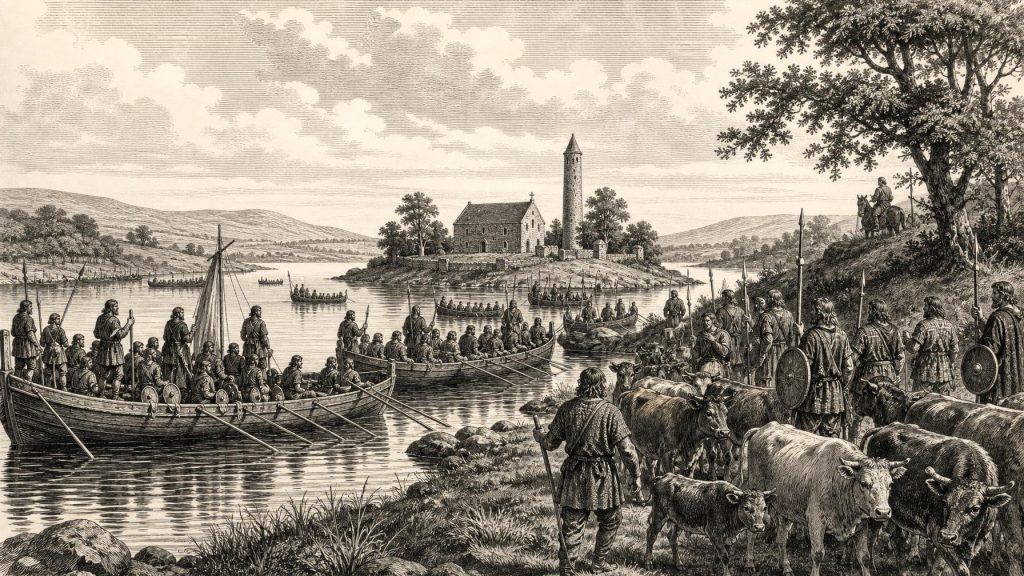
The best-attested operation of the year began when a large Munster fleet, led according to the Annals of Tigernach and the Four Masters by Muirchertach Ua Briain, entered the Shannon and Lough Ree. Its crews plundered the island churches of Inis Clothrann, Inis Bó Finne, Inis Ainghin and Cluain Eamhain. These were not isolated hermitages without worldly value. Monastic settlements could possess livestock, vessels, metalwork, food reserves and the offerings of patrons and pilgrims. Their islands also occupied strategic positions on one of Ireland’s principal routes of communication.
Ruaidrí Ua Conchobair and the Connachtmen blocked channels behind the fleet, while Domnall Ua Máelsechlainn’s forces pressed it near Athlone. Trapped between opponents and unable to move freely upstream or downstream, the Munstermen sought Ua Máelsechlainn’s protection and surrendered their ships. This was more than a battlefield capitulation. Protection created an obligation to spare those who submitted, and the Four Masters say that the crews were conveyed safely home. The episode illustrates how warfare and negotiated settlement could operate together: enemies might seize vessels and demand submission without necessarily massacring a defeated force.
Ruaidrí and Ua Máelsechlainn then turned the captured boats against Munster. The annals describe a counter-raid into Ormond and towards the Dál Cais country, with cattle and captives carried away. Their language is characteristically sweeping, claiming that scarcely a beast or person remained along the route. Such phrases should not be read as a literal census of devastation, but they convey the intended severity. The campaign checked Muirchertach’s advance, exposed the vulnerability of his river strategy and showed that control of the Shannon depended upon landing places, narrow channels and local alliances as much as upon the number of boats.
A Leinster Succession Broken
A major political death reshaped eastern Ireland. Donnchad, son of Domnall Remar and grandson of Diarmait mac Máel na mBó, was killed in 1089. He is described as king of Leinster and, in some chronicles, king of “the foreigners”, meaning the Hiberno-Norse inhabitants of Dublin. The Annals of Tigernach and the Four Masters praise him as an outstanding warrior and say that Conchobar Ua Conchobair Failge killed him with support from Osraige and western Leinster. The Annals of Ulster more generally blame his own people.
The Munster-centred Annals of Inisfallen present a different version. They place Donnchad’s death within a campaign by Muirchertach Ua Briain, claim that Muirchertach took the kingship of Leinster and Dublin, and report the imprisonment of Énna son of Diarmait. This may preserve knowledge of Muirchertach’s political exploitation of the killing, but it conflicts with chronicles that name Conchobar as the immediate killer. It is therefore safest to conclude that Donnchad fell amid internal Leinster conflict from which Muirchertach attempted to profit. Possession of Dublin mattered greatly: the town offered ships, warriors, craftsmen, coinage and access to Irish Sea trade.
Violence Across the Provinces
Donnchad Ua Gilla Pátraic, king of Osraige, was also killed. The Ulster annalist says that his own people were responsible, while the Four Masters identify descendants of Domnall Breac. Most chronicles place the death in 1089, although the Annals of Inisfallen record it under 1090, a reminder that annalistic year labels are not always perfectly aligned. Osraige occupied the important zone between Munster and Leinster, and instability there affected both provincial kingdoms.
In the north, the Uí Echach and the Ulaid defeated the rulers of Fir Manach at Sliab Fuaid. The Four Masters identify among the dead a son of Áed Ua Crícháin, lord of Fir Manach, together with twelve members of the noble succession and many others. The scale of elite loss suggests a serious disruption to local leadership. Muirchertach Ua Laithéin, king of Síl Duibtire, also died during the year. Elsewhere, Gilla Cainnigh Ua Flaithfhileadh, lord of Delbna Bethra, was killed by his brother. These notices reveal political life below the level of provincial kings: local lordships were repeatedly reshaped by feud, contested succession and opportunistic violence.
The Four Masters additionally place a far-reaching raid by Domnall Ua Máelsechlainn into the territories of Fir Manach, Conaille, Mughdorna and Uí Méith in this year, ending with the burning of Conaille. The Annals of Tigernach place a closely corresponding expedition under 1091, so its precise dating remains uncertain. It nevertheless belongs to the immediate pattern of Ua Máelsechlainn pressure towards the north-east and demonstrates how a Meath ruler could project force well beyond his central territories.
Churches in the Flames
The starkest entry concerns Lusk in north County Dublin. The Annals of Ulster and the Four Masters agree that Munstermen burned the settlement and that nine score people—180 in the annalists’ reckoning—died in its stone church. A masonry church could still contain a timber roof, doors, furnishings and other combustible material. People had presumably crowded inside because a church was both a sacred refuge and one of the strongest buildings available. The report records not simply damage to property but a disaster remembered for its concentrated loss of life.
Kildare was burned three times during the year, according to the Annals of Ulster. The Four Masters also list fires at Cork, Emly and Ardfert, although they do not attribute every burning to warfare. Accidental fire was a constant danger in settlements where most houses, workshops, fences and roofs were made from timber, wattle and thatch. Even so, the repeated destruction of major ecclesiastical centres points to a year of exceptional insecurity. Churches were sacred places, but they were also landholders, storehouses, schools and centres of political patronage; damaging one could weaken both a religious community and the dynasty associated with it.
Clergy, Learning and Property
Several learned churchmen died in 1089. Gilla Pátraic Ua Célecáin, prior of Armagh, died on Christmas Eve. The Four Masters also record the deaths of Conchobar son of Fogartach Ua Máel Dúin, prior of Clonmacnoise, and Fergal Ua Meisdeadhaigh, lector of Emly. A lector was responsible for advanced teaching and the transmission of Latin and ecclesiastical learning. Their obituaries show that the annalists regarded intellectual and institutional leadership as worthy of remembrance alongside kingship and battle.
This was also the cultural setting in which manuscripts continued to be copied and assembled. The Book of the Dun Cow, generally dated to about 1050–1100 and associated with Clonmacnoise, cannot be assigned specifically to 1089, but it demonstrates the breadth of contemporary scholarship. Religious material appeared beside poetry, genealogical learning and vernacular narrative. The larger monasteries remained communities of clerics, craftspeople, tenants and dependants rather than secluded groups of monks alone.
The Four Masters record that Cormac Mac Cuinn na mBocht purchased Ísel Chiaráin permanently from Ua Flaithéin and Domnall Ua Máelsechlainn, king of Meath. The exact circumstances are obscure, but the notice is valuable evidence for recognised transactions in land or rights involving ecclesiastical interests and secular rulers. Such agreements depended on witnesses, memory and documentary learning. They also remind us that monasteries were economic institutions whose estates, rents and privileges could be negotiated.
Wealth and Everyday Survival
The year’s campaigns reveal the foundations of the economy more clearly than any formal account does. Raiders repeatedly sought cattle, captives, horses, ships, gold and silver. Cattle supplied meat, milk, hides and social status and remained a principal measure of movable wealth. Captives could be ransomed, exchanged or compelled to labour. Boats linked inland communities along the Shannon, while Dublin, Cork, Waterford, Wexford and Limerick connected Ireland to Britain and continental markets. Silver coin circulated most strongly in Dublin and other trading environments, but livestock and obligations remained fundamental across the countryside.
Most people lived in dispersed farmsteads, ringforts, crannógs or small settlements, cultivating grain and keeping cattle, sheep and pigs. Their experience of high politics came through demands for food, billeting and military service, or through the sudden arrival of raiders. A campaign described as a royal victory could mean lost animals, burned buildings and displaced families at local level. Monastic centres and towns offered markets and specialist crafts, yet their accumulated resources also made them targets.
A Wind Remembered
Chronicon Scotorum closes its entry with “the Easter of the high wind”, placing Easter on 1 April. No detailed damage is given, so the scale of the storm cannot be reconstructed. Its preservation nevertheless shows that weather could become a chronological landmark in communal memory. By the end of 1089, Muirchertach Ua Briain remained formidable but checked, Ruaidrí Ua Conchobair had demonstrated control of the central waterways, and Leinster and Osraige faced disrupted successions. The year left no decisive ruler of Ireland—only a sharper contest for rivers, towns, tribute and allegiance.
Primary Sources
- The Annals of Ulster: Year U1089
- The Annals of Tigernach: Annal T1089
- Annals of the Four Masters: Annal M1089
- Chronicon Scotorum: Annal CS1089
- Annals of Inisfallen: Annal AI1089
- CELT Project: Chronicon Scotorum
- CELT Project: Annals of Loch Cé
- Ua Briain, Muirchertach
- Ua Conchobair, Ruaidrí na Saide Buide
- Ua Lochlainn (Mac Lochlainn), Domnall
- Ua Máelshechlainn, Conchobar
- Ua hÉnna, Domnall
- Irish School of Illumination, c. 650–1100
- Clonmacnoise Visitor Guide
- High Crosses
- Viking
- 950–1450: Vikings, Normans and Medieval Mints
- Early Medieval
- Guide to the National Museum of Ireland: Archaeology
- Medieval Ireland: Territorial, Political and Economic Divisions
- Animals and the Economy of Medieval Ireland
- County Kildare Urban Archaeology Survey
- 2008:456 – Lusk, Church Road
- Ardfert Cathedral
- Ardfert Franciscan Friary
- History of Emly
- Kingship, Lordship, and Resistance: A Study of Power in Eleventh- and Twelfth-Century Ireland
- The Leinster–Marshal Thesis