Derryvree’s Two-Till Basin30648 BCE
The assigned date is not recoverable from Irish evidence, but lies within a broad MIS 3 climatic interval. At Derryvree, County Fermanagh, freshwater sediments, plants and insects between two glacial tills demonstrate episodic local ice advances and a cold, wetland, tundra-like environment. Castlepook Cave, County Cork, contains a mixed long-term fauna, including mammoth, reindeer and hyaena, showing that suitable open habitats periodically supported mammals. A possibly cut-marked reindeer bone suggests an early human visit, but lacks associated settlement evidence. No polities, farming, trade or cultural institutions are known. They document changing late-Pleistocene landscapes, not a specific event or recoverable history.
Dateline
30,648 BCE is a modern chronological label, not a year that can be recovered from Irish evidence. No calendar, written record, named community or dated event exists for Ireland at this depth of time. The responsible setting is the later Pleistocene, within Marine Isotope Stage 3 (MIS 3), a climatically volatile part of the last Ice Age. In simple calendar arithmetic, the label lies about 32,600 years before the radiocarbon reference year of AD 1950, but archaeology cannot identify what happened in this particular year.
The closest securely relevant Irish sequence is at Derryvree, near Maguiresbridge in County Fermanagh. There, roadworks exposed freshwater silts and fine sands trapped between two distinct sheets of glacial till within a drumlin. Organic material from the intervening deposit produced a conventional radiocarbon age of 30,500 ± 1,200 radiocarbon years BP. A later published calibration places that result broadly at c. 36,900–31,700 calibrated years BP, or roughly 34,950–29,750 BCE. Thus 30,648 BCE falls near the younger end of a wide chronological window represented by the deposit, not at a point that can be isolated within it.
A Landscape Between Ice Advances
Derryvree’s importance lies in the order of its layers. An earlier episode of glaciation laid down the lower till: an unsorted mixture of clay, stones and debris deposited directly by moving ice. Afterwards, at least around this Fermanagh basin, conditions allowed freshwater sediment, plant material and insect remains to accumulate. Later ice advanced again, covering and preserving the deposit beneath an upper till. This is firm evidence that ice cover in the locality was episodic rather than continuous. It is not, however, proof that every part of Ireland was ice-free at once.
That distinction matters. Ireland was approaching the much more extensive phase generally termed the Last Glacial Maximum. Modern reconstructions show that the British–Irish Ice Sheet did not grow or reach its maximum everywhere simultaneously: different sectors advanced at different times, while later maximum Irish ice extended well beyond today’s coastline. For the maximum phase, scholarship commonly places full Irish and offshore ice expansion broadly around 27,000–23,000 calibrated years BP, although local sequences and models continue to refine the timings. Around the date assigned here, one should picture unstable regional conditions, with ice margins, exposed ground and shallow water changing across long spans of time—not a single island-wide scene.
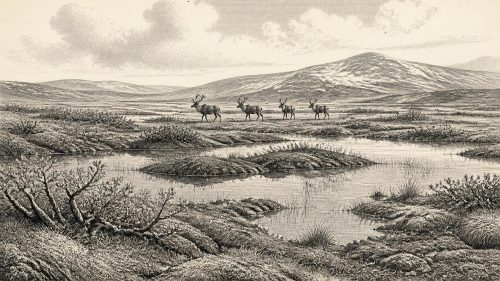
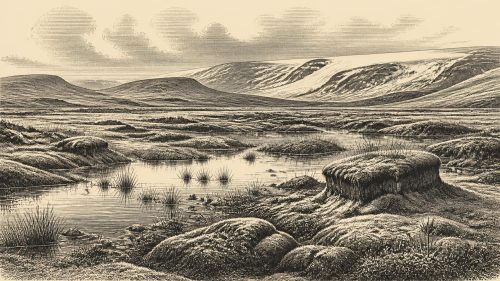
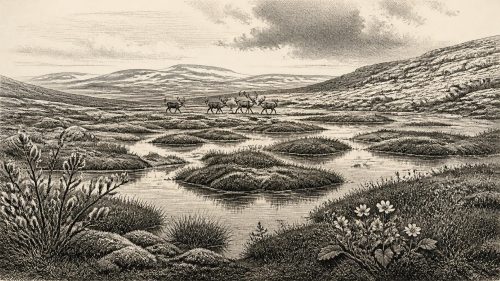
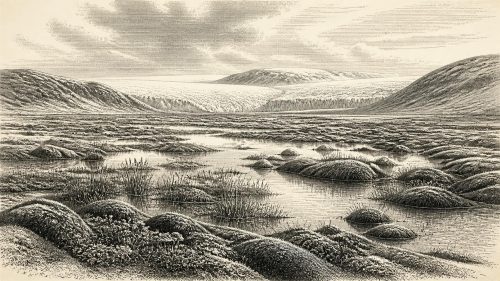
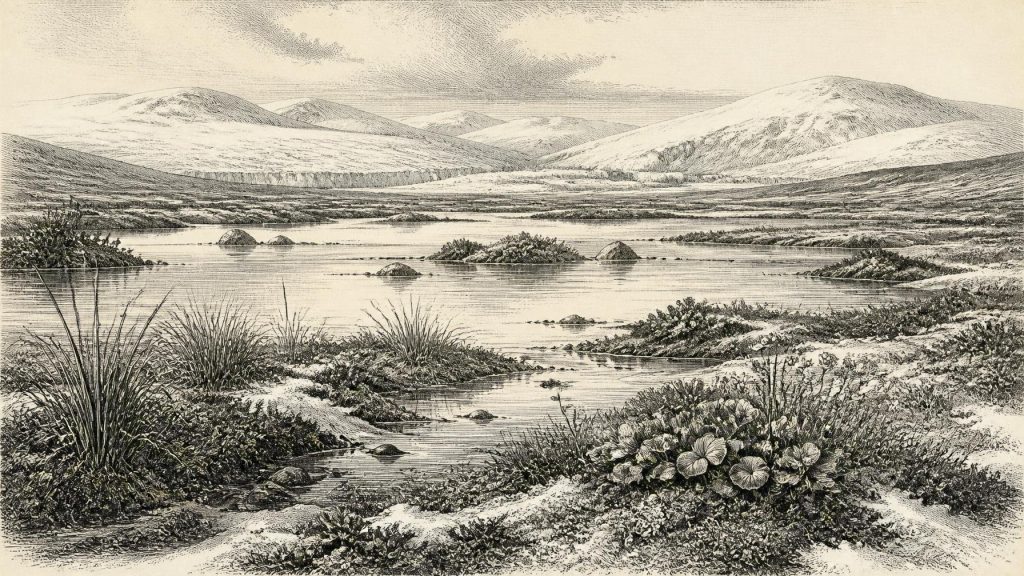
The Fermanagh evidence nevertheless corrects a simplistic image of an Ireland wholly buried beneath lifeless ice. The Derryvree deposit records a cold but active freshwater environment. Plant macrofossils include species associated with wet ground and open water, among them bogbean (Menyanthes trifoliata), mountain avens (Dryas octopetala) and other cold-tolerant vegetation. Mosses, sedges and aquatic plants point to a marshy shore or shallow basin, while insect remains help reconstruct conditions around it. Such evidence supports an open, tundra-like or periglacial mosaic with patches of water and wetland. It does not support woodland, cultivation, fields or a settled village.
Water, Frost and Sparse Vegetation
Everyday life, in the ordinary human sense, cannot be described with confidence because no dwelling, hearth, tool assemblage, human bone or rubbish deposit of this age has been excavated in Ireland. But Derryvree allows the everyday ecology of one locality to be approached. Seasonal thaw would have made pond margins productive even amid severe cold. Sedges and mosses could root in saturated ground; aquatic plants could grow in open water; low shrubs and herbaceous plants could occupy better-drained patches. Frost action, sparse cover and little shelter from wind would have made this a far harsher terrain than later prehistoric Ireland.
This was not the familiar green and wooded island evoked by much later history. Trees were absent or extremely restricted in the coldest regional settings, and the landscape’s dominant processes were glacial and periglacial: freezing and thawing, waterlogging, sediment movement, snow cover and the expansion or retreat of ice. Rivers and lakes did not merely decorate the landscape; they were agents of change, moving sediment and creating temporary habitats at ice-free margins. Subsequent ice movement would erase or bury much of what had existed, one reason why the archaeological record is exceptionally thin.
Coastlines also differed greatly from those of the present, because global sea level was much lower during the late Pleistocene and the ice sheet itself affected the level of land relative to sea. Yet it would be misleading to draw a confident route across the Irish Sea for this precise date. Whether particular corridors were dry land, shallow water, ice, islands or changing coastal margins depended on local topography, ice loading and sea-level change. Ireland’s later separation from Britain has been intensively modelled, but a single fixed geography for 30,648 BCE is beyond the evidence.
Castlepook’s Animal Record
County Cork offers a second, very different window. Castlepook Cave, near Doneraile—also called Mammoth Cave—has yielded Ireland’s richest assemblage of vertebrate remains from the period leading towards the Last Glacial Maximum. More than 2,000 bones were recovered during excavations undertaken between 1904 and 1918, and later research has revised the chronology of parts of the collection. Individual remains span a long interval rather than one occupation episode. The cave is therefore an archive of changing faunas, not a snapshot of a single year or even a single century.
Its Ice Age fauna includes woolly mammoth, giant deer, reindeer, brown bear and spotted hyaena; later cold-stage remains include Arctic fox, wolf, Norwegian lemming and collared lemming. These animals demonstrate that Ireland was repeatedly accessible to terrestrial mammals during parts of the late Pleistocene and that open, cold-adapted habitats existed. Reindeer and lemmings in particular fit an exposed landscape with limited tree cover. Hyaenas complicate any romantic notion of a peaceful tundra: caves could be dens, scavenging sites and traps into which bones were brought or washed, rather than places where each animal died.
The animal list should not be turned into an imagined herd gathered beside the Derryvree pool in 30,648 BCE. Some specimens are separated by many thousands of years; cave deposits were disturbed by water and earlier excavation; and the presence of a species in Cork does not establish its distribution in Fermanagh. Still, the combined evidence from cave bone and intertill sediment makes a broad conclusion secure: during portions of MIS 3, Ireland contained ice-free or seasonally viable habitats capable of supporting cold-adapted plants and mammals.
People: A Possibility, Not a Population
Human presence at this early date remains the most delicate question. A reindeer femur from Castlepook has been interpreted by palaeozoologist Ruth Carden and by County Cork heritage publications as bearing a cut mark made by a sharp stone tool during butchery. The object has been presented as evidence for Palaeolithic hunters in Ireland at about 31,000 BCE. If that interpretation is sustained, it would indicate that people handled a reindeer carcass during the broad period relevant to this article.
Its limits must be stated equally plainly. No securely associated lithic tool, hearth, working floor, shelter, burial or dense food refuse has been recovered from Castlepook for this early horizon. The bone was recovered from a cave whose deposits accumulated and were disturbed over long periods, perhaps partly through carnivore activity. A cut-marked bone would demonstrate an encounter or episode of carcass processing, not a permanent population, a named group, or a settlement. It cannot establish whether hunters lived on the island year-round, visited briefly, or reached the locality by a route now hidden beneath later deposits and sea.
The clearest published evidence for a human presence in Ireland is in fact much later: a butchered brown-bear bone from Alice and Gwendoline Cave, County Clare, radiocarbon dated to c. 12,810–12,590 calibrated years BP. That terminal-Pleistocene evidence cannot be projected backwards twenty millennia. It does, however, underline why scholars treat early claims cautiously: improved dating, renewed excavation and taphonomic study can substantially alter the story told by old cave collections.
No Polities, No Trade Network
There is no evidence from Ireland around this time for political institutions, leaders, territorial states, diplomacy or organised warfare. Nor is there evidence for farming, stockkeeping, metalworking, pottery, long-distance trade, formal burial, monuments, ritual sites or a local artistic tradition. These absences are not proof that people could have had no beliefs, social ties or cultural practices; rather, the Irish record does not reveal them. It would be irresponsible to assign Gaelic, Celtic, tribal or national identities to possible visitors who lived tens of millennia before those categories emerged.
Likewise, the language of economy must be restrained. If people did reach Ireland, the Castlepook bone suggests the practical value of large-animal carcasses—meat, fat, hide, sinew and bone—but it does not prove hunting strategy, exchange, seasonal rendezvous or a regular reindeer-hunting economy. The most tangible ‘economy’ visible in the evidence is ecological: plants taking hold in wet ground, herbivores using open country, predators and scavengers exploiting carcasses, and ice repeatedly rearranging the land on which all depended.
An Archive Rather Than an Anniversary
The historical significance of 30,648 BCE therefore lies not in a dateable Irish event but in a buried environmental record. Derryvree preserves a rare interval when cold freshwater life developed between two advances of ice. Castlepook preserves a long, mixed record of mammals that crossed and inhabited parts of Ireland during the later Ice Age. Together they reveal an island—or a changing landmass with very different coasts—subject to dramatic environmental shifts but not devoid of life.
The strongest conclusion is necessarily modest. Around this broad period, parts of Ireland could be open, cold and wet rather than uniformly ice-covered; plants, insects and large mammals occupied suitable habitats; and a disputed but important bone from Cork raises the possibility of a very early human visit. Beyond that, silence is evidence too. There are no recoverable governments, wars, treaties, towns or religions for this year—only sediments, bones, calibrated ranges and the caution required to read them well.
Primary Sources
- A Middle Midlandian Freshwater Series at Derryvree, Maguiresbridge, County Fermanagh, Northern Ireland
- Trimlines, Blockfields and the Vertical Extent of the Last Ice Sheet in Southern Ireland
- Growth and Retreat of the Last British–Irish Ice Sheet, 31,000 to 15,000 Years Ago: the BRITICE-CHRONO Reconstruction
- Pattern and Timing of Retreat of the Last British-Irish Ice Sheet
- Timing and Pace of Ice-Sheet Withdrawal Across the Marine–Terrestrial Transition West of Ireland During the Last Glaciation
- The Timing and Magnitude of the British–Irish Ice Sheet Between Marine Isotope Stages 5d and 2
- Castlepook Cave: County Geological Site Report
- The Exploration of Castlepook Cave, County Cork
- The Irish Quaternary Fauna Project
- A Reconsideration of the Radiocarbon Dating of the Marine Isotope Stage 3 Fauna from Southern Ireland
- First Evidence of a Late Upper Palaeolithic Human Presence in Ireland
- New Insights on the Fauna of Ireland’s Younger Dryas and Early Holocene from Alice & Gwendoline Cave
- The IntCal20 Northern Hemisphere Radiocarbon Age Calibration Curve (0–55 cal kBP)
- IntCal20
- Prehistoric Details
- Menyanthes trifoliata
- Dryas octopetala
- The Island of Ireland: Drowning the Myth of an Irish Land-Bridge?
- Heritage Artefacts of County Cork
- Castlepook Cave, Castlepook South, Cork: 2022 Excavation Report