The Derryvree Drumlin30434 BCE
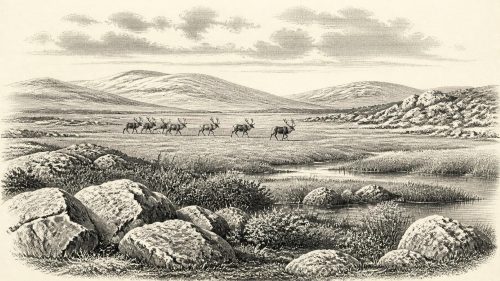
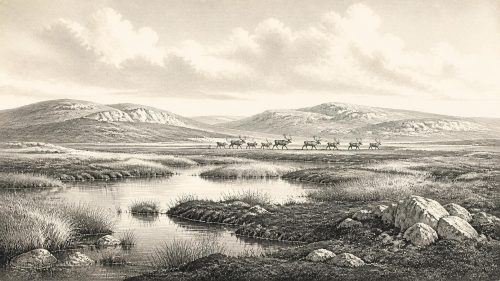
Around 30,434 BCE, Ireland’s history is reconstructed from environmental evidence rather than events. At Derryvree, County Fermanagh, freshwater silts between glacial tills record an ice-free interval before later ice-sheet advance. Plant remains, pollen and insects indicate treeless tundra wetlands with sedges, mosses, aquatic plants and open ground. Castlepook Cave, County Cork, preserves a broader cold-stage fauna including mammoth, reindeer, giant deer, bears, hyaenas and lemmings, although its disturbed deposits cannot date a single moment. A possibly butchered reindeer bone may suggest human visitation, but no secure settlement evidence exists. These sites demonstrate fluctuating habitats, not permanently frozen or empty Ireland.
Dateline
30,434 BCE is a modern chronological label, not a recoverable year in Irish prehistory. No community in Ireland then kept a calendar, wrote an account, minted an object or built a monument that can be assigned to this point. In archaeological terms, the label falls approximately 32,400 calendar years before AD 1950, during the Late Pleistocene and broadly within Marine Isotope Stage 3. That conversion is only a guide: radiocarbon measurements must be calibrated, their uncertainties widen at this depth of time, and environmental deposits usually represent spans rather than moments. The responsible history of Ireland at this date is therefore a history of layers, fossils and probabilities, rather than an annal of events.
The closest unusually informative Irish record is not a settlement but a buried wetland at Derryvree, near Maguiresbridge in County Fermanagh. Roadworks in 1969 cut through a drumlin and revealed fine sand and organic-rich freshwater silts sealed between two separate layers of glacial till. The deposit carried the laboratory determination BIRM-166, conventionally dated to 30,500 ± 1,100 radiocarbon years BP. Published calibrations place it broadly at about 36,900–31,700 calibrated years BP. The notional date of 30,434 BCE lies within that wide interval, but it must not be mistaken for the date on which a particular pool formed, an animal drank, or a person arrived. It identifies a portion of an extended, changing environmental episode.
An Ice-Age Interval
Derryvree matters because its organic horizon establishes that this part of Fermanagh was ice-free when plants grew and freshwater sediments accumulated, before later ice overrode the ground and incorporated it into a drumlin. The evidence does not show an ice-free Ireland in every direction, nor does it supply a precise map for one year. It does show a landscape of strong regional contrasts: ice centres and glaciers could occupy uplands while lower ground elsewhere supported tundra, wet hollows and shallow water. Later expansion of the British–Irish Ice Sheet would destroy, bury or rearrange much of this earlier terrain, helping to explain why surviving evidence is so fragmentary.
At roughly this point in the wider glacial cycle, Ireland was approaching, but had not yet reached, the Last Glacial Maximum. Modern reconstructions of the British–Irish Ice Sheet identify a long and uneven history of growth and retreat rather than a single advance across a uniform island. They also emphasise uncertainty at the edge of their chronological resolution. Derryvree provides a local constraint upon that larger picture: life and sedimentation persisted in north-central Ireland before the later glacial cover that sealed the deposit. The drumlin is thus both a landform made by ice and a container preserving evidence of a preceding habitable interval.
Water, Moss and Open Ground
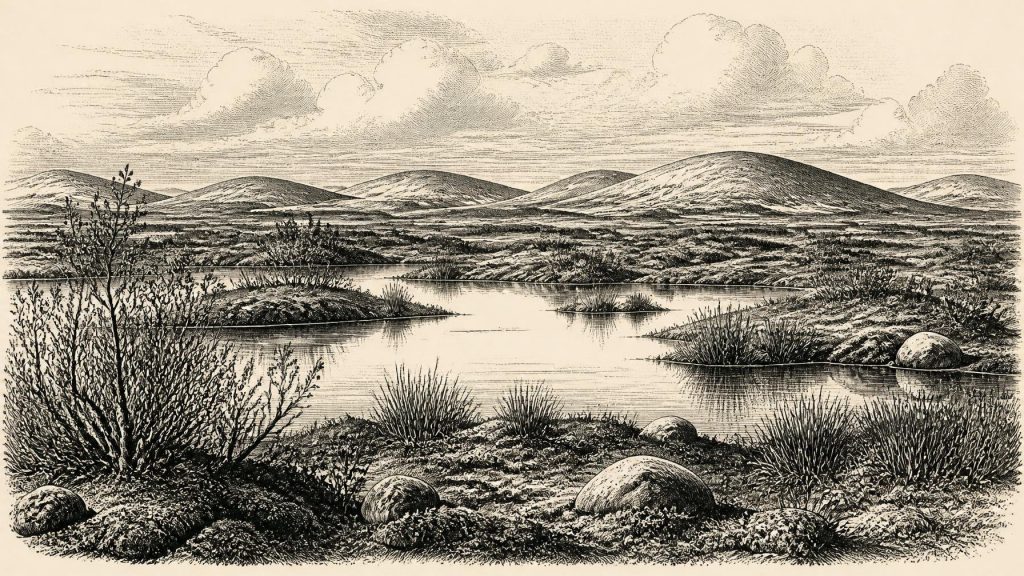
The Derryvree silts preserve a remarkably specific ecological signal. Plant macrofossils, pollen, mosses and insects point to an open, cold landscape with freshwater pools and a marshy, organic-rich margin: a tundra or muskeg-like mosaic rather than forest. Sedges and grasses grew alongside mosses; aquatic plants included water-milfoil and bogbean, while dwarf willow, juniper and Arctic-alpine herbs occurred in the broader flora. This was not barren ground. During the growing season, shallow water, saturated sediments and low vegetation could sustain a productive food web, even though long winters, frost action and short summers imposed severe limits.
Such evidence should be read at the scale it warrants. A bogbean seed or moss fragment demonstrates that the plant was present in or close to the depositing environment; it does not prove that all of Ireland looked the same. Equally, cold-adapted taxa do not translate neatly into a modern thermometer reading. They indicate seasonality, exposed ground and harsh conditions relative to modern Ireland. The most defensible image is of a treeless Fermanagh wetland, flanked by open terrain, where snowmelt and seasonal water shaped opportunities for plants, insects and animals. Comparable buried organic deposits at Greenagho, Hollymount and other northern sites reinforce the conclusion that brief or local ice-free landscapes punctuated the wider glacial history.
Castlepook’s Animal World
County Cork offers a different but complementary window. Castlepook Cave, also called Mammoth Cave, lies in the Awbeg Valley below the Ballyhoura Hills. Excavated principally in the early twentieth century, it yielded Ireland’s most substantial assemblage of older Pleistocene animal remains. The cave’s sands and stalagmite floors produced bones of woolly mammoth, reindeer, giant deer, brown bear, spotted hyaena, wolf, fox, Arctic fox, mountain hare and lemmings, among other fauna. A mammoth bone has returned a Middle Devensian radiocarbon determination of about 33,400 ± 1,200 BP. Together, the assemblage makes clear that Ireland could support a much richer cold-stage mammal community than the island has today.
Yet Castlepook should not be turned into a tidy snapshot of 30,434 BCE. The bones were collected from complex cave deposits over many years, with limited recording by modern standards. Some deposits were disturbed, and cave entrances can receive material through carnivore activity, water movement, collapse and later digging. Individual animals need not have died at the same time, while later contamination is a recognised difficulty in historic cave collections. The assemblage is best treated as evidence for a broad Late Pleistocene animal world, not as a census of one valley in one season. Recent excavation has confirmed that the cave still contains deposits of scientific interest, but recovered no cultural artefacts in its 2022 investigation.
A Human Question, Not a Settlement
Castlepook has nonetheless raised an important archaeological question. A reindeer femur from the cave, reported as around 33,000 years old, bears a deep linear mark interpreted by zoologist Ruth Carden as the result of butchery with a sharp stone tool. If that interpretation is sustained, it would indicate that a person handled a reindeer carcass in Ireland far earlier than the securely dated terminal-Pleistocene evidence from County Clare. It would be significant evidence for a brief human presence or visit during the Upper Palaeolithic, when modern humans were established elsewhere in north-west Europe.
But the inference must remain narrow. A radiocarbon result dates the animal bone, not automatically the mark; an incision has to be assessed against natural breakage, carnivore damage, sediment abrasion and excavation damage; and the old cave context limits certainty about association. Even a confirmed cut mark would demonstrate carcass processing, not a village, a permanent population, a named culture or a direct ancestry for later Irish people. There are no securely stratified stone tools, hearths, shelters, graves or occupation surfaces from Ireland that can be confidently assigned to this date. The better-documented cut-marked brown-bear bone from Alice and Gwendoline Cave is much later, around 12,800–12,600 calibrated BP, and cannot fill that enormous chronological gap.
Society Beyond the Evidence
Political affairs, diplomacy and warfare are therefore beyond recovery for Ireland around 30,434 BCE. There is no evidence for territories, leaders, law, alliances or conflict. Nor can archaeologists responsibly identify religious rites, languages, artistic traditions, teaching systems or trade routes. The absence is not proof that no people ever passed through; it is a limit imposed by the surviving record. Later ice action, rising seas, erosion and the rarity of well-preserved pre-maximum deposits have all reduced the chance of finding camps or coastal activity. Low sea levels altered the surrounding geography, but they do not by themselves prove a dry land bridge, a migration route or regular exchange with Britain or continental Europe.
If people did reach Ireland during this interval, the animal evidence suggests the practical attractions and dangers they encountered: mobile herds, edible large mammals, freshwater, fuel from sparse vegetation and cave shelter, but also cold, unstable weather and formidable carnivores. That is an ecological inference, not a recovered biography. Reindeer may have provided meat, hide, sinew, antler and bone to Upper Palaeolithic hunters elsewhere, but no comparable toolkit or camp material has been found in Ireland at this age. It is safer to say that Ireland possessed resources which might have supported short visits than to claim a settled hunting society.
The Surviving Record
The principal development illuminated by this date is environmental rather than political. At Derryvree, a freshwater wetland formed between glacial advances; at Castlepook, cold-stage mammals occupied or were accumulated in a limestone cave system. Together they show that parts of Ireland were neither permanently entombed beneath ice nor biologically empty throughout the later Ice Age. They reveal local habitats in a fluctuating northern world, while also warning against overconfidence. The Derryvree drumlin preserves a small, precious interval of life before later ice sealed it away. For 30,434 BCE, that interval is the history: open water, low vegetation, wandering animals, advancing ice—and perhaps, still unproven, a fleeting human hand at a reindeer carcass.
Primary Sources
- A Middle Midlandian Freshwater Series at Derryvree, Maguiresbridge, County Fermanagh, Northern Ireland
- The Irish Quaternary Fauna Project
- First Evidence of a Late Upper Palaeolithic Human Presence in Ireland
- New Insights on the Fauna of Ireland's Younger Dryas and Early Holocene from Alice & Gwendoline Cave
- Irish Pleistocene Biostratigraphy
- Pleistocene Vertebrates in the British Isles
- The Exploration of Castlepook Cave, Co. Cork. With 3 Plates
- On the Cave of Castlepook, Near Doneraile, Co. Cork
- Areas of Scientific Interest in County Cork: Castlepook Caves
- 2022:564 – Castlepook Cave, Castlepook South, Cork
- Heritage Artefacts of County Cork
- Ireland's Palaeolithic Archaeology – Fleeting Footprints in a Frozen Land
- Quaternary Site Descriptions
- Figure 6: The Subdivision of the Quaternary Period in Ireland
- Quaternary Data and Maps
- Exploring Controls of the Early and Stepped Deglaciation on the Western Margin of the British-Irish Ice Sheet
- Growth and Retreat of the Last British–Irish Ice Sheet, 31,000 to 15,000 Years Ago: The BRITICE-CHRONO Reconstruction
- BRITICE-CHRONO Maps and GIS Data of the Last British-Irish Ice Sheet 31 to 15 ka
- The IntCal20 Northern Hemisphere Radiocarbon Age Calibration Curve (0–55 cal kBP)
- Episodic Speleothem Deposition Tracks the Terrestrial Impact of Millennial-Scale Last Glacial Climate Variability in SW Ireland