
Kings, Pilgrims and Relics1034 CE
In 1034, Ireland lacked an uncontested high king, as regional dynasties, churches and maritime networks shaped a fragmented political landscape. Donnchad mac Briain of Munster ravaged Osraige, challenging its ruler’s expanding Leinster authority, while Flaithbertach Ua Néill resumed control of Ailech after his son’s death. Killings and treachery destabilised Connacht, Brega, Tethba and neighbouring regions. Ecclesiastical losses included leading figures at Cork, Mungret and Clonmacnoise, and Kells’s lector drowned returning from Scotland with companions and relics. Amlaíb, Dublin’s royal pilgrim, was killed en route to Rome. Annals reveal elite conflict and religious connections, while rural communities bore warfare’s economic burdens.
Dateline
Ireland in 1034 was a land of competing over-kings, ambitious regional dynasties, wealthy churches and seaborne connections extending from Rome to Scotland. The surviving annals record no single battle that transformed the island. Instead, they reveal pressure along several political frontiers: a Munster invasion of Osraige, a restoration in the north, killings among the Connachta and lesser conflicts in Mide and Brega. Alongside these struggles came the deaths of distinguished churchmen and a maritime disaster in which clerics and treasured relics were lost.
Reading a Fragmentary Year
The events firmly assigned to 1034 come principally from the Annals of Ulster, Annals of Inisfallen, Annals of Tigernach and the later Annals of the Four Masters. These chronicles sometimes disagree over titles, circumstances and even the identities of participants. Their notices are also highly selective. Kings, abbots, scholars, relics and military expeditions appear; ordinary births, marriages, harvests and local exchanges generally do not. A responsible account must therefore distinguish the year’s recorded events from the broader conditions under which most people lived.
No ruler exercised uncontested government over the whole island. Since the death of Máel Sechnaill mac Domnaill in 1022, the traditional high-kingship had lacked a universally acknowledged holder. Powerful provincial rulers could demand hostages and tribute far beyond their homelands, but their authority depended upon campaigning, alliances and the continuing obedience of subordinate kings.
Munster Strikes Osraige
The most conspicuous military event was Donnchad mac Briain’s devastation of Osraige. The Annals of Ulster state that Brian Bóruma’s son “ravaged all Osraige”, while the Four Masters more briefly say that he plundered it. The wording indicates a substantial predatory expedition, although no surviving account supplies a battlefield, casualty figure or exact date.
Donnchad was king of Munster and the senior surviving son of Brian. His target was ruled by another Donnchad: Donnchad mac Gilla Pátraic, king of Osraige, who had recently secured the kingship of Leinster. In 1033 the Osraige ruler had celebrated the important assembly or fair of Carman, an assertion of Leinster royal authority. The Munster invasion in 1034 can consequently be understood as more than a routine border raid. It challenged a neighbour whose power now stretched across Osraige and Leinster and whose position threatened Munster’s influence in the south-east.
Osraige, centred broadly on modern County Kilkenny and adjoining districts, occupied a strategic zone between Munster and Leinster. Its rulers had long exploited this position, alternately resisting and cooperating with larger kingdoms. Donnchad mac Briain had campaigned there before, suffering losses during an expedition in 1027. The renewed attack demonstrated both his persistence and the limits of supposedly provincial boundaries. The annals do not say that he conquered Osraige or removed its king; Donnchad mac Gilla Pátraic remained powerful until his death in 1039.
A Restoration in Ailech
In the north, the Annals of Inisfallen record that Flaithbertach Ua Néill took Ailech again and that northern Ireland submitted to him “on account of seniority”. Flaithbertach was an experienced ruler of the Cenél nEógain branch of the Northern Uí Néill. He had gone on pilgrimage to Rome in 1030 and had previously withdrawn from active kingship. His son and successor Áed died late in 1033, creating the circumstances for the older man’s return.
The reference to seniority is important. Irish kingship did not pass automatically to a ruler’s eldest son. Eligibility extended among recognised royal relatives, and age, reputation, military support and political agreement could all influence selection. Flaithbertach’s restoration suggests that his standing outweighed retirement or advanced age. It did not create a stable monarchy over all Ulster, but it restored an experienced figure to Ailech at a moment of dynastic uncertainty.
Elsewhere, the Annals of Ulster note an expedition by the Ulaid into Mide as far as Tech Meic Melléin. They give no result, making it unsafe to claim a victory or permanent territorial change. Several rulers in Brega and the midlands were also killed. Gilla Sechnaill son of Gilla Mo-Chonna, associated by the Four Masters with southern Brega, was slain, as was Gilla Fulartaig, king of the Déisi of Brega. Gilla Pátraic Ua Flannacáin, king of Tethba, was killed by treachery according to the Annals of Tigernach. Such entries expose the persistent local violence beneath the campaigns of provincial rulers.
Instability in Connacht
Connacht experienced its own disruption. Dub Daingen, whom the Annals of Ulster call king of Connacht, was killed by his own people; the Annals of Inisfallen identify his killers as the Uí Maine. The title “king of Connacht” should not be read as proof of undisputed provincial control, for rival branches of the Connachta frequently supported competing rulers.
Muiredach Ua Flaithbertaig was also killed during the year. The Annals of Tigernach describe him as king of Uí Briúin Seóla and say that he died through treachery, while the Annals of Inisfallen attribute his killing to the Connachta. His power had lain around Mag Seóla, east of Lough Corrib. His death formed part of the prolonged competition among the Uí Briúin kindreds for land and supremacy in western Ireland, rather than a simple transition between settled provincial administrations.
Churchmen and Sacred Authority
The churches appearing in the annals were not isolated retreats. Major foundations controlled estates, educated clerics, preserved books and relics, received pilgrims and maintained relationships with ruling families. Their senior offices could carry considerable political and economic influence.
Cathal, called “the Martyr”, died as head of the church of Cork associated with St Fin Barre. The sources variously style him superior, coarb or airchinneach, terms reflecting overlapping traditions of ecclesiastical leadership and stewardship. The Annals of Inisfallen add that Aengus son of Cathán succeeded him. Conn son of Máel Pátraic, superior of Mungret near Limerick, also died. Mungret was an old and important Munster foundation situated close to the Hiberno-Norse town of Limerick.
At Clonmacnoise, Aengus son of Flann, its lector or chief teacher, died. The Four Masters praise him as the chief sage of the western world, characteristically expansive language that nevertheless conveys his reputation. A lector supervised advanced learning in scripture, Latin and related disciplines. His notice confirms Clonmacnoise’s continuing intellectual importance on the Shannon, where scholarship, craftsmanship, pilgrimage and regional politics met.
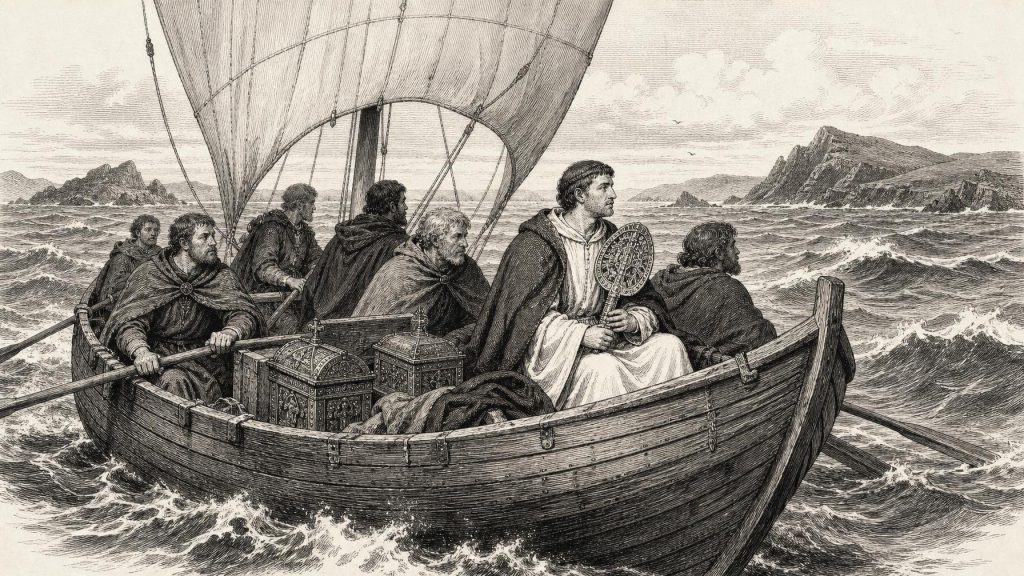
The year’s most poignant ecclesiastical event was the drowning of Maicnia Ua hUchtáin, lector of Kells, while returning from Scotland. Thirty other people were reportedly lost, together with three relics of Patrick and the cuilebad of Colum Cille. The cuilebad appears to have been a flabellum or liturgical fan associated with the saint, not merely an everyday object. Relics of this kind embodied the history and authority of a religious community and could accompany ceremonies, journeys and negotiations.
The annals do not identify the vessel, route, weather or precise place of the disaster. They do, however, show that movement between Irish and Scottish churches remained normal and institutionally significant. Kells belonged to the Columban religious network linking Ireland with Iona and other Scottish foundations. Its community also possessed the famous Gospel manuscript now known as the Book of Kells, recorded at the monastery earlier in the eleventh century.
Dublin and the Wider Sea
Another pilgrim met a violent death abroad. Amlaíb, son of Sitriuc Silkbeard, the Hiberno-Norse king of Dublin, was killed by “Saxons” while travelling to Rome. Nothing reliable is known about the immediate circumstances. His journey nevertheless illustrates the Christian identity and international outlook of Dublin’s ruling dynasty. Amlaíb had previously been important enough to command an enormous ransom when captured in 1029, including cattle, horses, gold and silver.
His death connected Ireland with a wider sequence of events around the Irish Sea. The Irish annals also record the death of Máel Coluim mac Cináeda, Malcolm II of Scotland, and of Suibne mac Cináeda, king of the Gall-Ghaeil or Norse-Gaels. These notices reflect the annalists’ awareness of neighbouring Gaelic and maritime societies whose rulers, traders, warriors and clerics interacted regularly with Ireland.
Work, Trade and Settlement
For most inhabitants, daily life remained rural. Archaeology indicates a managed landscape of enclosed farmsteads, fields, routeways, woodland and pasture. Cattle supplied milk, meat, hides, status and units of tribute, while sheep, pigs and cereal cultivation supported household economies. People ground grain, made butter and cheese, spun wool, repaired fences and buildings, and prepared stores for winter. These activities rarely entered the written record unless disrupted by famine, disease or warfare.
“Ravaging” was therefore an attack upon livelihoods as well as rulers. Armies sought cattle, captives and portable wealth, while damage to crops, houses and food stores could burden communities long after warriors departed. The sources provide no figures for the human cost of Donnchad mac Briain’s Osraige campaign, but its description implies hardship extending beyond the defeated king’s following.
Alongside this overwhelmingly rural world stood the Hiberno-Norse ports of Dublin, Waterford, Wexford and Limerick. Dublin under Sitriuc remained Ireland’s leading commercial centre, with craftsmen working wood, bone, leather and metal and merchants trading across Britain and continental Europe. Silver pennies had been minted there since about 997 or 998. Coin use was strongest in towns and international commerce; cattle, produce, silver by weight and obligations of service remained more important across much of the countryside.
A Year of Connected Rivalries
The surviving evidence presents 1034 not as an isolated catalogue of deaths but as a year shaped by interconnected rivalries. Munster tested the new Osraige–Leinster power, Flaithbertach Ua Néill restored experienced leadership in Ailech, and western kings fell amid Connacht’s dynastic divisions. Meanwhile, pilgrims, teachers and sacred objects travelled across seas linking Kells, Dublin, Scotland and Rome. Political authority remained fragmented, yet Ireland’s churches, ports and ruling families belonged to networks extending far beyond any single kingdom.
Primary Sources
- The Annals of Ulster: Year U1034
- Annals of Inisfallen: Annal AI1034
- Annals of Inisfallen: Irish Text, I1034
- Annals of Tigernach
- Annals of the Four Masters: Annal M1034
- CELT Project: The Annals of Ulster
- CELT Project: Annals of Inisfallen
- CELT Project: Annals of the Four Masters
- Sitriuc Silkbeard (Sitric, Sigtryggr Ólafsson Silkiskeggi)
- Ua Néill, Flaithbertach
- Viking
- 950–1450: Vikings, Normans and Medieval Mints
- Early Medieval Ireland: Archaeological Excavations 1930–2009
- Irish School of Illumination, c. 650–1100
- Clonmacnoise Monastic Site
- Mungret Churches
- History of Saint Fin Barre
- Osraige: A Kingdom in Medieval Ireland
- Viking Ireland—Afterthoughts
- The Archaeology of Ireland’s Viking-Age Towns
- Colm Cille’s Spiral: The Object
- About the Book of Kells
- Iona and the Shrine of Columba, c. 800–1200
- The Making of the Book of Kells
- Kingship, Society, and Sacrality: Rank, Power, and Ideology in Early Medieval Ireland
- Ireland in the Middle Ages
- Making Hay While the Sun Shines? Socio-economic Change, Cereal Production and Climatic Deterioration in Early Medieval Ireland