Jewish Visitors1079 CE
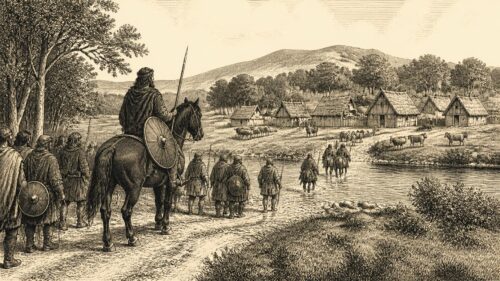
In 1079, Tairdelbach Ua Briain, king of Munster, demonstrated wide but negotiated power across Ireland. He campaigned through Dublin and Mide, where Máel Sechnaill submitted under the guarantee of Patrick’s successor and the Bachall Ísu, and intervened in Connacht, expelling Ruaidrí Ua Conchobair and plundering western districts. Regional warfare included cattle raiding and the assertion of authority at Carman’s assembly. Five Jewish visitors arrived by sea with gifts for Tairdelbach, the earliest recorded reference to Jews in Ireland, but were sent away. Deaths of church leaders and scholars highlighted Clonmacnoise, Armagh and learned networks linking a fragmented yet connected island.
Dateline
The surviving records make 1079 unusually revealing for an eleventh-century Irish year. They describe campaigning from Dublin and Mide to the Atlantic coast, a violent change in the balance of power within Connacht, the formal submission of a king under the authority of Patrick’s successor and a celebrated relic, and the arrival of five Jewish visitors from overseas. They also record the deaths of prominent churchmen and a leading scholar. These notices are brief, and later annalists did not always agree on chronology or detail, but together they show an island whose kingdoms, churches, learned professions and maritime towns were closely interconnected.
Tairdelbach’s Ascendancy
The dominant figure was Tairdelbach Ua Briain, king of Munster and grandson of Brian Bóruma. Since the death of the Leinster ruler Diarmait mac Máel na mBó in 1072, Tairdelbach had become the strongest king in southern Ireland. He controlled Munster directly, intervened repeatedly in Leinster and Connacht, and kept Dublin within his political orbit. Although there was no permanent national monarchy, contemporary annalists could regard a ruler who received hostages and submissions across several provinces as king of Ireland. Tairdelbach’s authority depended not on a central administration but on movement, military force, tribute, alliances and the careful management of subordinate kings.
His activity in 1079 was extensive. The Annals of Tigernach and Chronicon Scotorum record a hosting to Dublin and the men of Mide. Dublin was more than a fortress to be occupied: it was Ireland’s leading port, a centre of shipping, craft production, coinage and overseas commerce. Possession of influence there gave Tairdelbach access to fleets, revenues and connections across the Irish Sea. His progress into neighbouring Mide, meanwhile, placed pressure on the kingdom controlling much of Ireland’s central plain and important routes between Dublin, the Shannon and the northern provinces.
A Submission Under Sacred Guarantee
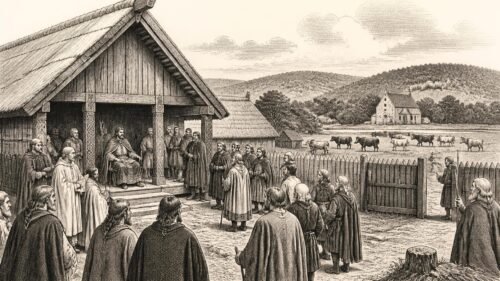
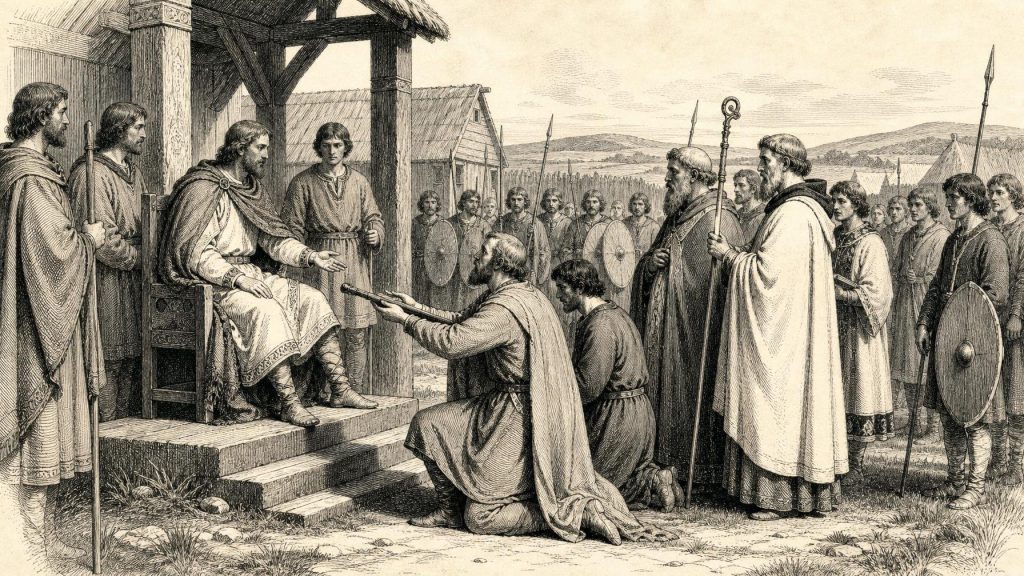
The expedition ended with Máel Sechnaill son of Conchobar, a ruler of Mide, coming into Tairdelbach’s house. He was accompanied by the successor of Patrick and by the Bachall Ísu, the Staff of Jesus. The wording indicates a formal act of submission or reconciliation rather than an accidental meeting. A king’s “house” could mean his immediate protection and authority as well as a physical residence. Máel Sechnaill was therefore acknowledging Tairdelbach’s superior position, although such agreements endured only while political circumstances made them useful.
The presence of Patrick’s successor and his staff gave the settlement exceptional solemnity. Armagh claimed primacy through its association with Patrick, while the Bachall Ísu was treated as one of the saint’s principal insignia. Relics could witness agreements, reinforce oaths and place those breaking them under spiritual as well as political sanction. In 1079 ecclesiastical authority was not separate from diplomacy: a leading churchman could serve as mediator and guarantor between kings. The episode also demonstrates Armagh’s ability to act far beyond its northern heartland at a time when powerful rulers competed for the support and prestige of major churches.
War in Connacht
Tairdelbach also led a major expedition into Connacht. The Annals of the Four Masters state that he expelled Ruaidrí na Saide Buide Ua Conchobair from the provincial kingship. That compilation was completed centuries later, so its fuller account must be used carefully, but it agrees with earlier annals that Tairdelbach campaigned aggressively in western Connacht during the year. Ruaidrí belonged to the rising Síl Muiredaig branch of the Uí Briúin Aí, but his position remained vulnerable to rival Connacht dynasties and to intervention by an outside overking.
Before or during this crisis, Ruaidrí killed Áed Ua Flaithbertaig, king of Iarthar Connacht. The Annals of Inisfallen more generally report that two Ua Flaithbertaigs were slain. The Uí Flaithbertaig ruled in the west, around territories later associated with Connemara and the Galway region, and their defeat strengthened Ruaidrí locally. It did not, however, protect him from Tairdelbach. The Munster king’s intervention shows his policy of preventing any one Connacht ruler from becoming secure enough to challenge him.
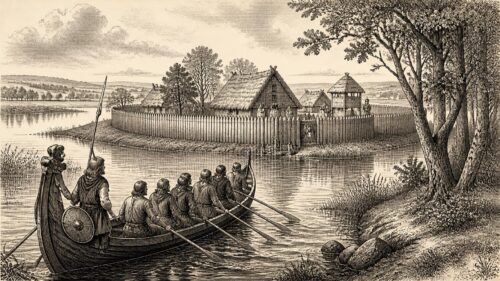
The campaign reached the far west. Annalistic accounts say that Tairdelbach plundered the Cruach, evidently the district around Croagh Patrick, as well as Inse Mod and Loch Beannchair. Inse Mod is associated with islands in Clew Bay, while Loch Beannchair has been identified with Turlough Bay, though medieval place-name identifications are not always certain. These notices imply the use of boats or coordinated movement along lakes, inlets and coastal waters. Tairdelbach’s army was operating not merely on the central plains but among the broken coastline and island settlements of western Mayo.
Cattle, Conflict and Assembly
A separate conflict is preserved by the Four Masters. Men from Tethba and Cairbre raided Uí Fhailge and drove away many cattle. Their opponents overtook them at Clonfertmulloe, where the raiders suffered a defeat and their king, Mac Con Geimhle, was killed. Cattle raids were fundamental instruments of warfare. Herds represented food, movable wealth, rents and social standing; taking them injured an enemy’s economy while rewarding warriors and followers. For farming families, such campaigns meant lost livestock, damaged crops, forced hospitality and the danger of enslavement or displacement.
The same source records that Conchobar Ua Conchobair Failge celebrated the assembly of Carman. Because this detail occurs in a later compilation and the exact location of Carman remains debated, it should not be embellished into a fully documented festival programme. Nevertheless, an óenach was much more than a market. Such gatherings could combine political council, legal business, public ceremony, trading, entertainment and competitive displays. Holding a renowned provincial assembly advertised a ruler’s capacity to provide order and hospitality. Coming after victory over raiders, the notice presents Conchobar as a king publicly asserting authority within the Leinster midlands.
Visitors From Overseas
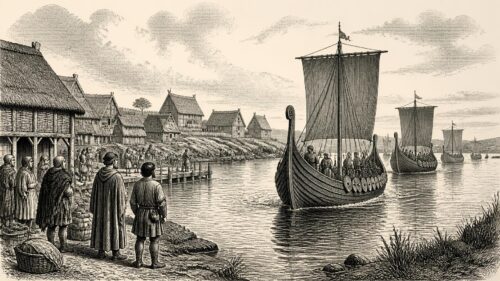
The Annals of Inisfallen preserve the year’s most internationally striking episode: five Jews came across the sea bearing gifts for Tairdelbach and were sent back overseas. This is the earliest surviving written reference to Jewish people in Ireland. The annal does not identify their homeland, occupation or purpose, and it does not justify claims that a Jewish community was established in Ireland at this time. Suggestions that they were merchants or representatives seeking permission to settle remain plausible possibilities, not established facts.
What can be said is that the visitors expected access to Tairdelbach’s court and approached him through the diplomatic convention of gift-giving. Their voyage fits the maritime setting of late eleventh-century Ireland. Dublin, Waterford, Wexford, Cork and Limerick connected Irish rulers and producers with Britain, Scandinavia and continental Europe. Imported silver, textiles, wine and luxury goods circulated alongside exports such as hides, livestock products and enslaved people. Tairdelbach’s decision to send the visitors away may have reflected political, religious or practical concerns, but the annalist supplies no explanation.
Churches and Learned Families
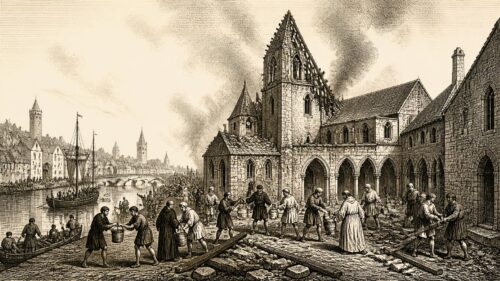
Several deaths reveal the importance of religious and intellectual office. Máel Ciaráin mac Cuinn na mBocht, successor of Ciarán at Clonmacnoise, died in 1079. He belonged to the Meic Cuinn na mBocht, an ecclesiastical family whose members held senior offices at the monastery. Earlier in his career he had been credited with constructing causeways within the settlement. His obituary calls him the glory and veneration of Clonmacnoise, language reflecting both personal reputation and the institutional importance of the office he held.
Clonmacnoise stood beside a strategic Shannon crossing and was simultaneously a monastery, place of pilgrimage, burial centre, school and busy settlement. Its community required food, labour and specialised crafts, while its churches attracted royal patronage and valuable gifts. Máel Ciaráin’s recorded building work recalls the practical demands of maintaining streets and approaches on low ground beside the river. Another scholar associated with Clonmacnoise, the lector Muiredach son of Mugrón, is placed in 1079 by Chronicon Scotorum, although the Four Masters assign his death to 1080. The discrepancy cautions against false precision.
Cellach Ua Ruanada, described as chief ollam of Ireland, also died. An ollam occupied the highest grade within a learned profession and could preserve poetry, genealogy, historical lore and the public reputation of patrons. Cellach’s title indicates exceptional standing, even if little of his individual work can now be identified with certainty. The Annals of Ulster additionally record the deaths of Cú Midhe, king of Fernmag, and a son of Gilla Digde Ua Lorcáin who was prior of Armagh. The Annals of Inisfallen note the death of Bishop Ua Suairlig at Ard Pátraic.
A Connected but Unsettled Island
Most people in 1079 lived in dispersed farmsteads, ringforts and small communities sustained by cattle, dairying, grain cultivation and local exchange. Yet their world was not isolated. Roads, rivers and sea lanes linked royal centres, monasteries, assemblies and ports. Armies travelled these same routes, consuming supplies and carrying away cattle, while clerics, poets, pilgrims and foreign visitors moved between courts and churches.
The year therefore stands out not for one decisive battle but for the breadth of Tairdelbach Ua Briain’s reach. He compelled submission in Mide, maintained influence over Dublin and intervened forcefully in Connacht as far as the Atlantic coast. At the same time, sacred relics helped guarantee diplomacy, assemblies proclaimed regional authority, overseas visitors reached an Irish royal court, and the deaths of leading churchmen and scholars marked changes within influential institutions. The annals reveal a politically fragmented Ireland, but also one joined together by ambition, belief, learning and movement.
Primary Sources
- The Annals of Ulster: Year U1079
- The Annals of Tigernach
- The Annals of Tigernach, Part 19
- Annals of Inisfallen
- Annals of the Four Masters, Volume II
- Annals of the Four Masters, Part 18: Irish Text
- Chronicon Scotorum
- Chronicon Scotorum, Part 130
- Ua Briain, Tairdelbach
- Ua Conchobair, Ruaidrí na Saide Buide
- Conn na mBocht
- Was There a Jewish Presence in Medieval Ireland?
- In the Egypt of This Our Island: The Otherworld and the Hebrew Bible in Medieval Irish Literature
- Perception and Reality: Ireland c. 980–1229
- The Economy of Early Medieval Ireland
- Early Medieval Ireland: Archaeological Excavations 1930–2009
- Clonmacnoise Monastic Site
- Clonmacnoise, County Offaly
- The Roles of Poets
- Bachal Isu: The Symbolism of St Patrick’s Crosier in Early Medieval Irish Hagiography
- The Relic Cult of St Patrick between the Seventh and the Twelfth Centuries
- St Patrick
- The Association of Burials with Popular Assemblies, Fairs and Races in Ancient Ireland
- Éigse, Volume 33
- Early Medieval Lake Settlement in Ireland, Volume II
- The Dublin Region in the Middle Ages: Settlement, Land-use and Economy