Maguirebridge’s Muskeg Ledger30641 BCE
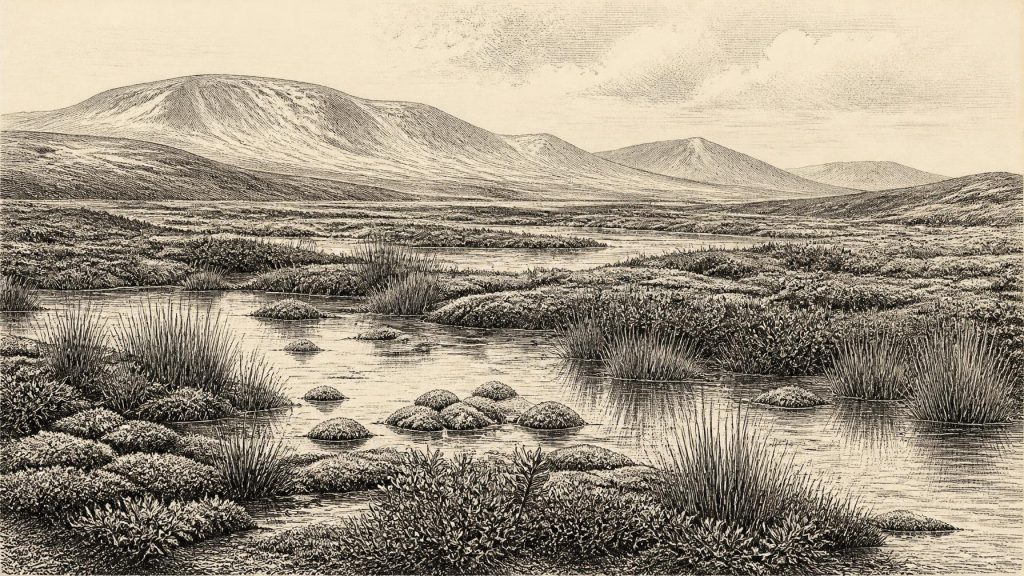
Around 30,641 BCE, Ireland was in the Late Pleistocene, during an unstable cold phase before the last ice-sheet maximum. At Derryvree near Maguiresbridge, Fermanagh, wetland silts and organic deposits between tills record an ice-free periglacial muskeg, with shallow freshwater, sedges, mosses, tundra plants and invertebrates. Their dates span a broad calibrated range, preventing annual precision. Castlepook Cave, Cork, provides complementary evidence of mammoth, reindeer, giant deer and predators in open cold habitats. A cut-marked reindeer femur may indicate Upper Palaeolithic carcass processing, but cannot prove settlement. Fragmentary environmental evidence supports no claims for polities, trade, culture or continuous human occupation.
Dateline
Modern calendar-year precision is not available for Ireland in 30,641 BCE. The label is a useful point on a modern timeline, not a date preserved by anyone living then. There were no written calendars, named rulers, settlements with annual records or events that can responsibly be attached to this particular year. In archaeological terms, it lies about 32,590 years before AD 1950, within the Late Pleistocene, Marine Isotope Stage 3 and the Middle Midlandian sequence of Irish glacial history. The evidence nearest to this point is dated in broad probability ranges, often extending across centuries or millennia.
A Wetland Between Ice Advances
The most illuminating Irish evidence is at Derryvree, near Maguiresbridge in County Fermanagh. Roadworks in 1969 cut through a drumlin and revealed an unusual sequence: freshwater silts, fine sands and organic muds lay between two thick layers of till, the unsorted debris deposited by glacier ice. This arrangement gives a dependable relative history. Ice had occupied the locality before the wetland sediments formed; a period without overriding ice then permitted standing or slow-moving water, plants and small animals to leave remains; later glacial action covered and preserved the deposit beneath a further till.
Organic material from the Derryvree deposit produced the radiocarbon determination BIRM-166, 30,500 radiocarbon years before present, with a substantial uncertainty of +1,170 and −1,030 years. A radiocarbon age is not identical to a calendar age: atmospheric carbon-14 has varied over time, and measurements at this depth in time have wide calibrated ranges. Later calibration has commonly placed the deposit broadly around 36,900–31,700 calibrated years before present, approximately 34,950–29,750 BCE. Thus 30,641 BCE falls within a range relevant to the archive, but cannot be treated as the date of one sediment layer, season, animal death or human visit.
Treeless Ground and Shallow Water
What Derryvree does establish is a local environment very different from modern Fermanagh. Pollen was poorly preserved, but the surviving assemblage, together with plant macrofossils, mosses and small invertebrate remains, indicates open tundra and muskeg: cold, wet ground with sedges, mossy vegetation, shallow freshwater and patches of exposed or sparsely vegetated soil. The Irish Quaternary Association’s synthesis emphasises the deposit’s full-glacial character. In a landscape of severe winters and a short growing season, sheltered wet margins could nevertheless sustain richer plant cover than the drier ground around them.
Individual taxa matter because they make this reconstruction more exact without making it falsely complete. Fossil evidence from the Derryvree silts includes plants associated with cold, northern or alpine conditions, alongside aquatic and wetland species. Such remains show that freshwater habitats existed locally and that vegetation was not absent. They do not prove a uniform island-wide tundra, nor do they allow a precise annual temperature to be assigned. Pollen may have travelled some distance; a seed or moss fragment identifies a plant’s presence in, or near, a particular depositional setting. The strongest conclusion is therefore local and environmental: south Fermanagh contained an ice-free, periglacial wetland during part of a fluctuating glacial period.
An Ireland Before Maximum Ice
This was not yet the most extensive phase of the last British–Irish Ice Sheet. Reconstructions place the later maximum advance over much of Ireland and the adjoining shelf broadly around 27,000–23,000 calibrated years before present. The date considered here precedes that culmination by several millennia. It belongs to an unstable long cold phase, not to a simple story in which Ireland changed once from green land to continuous ice. Ice margins advanced and withdrew; local conditions depended on altitude, proximity to ice, drainage, wind and season. Derryvree’s enclosed wetland is especially valuable because later ice sealed a fleeting environmental record that would otherwise have been removed or altered.
The future ice sheet would profoundly reshape the island: it scoured bedrock, deposited till, altered drainage and destroyed or buried many earlier surfaces. That destruction helps explain why direct archaeological traces of any very early people are exceptionally rare. Absence of known camps cannot prove that no person ever entered Ireland during Marine Isotope Stage 3. But it does mean that claims about population, settlement or routes of movement must remain much more modest than the evidence for plants, sediments and animals.
Castlepook’s Animal World
County Cork provides the other major window onto this broader period. Castlepook Cave, near Doneraile and sometimes called Mammoth Cave, yielded a striking Late Pleistocene fauna during antiquarian and later excavations. Re-dating has shown that parts of its mixed assemblage belong to Marine Isotope Stage 3. The animals represented include woolly mammoth, reindeer, giant deer, brown bear, wolf, Arctic fox, lemmings and spotted hyaena. Together they support the picture of open, cold habitats capable of feeding grazing and browsing animals, while also sustaining formidable predators and scavengers.
Yet a cave bone collection is not a census of a single moment. Castlepook’s galleries accumulated material over long periods through animal activity, natural deaths, water movement, disturbance and early excavation. A mammoth or hyaena bone demonstrates that the species reached the area during the broad period represented by its date; it does not show that every listed animal occupied north Cork together, or that it lived at Derryvree in the same generation. The fauna is best understood as evidence for the ecological possibilities of pre-maximum-glaciation Ireland, rather than as a tableau frozen in 30,641 BCE.
The Reindeer Femur Question
Castlepook also has a potentially important, but limited, human implication. A reindeer femur in the National Museum of Ireland’s natural-history collection has been identified by zooarchaeologist Ruth Carden as bearing a deep mark consistent with cutting by a sharp stone tool. County Cork heritage material dates the bone broadly to about 31,000 BCE. If the interpretation is sustained, it would be evidence that a person processed a reindeer in Ireland during the Upper Palaeolithic, vastly earlier than the long-established record of post-glacial settlement.
The responsible wording is conditional. The specimen is a single marked bone from an old and complex cave assemblage, not a sealed occupation floor. No securely associated stone-tool assemblage, hearth, built shelter, burial, human remains or concentration of butchered refuse demonstrates a camp at Castlepook of this age. Nor can the bone establish whether hunters killed the animal, processed a carcass brought by others, stayed for hours or days, or returned. It is evidence for a possible act of carcass processing, not proof of a resident population or an unbroken ancestry linking such visitors with later Irish communities.
No Polities, Trade or Religious Record
Accordingly, political history cannot be written for Ireland at this date. There is no evidence for chiefs, territories, diplomacy, organised warfare, law or institutions. Nor is there evidence for agriculture, herding, villages, craft specialisation, exchange networks, boats or trade. A putative hunting visit would imply practical knowledge of animals, stone and landscape, but no Irish artefact assemblage of this age exists from which to reconstruct tools, language, kinship, ritual or teaching. It would be equally unwarranted to invent a ‘tribe’ from a bone incision or to project later Celtic, medieval or modern identities into the deep Pleistocene.
Conflict, if it occurred, is therefore archaeologically invisible. The clearest violence in the record is ecological rather than political: predators scavenged or killed prey; harsh winters, frozen ground and advancing ice constrained the lives of animals and any people who may have crossed this far north-west. Reindeer, mammoth and giant deer were potential sources of meat, hide, bone, sinew and antler for Upper Palaeolithic groups elsewhere in Europe, but that wider comparison cannot prove how resources were used in Ireland. The Castlepook mark makes the possibility relevant; it does not supply the missing social context.
A Landscape, Not an Anniversary
The most important development around this notional year was environmental: Ireland was part of a cold, dynamic north-west European world in which ice, tundra, wetland and animal movement repeatedly rearranged the conditions for life. Derryvree preserves the most direct local testimony—a freshwater muskeg, held between separate ice advances—and Castlepook preserves a complementary animal archive from the south. These records show that parts of Ireland could be ice-free and biologically productive before the later glacial maximum. They also show why certainty is scarce. The evidence is precious precisely because it is fragmentary: sediments, pollen, mosses, insects and bones, rather than chronicles. For 30,641 BCE, that is the honest history of Ireland.
Primary Sources
- A Middle Midlandian Freshwater Series at Derryvree, Maguiresbridge, County Fermanagh, Northern Ireland
- Palaeoecology
- The Subdivision of the Quaternary Period in Ireland
- A Reconsideration of the Radiocarbon Dating of the Marine Isotope Stage 3 Fauna from Southern Ireland
- The Irish Quaternary Fauna Project
- Phylogeographic, Ancient DNA, Fossil and Morphometric Analyses Reveal Ancient and Modern Introductions of a Large Mammal: The Complex Case of Red Deer (Cervus elaphus) in Ireland
- Timing and Pace of Ice-Sheet Withdrawal Across the Marine–Terrestrial Transition West of Ireland During the Last Glaciation
- Response of the Irish Ice Sheet to Abrupt Climate Change During the Last Deglaciation
- Dimensions and Chronology of the Last Ice Sheet in Western Ireland
- Trimlines, Blockfields and the Vertical Extent of the Last Ice Sheet in Southern Ireland
- Pattern and Timing of Retreat of the Last British-Irish Ice Sheet
- Growth and Retreat of the Last British–Irish Ice Sheet, 31,000 to 15,000 Years Ago: the BRITICE-CHRONO Reconstruction
- Maximum Extent and Dynamic Behaviour of the Last British–Irish Ice Sheet West of Ireland
- Oscillating Retreat of the Last British-Irish Ice Sheet on the Continental Shelf Offshore Galway Bay, Western Ireland
- The IntCal20 Northern Hemisphere Radiocarbon Age Calibration Curve (0–55 cal kBP)
- Heritage Artefacts of County Cork
- New Insights on the Fauna of Ireland’s Younger Dryas and Early Holocene from Alice & Gwendoline Cave
- New Insights on the Fauna of Ireland’s Younger Dryas and Early Holocene from Alice & Gwendoline Cave
- The Colonization of Ireland: A Human Ecology Perspective
- Reindeer Bone Found in Cork Cave Shows Human Activity in Ireland 33,000 Years Ago