
Rival Kings and Raids1055 CE
In 1055, Ireland lacked an uncontested high king, as provincial dynasties, churches and alliances competed for power. Toirdelbach Ua Briain defeated his cousin Murchad in Corcu Modruad, weakening Munster’s ruler Donnchad; raids, casualties and Kilfenora’s burning marked the campaign. Allied with Toirdelbach, Áed Ua Conchobair raided western Mide, taking spoil and captives. Gilla Pátraic of Osraige died and was succeeded by Domnall. Church leaders fought over Martarthech, where Armagh prevailed. Ecclesiastical deaths illustrate influential religious networks. Farming, cattle wealth, raiding, and Dublin’s trade underpinned politics, while 1055 foreshadowed Toirdelbach’s eventual ascendancy. Annals differ on details but confirm broad nationwide developments.
Dateline
Ireland in 1055 had no uncontested high-king. Power rested with provincial rulers, lesser kings, dynastic kindreds and major churches, all joined by shifting ties of tribute, fosterage, marriage and hostility. The annals firmly place several deaths, raids and battles in this calendar year, but provide no secure day for the principal conflicts. Their terse reports must also be compared carefully: separate entries can describe different stages of one campaign, while casualty figures may reflect remembered scale rather than precise counting.
Munster’s Deepening Division
The year’s most important development was the intensification of civil war within the Uí Briain dynasty. Donnchad son of Brian Bórama still ruled Munster, but his authority had been weakened by external attack and by the ambitions of his nephew, Toirdelbach Ua Briain. Toirdelbach’s father, Tadc, had been killed in 1023 at Donnchad’s instigation. The resulting feud divided Brian’s descendants and allowed neighbouring rulers to cultivate Toirdelbach as a useful challenger.
In 1055 Toirdelbach defeated Donnchad’s son Murchad Ua Briain in or around Corcu Modruad, the territory later known as Corcomroe in north-west County Clare. The Annals of Ulster and Annals of Loch Cé report that 400 men fell, including fifteen chiefs. The Annals of Inisfallen instead identify two kings of neighbouring Corcu Baiscinn among the dead. These details differ, but the sources agree that Murchad suffered a major reverse and that Toirdelbach emerged strengthened.
The fighting seems to have followed a Dál Cais expedition into Corcu Modruad. One annal records that Murchad carried off considerable spoil; another says that part of the raiding force was overtaken and many killed. Cattle, captives and portable goods were the customary objectives of such operations. A successful raid deprived an opponent of food, labour and prestige while rewarding the warriors and dependants of the victorious lord.
The stone church of Cell Fhinnabrach, identified with Kilfenora, was also burned. The Annals of Tigernach connect its destruction directly with Murchad’s raid, whereas the Annals of Inisfallen record the burning separately. It is therefore safest to place the event within the year’s warfare without claiming certainty about the exact sequence. Later stories describing the destruction of a cathedral and a town of one hundred houses go beyond the restrained evidence of the medieval annals.
The victory did not immediately make Toirdelbach king of Munster, yet it was a decisive step in a longer struggle. He had support from Áed Ua Conchobair of Connacht and was the foster-son and political protégé of Diarmait mac Máel na mBó, king of Leinster and ruler of Dublin. That wider network enabled him to challenge his uncle from several directions. Donnchad survived until the early 1060s, but the balance of power was already moving towards Toirdelbach.
Connacht Strikes East
Áed Ua Conchobair, king of Connacht, led a raid into western Mide. The later Annals of the Four Masters call it the “May prey”, while the Annals of Tigernach and Chronicon Scotorum simply place the expedition in 1055. Áed returned with extensive spoils and many prisoners. No battle is described, suggesting that speed, surprise and the seizure of livestock may have mattered more than holding territory.
The raid showed Connacht’s growing reach across the Shannon and placed pressure on the Ua Máel Sechlainn kingdom of Mide. It also complemented Áed’s alliance with Toirdelbach. Attacks on Mide and northern Munster forced several dynasties to defend their own lands at once, weakening Donnchad’s ability to concentrate against his nephew. For ordinary communities, such strategy meant lost herds, damaged crops, disrupted seasonal work and the danger of enslavement or forced relocation.
A Succession in Osraige
Gilla Pátraic, king of Osraige, died in 1055. His kingdom occupied a strategically important region around the Nore valley, between Leinster and Munster. He belonged to the Mac Gilla Pátraic dynasty, which had risen to prominence after the age of Brian Bórama and repeatedly intervened in the affairs of both provinces.
Gilla Pátraic had been closely associated with Diarmait mac Máel na mBó. Only the previous year, the two rulers, accompanied by Leinstermen, Osraige and Dublin forces, had invaded Munster as far as Emly. Gilla Pátraic’s death therefore removed an experienced ally from Diarmait’s coalition. The kingship of Osraige passed to Domnall Mac Gilla Pátraic, preserving dynastic continuity, though succession always required renewed negotiation with nobles, clients and neighbouring kings.
Churchmen at War
A striking northern entry records a battle between Dub dá Leithe, coarb or successor of Patrick at Armagh, and Murchad Ua Máel Sechlainn, described as successor of Finnian and Colum Cille. They fought over a place or institution called Martarthech, and Dub dá Leithe won. The Annals of Tigernach add that victory belonged to Patrick’s successor and the Bachall Ísu, the revered Staff of Jesus carried as a relic of Armagh. Many people were killed.
This was not a theological dispute in the modern sense. Great Irish churches possessed lands, tenants, tribute rights, relics and political alliances. Their senior offices were often controlled by powerful ecclesiastical kindreds closely connected to royal dynasties. Armagh’s claim to primacy through Patrick could therefore be advanced by armed followers as well as preaching, visitation and law. Murchad’s association with Clonard and the Columban church of Kells similarly joined religious authority to the politics of Mide.
Dub dá Leithe himself was more than a fighting church lord. He had served as lector at Armagh and is credited with compiling a now-lost collection of annals, poetry and traditional learning later used by Irish chroniclers. The episode consequently reveals no simple opposition between violence and scholarship: the same ecclesiastical elite could preserve books, guard relics, administer estates and command armed supporters.
Churches and Learned Life
The annals record an unusual concentration of ecclesiastical deaths. These include Máel Mártain, successor of Comgall at Bangor; Colum Ua Cathail, superior of Ros Ailithir in west Cork; Odar Ua Muiredaig, superior of Lusk and chief of Uí Cholgain; and, in the Four Masters, Tuathal Ua Follamain, successor of Finnian at Clonard. Máel Brigte son of Báetán, lector of Ardbraccan, and Máel Brigte Ua Máelruain, airchinnech of Sletty, are also commemorated.
Such notices map a living network of churches from Ulster to Cork. A coarb represented succession to a founding saint; an airchinnech managed a church community and its lands; a lector taught and maintained learned traditions. These institutions were centres of worship and burial, but also of literacy, hospitality, craft production, estate management and local exchange. Their leaders mattered enough for deaths to be remembered alongside those of kings.
Work, Wealth and Settlement
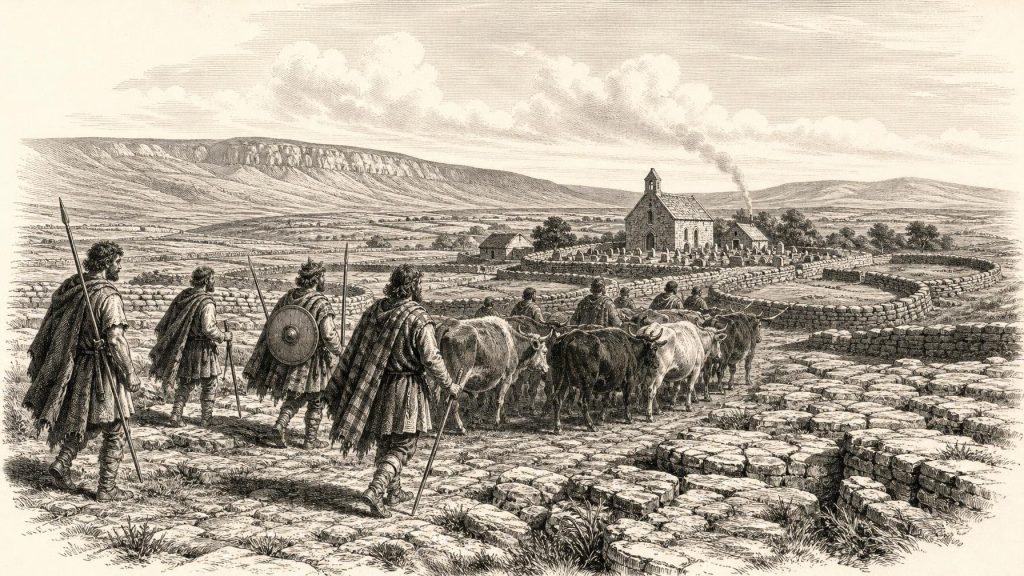
Most people nevertheless lived beyond the annalists’ attention in dispersed farmsteads, ringforts, cashels and crannogs. Mixed farming sustained households, although cattle remained especially important as stores of wealth and sources of dairy produce, hides and social status. The prominence of cattle-raiding in 1055 reflects that economy. Herding, milking, ploughing, sowing, textile production, woodworking and maintaining enclosures filled everyday life, even as political conflict threatened the results.
Ireland also possessed thriving coastal towns. Diarmait mac Máel na mBó had controlled Dublin since 1052, although he is not personally assigned a campaign in the surviving entries for 1055. Dublin’s Hiberno-Norse craftsmen worked in wood, iron, leather, textiles, antler, amber and precious metals. Silver pennies had been struck there since the late tenth century, and trade connected Ireland with Britain, Scandinavia and continental Europe. Such urban wealth helped ambitious rulers maintain fleets, reward followers and campaign beyond their ancestral territories.
A Year of Movement
The events of 1055 did not transform Ireland overnight, but they exposed the forces reshaping its politics. Toirdelbach’s victory in Clare weakened Donnchad’s branch of the Uí Briain; Connacht demonstrated its power in Mide; Osraige underwent an important succession; and armed competition reached even the leadership of major churches. Beneath these contests, cattle, captives, church estates, ports and learned offices remained the practical foundations upon which royal ambition was built.
Primary Sources
- The Annals of Ulster: Year U1055
- Annals of the Four Masters: Annal M1055
- The Annals of Tigernach: Annal T1055
- Annals of Inisfallen: Annal AI1055
- Chronicon Scotorum: Annal CS1055
- Annals of Loch Cé, Volume I: English Translation
- Annals of Loch Cé: Irish Text, Annal LC1055
- Diarmait mac Máel na mBó
- Donnchad, Son of Brian Bórama
- Ua Briain, Tairdelbach
- Dub-dá-leithe, Abbot of Armagh
- Ua Máelshechlainn, Conchobar
- Viking Collections
- 950–1450: Vikings, Normans and Medieval Mints
- Early Medieval Collections
- Guide to the National Museum of Ireland
- Early Medieval Ireland, AD 400–1100: The Evidence from Archaeological Excavations
- Early Medieval Ireland: Archaeological Excavations, 1930–2009
- The Archaeology of Livestock and Cereal Production in Early Medieval Ireland, AD 400–1100
- Kingship, Society, and Sacrality: Rank, Power, and Ideology in Early Medieval Ireland
- The Decline of the Cow: Agricultural and Settlement Change in Early Medieval Ireland
- Reflections on Kingship, the Church and Viking-Age Silver in Ireland
- Ireland in the Middle Ages
- The Practice of Irish Kingship in the Central Middle Ages
- Kings and Kingship in Early Medieval Ireland
- The Dublin Region in the Middle Ages: Settlement, Land-use and Economy