The Tuam Chambers and Border2017 CE
Ireland in 2017 faced political, social and constitutional uncertainty amid economic recovery. Leo Varadkar became Taoiseach, leading a fragile Fine Gael minority after Frances Fitzgerald’s resignation. Northern Ireland’s Executive collapsed, while Brexit negotiations elevated the border, producing commitments to avoid a hard border and protect the Belfast Agreement. Citizens’ Assembly and Oireachtas processes advanced debate on repealing the Eighth Amendment. Tuam excavations revealed infant and child remains, intensifying scrutiny of mother-and-baby homes. Growth coexisted with severe housing need and homelessness. Census profiles highlighted education and diversity; Storm Ophelia caused disruption and deaths; Creative Ireland promoted cultural participation across communities nationwide.
Dateline
Ireland in 2017 was shaped by two very different kinds of uncertainty. One concerned the constitutional and diplomatic consequences of the United Kingdom’s decision to leave the European Union: a question that made the Irish border, long made less visible by the peace process and shared EU membership, central to international negotiations. The other concerned domestic change: who governed, how the State confronted institutional wrongs, and whether long-standing constitutional restraints should be altered. Economic recovery was unmistakable, but so were the stresses of housing shortage and homelessness. Across the island, political institutions and everyday expectations were being tested.
A New Taoiseach
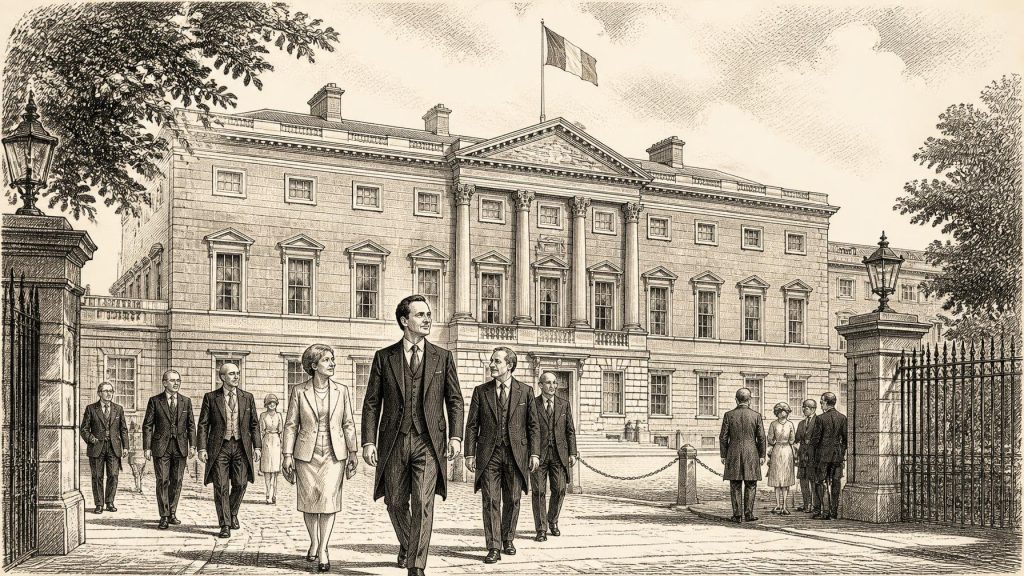
Enda Kenny resigned as Taoiseach on 13 June. The following day Dáil Éireann nominated Leo Varadkar, Fine Gael’s new leader, for appointment by President Michael D. Higgins. The nomination passed by 57 votes to 43, with 35 abstentions: a reminder that Varadkar led a minority administration dependent on the confidence-and-supply arrangement with Fianna Fáil. At thirty-eight, he was Ireland’s youngest Taoiseach to date and its first openly gay head of government. His appointment had a symbolic importance in a republic whose public culture had changed rapidly in the preceding decade.
There was nevertheless more continuity than rupture in the government’s immediate business. Fine Gael retained office and faced a familiar agenda: managing the recovery from the financial crisis, improving public services, increasing housing supply and preparing for Brexit. Varadkar presented the administration as one of renewal, but its parliamentary position remained precarious. That vulnerability became plain in November, when Tánaiste Frances Fitzgerald resigned amid controversy over her handling, as Minister for Justice, of matters connected with the case of Garda whistleblower Maurice McCabe. Her departure averted a threatened confidence motion and an early general election. The episode demonstrated how narrow the government’s room for manoeuvre was at precisely the moment when Brexit required sustained attention.
Stormont Without Ministers
The year opened with a grave institutional crisis in Northern Ireland. On 9 January Martin McGuinness resigned as deputy First Minister. The immediate background included the Renewable Heat Incentive controversy, but his resignation also reflected wider disputes between Sinn Féin and the Democratic Unionist Party over the operation of devolved government, equality and language issues. Because the offices of First Minister and deputy First Minister were jointly held, his departure brought down the Executive and led to an early Assembly election on 2 March.
The result was exceptionally close. The DUP won 28 of the Assembly’s newly reduced total of 90 seats; Sinn Féin won 27. The SDLP took 12, the Ulster Unionists 10 and Alliance eight. Turnout was 64.8 per cent. The election did not settle the dispute: negotiations failed to restore an Executive, leaving Northern Ireland without locally accountable ministers for the rest of 2017. Civil servants continued essential administration, but they could not set new political priorities or provide the democratic direction expected under devolution. The absence of ministers also limited the normal operation of the North–South bodies created under the 1998 Belfast/Good Friday Agreement.
For the Republic, the Stormont impasse was more than a northern party-political matter. It complicated all-island cooperation just as Brexit made that cooperation newly vulnerable. The political vacuum exposed a tension at the heart of the peace settlement: its institutions were designed to share authority between unionists and nationalists, yet their effectiveness depended on consent and continuing partnership between the principal parties.
The Border Becomes European
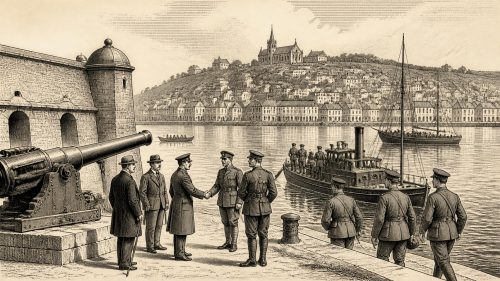
On 29 March the British government triggered Article 50, formally beginning the process of the United Kingdom’s withdrawal from the European Union. Ireland’s government insisted that the distinctive circumstances of the island must be dealt with early in the negotiations. The issue was practical as well as constitutional. People, goods, workers, students and services crossed the border routinely; the Common Travel Area pre-dated both states’ membership of the European Economic Community; and North–South cooperation rested substantially on common EU rules and funding.
The first-stage EU–UK joint report of 8 December marked a major diplomatic moment. It committed both sides to protect the Belfast/Good Friday Agreement in all its parts, avoid a hard border including physical infrastructure and related checks, preserve the Common Travel Area, and safeguard North–South cooperation. It also recorded the British commitment that, if the future EU–UK relationship and specific solutions did not achieve these ends, the United Kingdom would maintain “full alignment” with relevant Internal Market and Customs Union rules. This was an agreement in principle rather than a final settlement, and it expressly did not predetermine the wider future relationship. Yet it made Ireland’s concerns inseparable from the next stage of Brexit negotiations.
The border question therefore transformed Ireland’s place in the European debate. A state geographically small but fully committed to EU membership acquired particular leverage because no durable withdrawal arrangement could ignore the island’s peace settlement, integrated economy and daily cross-border life.
Constitutional Debate and Tuam
Domestic constitutional discussion also intensified. The Citizens’ Assembly, chaired by Ms Justice Mary Laffoy, had considered the Eighth Amendment across five weekends between November 2016 and April 2017. Its report was published and laid before the Oireachtas on 29 June. After hearing expert evidence, personal testimony and public submissions, the Assembly recommended replacing Article 40.3.3 with a constitutional provision explicitly authorising the Oireachtas to legislate on termination of pregnancy, the rights of the unborn and the rights of pregnant women. It also made recommendations about circumstances in which termination should be lawful, including a recommendation for access without restriction as to reason up to twelve weeks’ gestation.
The Oireachtas Joint Committee on the Eighth Amendment, established in April, examined the Assembly’s work through the autumn. On 20 December it reported in favour of simple repeal: removal of Article 40.3.3 without inserting replacement text. The year did not itself resolve the issue, but it changed the terms of national debate. A question often argued through abstract principle was subjected to a structured process of evidence, deliberation and parliamentary scrutiny.
Another reckoning with Ireland’s past unfolded at Tuam, County Galway. On 3 March the Commission of Investigation into Mother and Baby Homes announced results from test excavations at the site of the former Bon Secours home, which had operated from 1925 to 1961. It reported significant quantities of human remains in at least 17 of 20 examined underground chambers. Analysis indicated remains of infants and young children, with radiocarbon dates within the home’s period of operation. The Commission did not at that point establish how many individuals were buried there or assign final responsibility for the burial arrangements; such distinctions mattered amid intense public shock and grief.
In June, Minister for Children and Youth Affairs Katherine Zappone appointed an international expert group to advise on the site’s future. Its technical report was published in December and set out possible courses ranging from memorialisation to excavation, recovery, examination and reburial. Tuam gave exceptional force to wider questions about the treatment of unmarried mothers and children in church-run and State-regulated institutions. In 2017, those questions moved from historical allegation to an urgent problem of forensic, legal and ethical responsibility.
Recovery With Acute Pressures
Economic indicators suggested a country well beyond the deepest years of recession. Later national accounts placed real GDP growth in 2017 at 7.2 per cent and real GNP growth at 4.4 per cent. Such headline measures required caution in Ireland, where multinational companies’ intellectual-property transactions could greatly distort GDP. Even so, domestic consumption and employment were rising, and the recovery was visible in construction, employment and public revenue.
Prosperity was unevenly experienced. Housing scarcity, high rents and homelessness remained defining social problems, particularly in Dublin and other cities. The Department of Housing continued monthly homelessness reporting, while Rebuilding Ireland sought to expand social housing through construction, acquisitions, leasing and tenancy supports. The 2017 social-housing assessment still identified 85,799 households in need of support. New building had resumed after the crash, but provision lagged behind demand, and the practical meaning of recovery differed sharply between secure homeowners, private renters and families dependent on emergency accommodation.
The year’s publication of detailed Census 2016 profiles supplied a more textured picture of the population. The results showed a highly educated society: 42 per cent of people aged fifteen and over held a third-level qualification. They also revealed linguistic diversity, with more than 612,000 residents speaking a language other than Irish or English at home. Irish retained broad symbolic and educational reach—1.76 million people said they could speak it—but only 73,803 reported speaking it daily outside the education system. These figures described the census date rather than a fresh count for 2017, but their publication shaped contemporary understanding of a more diverse, urban and qualified Ireland.
Ophelia and Creative Ireland
Storm Ophelia brought a sudden reminder of physical vulnerability. It made landfall as an extra-tropical storm on the morning of 16 October. Met Éireann’s nationwide Status Red warning reflected the danger: gusts reached 156 km/h at Roche’s Point, County Cork. Schools and many businesses closed, electricity supplies failed on a large scale, trees and roofs were torn down, and coastal flooding occurred. Three deaths were attributed to the storm. For many households, the event was experienced not as an abstract weather record but through cancelled journeys, darkened homes, disrupted work and the work of neighbours, emergency services and utility crews.
There was also an effort to convert the civic energy of the 2016 centenary into a longer cultural programme. Creative Ireland began its five-year initiative in 2017, placing creativity and cultural participation at the centre of public policy. Local authorities formed culture teams, public workshops took place across the country, and Cruinniú na Cásca drew large participation on Easter Monday. In December, the Creative Youth plan set out ambitions for children’s access to music, drama, art and coding. The programme was an assertion that culture, heritage and learning belonged not solely to national institutions or professional artists, but to local life and public wellbeing.
By the end of 2017, Ireland had gained a new Taoiseach but not political ease. The North lacked devolved government, Brexit had made the border an international concern, and difficult domestic questions about bodily autonomy, housing and institutional memory demanded answers. Recovery provided resources and confidence; it did not remove the strains that made the year so consequential.
Primary Sources
- Appointment of Taoiseach and Nomination of Members of Government – Dáil Éireann (32nd Dáil) – Wednesday, 14 Jun 2017
- Thirty-Second Dáil (10.03.2016 -13.06.2017)
- Taoiseach’s Statement on the Resignation of the Tánaiste
- Snapshots of Devolution
- Election Report: Northern Ireland Assembly Election, 2 March 2017
- Report: The March 2017 Northern Ireland Assembly election
- Northern Ireland Assembly Elections: 2017
- Timeline and Key Documents
- Joint Report from the Negotiators of the European Union and the United Kingdom Government on Progress During Phase 1 of Negotiations under Article 50 TEU
- First Report and Recommendations of the Citizens’ Assembly: The Eighth Amendment of the Constitution
- Report of the Joint Committee on the Eighth Amendment of the Constitution, December 2017
- Committee on the Eighth Amendment of the Constitution (32nd Dáil)
- Mother and Baby Homes Commission of Investigation Statement, 3 March 2017
- Minister Zappone appoints a team of international experts to advise on burial site in Tuam during Dáil Statements on Mother and Baby Homes
- Minister Zappone publishes Expert Technical Group Report on the site of the former Tuam Mother and Baby Home
- National Income and Expenditure 2017
- Press Statement Census 2016 Results Profile 10 – Education, Skills and the Irish Language
- Demographics Census of Population 2016 – Profile 7 Migration and Diversity
- Homelessness data 2017
- Statement by Minister Damien English – Key findings of Summary of Social Housing Assessments 2017 Published
- Action Plan for Jobs 2017
- Ophelia Report
- The Creative Ireland Programme Vision: End-of-Year Report 2017
- New Creative Youth Plan Launched