Derryvree’s Iceward Silts30529 BCE
30,529 BCE cannot be reconstructed as a single Irish historical year, but falls within an unstable Late Pleistocene interval. Derryvree, County Fermanagh, preserves freshwater silts between glacial tills, radiocarbon dated broadly to 36,900–31,700 calibrated years BP. Its plants, insects and sediments indicate cold, open, tundra-like wetland with shallow water, before expanding ice covered much of Ireland. Castlepook Cave’s fauna demonstrates links with cold-stage north-west Europe, though deposits span long periods. A possibly tool-marked reindeer bone suggests fleeting human presence, not settlement. No evidence supports agriculture, permanent communities, politics or ritual. The period was dynamic, episodically habitable, and dominated by ice.
Dateline
“30,529 BCE” is a modern chronological label, not a year that can be recovered from Ireland’s archaeological record. At this depth of time, no document, settlement layer or individual find can be assigned to a single calendar year. The responsible history is therefore a reconstruction of a broad Late Pleistocene interval, using deposits, fossils, landforms and radiocarbon measurements. The notional date falls within Marine Isotope Stage 3, a climatically unstable phase of the last Ice Age, when Ireland’s environments were changing rapidly and the British–Irish Ice Sheet was beginning a major expansion.
The closest Irish chronological anchor is not a human event but a buried wetland at Derryvree, near Maguiresbridge in County Fermanagh. Roadworks in 1969 cut through a drumlin and exposed freshwater silts and fine sands trapped between two substantial layers of glacial till. Organic material from the intervening deposits produced the conventional radiocarbon result BIRM-166, 30,500 +1,170/−1,030 radiocarbon years BP. Modern calibration converts such a measurement into a broad probability range rather than a date of annual precision; published discussion places it broadly around 36,900–31,700 calibrated years BP. The requested year lies within that wide span, but Derryvree cannot tell us what occurred at one recoverable moment within it.
A Wetland Between Glaciers
Derryvree’s importance lies in its position between tills. Till is unsorted material left directly by glacier ice, so the freshwater beds demonstrate that this part of Fermanagh was ice-free for a time between glacial advances. They preserve a local environmental interval rather than a continuous national history. Nevertheless, their plants, pollen and small animal remains offer unusually direct evidence of a landscape that existed before renewed ice covered or reshaped much of the region.
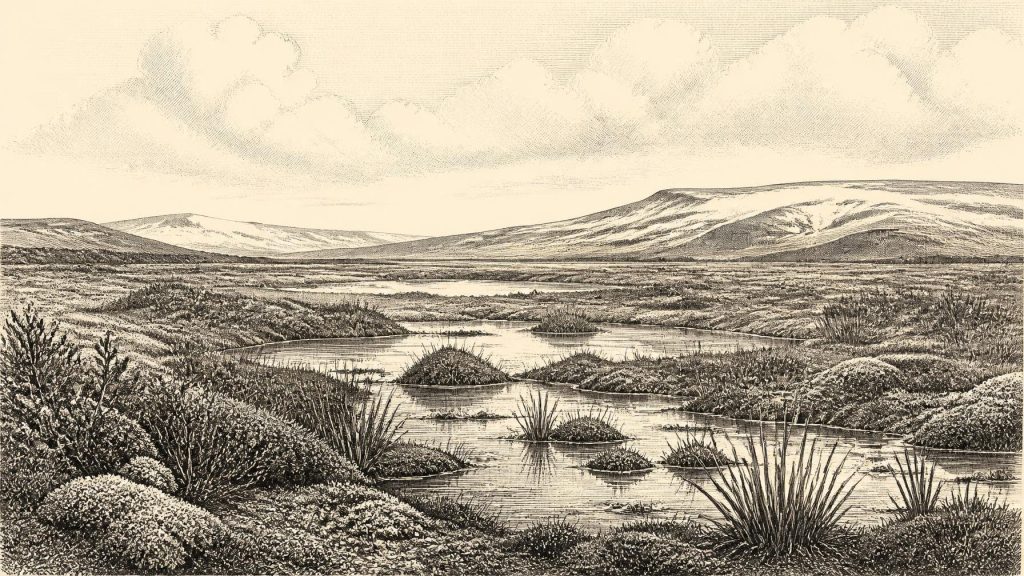
The picture is emphatically not of modern Ireland. The deposits indicate cold, open and largely treeless ground, with wet hollows, shallow water and tundra-like vegetation. Sedges, grasses, mosses and herbs could occupy damp margins; dwarf shrubs and scattered juniper formed part of the wider vegetation mosaic. Aquatic plants, including water-milfoil and bogbean, show that open freshwater existed in at least some pools or channels during the interval. Insects and plant macrofossils are especially valuable because, unlike much wind-blown pollen, they normally register conditions relatively near the site.
“Tundra” is a useful shorthand, but it should not imply a flat, uniform wilderness. Derryvree probably combined saturated ground, small freshwater basins, frost-disturbed soils and better-drained patches. Seasons would have mattered intensely. Summer growth could be rapid where meltwater and light allowed it, while winter brought severe cold, frozen ground and a short supply of plant food. This was a landscape capable of supporting specialised plants and animals, but it was not an agricultural countryside and certainly not a forested island of oak, ash and hazel.
Ice Growing Across Ireland
At roughly this stage of the last glacial cycle, the central issue in Irish regional history was the growth of ice. Reconstructions of the British–Irish Ice Sheet show substantial uncertainty before about 31,000 years ago, because securely dated Irish evidence is sparse and unevenly distributed. Even so, the broad direction of change is clear: upland and northern ice masses were expanding, and over the following millennia they coalesced and spread. By around 28,000 years ago, reconstructions suggest that Ireland was almost completely ice-covered; the greatest extent of the ice sheet followed later, around 26,000 years ago.
Derryvree therefore records neither a timeless “Ice Age Ireland” nor a comfortable warm interlude. It represents an environmentally viable but precarious interval before, or perhaps amid, major glacial reorganisation. The two tills framing its freshwater sediments are physical evidence for that transformation: wet ground and shallow water were eventually overridden or sealed by advancing ice. The drumlin landscape now characteristic of Fermanagh was shaped through repeated glacial processes, although a single exposure cannot by itself date every part of that wider landform system.
Sea level was lower than today because vast quantities of water were held in continental ice. This changed the shape of coasts and exposed parts of the surrounding continental shelves. It does not, however, permit a simple claim that Ireland was connected to Britain by a known dry land bridge at this date. The geography of the Irish Sea was changing, and possible routes for animals or people require separate evidence. No mapped crossing, trackway or migration corridor survives from Ireland around 30,529 BCE.
Animals and the Castlepook Record
County Cork offers a second, very different archive. Castlepook Cave, near Doneraile, has yielded one of Ireland’s richest Pleistocene vertebrate assemblages. Its fauna includes reindeer, woolly mammoth, giant deer, brown bear, wolf, Arctic fox, mountain hare, lemmings and spotted hyaena. Together these remains show that Ireland was intermittently linked to the ecological world of cold-stage north-west Europe and could support, or receive, a strikingly varied mammal community.
Yet Castlepook must be used carefully. Cave deposits often accumulate over long periods, and the bones need not represent animals living together, let alone animals present in the same season. Carnivores, water, sediment movement and earlier excavation methods can all complicate a collection. A mammoth tooth or hyaena bone shows that the species occurred in the broader Irish Pleistocene record; it does not prove that a mammoth, hyaena or reindeer stood near Derryvree in the notional year under discussion. The cave is evidence for regional possibilities and long-term ecological change, not a snapshot of one day’s fauna.
The Human Question
The most consequential, and most limited, evidence relevant to people is a reindeer femur from Castlepook reported as bearing a deep mark interpreted as having been made by a stone tool during carcass processing. If that interpretation is correct, it would indicate Upper Palaeolithic human activity in Ireland far earlier than the island’s formerly accepted post-glacial record. It would show that at least one person, or small party, handled a reindeer carcass during a cold-stage phase of the Late Pleistocene.
That proposition must not be expanded into an invented Ice Age society. There is no securely associated dwelling, hearth, stone-tool assemblage, burial, artwork, storage pit or settlement surface of comparable antiquity from Ireland. The bone does not establish whether people hunted the reindeer, found it dead, processed it at the cave entrance, remained for a night or returned repeatedly. Nor does it establish a population size, language, kin group or route of arrival. It is evidence for a possible episode of butchery, not evidence for a village, tribe or permanent colony.
Accordingly, political affairs, diplomacy and warfare cannot responsibly be described for Ireland around this point. There are no rulers, territories, alliances, fortifications or weapons assemblages known from the island. Religion and learning are equally beyond the evidence: no shrine, burial rite, engraving, pigment use or formal symbolic site of this age has been identified in Ireland. It would be tempting to borrow the elaborate art, ornaments and social practices known from better-documented Upper Palaeolithic regions of France, Iberia or central Europe, but analogy cannot replace Irish finds.
Livelihood Without an Economy
If people did reach Ireland in this interval, their practical world would have revolved around mobility, weather, animal movements and the immediate use of raw materials. A sharp stone edge capable of making the Castlepook mark is the most that can be cautiously inferred from the proposed butchery evidence. Reindeer could have provided meat, hide, sinew, bone and fat, but the Irish record does not demonstrate which materials were taken or how they were shared. Mammoth and giant deer were part of the wider faunal landscape, not proven targets of Irish hunters.
There is no evidence for farming, herding, pottery, metalworking, settled craft production or regular exchange. “Trade” is therefore the wrong word for what can be observed. Movement of people, animals and stone across a changing coastal region may have occurred, but no imported artefact network has been demonstrated. The economy, in the modern sense of enduring production and exchange systems, remains archaeologically invisible. What survives is ecological evidence and one possible trace of a short-lived human action.
The principal development around 30,529 BCE was thus environmental: an open, cold wetland landscape existed in parts of Ireland while ice was growing elsewhere and would soon dominate much of the island. Derryvree’s silts preserve that fragile interval with remarkable clarity. Castlepook’s bones add the possibility that people briefly entered the same wider world. Together they replace the old image of an empty land beneath permanent ice with a more demanding and more accurate one: a changing Pleistocene Ireland, episodically habitable, ecologically connected to Europe and still far beyond the reach of calendar-year history.
Primary Sources
- A Middle Midlandian Freshwater Series at Derryvree, Maguiresbridge, County Fermanagh, Northern Ireland
- The Irish Quaternary Fauna Project
- Growth and Retreat of the Last British–Irish Ice Sheet, 31,000 to 15,000 Years Ago: The BRITICE-CHRONO Reconstruction
- The Deglaciation of the Western Sector of the Irish Ice Sheet from the Inner Continental Shelf to its Terrestrial Margin
- Ice-Rafting from the British–Irish Ice Sheet Since the Earliest Pleistocene: Implications for Long-Term Mid-Latitudinal Ice-Sheet Growth in the North Atlantic Region
- First Evidence of a Late Upper Palaeolithic Human Presence in Ireland
- The Colonization of Ireland: A Human Ecology Perspective
- The IntCal20 Northern Hemisphere Radiocarbon Age Calibration Curve (0–55 cal kBP)
- Palaeoecology: A Field Guide to the Quaternary of Northern Ireland
- Quaternary Site Descriptions
- Outreach and Education Resources
- Castlepook Cave: County Geological Site Report
- Heritage Artefacts of County Cork
- Archaeological Heritage of County Cork
- Irish Association of Hydrogeologists Field Guide 2014
- New Insights on the Fauna of Ireland’s Younger Dryas and Early Holocene from Alice & Gwendoline Cave
- Lateglacial Vegetation and Environment in Ireland: First Results from Four Western Sites
- Irish Quaternary Association
- Irish Caves Database: Mammoth Cave
- Proceedings of the Royal Irish Academy: Castlepook Cave