Mosses Beneath the Drumlin30528 BCE
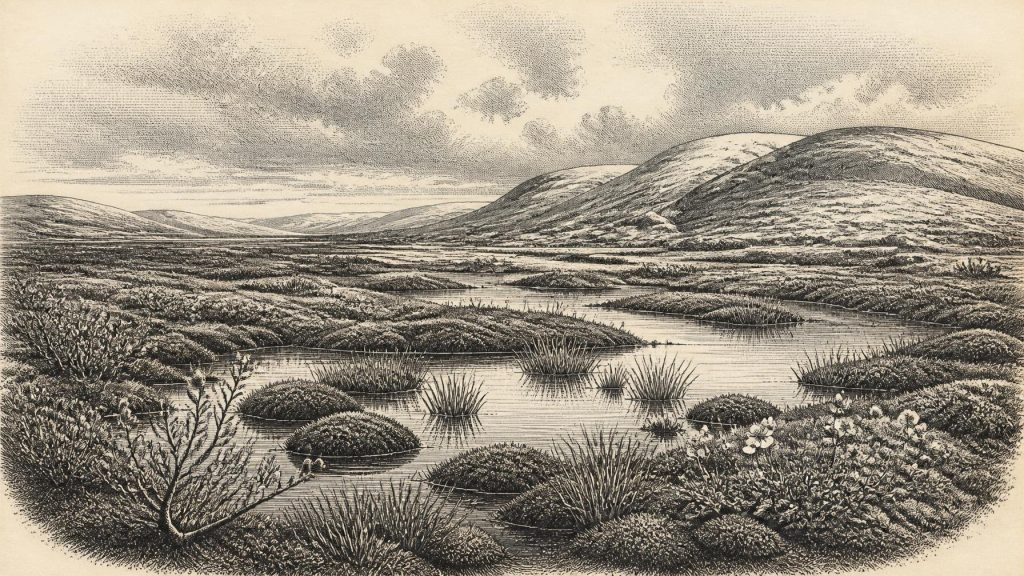
Thirty thousand five hundred and twenty-eight BCE is an imprecise modern label for a Late Pleistocene interval, not a documented Irish year. Ireland experienced unstable pre-Last Glacial Maximum conditions, with advancing and retreating ice repeatedly erasing evidence. At Derryvree, County Fermanagh, freshwater sediments between tills, radiocarbon dated broadly to 30,500 BP, preserve tundra wetlands with mosses, grasses, sedges, shrubs, insects and aquatic plants. Castlepook Cave, County Cork, records cold-adapted mammals, though bones accumulated across episodes and dates require reassessment. A possibly cut-marked reindeer bone suggests, but cannot prove, human visitation. No settlement, polity, trade network or continuous occupation is evidenced.
Dateline
The label 30,528 BCE is a modern chronological convenience, not a date at which Ireland’s past can be observed with calendar-year precision. It corresponds roughly to 32,500 calendar years before AD 1950, within the Late Pleistocene and Marine Isotope Stage 3, a long, climatically unstable portion of the last Ice Age. No Irish written record, named community, political event or securely dated human action can be assigned to this individual year. The responsible history is therefore one of evidence ranges: sediments, fossils, landforms and radiocarbon determinations that illuminate conditions in Ireland over millennia rather than an annual sequence.
Around this broad horizon, Ireland was an Atlantic-edge landscape undergoing profound environmental change. It lay before the Last Glacial Maximum, conventionally dated at about 28,200–20,400 calibrated years BP, when ice became especially extensive. The interval was not simply a story of a permanently frozen island. Ice margins advanced and retreated; some localities were glaciated while others preserved open ground, water and life. Subsequent ice action also destroyed or reworked much of the older record. That geological violence is one reason why the evidence is sparse, uneven and precious.
A Wetland Between Ice Advances
The most informative Irish archive for this general period lies at Derryvree, near Maguiresbridge in County Fermanagh. Roadworks in 1969 cut through a drumlin and revealed freshwater silts and fine sands sealed between two substantial layers of till: unsorted debris deposited directly by glacier ice. The sequence provides a firm relative history. An earlier ice advance left the lower till; a period without local ice cover allowed freshwater sediments and organic remains to accumulate; a later advance covered the deposit with a second till sheet. It is evidence for changing local conditions, not a claim that all Ireland was ice-free at once.
The Derryvree deposit, laboratory sample Birm-166, produced a conventional radiocarbon age of 30,500 years BP, with a large uncertainty of approximately +1,170/−1,030 years. That is a radiocarbon determination, not a BCE year, and should not be treated as an exact anniversary. Calibration of dates this old produces broad probability ranges, while the original sample’s uncertainty and the complexity of the calibration curve require particular caution. Nevertheless, the dated freshwater series belongs squarely to the cold late-Pleistocene world relevant to 30,528 BCE.
Its contents make that world unusually vivid. Pollen, plant macrofossils, mosses and insects point to treeless, open tundra under a periglacial climatic regime. Grasses, sedges, herbs and low shrubs grew where conditions permitted. Finds associated with cold, open ground include dwarf willow and mountain-avens; wetland and aquatic plants include bogbean and water-milfoil. Mosses flourished in saturated places. The original investigators described a landscape resembling muskeg: a mosaic of waterlogged organic ground, shallow pools and mossy margins. That comparison is useful if kept modestly in scale. It identifies cold, wet and plant-rich patches, not a modern Canadian peatland reproduced intact in Fermanagh.
Seasonality was probably the decisive rhythm. Winters were severe, ground was repeatedly affected by frost, and snowmelt or seasonal thaw would have reorganised watercourses and muddy margins. Yet the deposit also proves that summers or growing seasons were sufficient for plants, insects and freshwater sediment to accumulate. Derryvree was therefore neither forest nor featureless ice desert. It was a locally habitable ecological patch within a colder, exposed and unstable wider landscape.
Caves and Mobile Fauna
County Cork offers a different kind of evidence. Castlepook Cave, near Doneraile, has yielded a notable assemblage of Late Pleistocene animal remains, including reindeer, mammoth, giant deer, wolf, Arctic fox and spotted hyaena. These animals should not be imagined as a single herd standing together in one Irish valley in 30,528 BCE. Cave deposits often accumulated over long periods; carnivores could drag bones into dens; water, sediment movement and older excavation practices further complicate associations. A cave collection is an archive of repeated episodes, not an instant census.
Even so, the assemblage establishes that Ireland formed part of a wider north-west European world of cold-adapted and open-country mammals before the Last Glacial Maximum. Reindeer imply seasonal forage and mobility across broad, sparsely wooded terrain. Mammoth and giant deer evoke substantial herbivores, but their presence says nothing by itself about the density of vegetation in every region or season. Hyaenas and wolves indicate predators and scavengers able to exploit animal carcasses and, in the case of caves, to shape what later archaeologists recover.
Dating has made the Castlepook archive more instructive but also more cautionary. The Irish Quaternary Fauna Project demonstrated the value of directly dating old museum collections, while later work showed that some 1990s bone dates required reassessment because radiocarbon pretreatment methods had improved. Re-dating has suggested that some southern Irish mammal occurrences were substantially older than formerly thought, with giant deer and spotted hyaena perhaps locally absent before about 40,000 calibrated years BP. The lesson is methodological as well as chronological: names on a species list and a single old radiocarbon result cannot establish an exact landscape at an exact year.
The Human Question
This caution matters most for people. A reindeer femur from Castlepook has been interpreted as bearing a deep incision made by a sharp stone tool during carcass processing. If that interpretation is correct, it could indicate a brief Upper Palaeolithic human encounter with a reindeer in Ireland during the wider Ice Age. It does not prove a settled population, a camp, a hunting territory, a named archaeological culture or continuous occupation. No securely associated hearth, stone-tool assemblage, dwelling, burial or human remains is known from Ireland for this horizon.
Nor can the femur securely turn 30,528 BCE into Ireland’s first documented year of human history. Bone dates establish the age of an animal’s death, not automatically the moment an observed mark was made; cave taphonomy further limits certainty. The strongest published evidence for a human incursion into Ireland is far later: butchered brown-bear remains from Alice and Gwendoline Cave in County Clare have calibrated ranges of 12,810–12,590 cal BP. Full-scale, securely evidenced settlement belongs later again, in the Mesolithic. At the date considered here, human presence remains an intriguing possibility rather than a demonstrated social fact.
No Polities, No Trade Routes
There were no Irish kingdoms, provinces, diplomatic relations, laws or historical peoples that can responsibly be projected into this period. Modern political divisions are equally irrelevant: Derryvree and Castlepook are useful place names for archaeological discussion, not ancient territories. The evidence does not reveal households, kin groups, language, ritual, visual art, teaching or formal religion. It also gives no direct grounds for describing economy or trade. Hunting, scavenging and the use of stone tools are plausible activities for Upper Palaeolithic people elsewhere in north-west Europe, but Ireland has not yielded the securely dated artefact assemblage needed to assign those activities here.
What can be said is more elemental. Wetlands, open vegetation and mobile animals created resources and constraints that would have mattered to any visitors: drinkable water, plant cover, animal pathways, sheltering landforms, exposure to wind and cold, and seasonal scarcity. Lower sea levels altered the shape of the surrounding coasts, but this does not demonstrate a simple land bridge, a regular travel route or an Irish trading network. Animal arrivals show that dispersal into the region occurred at different times; the precise routes and circumstances remain subjects for investigation.
An Archive, Not an Episode
For this date, environmental evidence deserves greater emphasis than invented human drama. Derryvree’s silts preserve a northern freshwater tundra landscape sealed beneath later ice. Castlepook’s bones preserve fragments of a southern animal world, although their original depositional histories require painstaking reconstruction. Together they show an Ireland that was ecologically active, regionally varied and repeatedly transformed by ice-age climate. They do not disclose what happened in one numbered year.
The enduring significance of 30,528 BCE is therefore not an event but a condition: Ireland stood within a changing Late Pleistocene world, where shallow water and mossy ground could exist between glacial advances, cold-adapted mammals ranged through open country, and any human visit remains difficult to prove. Future dating, cave excavation and analysis of old museum collections may sharpen that picture. For now, the evidence supports a disciplined conclusion—an ancient landscape can be recovered in outline, but its calendar cannot.
Primary Sources
- Middle Midlandian Freshwater Series at Derryvree, Maguiresbridge, County Fermanagh, Northern Ireland
- Middle Midlandian Freshwater Series at Derryvree, Maguiresbridge, County Fermanagh, Northern Ireland
- The Irish Quaternary Fauna Project
- A Reconsideration of the Radiocarbon Dating of the Marine Isotope Stage 3 Fauna from Southern Ireland
- New Insights on the Fauna of Ireland’s Younger Dryas and Early Holocene from Alice & Gwendoline Cave
- First Evidence of a Late Upper Palaeolithic Human Presence in Ireland
- Ireland: Submerged Prehistoric Sites and Landscapes
- Pattern and Timing of Retreat of the British-Irish Ice Sheet
- Exploring Controls of the Early and Stepped Deglaciation on the Western Margin of the British-Irish Ice Sheet
- Britain and Ireland: Glacial Landforms Prior to the Last Glacial Maximum
- The IntCal20 Northern Hemisphere Radiocarbon Age Calibration Curve (0–55 cal kBP)
- IntCal Publications
- Rapid Global Ocean-Atmosphere Response to Southern Ocean Freshening During the Last Glacial
- Mid-to-Late Marine Isotope Stage 3 Mammal Faunas of Britain: A New Look
- The Subdivision of the Quaternary Period in Ireland
- Palaeoecology: Fermanagh Field Guide
- Menyanthes trifoliata
- Dryas octopetala
- Heritage Artefacts of County Cork
- Castlepook Cave, County Cork, 2022
- Last Glacial Maximum Cirque Glaciation in Ireland and Implications for Reconstructions of the Irish Ice Sheet
- A Critical Review and Re-Investigation of the Pleistocene Deposits of Northern Ireland