
The Awbeg Tundra31434 BCE
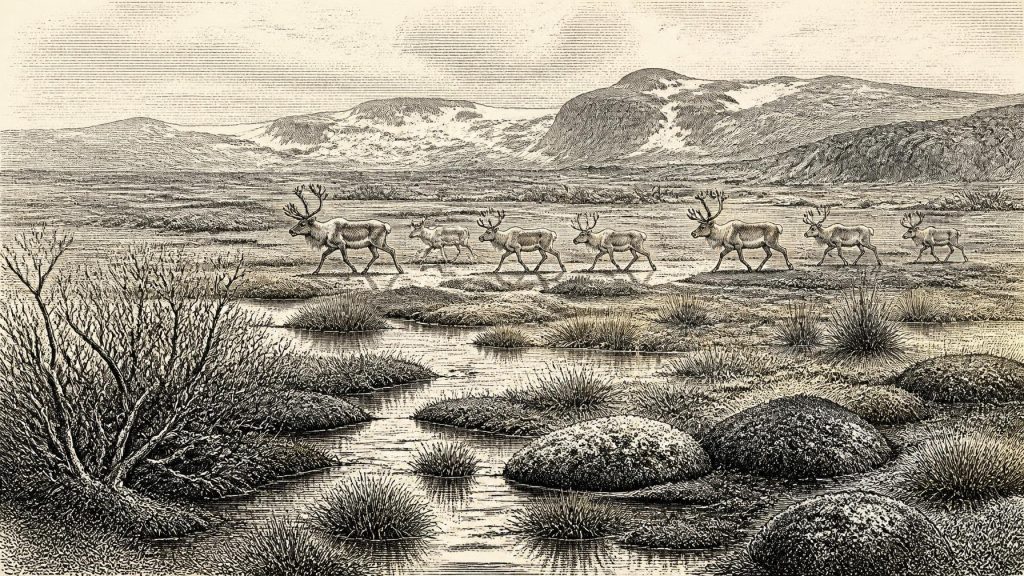
Around 31,434 BCE, Ireland lay within a fluctuating Marine Isotope Stage 3 cold environment, although no event can be dated precisely to that year. Derryvree, County Fermanagh, preserves an inter-till wetland sequence showing locally ice-free, open tundra terrain with sedges, mosses, pools and cold-tolerant plants, rather than woodland. Castlepook Cave, County Cork, records a time-averaged fauna including reindeer, mammoth, giant deer and predators, indicating cold open country. A possibly stone-cut reindeer femur suggests brief human contact, but lacks secure archaeological context. No settled population, culture or institutions can be demonstrated from Ireland; later glaciation and inundation probably erased much evidence.
Dateline
Modern calendar-year precision is not available for Ireland in 31,434 BCE. No community on the island recorded this year, and neither radiocarbon dating nor glacial stratigraphy can isolate an event to a single season, let alone a day. The responsible approach is to place it within a broad late Pleistocene horizon: roughly 33,383 years before AD 1950, during Marine Isotope Stage 3, a fluctuating cold phase of the last Ice Age. The closest important Irish environmental sequence, at Derryvree near Maguiresbridge in County Fermanagh, has a published calibrated range of approximately 36,900–31,700 calendar years before present. That span includes 31,434 BCE, but does not prove that every condition recorded at Derryvree existed across Ireland, or even at Derryvree itself, in this exact numbered year.
A Landscape Between Advances
Ireland was not yet in the fullest grip of the Last Glacial Maximum, the later phase when the Irish Ice Sheet expanded over much of the island and across adjoining seas. The timing and size of earlier ice advances remain subjects of active research, but geological evidence shows that ice sheets had repeatedly altered the country long before this point and would do so again. At Derryvree, organic freshwater sediments and fine sands were trapped between two layers of till, the unsorted debris laid down by glacier ice. The intervening bed therefore records an interval when ice was absent from that locality and water, plants and animals occupied the ground before renewed glaciation sealed the evidence beneath a drumlin.
This does not licence a picture of a uniformly ice-free Ireland. An inter-till deposit is a local archive, while ice margins and upland snowfields could change substantially from region to region. Yet Derryvree is decisive in one respect: north-central Ireland was capable of sustaining terrestrial and wetland ecosystems during part of this broad cold-stage interval. Other geological research similarly indicates that the build-up to the final large Irish Ice Sheet was prolonged and complex rather than a single instant when all land vanished beneath ice.
The country’s familiar modern outlines are also a poor guide to its appearance. Sea level was lower during the Ice Age, river systems and coastal plains differed from those of today, and later glaciation, erosion and marine inundation removed or buried vast areas of old landscape. It is therefore safer not to draw an exact coastline or a definite land route between Ireland and Britain for 31,434 BCE. What can be said is that the island lay within the changing north-west European world of cold climates, shifting ice, exposed shelves and mobile animal populations.
Derryvree’s Wet Ground
The fossils preserved at Derryvree provide the most vivid evidence for conditions relevant to this date. Pollen, plant macrofossils, mosses and insect remains point towards open, treeless vegetation in a severe periglacial setting: terrain shaped by persistent frost, seasonal thaw and waterlogging rather than by forest. Sedges and mosses occupied wet ground; shallow freshwater pools and their margins supported aquatic and semi-aquatic plants. Mountain avens, willow, juniper and other cold-tolerant plants are part of the broader picture reconstructed from the assemblage, although individual taxa need not all have flourished together at precisely the same moment.
“Tundra” is a useful shorthand, provided it is not mistaken for a modern Arctic landscape transferred unchanged to Ireland. The Derryvree evidence suggests a mosaic of bare or sparsely vegetated ground, sedgy and mossy hollows, pools and low scrub. It was biologically productive in sheltered, wet places, but vulnerable to cold, wind and frozen soils. A few grains of tree pollen do not demonstrate woodland: pollen can travel long distances, while the bulk of the evidence favours an open landscape. The buried organic bed is valuable precisely because it preserves such modest materials, which are usually erased when glaciers advance.
There is no basis for imagining farms, fields, villages or permanent buildings here. The people who later transformed Ireland’s ecology through clearance and agriculture belonged to a vastly more recent past. At this depth in time, even a successful human presence would have depended on moving through a difficult country and on exploiting seasonally available animals, plants and sheltered terrain.
Animals at Castlepook
In north County Cork, Castlepook Cave near Doneraile, beside the Awbeg valley, offers a different kind of evidence. Excavated principally in the early twentieth century and once popularly known as Mammoth Cave, it produced a remarkable accumulation of Pleistocene animal bones. Modern redating has shown that some old cave dates substantially underestimated their true age, and the site is now central to discussion of Ireland’s Marine Isotope Stage 3 fauna. Its collections include remains attributed to reindeer, brown bear, wolf, Arctic fox, mountain hare, lemmings, giant deer, woolly mammoth and spotted hyaena.
That list must not be read as a census for 31,434 BCE. Cave assemblages are time-averaged: bones can have entered over thousands of years through carnivore activity, natural death, water movement and excavation disturbance. Some species may have been locally absent before others arrived; some specimens are more securely dated than others. Castlepook nevertheless demonstrates that, during the wider pre-Last Glacial Maximum world, Ireland formed part of a cold-open-country ecological zone capable of supporting large herbivores and their predators. Reindeer in particular are well suited to a landscape of open vegetation, though their bones alone cannot tell us precisely when or where herds moved.
Predators mattered as much as prey. Spotted hyaenas could carry selected carcass parts into caves and gnaw, crush and scatter bone, while wolves and other scavengers further complicated the record. Caves were therefore not automatically human shelters. At Castlepook, they were at least intermittently carnivore places and natural traps or repositories. This is why every apparent human modification must be studied microscopically and in context, distinguishing a stone-tool cut from tooth damage, trampling, sediment abrasion, weathering or damage caused during old excavations.
The Reindeer Femur Question
A reindeer femur from Castlepook has made this broad chronological horizon especially important. County Cork heritage interpretation dates the bone to about 31,000 BCE and identifies a deep mark as likely to have been made on fresh bone by a sharp stone tool during butchery. If that interpretation is confirmed, it may represent exceptionally early evidence that people handled an animal in Ireland, far earlier than the better-supported terminal Palaeolithic evidence from County Clare.
Its importance is matched by its limitations. The date concerns the animal bone, not an independently dated instant when a tool met its surface. The specimen derives from an older cave collection rather than a modern, sealed archaeological context. No securely associated hearth, stone-tool assemblage, occupation floor, dwelling, human burial or repeated concentration of butchered remains of comparable age has yet been recovered from Castlepook. Recent excavation has identified surviving sediments and areas worth further study, but it has not yet supplied the decisive contextual evidence.
The cautious conclusion for around 31,434 BCE is therefore not that Ireland had a settled Palaeolithic population. It is that a reindeer bone near this broad period carries a serious proposed sign of butchery, making a brief human incursion possible. A small travelling party could have encountered or killed an animal, processed part of it and left little that survived later glaciation, erosion, rising sea levels and antiquarian digging. Equally, the claim remains dependent on specialist taphonomic judgement and corroboration. Archaeology can responsibly preserve both the possibility and the uncertainty.
No Kingdoms, No Recorded Culture
Political affairs, warfare, diplomacy and institutions cannot be described for Ireland in this year. There are no named peoples, rulers, territories, languages or treaties. Nor is there evidence for Irish ritual sites, art, formal burial practice, trade networks or teaching traditions at this date. Assigning an Aurignacian, Gravettian or another continental Upper Palaeolithic identity to possible visitors would go beyond the evidence, because Ireland has not produced a diagnostic toolkit from this period.
Even so, the wider European context helps define what is plausible without becoming proof. Human groups elsewhere in north-west Europe lived by hunting, gathering and seasonal movement, using stone, bone, antler, hide and wood. If people reached Ireland during a favourable interval, their economy would probably have been similarly mobile and dependent on immediate landscapes rather than on permanent agricultural settlement. That is an inference from comparable societies, not a discovery made at an Irish camp. No Irish object presently demonstrates their technology, clothing, food-sharing arrangements, beliefs or social organisation.
An Archive of Absence
The absence of clear settlement evidence is itself historically meaningful, but it has more than one possible explanation. Ireland may have been visited rarely, or not at all, in this period. Any visits may have been too short and too small to leave recognisable traces. Alternatively, later ice sheets may have destroyed many open-air sites, while drowned coastal landscapes now lie beneath the sea. The country’s Palaeolithic record is unusually fragile: caves preserve selected bones, but even caves have been disturbed by animals, sediment movement and generations of excavation.
For 31,434 BCE, then, Ireland is best understood not as an empty stage awaiting history, nor as a landscape with an undocumented society that can be confidently reconstructed. It was a changing cold-world environment: locally ice-free in places during a broad interval, furnished with wet tundra habitats and connected ecologically to the larger Pleistocene north-west. Derryvree supplies the clearest environmental window; Castlepook raises the tantalising prospect of human contact. Both insist on the same discipline: evidence can illuminate a period, but it cannot turn a prehistoric calendar number into a witnessed year.
Primary Sources
- A reconsideration of the radiocarbon dating of the Marine Isotope Stage 3 fauna from southern Ireland
- First evidence of a Late Upper Palaeolithic human presence in Ireland
- New insights on the fauna of Ireland's Younger Dryas and Early Holocene from Alice & Gwendoline Cave
- Trimlines, blockfields and the vertical extent of the last ice sheet in southern Ireland
- Radiocarbon constraints on the history of the western Irish ice sheet prior to the Last Glacial Maximum
- Advance and retreat of the marine-terminating Irish Sea Ice Stream into the Celtic Sea during the Last Glacial: Timing and maximum extent
- Timing and pace of ice-sheet withdrawal across the marine–terrestrial transition west of Ireland during the last glaciation
- Stratigraphic and palaeo-geomorphological evidence for the glacial-deglacial history of the last British-Irish Ice Sheet in the north-western Irish Sea
- The exploration of Castlepook Cave, County Cork
- 2022:564 – Castlepook Cave, Castlepook South, Cork
- Archaeology Research Excavation Grant 2022: Final Report
- Heritage Artefacts of County Cork
- The Irish Quaternary Fauna Project
- The colonization of Ireland: a human ecology perspective
- Hunter-Gatherer Ireland
- Ireland: Submerged Prehistoric Sites and Landscapes
- Investigating seasonal mobility in Irish giant deer Megaloceros giganteus through strontium isotope analysis
- The IntCal20 Northern Hemisphere Radiocarbon Age Calibration Curve (0–55 cal kBP)
- Marine20 – The Marine Radiocarbon Age Calibration Curve (0–55,000 cal BP)
- A North-Western Habitat: the Paleoethology and Colonisation of a European Peninsula