
Castlepook’s Hyena Passage31441 BCE
Around 31,441 BCE, Ireland lay within Marine Isotope Stage 3, a fluctuating prelude to the Last Glacial Maximum rather than a uniformly ice-covered landscape. Derryvree sediments in Fermanagh indicate cold, treeless wetlands of sedges, grasses, juniper, mosses and arctic-alpine plants, alongside regional variation. Castlepook Cave in Cork preserves MIS 3 fauna including mammoth, reindeer, giant deer, bears, wolves, Arctic foxes, lemmings and spotted hyaenas, which used the cave as a den. A marked reindeer femur may indicate human butchery about 33,000 years ago, but cannot prove permanent settlement. Later glaciation erased much evidence, leaving deposits and bones as Ireland’s witnesses.
Dateline
The label 31,441 BCE offers a useful point of entry, but it cannot identify a witnessed Irish “year”. No calendar, settlement sequence or human biography permits that degree of precision so far back in the Late Pleistocene. Expressed in the dating language used by Quaternary researchers, it falls roughly 33,390 years before AD 1950, within Marine Isotope Stage 3 (MIS 3), a climatically unstable part of the last Ice Age. The responsible history of Ireland at this point is consequently a history of deposits, bones, pollen, seeds, insects, cave sediments and ice margins—not of named rulers or dated events.
A Date Within a Range
The closest important environmental archive is Derryvree, near Maguiresbridge in County Fermanagh. There, organic-rich freshwater silts were preserved between two layers of glacial till. A legacy radiocarbon determination from the deposit, when calibrated, has been placed broadly at about 36,900–31,700 calibrated years before present. That range encompasses 31,441 BCE. It does not mean that every part of Ireland looked identical at that moment, nor that the whole deposit formed in a single season. It does establish something more valuable: for part of this interval, an ice-free or largely ice-free local basin in north-central Ireland sustained freshwater, wet ground and a distinct cold-climate plant community before later ice buried it.
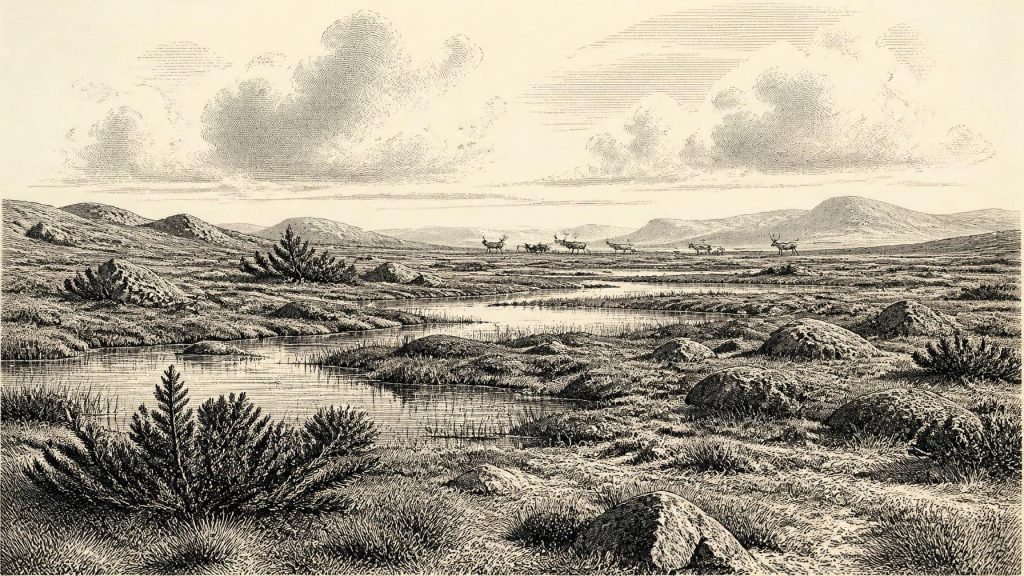
At Derryvree, plant remains include sedges and grasses, with juniper and small arctic-alpine herbs; mosses were also prominent. The resulting reconstruction is an open, treeless muskeg or tundra wetland: a waterlogged landscape with shallow pools, peat-forming vegetation and exposed ground nearby. This is direct environmental evidence from one locality. Calling the entire island a uniform “tundra” is an interpretation, albeit a reasonable broad one when Derryvree is considered alongside comparable Irish sequences at Greenagho in Fermanagh and Aghnadarragh in County Antrim. Local shelter, drainage, altitude and distance from the sea would have produced marked regional differences.
An Unsettled Ice-Age Island
Ireland was then in the middle-to-later part of the Midlandian cold stage, the Irish expression of the last glacial cycle. MIS 3 was not a single unbroken freeze. Greenland ice-core records show repeated abrupt climatic shifts across the North Atlantic world, and Irish deposits suggest alternating glacial, periglacial and relatively milder episodes. Correlating a particular Irish bed exactly with one Greenland warming pulse remains difficult: radiocarbon uncertainty grows substantial at these ages, and old deposits have often been reworked, eroded or sealed beneath younger ice.
Nevertheless, the overall sequence matters. The Derryvree sediments lie below later glacial deposits, while evidence from southern Ireland indicates that the major expansion of the last Irish Ice Sheet came later, building from around 34,000 years ago and reaching far more extensive limits after about 24,000 years ago. Thus 31,441 BCE belongs not to the Last Glacial Maximum itself, conventionally dated to roughly 23,000–19,000 calibrated years before present, but to its long and variable prelude. Some areas could support land animals and wetlands; other districts may already have experienced severe periglacial conditions or advancing ice.
This distinction corrects a misleading image of Ireland as simply entombed beneath ice throughout the Ice Age. Ice did repeatedly reshape the island, stripping and disturbing earlier ground surfaces. Yet the survival of organic sediments beneath till, and of bones in protected caves, shows that interludes of habitable land existed. Such evidence is fragmentary precisely because subsequent glaciation destroyed much of what might otherwise have survived. Absence of a site on the modern map is therefore not proof that no animal, plant or person ever occupied the surrounding landscape.
Castlepook’s Animal World
The most vivid evidence from southern Ireland comes from Castlepook Cave near Doneraile, County Cork, historically also called Mammoth Cave. Excavations and later reassessment of old collections recovered a striking Late Pleistocene fauna: woolly mammoth, reindeer, giant deer, brown bear, wolf, foxes including Arctic fox, mountain hare, stoat, lemmings and spotted hyaena. Not every bone belongs to precisely the same date or deposit; the cave was excavated early in the twentieth century, and its complicated galleries, disturbed sediments and later material make simple narratives unsafe. But modern radiocarbon reassessment places significant elements of the assemblage in MIS 3, well before the Last Glacial Maximum.
That animal list is evidence of ecological possibility, not a census for 31,441 BCE. It shows that, during this broad phase, Ireland sometimes supported a cold-open-country mammal community richer than the island’s later fauna. Reindeer point to seasonal grazing opportunities; lemmings and Arctic fox support the picture of severe, open habitats. Mammoth and giant deer indicate that sufficient forage and connected land routes existed at least intermittently. Spotted hyaena is especially revealing. Its teeth, bones and dung at Castlepook suggest that the cave served at times as a carnivore den or a place into which carcass parts were dragged, rather than a tidy record of animals dying where they fell.
Consequently, Castlepook should not be imagined as a peaceful parade of species sharing one valley. Predation, scavenging and competition were built into this food web. Wolves and hyaenas could exploit reindeer or deer carcasses; bears used caves in different ways and seasons; humans, if present, would have entered a landscape already claimed by powerful carnivores. This was conflict in an ecological sense, but there is no evidence for organised warfare, political boundaries, alliances or diplomacy. Terms such as tribe, chiefdom and territory would impose later social structures upon a record that cannot sustain them.
The Reindeer Femur Question
One Castlepook object has transformed the discussion of people in Ice-Age Ireland: a reindeer femur fragment reported as bearing a deep mark interpreted as having been made on fresh bone by a sharp stone tool. The bone has been publicly dated to about 33,000 years ago, close enough to the chronological horizon of this article to be directly relevant. If the modification is confirmed as anthropogenic, it is evidence that one or more people processed a reindeer in Ireland during MIS 3—far earlier than the previously established Late Palaeolithic and Mesolithic evidence.
The limits are as important as the excitement. A dated animal bone does not date a visit to the exact year, identify the tool user, prove that the reindeer was hunted rather than scavenged, or show that butchery took place inside the cave. No securely associated stone-tool assemblage, hearth, dwelling, burial or repeatedly occupied campsite has yet been recovered from this period in Ireland. The bone may preserve a fleeting action: meat removed, sinews cut or a limb dismembered before carnivores or water moved the remains. It is therefore best described as possible evidence of human activity, rather than proof of a permanent population or a settled “first Irish” community.
Daily Life Beyond the Evidence
If people did reach Ireland around this horizon, their likely material world can only be inferred cautiously from Upper Palaeolithic hunter-gatherers elsewhere in north-west Europe. Small mobile groups would have required clothing, fire, stone cutting edges and detailed knowledge of animal movement, weather and safe routes. Reindeer offered meat, hide, sinew, bone and antler; wetlands offered water, plant materials and places where game might concentrate. None of those general possibilities demonstrates that a particular camp stood at Derryvree or Castlepook.
There is no direct Irish evidence at 31,441 BCE for houses, food stores, boats, exchange networks, visual art, formal burial or ritual places. Nor can religion, learning, language, kinship rules or gendered work be reconstructed from the known remains. It would be mistaken to treat that silence as evidence that such things did not exist. Rather, mobile hunter-gatherer activities usually leave light archaeological traces, and Ireland’s acidic soils, changing coastlines and later ice have been exceptionally destructive. Cave bone deposits and buried wetland silts have survived because they were unusually protected.
Economy and trade likewise cannot be written as a conventional story. There were no farms, fields, coins, markets or documented routes. The relevant economy, if humans were present, was subsistence conducted within a highly seasonal animal landscape. Wider movement between Ireland, Britain and continental Europe is indicated indirectly by the presence of large terrestrial mammals, but the exact pathways remain debated. Lower sea level altered coasts and narrowed sea crossings, yet lowered seas did not automatically create a continuous, simple land bridge to Ireland. Ice, water, marine channels and changing routes all mattered.
A Landscape Before Erasure
For Ireland, the chief significance of 31,441 BCE lies in its position before a more severe phase of glaciation removed animals from many regions and remodelled the land. Fermanagh’s freshwater silts preserve a local cold wetland; Castlepook preserves a wider animal community and a tantalising possible human trace. Aghnadarragh and Greenagho demonstrate that other northern basins retain pieces of the same longer environmental story. Together they replace a blank prehistoric void with a landscape of sedges, mosses, shallow water, wind-exposed ground, migrating herbivores and carnivore dens.
That is already a remarkable history. It is not the history of an Irish state, a people with a recorded name or an event dated to a day. It is the deep prehistory from which later Ireland would eventually emerge: an island repeatedly opened, narrowed, chilled and remade by climate, where the best witnesses are a buried wetland and a marked reindeer bone.
Primary Sources
- A Middle Midlandian Freshwater Series at Derryvree, Maguiresbridge, County Fermanagh, Northern Ireland
- Middle Midlandian Interstadial Deposits at Greenagho, Near Belcoo, County Fermanagh, Northern Ireland
- Freshwater Organic Deposits and Stratified Sediments Between Early and Late Midlandian (Devensian) Till Sheets, at Aghnadarragh, County Antrim, Northern Ireland
- A Reconsideration of the Radiocarbon Dating of the Marine Isotope Stage 3 Fauna from Southern Ireland
- The Irish Quaternary Fauna Project
- New Insights on the Fauna of Ireland's Younger Dryas and Early Holocene from Alice & Gwendoline Cave
- Trimlines, Blockfields and the Vertical Extent of the Last Ice Sheet in Southern Ireland
- Late Pleistocene Chronostratigraphy and Ice Sheet Limits, Southern Ireland
- New Data for the Last Glacial Maximum in Great Britain and Ireland
- Dimensions and Chronology of the Last Ice Sheet in Western Ireland
- Irish Pleistocene Biostratigraphy
- Cenozoic: Tertiary and Quaternary
- Figure 6.— The Subdivision of the Quaternary Period in Ireland
- The Pollen Record: Its Nature and Uses
- Aghnadarragh
- Introduction to the Late Quaternary and Holocene of Northern Ireland
- Occurrence of Mammalia Relicts at Site Castlepook Cave
- Pleistocene Vertebrates in the British Isles
- Heritage Artefacts of County Cork
- 2022:564 – Castlepook Cave, Castlepook South, Cork
- The Mesolithic in Ireland: When Was It?
- Landscapes and Environments of the Last Glacial-Interglacial Transition: A Time of Amazingly Rapid Change in Ireland