Doneraile’s Reindeer Trace
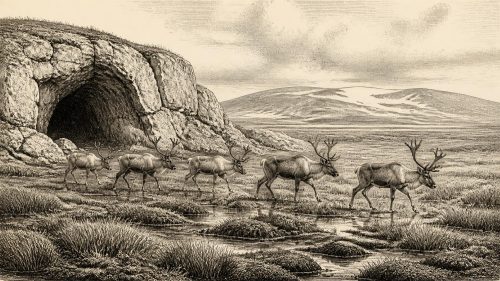
Around 31,859 BCE, Ireland lay within the climatically unstable Marine Isotope Stage 3 of the last Ice Age, although conditions and ice extent varied regionally. Freshwater deposits at Derryvree, County Fermanagh, preserve evidence of cold, open, wet tundra-like terrain, while other deposits remain fragmentary and difficult to date. Castlepook Cave, County Cork, yielded reindeer, mammoth, giant deer, bear and hyaena remains, demonstrating intermittent animal use of southern Ireland. Re-dating has complicated their chronology. A marked reindeer femur may indicate human butchery about 33,000 years ago, but lacks excavation context. No established Palaeolithic settlement, tools, hearths or social history is known.
View Record
Derryvree’s Tundra Sedgebeds
Around 31,860 BCE, Ireland cannot be described through a precise annual chronology, but through uncertain environmental evidence from Marine Isotope Stage 3. At Derryvree, County Fermanagh, organic silts beneath later till record an ice-free, cold landscape of sedges, mosses, wet basins and open tundra-like vegetation. Ice-sheet advance and retreat varied regionally, altering drainage and relative sea levels. Revised cave-bone dates from southern Ireland show brown bears, giant deer, hyaenas and mammoths during broad MIS 3 phases. No accepted evidence demonstrates human settlement then. Later glaciation destroyed much evidence, leaving a fragmentary prehistory interpreted through calibrated ranges, sediments, fossils and probabilities.
View Record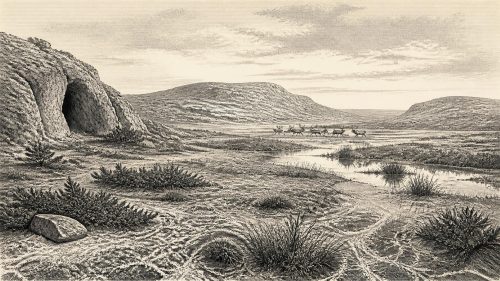
Juniper Beneath the Drumlins
Around 31,861 BCE, Ireland was a climatically unstable Late Pleistocene landscape approaching more extensive glaciation, not a historically documented society. Derryvree sediments in Fermanagh indicate open, treeless tundra or wet muskeg, with grasses, sedges, juniper, herbs and cold-adapted mosses. Castlepook Cave in Cork preserves remains of reindeer, mammoth, giant deer, bears, wolves, hyaenas, Arctic foxes and lemmings, demonstrating a diverse cold-stage fauna. Possible cut marks on a reindeer bone may indicate Upper Palaeolithic human activity, but remain unconfirmed and cannot prove settlement. Later ice reshaped and obscured older landscapes, leaving fragmentary evidence of Ireland’s ecological connection with Ice Age Europe.
View Record
Mammoth Cave, Derryvree Silts
About 31,862 BCE, Ireland lay within the volatile MIS 3 phase of the Late Pleistocene, before the Last Glacial Maximum. Derryvree sediments in Fermanagh indicate an ice-free but severe tundra wetland, supporting mosses, insects and freshwater life between roughly 36,900 and 31,700 years ago. Castlepook Cave in Cork preserves bones of mammoth, reindeer, giant deer, hyaena and other cold-adapted animals, although its deposits span millennia and do not represent one community. A possibly cut-marked reindeer bone suggests brief human activity, not settlement. Ireland was a changing landscape of wetlands, grazing animals, predators, caves and fluctuating ice during this remote period.
View Record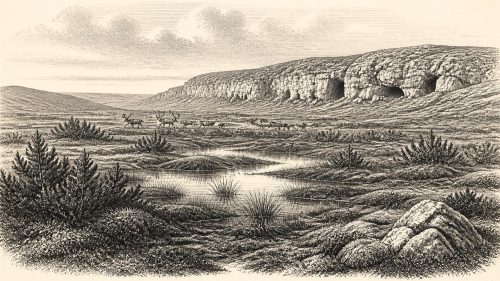
Reindeer by the Awbeg
At roughly 31,863 BCE, Ireland experienced an unstable MIS 3 cold phase, with open, wet, treeless tundra recorded at Derryvree and intermittent milder conditions indicated by Crag Cave calcite. The Last Glacial Maximum was approaching, but Ireland was not uniformly ice-covered. Castlepook Cave in County Cork preserves diverse cold-stage fauna, including reindeer, mammoth and hyaena, accumulated over extended periods. A reindeer femur, dated broadly around 33,000 years ago, bears a possible cut mark suggesting human carcass processing. Without secure context, tools or campsites, this indicates only tentative, mobile Upper Palaeolithic visits. Ongoing investigation may clarify Ireland’s fragmentary pre-glacial human record.
View Record
Maguirebridge’s Arctic Silts
At the notional date of 31,864 BCE, Ireland lay in the unstable MIS 3 phase before the Last Glacial Maximum, not beneath uniform ice. Lower seas altered coasts, while glaciers advanced unevenly. Derryvree deposits near Maguiresbridge preserve evidence of open, treeless tundra, wet hollows and severe periglacial conditions; other records show intermittent climatic amelioration. Castlepook Cave documents diverse cold-adapted fauna, including mammoth, reindeer, giant deer and hyaena, accumulated over extended periods. A cut-mark-like incision on a dated reindeer bone may indicate Upper Palaeolithic visitors, but disturbed contexts preclude certainty. No contemporary settlement exists; later glaciation and early excavation obscured traces.
View Record
Awbeg Limestone Fauna
The label 31,865 BCE denotes an approximate MIS 3 horizon, not an observable year. Ireland was a cold, unstable glacial landscape before the Last Glacial Maximum, with changing ice, lower seas and open habitats. Castlepook Cave near the Awbeg preserves major but imperfectly recorded fauna, including reindeer, mammoth, giant deer, predators and lemmings, showing repeated cold-stage ecological opportunities. Revised dating suggests some remains are older than first believed. A possibly cut-marked reindeer bone may indicate human handling, but insecure context precludes claims of settlement. No evidence supports polities, permanent communities, trade or culture. Later evidence cannot confirm this earlier possibility.
View Record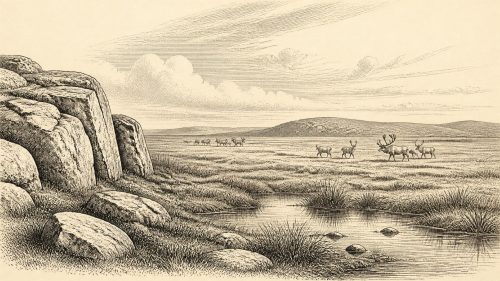
Castlepook’s Faunal Boundary
Approximately 33,800 years ago, Ireland lay within the climatically volatile Late Pleistocene, but neither its conditions nor ice extent can be fixed. Competing reconstructions suggest advancing ice alongside patches of open, treeless habitat supporting cold-adapted fauna. Organic deposits and cave assemblages document wetlands, grassland and mammals including deer, giant deer and spotted hyaena. Castlepook Cave provides MIS 3 evidence, revising animal chronologies and suggesting local disappearances before the Last Glacial Maximum. A marked reindeer bone may indicate an early human visit, but no secure settlement evidence exists. Uncertain sea routes, glacial erosion and records define this changing, intermittently habitable island.
View Record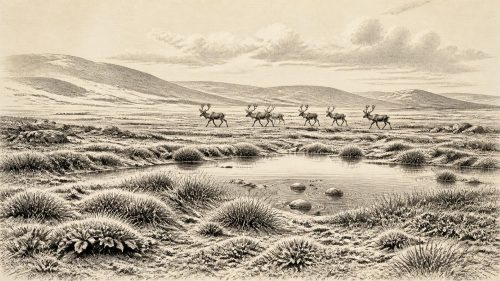
Cork Caves, Fermanagh Silts
Around 31,867 BCE, Ireland formed part of a climatically unstable late Last Glacial Period landscape, rather than a recognisable historical year. Fermanagh deposits at Derryvree and Greenagho indicate local freshwater, tundra and periglacial conditions before major ice-sheet expansion. Open vegetation supported changing assemblages of cold-stage mammals, documented especially by mixed cave remains at Castlepook, County Cork. A cut-marked reindeer bone there may suggest brief human activity around 33,000 years ago, but cannot establish permanent settlement. Lower sea levels altered possible routes, without proving a land bridge. Later glaciation destroyed or obscured evidence, leaving environmental fragments rather than evidence of societies.
View Record
Fermanagh’s Silt Interval
Around 31,868 BCE, Ireland lay in the unstable later Marine Isotope Stage 3, as the British–Irish Ice Sheet expanded unevenly. Derryvree, County Fermanagh, preserves freshwater silts between tills, recording an ice-free, sedge-rich tundra wetland later buried by advancing ice. Castlepook Cave, County Cork, contains a complex fauna including mammoth, giant deer, reindeer, predators and cold-adapted species, indicating productive open landscapes during favourable intervals. Butchery marks on a reindeer femur may represent Ireland’s earliest human activity, but cannot prove settlement or continuity. Changing climate, sea levels and ice margins made access and survival precarious. Evidence supports intermittent opportunity, not permanent occupation.
View Record